Most bird names that sound sexual are simply old English words, borrowed foreign terms, or descriptive nicknames that existed centuries before modern slang caught up with them. "Booby" comes from a Spanish word for a foolish person. "Tit" is a medieval word for something small. "Cock" is a straightforwardly old Germanic name for a male bird. None of these names were coined with any double meaning in mind, the awkwardness is entirely a product of how English slang evolved much later around sounds that were already locked into the ornithological record.
Why Are Bird Names So Sexual? Origins, Examples & Guidance

Maya Castellanos
26 Jul 2026
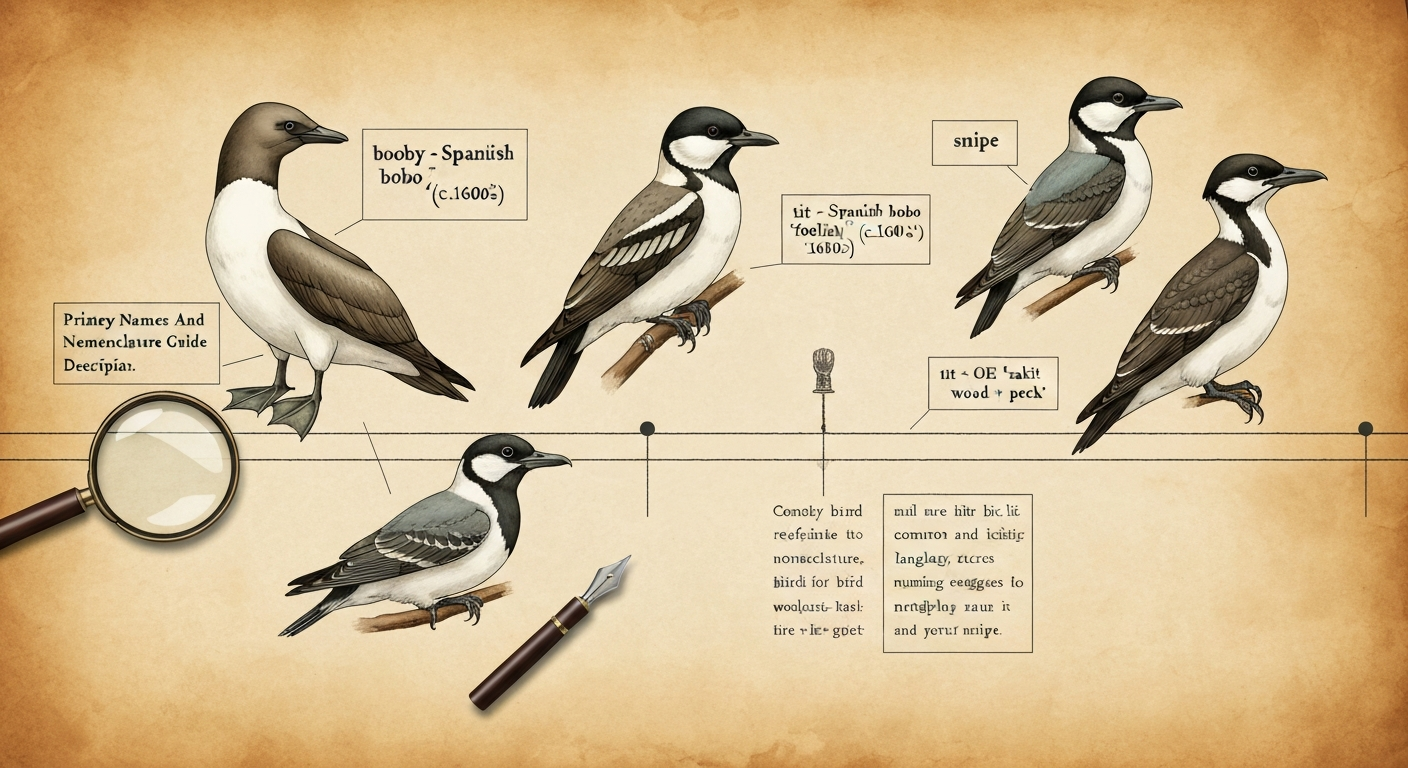
Why some bird names sound sexual: the linguistic and historical picture
English bird names are old. Many were coined in Old English, Middle English, or borrowed from Latin, Greek, Spanish, or Norse between the 10th and 17th centuries. Modern sexual slang, by contrast, is mostly a product of the 18th century onward, with many terms attested only from the 19th or 20th centuries. The collision between these two timelines is the core reason for the awkwardness. When the name "cock" was attached to a male bird (Old English cocc), it was almost certainly onomatopoeic, mimicking the bird's call. Nobody in 10th-century England was being cheeky about it. The same goes for "tit," "booby," and "woodpecker", they all had entirely innocent origins that later slang simply crashed into.
There are several distinct mechanisms at work here, and it helps to know them if you want to understand why the pattern is so common. First, onomatopoeia: birds get named for their calls, and those calls sometimes produce syllables that later acquire unrelated slang meanings. Second, folk etymology: speakers who no longer recognize the original form of a word reshape it into something familiar, which can accidentally introduce new connotations ("titmouse" is the classic example). Third, borrowing: English took bird names from Spanish, Latin, and Norse, and the original meanings in those languages were sometimes unflattering or body-referencing in ways that translated oddly. Fourth, semantic extension: words used for animal anatomy ("cock" for a male bird, "pecker" for a pecking beak) were later extended figuratively to human anatomy in slang, making the original bird name look retroactively rude. Fifth, behavioral description: some birds really do have dramatically sexual or aggressive mating displays, and their names honestly reflect that behavior, it just sounds jarring in a 21st-century context.
How words change meaning over time
The technical term for a word shifting toward a worse or more vulgar meaning is pejoration. It's one of the most reliably documented processes in historical linguistics, and it's responsible for a surprising amount of the bird-name awkwardness we're discussing. Elizabeth Traugott and Richard Dasher's work on regularity in semantic change outlines the main pathways: words can be extended by metaphor (a rooster's comb looks like a specific body part, so the word travels), by metonymy (one associated thing stands in for another), or by what linguists call "taboo displacement," where a neutral word gets conscripted as a euphemism and then becomes just as taboo as the thing it replaced.
Folk etymology is a related but distinct process. This is what happened to "titmouse." The original Middle English form was "titemose" (attested around the 14th century), combining a word for "small" with Old English "mase," meaning a small bird. Because ordinary speakers no longer recognized "mase" as a word, they reshaped it into "mouse," producing "titmouse." This made no zoological sense (titmice are not mice) but it made phonological sense, and it stuck. The word "tit" in the name, meanwhile, simply meant "small" in its Old English and Middle English context. The modern vulgar sense of "tit" is attested from the 19th century but is historically distinct from the bird-naming element, even though the two words are phonologically related.
Borrowing from other languages is another major route to accidental double meanings. When English sailors encountered the calm, easily-caught seabirds of the tropical Atlantic in the early 17th century, they applied a word they had picked up from Spanish sailors: "bobo," meaning foolish or simple-minded. Spanish "bobo" is itself likely derived from Latin "balbus," meaning stammering. By the time Samuel Purchas recorded the word in English in 1625, it was already settling into "booby" in the ornithological record. The slang sense of "boob" meaning breast is not attested in American English until the early 20th century, and major dictionaries treat it as a probably independent development linked to nursery forms like "bubby," not a direct descendant of the bird name.
Onomatopoeia and descriptive naming: when accuracy creates awkwardness
Birds name themselves, in a sense. Ornithologists and folk namers throughout history simply wrote down what they heard. The kittiwake (Rissa tridactyla) gets its name directly from its call, which is reliably transcribed as something close to "kit-ti-waake." Nobody chose that name to be provocative; the bird chose it by being a bird. The same principle governs names like "chiffchaff," "pewee," and "cuckoo." Where onomatopoeic names create modern embarrassment, it is purely accidental, the sounds that birds make have no relationship to the sounds humans later decided to use as slang.
Descriptive naming creates a different kind of collision. "Woodpecker" is about as transparent as a compound English word can be: a bird that pecks wood. It was never metaphorical or suggestive at the time of naming. But "pecker" as an agent noun (a thing that pecks) was later borrowed into American slang for the penis, with historical dictionaries recording that sense from around 1902. Now the bird's honest, descriptive compound name looks like a joke. It isn't. Similarly, the ruff (a wading shorebird, Calidris pugnax) was named for the elaborate erectile collar feathers on breeding males, which genuinely resemble the stiff neck ruffs fashionable in 16th and 17th-century European clothing. The name is accurate and historically documented. The fact that "ruff" sounds vaguely cheeky today is an unintended consequence of the word's history.
Quick reference: bird names that raise eyebrows and what they actually mean
| Bird name | Species or group | Where the name actually comes from | When the sexual slang appeared |
|---|---|---|---|
| Booby | Sulidae (gannets and boobies) | Spanish bobo 'foolish, stupid,' from Latin balbus 'stammering'; applied by sailors to tame seabirds, English attestation c.1625 | Slang 'boob' (breast) first attested early 20th-century U.S., treated as independent of the bird name |
| Tit / Titmouse | Paridae (chickadees, tits) | Old/Middle English tit 'small thing' + OE mase 'small bird'; folk reanalysis produced -mouse by early modern period | Vulgar 'tit' (breast) attested from 19th century; historically distinct from the bird element |
| Cock | Male birds generally | Old English cocc, probably onomatopoeic (imitating a cockerel's crow); used for male birds since OE | Vulgar sense for penis attested from early modern English, well after the bird name was established |
| Hen | Female birds generally | Old English henn, feminine counterpart to hana 'cockerel'; used for female birds since OE | No direct sexual slang; figurative 'woman' sense attested by the 17th century |
| Shag | Phalacrocoracidae (European shag) | Old English sceacga 'rough matted hair or vegetation'; applied to the bird c.16th century for its shaggy crest | British slang 'shag' (intercourse) attested later; etymological dictionaries treat the two senses as historically independent or uncertainly connected |
| Ruff | Calidris pugnax | Named for the 16th-17th century fashion ruff (stiff collar); the male bird's erectile neck feathers look like one | No direct sexual slang etymology; the awkwardness is purely phonological and contextual for modern readers |
| Woodpecker / Pecker | Picidae | Transparent compound: wood + pecker (agent noun from 'peck'); Early Modern English | Slang 'pecker' (penis) recorded in American English from c.1902 |
| Snipe | Gallinago and related shorebirds | Old/Middle English snipe; Old Norse cognates; named for the bird | No sexual slang; 'to snipe' (shoot from cover) recorded from the 1770s, referencing snipe hunting, not anatomy |
| Kittiwake | Rissa tridactyla | Onomatopoeic: directly from the bird's call, transcribed as 'kit-ti-waake' | No sexual slang connection; sounds mildly suggestive to some readers due to the final syllable only |
| Nuthatch | Sitta species | Middle English nuthak: 'nut' + 'hack' (to chop); the bird hacks open nuts | No sexual slang; the -hatch spelling is a later folk reanalysis of -hack |
Detailed case studies: the real stories behind the most-noticed names
Why are boobies called boobies?
The booby's name is one of the best-documented cases of a bird name with an innocent etymology that developed an awkward afterlife. Spanish sailors working the Atlantic and Pacific tropical routes in the 16th century encountered large, ungainly seabirds that would land on ship rigging and sit there, completely unafraid of humans. The sailors could simply reach out and grab them. They called these birds "bobo," the ordinary Spanish word for a fool or simpleton, itself rooted in the Latin "balbus" meaning someone who stammers or speaks inarticulately. The word traveled into English via sailor culture, and by 1625, Samuel Purchas was using "booby" in his English travel writing, with Thomas Herbert confirming the sailors' usage in 1634. See why are boobies called boobies for fuller sourcing and historical references (e.g., Purchas 1625; Herbert 1634). WordOrigins.org documents these early citations, noting Samuel Purchas's 1625 use and Thomas Herbert's 1634 confirmation of sailors' 'booby' for the tame seabirds. The bird kept its name because it kept its behavior, boobies are still notoriously unafraid of humans on remote islands. The stupid bird is known as a "booby" in sailor slang. The English word "boob" meaning breast appears in American slang only in the early 20th century, and major etymological sources treat it as a separate development, most likely a shortening of "bubby," a nursery word for a nipple or breast. The bird was named first; the slang came much later by an unrelated route.
Tit and titmouse
The tit family (Paridae) has given generations of English speakers an excuse to snicker, but the etymology is thoroughly mundane. Middle English had "titemose" (or "titmose"), a compound of "tit" (a small thing or creature) and Old English "mase" (a small bird). "Tit" as a word for something small is well-attested in Old and Middle English; it also appears in words like "titlark" and "titling" for small passerine birds. The "-mouse" ending that replaced "-mase" is a classic example of folk etymology: ordinary speakers no longer recognized "mase" as a bird-word and substituted the familiar word "mouse," even though the birds are not remotely mouse-like. As for the vulgar sense of "tit" meaning a breast, it is attested from the 19th century onward but is treated by historical dictionaries as a separate development, albeit one that shares a phonological root with the "small" sense. The two histories are parallel but distinct.
Cock and hen
"Cock" is simply the oldest standard English word for a male bird, and it almost certainly began as an onomatopoeic imitation of a cockerel's crow. Old English "cocc" is a Germanic formation with cognates across northern European languages. It has been the default term for male birds in English compounds (woodcock, peacock, cock pheasant, cock robin) since well before the Norman Conquest. The word's vulgar sense for the penis is also genuinely old, recorded in early modern English in major historical dictionaries, which is why it generates more discomfort than some of the other names on this list: unlike "booby" and "woodpecker," where the slang came centuries after the bird name, "cock" has carried both meanings simultaneously for a long time in English. "Hen," its Old English feminine counterpart from "henn," has avoided the same fate: its figurative extension to mean "woman" (attested by the 17th century) never became as taboo, though "hen night" and "hen do" carry a distinct modern cultural flavor in British English.
Shag and ruff
The European shag (Gulosus aristotelis), a member of the cormorant family, gets its name from the Old English word "sceacga," meaning rough, matted hair or tangled vegetation. The bird has a distinctive shaggy crest in breeding plumage, and the name was applied to it from around the 16th century for that reason. The British slang verb and noun "shag" meaning sexual intercourse appears later and is treated by etymological dictionaries as either historically independent or possibly derived from an obsolete verb meaning "to shake." The connection to the bird name is not established, and the two senses are typically listed as separate entries. The ruff is a wading shorebird (Calidris pugnax) whose name is unambiguously innocent: male ruffs in breeding season grow spectacular erectile feathers around the neck that look exactly like the elaborate pleated collars, called ruffs, that wealthy Europeans wore in the 16th and 17th centuries. Ornithologists named the bird for its visual resemblance to a fashion item. There is no sexual etymology here at all; the name is purely descriptive of a piece of clothing that happened to also look like extravagant neck feathers.
Woodpecker and pecker
"Woodpecker" is one of those perfectly logical English compound words that became accidentally funny later. The birds peck wood, loudly and persistently; the name records that fact. "Pecker" as a standalone agent noun ("one who pecks") is also old and entirely describes the bird's bill-based foraging. The sexual slang sense of "pecker" meaning the penis is an American English development recorded from around 1902 in historical slang dictionaries, apparently arising through the same kind of anatomical metaphor that turned other pecking or pointed-thing words into body-part slang. Dictionary.com’s entry on pecker summarises its historical senses and notes a U.S. slang penis sense attested from the early 20th century pecker — Dictionary.com (entry summarising historical senses). The bird name came first by several centuries. When Woody Woodpecker debuted as a cartoon character in 1940, the double meaning had been in circulation in American slang for decades, which may or may not have been on the creators' minds.
Snipe
Snipe have the distinction of being a bird whose name went in an unexpected direction: not toward sexual slang, but toward military terminology. The wading birds of the genus Gallinago (and related genera) carry an Old English and Old Norse name that simply describes them as wading birds. British soldiers stationed in India in the 1770s discovered that shooting snipe in the field was extraordinarily difficult because the birds are small, fast, and erratic in flight. Expert marksmen who could hit them were called "snipers," and the verb "to snipe" (to shoot from concealment at a distance) entered military vocabulary from that hunting context. This is actually a reverse case: the bird name produced a new vocabulary rather than inheriting an embarrassing one. Snipe hunting itself gave rise to a classic American prank in which uninitiated campers are sent into the woods at night to catch imaginary birds, holding bags open in the dark.
Scientific names: when Latin and Greek look explicit
Binomial scientific names in ornithology follow Linnaean conventions established in the 18th century, and they draw on Classical Latin and Greek roots that describe appearance, behavior, habitat, and honorifics. Because these roots are designed to be descriptive and precise, they sometimes combine in ways that look startling to an English eye. A few genuine examples: Parus major (the great tit) uses "major" meaning "greater," but the genus name Parus means "tit" in Latin, so the full name translates as "greater tit" in a completely clinical context. Troglodytes troglodytes (the wren) means "cave-dweller" repeated twice, because wrens forage in dense low vegetation. Buteo buteo (common buzzard) is simply the Latin name for a hawk, repeated. None of these are crude in their original languages; the awkwardness comes from the collision between Classical vocabulary and modern English slang.
Some scientific names do describe sexual or reproductive anatomy, but in a strictly morphological sense: an epithet like "cristatus" means "crested," "pennatus" means "feathered," and "pectoralis" refers to the chest or breast region. "Ventralis" means "of the belly," and "caudatus" means "tailed." When a compound scientific name looks rude, it is almost always because a perfectly innocent anatomical Latin term has been misread through an English slang lens. Reading scientific names correctly just requires knowing what the roots mean, which is exactly the kind of linguistic exercise that makes ornithology genuinely interesting rather than snicker-inducing.
Semantic shift and slang overlap: why context determines meaning
Linguists document two main directions in which word meanings travel over time: amelioration (toward more positive or neutral meanings) and pejoration (toward more negative or taboo meanings). Bird names are almost universally victims of pejoration by association, meaning they didn't change themselves, they were overtaken by new slang words that happened to sound like them. "Cock," "tit," and "pecker" are all examples of words that retained their original bird-naming functions but acquired additional slang meanings through separate semantic routes. The key linguistic principle is that meaning is always context-dependent. In an ornithology textbook, "cock pheasant" is a completely standard descriptor for a male pheasant. In a comedy routine, the same phrase is a setup. Neither use cancels out the other; they simply coexist in the same language.
Taboo displacement is a particularly interesting mechanism here. When speakers want to refer to something taboo without using the most direct term, they reach for words that are close in sound or association but not yet fully taboo themselves. Once those substitute words become strongly associated with the taboo concept, they often become taboo too, and the process starts again with a new euphemism. This is part of why sexual slang cycles through so many different words over time, and it explains why some perfectly innocent bird names get caught in the current, not because they were used as euphemisms first, but because the slang vocabulary expanded to include sounds already present in the bird-naming record.
Idioms, racehorses, and cultural references: a note on related questions
A couple of related questions that often come up alongside this topic are worth addressing here. The idiom "a bird in the hand is worth two in the bush" sounds mildly suggestive to modern ears, but its origins are entirely about falconry and hunting. The phrase has medieval Latin antecedents ("plus valet in manibus avis unica quam dupla silvis" is one recorded form) and appears in English proverb collections at least as early as John Heywood's 1546 collection. It refers to the practical reality that a falconer holding a live hawk has something more valuable than birds that are still out in the undergrowth. The "hand" and "bush" are literal. The 2009 Kentucky Derby winner Mine That Bird is a different kind of name: racehorses traditionally receive whimsical, often punning names, and "Mine That Bird" plays on "mind that bird" as an exclamation, while also referencing the horse's dam and sire lineage in the way that thoroughbred naming conventions sometimes work. These kinds of cultural bird name references are worth noting because they show how bird vocabulary migrates into idioms, sports, and pop culture in ways that are always rooted in some aspect of actual bird behavior or history, even when the final result looks odd.
Practical advice for pet bird owners: choosing names that travel well
If you are naming a pet bird and want to avoid accidental awkwardness in public, at the vet, or on social media, a few practical guidelines go a long way. The key issue is not just whether a name is currently innocent, but whether it sounds unambiguous when called out loud in a waiting room or typed into an Instagram post. "Pecker" as a parrot name, for example, is historically fine but practically going to cause problems at every vet appointment. The same goes for anything that sounds like active slang in your regional dialect.
- Say the name out loud in a neutral social context before committing: imagine calling it in a vet's waiting room, at a children's birthday party, and in front of your employer.
- Test the name as a caption: type it into a social media post and see whether it autocorrects, flags, or looks odd in plain text.
- Consider regional variation: "shag" is broadly understood as slang in British English but much less so in American English; know your audience.
- Avoid names that combine two innocent words into an accidental phrase: "Woody Pecker" is the classic example of a name that looked fine on paper but assembled badly.
- Scientific names make excellent pet names if you want something unusual and utterly defensible: Parus, Sitta, Falco, or Aegolius are all genus names that sound interesting without any slang associations.
- If you genuinely want to honor a bird species whose common name is awkward, use a localized or translated version: the European shag is also called the common shag, and in other languages entirely different names are used.
- For birds that will be trained to say their own name, consider how the name sounds when spoken back by the bird itself in various tonal patterns.
Cultural sensitivity around bird names matters beyond personal pet naming. In professional ornithology, there is an active and ongoing conversation about renaming bird species whose common English names honor historical figures with troubling legacies, and some of those debates intersect with questions about names that are simply embarrassing in educational or public contexts. The American Ornithological Society's ongoing renaming project (which gained significant momentum from 2023 onward) demonstrates that common bird names are not permanent or sacred, they are practical labels that serve communication, and they can be changed when they stop serving that purpose well.
Bird names are a linguistic time capsule, not a prank
The real reason bird names sound sexual is not that ornithologists were secretly cheeky or that folk namers were being provocative. It is that the English vocabulary has been accumulating bird names for over a thousand years, drawing on half a dozen source languages, and modern sexual slang has had centuries to colonize sounds that were already in the record. See the discussion on why duck is called 'stupid bird' for a similar example of a behavior-based nickname that became the species' common name why duck is called stupid bird. Every name discussed here, from booby to woodpecker to tit, has a documented, innocent, and often fascinating etymology. Understanding that history doesn't just explain away the awkwardness; it actually makes the names more interesting. A booby is a foolish sailor's joke about a tame seabird. A titmouse is a small bird whose name got reshaped by people who forgot what "mase" meant. A shag is a cormorant with a rough crest. These are good stories, and they are all sitting right there in the names themselves.
FAQ
Short answer: Why do some bird names sound sexual?
Because of ordinary linguistic history: many bird names come from old words (some once had different meanings), onomatopoeia (names imitating calls), folk reanalysis (mis‑segmenting older forms), borrowings from other languages, and metaphorical extensions. Separately, human slang for sexual body parts or acts often reuses short, simple words (tit, cock, pecker), creating overlap. In most cases the bird‑name and the sexual sense are either historically separate or the sexual sense developed later by metaphor or taboo‑driven slang.
Deeper etymology: what mechanisms explain these overlaps?
Several well‑documented processes account for sexual‑sounding bird names: (1) Borrowing: sailors borrowed Spanish bobo ‘foolish’ → English booby (for tame seabirds). (2) Folk reanalysis/segmentation: Middle English titemose → titmouse (modern spelling misleads to tit + mouse). (3) Onomatopoeia: names from bird calls (kittiwake). (4) Metaphor/metonymy: words for male/female birds (cock/hen) used figuratively for humans and body parts. (5) Semantic shift and slang formation: short expressive words are prone to extension into taboo or vulgar senses over time. These are standard semantic‑change mechanisms treated in historical linguistics (see Traugott & Dasher on semantic change, Ullmann on pejoration/amelioration).
List of common examples with verified origins and clarifications
Booby — from Spanish bobo ‘foolish, simple’; English sailors applied it to tame seabirds (early 17th c.) (Merriam‑Webster; RAE). Tit / Titmouse — titmose (Middle English, c.14th c.) meaning a small bird; modern tit (nipple/breast slang) is historically distinct though phonologically related (MED; Merriam‑Webster). Cock / Hen — Old English cocc / henn for male/female birds; ‘cock’ extended to human male genitalia and sexualized senses later (Old/Middle English onward; OED/MW). Shag — name for a cormorant family member from OE root meaning ‘rough hair’; British sexual slang shag (‘to have sex’) is recorded later and is probably independently developed or uncertainly connected (Etymonline). Ruff — named from the fashion item ruff (a feathery collar); the bird’s neck plumage recalled the collar (Merriam‑Webster). Woodpecker / Pecker — transparent compound wood+pecker; pecker as sexual slang (U.S.) develops much later from ‘peck’ agent noun. Snipe — Old/Middle English and Norse roots; verb to snipe (shoot from concealment) derives from hunting the bird and later produced ‘sniper’. Kittiwake — onomatopoeic, from the bird’s call (call‑name formation). Clarification: in most cases the ornithological name predates or is independent of vulgar senses; apparent sexualness is often coincidental or due to later slang extension.
Why are boobies called boobies specifically?
‘Booby’ for the seabird comes from Spanish bobo ‘stupid, simple’ applied by Spanish sailors to tame, naive birds that allowed capture. English sailors adopted the term in the early 17th century (sources include Purchas 1625 and later lexicographers; Merriam‑Webster notes this borrowing). The unrelated English slang boob (breast) appears later and is treated as a separate development in dictionaries.
How did the proverb ‘A bird in the hand is worth two in the bush’ get its name/phrase?
The proverb has medieval and Latin antecedents (medieval Latin variants) and appears in English proverb collections by the 16th century (John Heywood’s proverbs c.1546 is an early attestation). It’s a proverb about valuing a certain small gain over a larger uncertain one; its wording uses common bird imagery rather than any sexual connotation.
How can scientific (Latin) names appear explicit and how should I interpret them?
Scientific names are descriptive combinations of Greek/Latin roots, commemorative names, or invented forms. Apparent explicitness is usually coincidental: e.g., Latin or Greek morphemes that look like modern slang often have unrelated classical meanings. Always check a taxonomic etymology source (original species description or a taxonomic database) before assuming vulgar intent. Taxonomists usually follow Classical languages or honorifics, not modern slang.