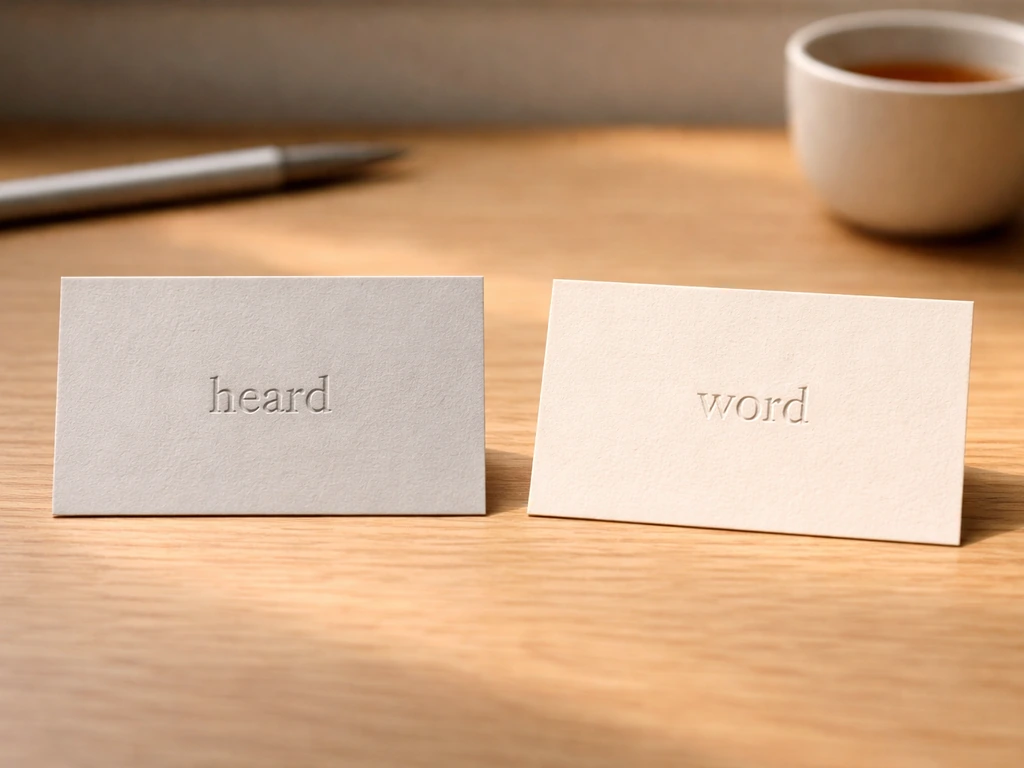
The best perfect rhymes for "bird" are heard, word, third, herd, curd, nerd, slurred, and spurred. Those eight words share the exact same sound pattern (a stressed vowel plus /r/ plus /d/), so any of them will land cleanly at the end of a poem line. If you need more options, near rhymes like stirred,urred, blurred, deferred, preferred, inferred, and occurred work just as well in most poems. That is the short answer. Merriam-Webster traces “bird” to Middle English “brid, bird,” from Old English “bridd,” meaning a nestling Merriam-Webster traces “bird” to Middle English “brid, bird”. merriam-webster.com/dictionary/bird). Keep reading if you want to know which one actually fits your line.
What Rhymes With Bird: Perfect and Slant Options

Maya Castellanos
10 Apr 2026
Perfect rhymes for "bird"
A perfect rhyme means everything from the last stressed vowel onward matches exactly. For "bird," that target sound is roughly /bɜːrd/ in British English and /bɝd/ in American English, so you need another word that ends in that same vowel-plus-/rd/ pattern. The good news is there is a solid cluster of them, and they are all common words you can drop into a line without sounding forced.
- heard (past tense of hear, very natural, extremely common)
- word (one of the most versatile rhymes in English)
- third (useful for sequential or counting imagery)
- herd (animals, crowds, groups, great for nature imagery)
- curd (dairy, earthy, less common but perfectly valid)
- nerd (playful, modern, works in lighter or humorous verse)
- slurred (sound or speech imagery)
- spurred (action, motivation, horse imagery)
- stirred (movement, emotion, cooking)
- blurred (vision, memory, uncertainty)
"Heard" is probably the workhorse of this group. It rhymes cleanly, it carries emotional weight, and it pairs naturally with bird imagery: you can write about a song heard, a call heard at dawn, or simply something you have not heard before. "Word" is almost as flexible, and since this site spends a lot of time thinking about language, the connection between "bird" and "word" feels especially apt. If you are curious about the deeper linguistic history behind the term, where the word bird comes from is worth a look, because the Old English root (bridd, meaning a nestling) went through some phonological shifts that explain why the modern word sounds the way it does and why its rhyme set is fairly tight.
Near (slant) rhymes that still work in poems
Slant rhymes, sometimes called near rhymes or half rhymes, do not match every sound from the stressed vowel onward, but they share enough similarity that the ear accepts them as a rhyme, especially when read aloud inside a poem. For "bird," the slant rhyme territory opens up considerably once you let go of the strict /d/ ending or the exact vowel quality.
| Word or phrase | Rhyme type | Why it works |
|---|---|---|
| deferred | Perfect (multi-syllable) | Ends in /-ɜːrd/, stress falls on last syllable |
| preferred | Perfect (multi-syllable) | Same ending, strong emotional resonance |
| inferred | Perfect (multi-syllable) | Clean ending, intellectual tone |
| occurred | Perfect (multi-syllable) | Narrative feel, easy to slot into story-driven lines |
| world | Slant | Shares the /ɜːr/ vowel, final /d/ replaced by /ld/ |
| girl | Slant | Strong vowel match, /d/ replaced by /l/ |
| earl | Slant | Same vowel, light ending |
| pearl | Slant | Soft, lyrical quality, feminine in feel |
| hurt | Slant | Vowel match, final consonant shifts to /t/ |
| earth | Slant | Shared vowel, works in nature or elemental imagery |
The words "girl," "world," and "pearl" are popular slant choices because the vowel is close enough that the rhyme registers immediately but the slightly different ending gives the line a softer, less resolved feel. That unresolved quality is actually a tool: poets use slant rhyme deliberately to create tension or ambiguity. "Hurt" and "earth" work especially well in nature-themed bird poems because the imagery fits and the sounds are close without being identical.
One interesting slant-rhyme neighbor is "dove," whose sound is obviously different but whose cultural pairing with birds is so strong that it can feel rhyme-adjacent in the right context. There is actually a well-known bird whose name rhymes with love, and thinking about those looser phonetic pairings can be a useful creative exercise when you are hunting for something that feels surprising in a poem.
How to pick the best rhyme for your line
Having a list of rhymes is the easy part. Picking the right one comes down to three things: sound, stress, and tone. Get all three right and the line feels effortless. You can also think of bird as a nickname in everyday language and character writing. Get one wrong and the rhyme will stick out like a wrong note.
Sound: does it actually rhyme when read aloud?
Rhyme is an aural effect, not a visual one. The best habit you can build is to read your line out loud before committing to a rhyme word. A word that looks like a match on paper can fall flat when spoken, and a word that looks wrong can sound perfect. This is especially important with slant rhymes, where the closeness of the match is hard to judge in your head. Say both the rhyming line and the target word aloud, pause, and listen. If the echo is there, even faintly, it works.
Stress: where does the emphasis land?
"Bird" is one syllable with a single stressed vowel, so your rhyme word ideally carries its stress on the final syllable too. Words like "deferred," "preferred," and "occurred" have two syllables but land the stress on the last one, so they rhyme cleanly. A word like "morning" would not work because the stress falls on the first syllable and the ending sounds nothing like "bird." Meter matters here: if your poem has a regular beat, dropping in a two-syllable rhyme word where a one-syllable word belongs will break the rhythm.
Tone: does the rhyme word fit the mood?
"Nerd" and "curd" are perfect rhymes for "bird," but they will undercut a serious, elegiac poem immediately. If you are writing something tender or solemn, "heard" or "word" carry far more weight. If you are writing something playful, "nerd" or "absurd" (a slant rhyme) can add a comic punch. The meaning and feel of the rhyme word have to align with what the line is trying to do, not just match the sound. If you are also curious about a poet named Bird, that search is a little different from finding rhyme words for bird. Think of the rhyme word as the landing note of a musical phrase: it colors everything that came before it.
Poem-ready rhyme lists: words and short phrases
Sometimes you need a phrase rather than a single word, either because you need extra syllables to fill a metrical line or because the single words feel too blunt. Here are ready-to-use options organized by feel and purpose.
Single-word options by tone
| Tone / mood | Best single-word rhymes |
|---|---|
| Serious, emotional | heard, word, stirred, blurred |
| Nature, pastoral | herd, curd, earth (slant), world (slant) |
| Playful, humorous | nerd, absurd (slant), curd |
| Action or movement | spurred, slurred, deferred, occurred |
| Lyrical, soft | pearl (slant), girl (slant), earl (slant) |
Short phrase options
- "not a word" (neutral, conversational, two syllables)
- "the herd" (adds a syllable, pastoral feel)
- "what I heard" (narrative, three syllables, easy to slot in)
- "every word" (emphatic, two syllables)
- "still unheard" (melancholy, three syllables)
- "long deferred" (regret, formal, three syllables)
- "as it occurred" (storytelling, four syllables)
- "absurd" (single word used as a phrase-level punch)
Phrase rhymes are especially useful when you need to match a longer line. "What I heard," for example, gives you three syllables and a narrative subject-verb structure that can close out an iambic line cleanly. Some people also use the nickname “Bird” for certain female celebrities, so the name can come up in celebrity trivia questions nickname “Bird” for a female celebrity. Merriam-Webster's rhyming resources list options like "last someone heard" and "singing bird" to show that phrase-level rhyming is completely standard practice in English verse, not a cheat. RhymeZone also provides blank" rel="noopener noreferrer">phrase-like compound rhymes as additional options on its “bird” perfect-rhyme page.
A quick method to find more rhymes fast (and test them)
The fastest approach is to isolate the sound you are trying to match and work from there. For "bird," that core sound is the /-ɜːrd/ vowel-plus-consonant pattern. If you are also looking for a specific “bird” nickname for a female, use the same search terms with “nickname” and “female” together bird female. Here is a repeatable method that takes about two minutes.
- Write down the phonetic ending: for bird, that is "-erd" (or "-urd" in some spellings). Any word ending in that pattern is a candidate.
- Run through the consonant alphabet mentally: B-erd (beard is close but not exact), H-erd (herd, heard), W-erd (word), Th-erd (third), N-erd (nerd), C-erd (curd), Sl-erd, Sp-erd... you will hit real words quickly.
- Check a rhyming dictionary or RhymeZone for anything you missed. Search "bird" and filter to one-syllable or two-syllable results.
- Read your candidate rhyme out loud inside an actual line, not just as an isolated word. The word has to land correctly in context.
- If no single word fits, try adding "the" or a short verb before a noun: "the herd," "I heard," "each word" all become usable phrase rhymes.
- For slant rhymes, widen your vowel target: words with the /ɜːr/ vowel (girl, world, earl, pearl, curl, hurl, swirl) are your nearest neighbors.
FAQ
Do “heard” and “bird” rhyme perfectly in both American and British English?
They do in most common accents because both end up with the same stressed vowel followed by the same /r/ plus /d/ sequence. If you pronounce “bird” with a different vowel quality in your accent, test by saying the two-word pair back to back, since that’s where many “looks right, sounds off” surprises come from.
Can I rhyme “bird” with a verb form like “spurred” or “preferred” without sounding awkward?
Yes, but watch the stress and meaning. Those longer options often work best when the line already has enough momentum to accommodate a two-syllable landing word. If the surrounding phrase is very short or flat, the multi-syllable rhyme can feel like it drops out of nowhere, so consider a phrase rhyme instead (like “I was heard” style constructions) to smooth the meter.
What’s the best slant rhyme if my line ends with a soft, lyrical feeling?
“Girl,” “world,” or “pearl” are usually safer than sharper-connotation choices. They tend to read as emotionally gentle because the vowel similarity is close and the ending feels less “clipped” than some perfect options, but still do the out-loud stress check so the rhyme doesn’t land one beat late.
Why does “nerd” work as a rhyme sound but ruin the mood of my poem?
Because the rhyme word brings its own semantic baggage (modern, comedic, often mocking) even when the phonetics fit. If your stanza has an elegiac or romantic tone, swap to “heard” or “word,” or use a slant rhyme whose common associations match your mood, then re-read the full stanza aloud.
How do I know whether my poem’s meter can handle a two-syllable rhyme word like “deferred”?
Count syllables in the line and identify where your stress lands. If your line is designed to end with a single stressed beat, a two-syllable rhyme can break the rhythm even if it sounds good in isolation. A practical fix is to replace the word with a shorter phrase rhyme that preserves the end stress placement (for example, “I heard” style endings).
Is it ever acceptable to rhyme using a phrase instead of a single word?
Yes, and it’s often cleaner. Phrase rhymes can add extra syllables to match a metrical slot while keeping the same end sound feel. When choosing a phrase, make sure the last stressed word in the phrase carries the same landing stress as your intended rhyme, otherwise the ear hears mismatch even if the letters look similar.
What’s the most common mistake people make when rhyming “bird”?
Picking the rhyme word first and forcing unrelated meaning into the line. A rhyme like “curd” can be “correct” phonetically, but if your line is about nature, the subject shift is distracting. Draft the line for sense and beat first, then select the rhyme word or phrase that naturally fits both.
How can I test a slant rhyme quickly if I can’t rely on what I see on paper?
Say the entire line up to the rhyming position, then swap only the last word (or ending) while keeping everything else constant. Pause and listen for whether your mouth produces a smooth echo, if it creates a jarring stop, choose a different slant word or adjust the syllable count with a short phrase.
Are there cases where “slurred” is a bad rhyme choice even if it matches the sound?
Yes. “Slurred” carries a specific connotation tied to blurred speech, intoxication, or diminished clarity. If you want the line to stay neutral, romantic, or nature-focused, that extra meaning can leak through. Prefer “girl,” “world,” “pearl,” “hurt,” or “earth” depending on your tone.
If I need a surprising ending, should I prioritize perfect rhymes or slant rhymes?
For surprise, slant rhymes usually give you more room because the sound match is softer and readers notice the texture rather than the exact match. Perfect rhymes feel settled and obvious, so if you’re trying to avoid predictability, use slant options first, then ensure the stanza’s overall sound pattern stays consistent.
Can I rhyme “bird” with something that includes “bird” itself or is that considered cheating?
It’s not cheating, but it’s a different technique (repetition, internal rhyme, or echo) rather than a traditional end rhyme match. If you use it, make sure the line still satisfies the rhythm slot at the end and that the repeated element adds meaning, not just an easy phonetic connection.