A last name 'means bird' in one of four ways: it came directly from a bird word used as a nickname, it was an occupational label for someone who caught or sold birds, it came from a place named after birds, or it was translated into English from another language that used a bird word. Knowing which of those four routes applies to your surname is the whole game, and guessing from modern English spelling almost always leads you in the wrong direction.
Last Names Meaning Bird: How to Research Your Surname

Maya Castellanos
18 May 2026
What it usually means when a last name is 'bird-related'
Most bird-related surnames do not mean the family was obsessed with birds or kept a famous flock. The connection is usually more indirect. When the Dictionary of American Family Names (2022 edition) defines the surname Bird, for example, the primary meaning is a nickname for 'a young or a small and slender person,' pulled from Middle English brid/bird, not from a literal 'this person owned a parrot' story. That matters because the medieval word brid originally meant a fledgling or young bird, and writers extended it to describe slight or youthful-looking people. So even the most obvious bird surname is really a social descriptor dressed up in feathers.
The same logic applies to Lark, Hawk, Sparrow, Quayle, and dozens of others. Lark meant a cheerful, merry person (larks being associated with lightness and song) or described someone who hunted larks for the food market. Hawk could point to a falconer or simply to someone with hawk-like features. Quayle traces to Old French quaille meaning quail, used as a nickname for someone considered timorous or, in older texts, lecherous (qualities medieval people apparently associated with quails). The point is: bird-related surnames usually say something about a person's character, job, or neighborhood, not their ornithological passions.
Where bird-derived surnames actually come from
Surname scholars generally organize origins into four main categories, and bird surnames appear in all of them. Understanding which category fits your name tells you what kind of evidence to look for.
| Origin Type | What It Means | Bird Surname Examples |
|---|---|---|
| Nickname | A descriptive label based on appearance, personality, or a perceived resemblance | Bird (small/slender person), Lark (cheerful), Sparrow (small and chatty), Quayle (timorous) |
| Metonymic Occupational | Named for what the person caught, sold, or worked with rather than a job title | Lark (sold larks for food), Hawk (falconer or hawk-keeper), Crane (possibly worked near cranes or caught them) |
| Locational / Toponymic | Family came from a place that had a bird-related name | Birdwood (a wood full of birds), any village or farm named after a bird species |
| Translation | A name from another language rendered into English using its nearest equivalent bird word | Bird as an English shortening of Lakota Sioux ziŋtkala meaning 'bird' |
The translation pathway is easy to overlook but genuinely important. Ancestry's entry for Bird explicitly notes that some bearers adopted it as an English translation and shortening of a Native American personal name built from a word meaning 'bird.' That means two families named Bird can share a surname for completely unrelated historical reasons. Never assume every Bird family arrived at the name the same way.
How spelling shifts and language changes disguise the bird connection
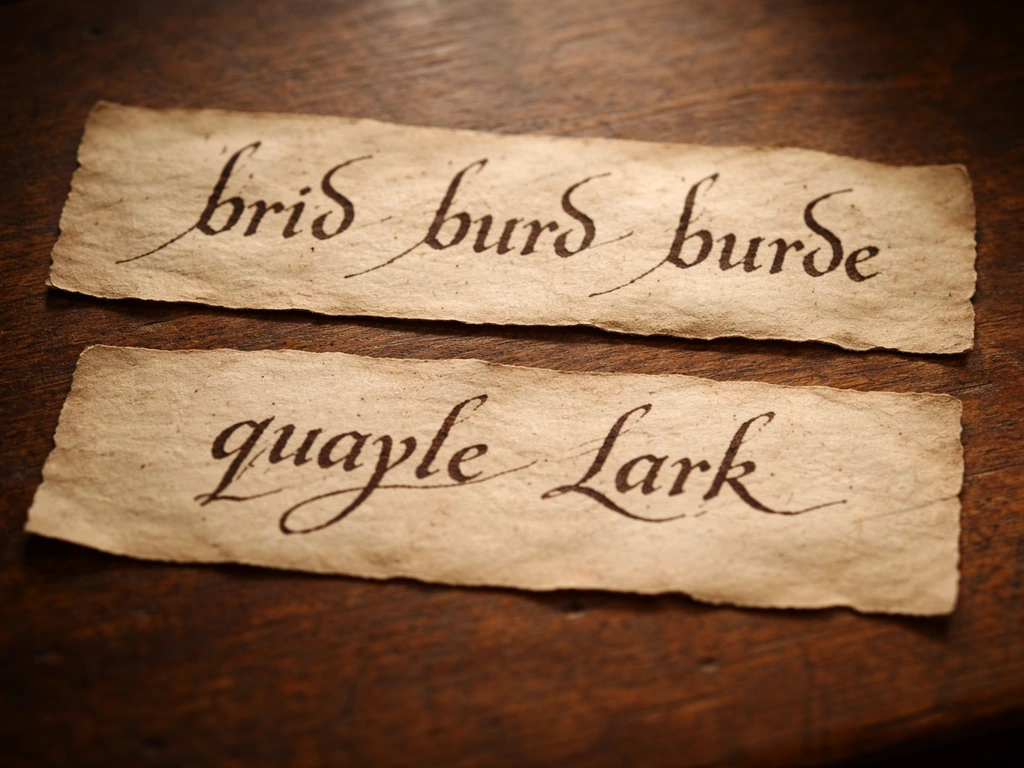
This is where most casual researchers get tripped up. English spelling was not standardized until the 18th century, and even after that, clerks, priests, and census takers spelled surnames phonetically based on what they heard. The surname Bird appears in historical records as Byrd, Byrde, and Bride. To get started, focus on the most common “Bird” origins and the spellings like Byrd, Byrde, and Bride that show up in records where does the last name bird come from.
Those are not different surnames: they are the same name written down differently depending on when and where it was recorded. The Wikipedia entry on Byrd confirms it is a direct variant of Bird, and multiple British surnames references treat all those spellings as a single entry.
The deeper complication is that the underlying Middle English word brid (from Old English bridd, meaning a chick or fledgling) had overlapping spellings with burd and burde, which meant 'woman' or 'young lady' in Middle English. Wiktionary explicitly flags burd as an alternative form of brid meaning 'bird,' while also being its own word meaning 'young woman.' If you dig into old parish records and find your ancestor's name spelled Burd, you cannot assume it means either bird or woman without looking at the date, region, and context of surrounding records.
For non-English bird surnames the complexity multiplies. Sparrow has cognates across Germanic and Semitic languages, each with its own spelling evolution. A German family whose name means 'sparrow' might arrive in an English-speaking country with a spelling that looks nothing like Sparrow until someone anglicizes it. The University of the West of England's methods document for surname history research makes this explicit: orthographic change is data, not noise, and you have to anchor it to documentary evidence rather than guessing from how a name looks today.
Matching common bird words to actual surname candidates
If you suspect your surname connects to a specific bird, here is a practical map of well-documented English bird-word surnames and their formation routes. This is not exhaustive, but it covers the most common ones people search for.
| Bird Word | Surname(s) | Formation Route | Medieval Root |
|---|---|---|---|
| Bird (generic) | Bird, Byrd, Byrde, Bride | Nickname (young/slender person); possibly metonymic | Middle English brid/bird, Old English bridd |
| Lark | Lark | Nickname (cheerful) or metonymic occupational (lark hunter/seller) | Middle English laverke/larke |
| Hawk | Hawk, Hawke | Metonymic occupational (falconer, hawk-keeper) or nickname | Middle English/Old English hafoc |
| Sparrow | Sparrow, Sparrowe | Nickname (small, chatty person) | Middle English spar(e)we, sperwe |
| Quail | Quayle, Quail | Nickname (timorous or associated with quail traits) | Middle English/Old French quaille |
| Robin | Robin, Robins | Primarily a given name (diminutive of Robert) that became a surname | Old French Robin, pet form of Robert |
| Crane | Crane | Nickname (tall, thin person) or possibly locational | Old English cran |
| Finch | Finch | Nickname (lively, cheerful) or metonymic | Old English finc |
| Martin | Martin, Martyn | Given name origin (Saint Martin), not a direct bird word | Latin Martinus (though martin the bird was named after the saint) |
A quick note on Robin and Martin: both look like bird surnames but actually work backward. The birds were named after people (or saints), not the other way around. If your surname is Robin or Robins, its origin is the given name Robin, a medieval pet form of Robert. The bird got its name because its red breast reminded people of a monk's robe, and 'Robin' was already a common human name. Do not assume Robins means 'family of robins' in the ornithological sense.
How to actually research and verify your surname's meaning

There is a real methodology here, and it is worth following in order rather than jumping straight to a Google search for 'what does my last name mean.' Here is the workflow I use.
- Gather the basics first: original spelling (especially any pre-immigration or pre-anglicization form), the region or country where the family lived earliest, and an approximate time period (even a rough century helps). These three pieces of information narrow the linguistic and historical context dramatically.
- Check a dedicated surname dictionary, not a general baby-names website. The Oxford Dictionary of Family Names in Britain and Ireland (Hanks, Coates, and McClure) and the Dictionary of American Family Names (2022) are the gold standard. Both give variant spellings, early attestations with dates and places, and explicit etymology. The Oxford dictionary is cataloged on FamilySearch and accessible through many public library systems.
- Look for early records that show the name in use. Parish registers (OPRs in Scotland), English census records before 1900, naturalization documents, and immigration records are all useful. The National Archives (UK) holds guidance on naturalization records with person-level details including birthplace and origin country. NARA in the US maintains a master file of naturalization proceedings after September 26, 1906. A name documented in a 1750 English parish register is much easier to trace than one that first appears in a 1920 US census.
- Build multiple hypotheses and compare them to the evidence. Do not lock in on one origin story. For Bird, the hypotheses are: (a) Middle English nickname for a slender/young person, (b) metonymic for a bird catcher, (c) locational from a place named Bird-something, or (d) translated from a non-English bird word. Each hypothesis predicts different geographic distribution, spelling variants, and time periods of first appearance.
- Score your hypotheses against the earliest documented spellings and locations. If your earliest known ancestor with this name lived in rural Yorkshire in 1680 and spelled it Byrd, the Middle English nickname hypothesis fits well. If the earliest record is a 1910 US naturalization paper for someone from a Native American community, the translation hypothesis is far more likely.
- Use Etymonline, Wiktionary, and the Middle English Dictionary (freely available through the University of Michigan) to check the actual historical meanings of the root words, not their modern equivalents.
Pitfalls that send researchers in the wrong direction
I have seen all of these mistakes made confidently, so it is worth going through them explicitly.
Trusting modern English meaning over medieval meaning
The word bird today means any feathered vertebrate. In Middle English, brid meant specifically a fledgling or young bird, and writers used it as a social metaphor for youthful or slender people. Etymonline confirms this, noting that the original sense was 'young bird' with the broader modern sense developing later. When the Dictionary of American Family Names says Bird as a surname meant 'a young or small and slender person,' that is a direct result of how the medieval word actually functioned, not a guess.
Confusing similar spellings across unrelated meanings
Middle English burd/burde meant 'woman' or 'young lady' and is simultaneously listed as an alternative form of brid meaning 'bird.' That is not a typo: medieval spelling was genuinely that unstable. If you pull a document showing the surname Burd and immediately conclude it means 'bird person,' you might be wrong. Context, date, and regional dialect all matter.
Assuming one surname has one origin story
The same surname can have completely different origins depending on the family line. Two families named Bird today might descend from: a medieval English nickname for a slight person, a Native American family whose name was translated into English, and a family from a village called something like Birdwood. The surname is the same; the etymology is not. This is why you research your specific family line, not the surname in the abstract.
Mixing up common bird names with scientific names
This one mostly affects people who come to surname research from a birding or biology background. Scientific (taxonomic) names like Turdus migratorius for the American Robin are governed by international nomenclature codes and have nothing to do with human surnames. Common names, as Merriam-Webster and Animal Diversity Web both point out, are unstable, geographically variable, and can overlap between species. If you search for the surname 'Martin' and end up reading about the family Hirundinidae, you have taken a wrong turn. Surname etymology is a branch of onomastics, the study of proper names, and it uses linguistic and archival methods, not taxonomic ones.
Over-relying on surname websites without checking their sources
Many surname websites confidently state a single origin with no sourcing. Some are accurate summaries of legitimate dictionaries. Others are folk etymology dressed up as fact. The test is simple: does the site cite a specific reference (like DAFN or the Oxford Dictionary of Family Names), give an early attestation with a date and place, and acknowledge variant spellings? If it just says 'Bird means a bird,' that is not etymology. That is a circular definition.
Pulling it all together and deciding what to do next
Once you have worked through the workflow above, you should be able to write a short summary that looks something like this: 'The surname Bird in my family line appears in Yorkshire parish records from the early 1700s, spelled both Bird and Byrd. This matches the Middle English nickname origin (brid, meaning a slender or young person) documented in the Dictionary of American Family Names. The alternative occupational or locational hypotheses are less supported because there is no corresponding occupation or place name in the documented region.' That is a defensible statement. It acknowledges uncertainty, identifies the best-supported hypothesis, and explains why alternatives were set aside.
If your research is inconclusive, that is also a valid answer. Some surnames genuinely cannot be pinned to a single confirmed origin with available records. Document what you found, note which hypotheses remain open, and flag what additional records (naturalization papers, earlier parish registers, a DNA geographic result that narrows regional origin) might resolve the question.
A note on bird-inspired naming for pets
If you came here partly because you are thinking about a bird-inspired name for a pet bird, and you want the name to carry the weight of your own surname's etymology, that is a genuinely fun project. A bird named Byrd as a nod to the Old English fledgling meaning, or Lark as a homage to a family with that name, works beautifully. Just keep the etymology claim separate from the naming inspiration: you can love the bird imagery in your surname without asserting that your medieval ancestor literally raised falcons. The meaning and the inspiration can both be real without being the same thing.
The surname Bird itself, the specific origins of the Byrd variant, whether Bird is an Irish or Jewish surname, and the question of what the standalone surname Bird means are each worth their own deep dive and carry details that go well beyond what fits in a general methodology guide. Whether Bird is an Irish surname is a separate question that you can answer by looking at specific records for Irish families bearing the name. The framework above gets you to the right starting point for any of those more specific questions. If what you really want is the bird last name meaning for your exact surname and spelling, focus on the medieval root and the earliest local attestations.
FAQ
If my family name is spelled Byrd or Bride, is it still the “bird” surname meaning bird? Or could it be something else?
Start with the earliest document where your ancestor’s name is written exactly, then record the surrounding fields (place of residence, occupation, spouse, neighbors, religion, and language of the record). If you see spellings like Bird, Byrd, Byrde, and Bride in the same locale and time window, they are usually the same surname in variant orthography, not different origins. If the spellings shift alongside a major change in place or record type (for example, parish to immigration paperwork), treat that as a clue to a new transcription context rather than assuming one English etymology fits all.
Can I trust modern English interpretations, like assuming Bird must mean someone literally owned birds?
Yes, but only in a limited way. Natural-language “bird” associations often reflect later English meanings, while your surname’s origin depends on the medieval word behind it (for example, brid meaning a fledgling or young bird) and the original social job or nickname context. So you can build a story about a “bird” connection, but you should not treat the modern bird animal as proof that the medieval bearer had an ornithology-related life.
What if my surname looks like a bird word (for example, Robin, Martin, Lark). How do I avoid the biggest traps?
Check whether your evidence is about a surname, a place-name, or a given name. Robin and Martin are common traps because the bird element is often downstream from people named Robin or saint-linked naming traditions, not the other way around. If you find “Robins” in records, look for whether it functions as “son of Robin” in the local naming system or simply as a family surname that never tied back to an actual bird-name origin in that community.
My cousin has a different family story for the same surname. Can two branches really have different origins?
You cannot safely generalize from a cousin’s branch, even if the surname looks identical today. Your next step is to trace each line back to a shared ancestor, then compare earliest spellings and places for each line. If one branch shows Native American translation context or a different early regional attestation pattern, that branch’s “bird” story may come from a different route even when the spelling is the same now.
How can I tell if my surname came from a translated Native personal name rather than an English bird-word nickname?
For “translation” origins, the strongest clues are (1) a time period of anglicization or translation into English, (2) evidence of the family being recorded in English-language contexts, and (3) a documented earlier given name or personal name that can be linked to the translated meaning. If the family moved across cultures, don’t rely on the surname alone. Instead, search for immigration, naturalization, land, or church records that show name changes and earlier personal names.
I found the species name for my “bird” surname. Is that proof of the surname meaning?
Beware of mixing taxonomic “common names” with surname etymology. A surname that matches a bird’s common name (or a genus reference) may be a coincidence, especially when you are starting from a species fact. Your practical safeguard is to require at least one human-name attestation, such as a dated parish register entry or a tax list, before you infer meaning.
How do I evaluate surname websites that claim a single origin with no sources?
Use an “evidence threshold.” Aim for an early dated attestation in a specific place, plus documented variant spellings over time, and at least one credible reference that discusses surname formation. If a site gives only a one-line gloss like “means a bird” without dates, places, or linguistic pathway, treat it as a guess. When in doubt, prioritize scholarly dictionaries or surname dictionaries that discuss the medieval roots and variant forms.
What should I do if my research is inconclusive and I cannot choose between the four origin routes?
Yes, and you should plan for it as a normal outcome. If you cannot pin the surname to one route, write down which category fits “best supported” based on your local evidence, then list the alternative routes that remain plausible (for example, nickname versus occupational versus locational versus translation). A useful next record set to target is earlier parish registers, manorial records, court records, and (if relevant) surname-change or naturalization documents, because those often provide the clearest earliest spellings.
I want to name a pet bird after my surname. How should I phrase the meaning so I do not overclaim?
If you are considering a pet bird name like Byrd or Lark, make the distinction explicit in your own notes. You can treat the bird imagery as inspiration, but when you claim “meaning,” you should phrase it as “surname root relates to a medieval bird-word nickname or related term,” not “my ancestor raised falcons” or “this family kept birds.” That keeps your creative connection aligned with how surname origins are actually established.