What the line actually means
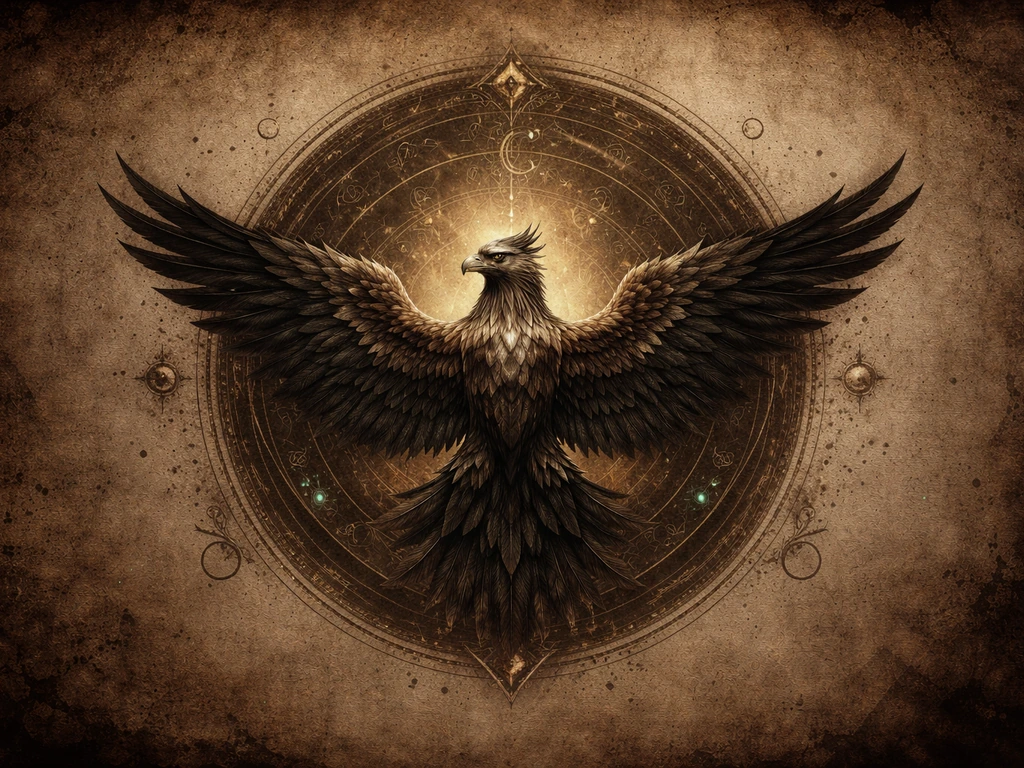
"The bird of Hermes is my name, eating my wings to make me tame" is a two-line verse from the Ripley Scroll, a 15th-century illustrated alchemical manuscript attributed to the English alchemist George Ripley. The speaker is the Ouroboros, the serpent or creature that eats itself, and the whole couplet is a riddle spoken in the first person by a mythic, self-consuming bird. It is not a casual quote or a line lifted from a poem anthology. It is an alchemical inscription, written directly onto the scroll beneath a symbolic illustration, and every word in it is doing specific symbolic work.
George Ripley was a 15th-century English canon and alchemist who wrote prolifically on the art of transmutation. The Ripley Scroll is not a book in the conventional sense. It is a long illustrated parchment, sometimes several feet in length, covered in allegorical images and short English verses. The British Library describes the Ripley Scroll as an illustrated alchemical manuscript set containing alchemical illustrations plus a series of poems called the “Verses upon the Elixer,” produced for English owners from the 15th through the 17th centuries. Multiple copies were made by hand across the 15th and 16th centuries, and several survive today in libraries and private collections. One example came up at Christie's auction house, where the lot description identified the manuscript section as carrying verses beneath the image of the "Bird of Hermes," showing how tightly the text and illustration are paired. The scroll was a teaching tool for initiates, and the images and words were meant to be read together, not separately.
The Bird of Hermes is one of the central symbols in the scroll. Hermes here refers to Hermes Trismegistus, the legendary figure associated with alchemy, astrology, and occult wisdom. If you are already familiar with names rooted in mythology, you may know that the greek name meaning bird often pulls from exactly this kind of symbolic tradition, where birds represent the soul, transformation, or divine messengers. In the alchemical context, the Bird of Hermes is a specific creature: typically depicted as a winged being associated with mercury (the element, not the planet), which was considered the prima materia, the foundational substance of all alchemical transformation.
How to find the full poem and confirm the exact wording
The couplet is the full poem, or rather, the full verse unit. It is not a stanza extracted from a longer lyric poem in the modern sense. The Ripley Scroll contains multiple short verse inscriptions alongside its illustrations, and this couplet stands as its own discrete unit beneath the Bird of Hermes image. If you want to confirm the exact wording, here is how to do it practically.
- Search for digitized versions of the Ripley Scroll held by institutions like the Beinecke Rare Book Library at Yale or the British Library. Several copies are publicly viewable online.
- Look for PDF transcriptions of the Works of Sir George Ripley, which reproduce the couplet with consistent capitalization: "The Bird of Hermes is my name, / Eating my wings to make me tame."
- Cross-reference at least two independent transcriptions, because capitalization and punctuation vary slightly between manuscript copies. The word 'bird' appears in lowercase in some transcriptions and capitalized as 'Bird' in others.
- For scholarly citation, check academic theses and papers that quote the line directly from the scroll. Multiple scholarly works reproduce it as: "The bird of Hermes is my name, eating my wings to make me tame."
The short answer is: the couplet itself is stable across sources. The meaning does not change. What varies is whether "Bird" is capitalized and whether the two lines appear separated by a line break or run together with a comma. Both forms are defensible because they reflect different manuscript copies and transcription conventions.
What the poem is actually saying

To interpret this couplet properly, you need two pieces of context: what the Bird of Hermes symbolizes, and what "eating my wings to make me tame" is describing.
The Bird of Hermes is a symbol for mercury in its volatile, unfixed state. In alchemical theory, mercury had to be "fixed" or made stable before it could be used in the Great Work (the process of creating the philosopher's stone). In its British Library feature on the Ripley Scroll, Google Arts & Culture similarly frames the Bird of Hermes within the scroll’s imagery as pointing to regeneration and to Hermes Trismegistus as a legendary alchemical sage mercury had to be "fixed" or made stable before it could be used in the Great Work. The bird image captures mercury's tendency to fly away, to be elusive and uncontrollable. Wings, in this metaphor, represent that volatility. When the bird eats its own wings, it is destroying its own capacity for flight, grounding itself, becoming tame. This is a symbolic description of the fixation of mercury.
This connects directly to the Ouroboros, the ancient symbol of a serpent eating its own tail, which represents cyclical self-renewal, the union of opposites, and the endless process of transformation. The Bird of Hermes is an avian variant of the same idea: the creature consumes itself not to destroy itself but to transform. Alchemists saw this as a model for the entire transmutation process. You break something down to build it back up in a purified form.
Thematically, the couplet covers: self-consumption as transformation, the domestication of a wild or divine force, the paradox of destroying something to perfect it, and the idea of identity being tied to a process rather than a fixed state. The creature names itself ("is my name") while describing an action that will change what it is. That tension is intentional and philosophically rich.
How people quote it (and the variants you'll see)
The couplet circulates in a few different forms online and in print. Knowing which variants exist helps you pick the version you actually want to use.
| Variant | Source type | Notes |
|---|
| The bird of Hermes is my name, eating my wings to make me tame. | Scholarly / academic transcription | Lowercase 'bird,' single sentence, period at end. Common in academic papers and theses. |
| The Bird of Hermes is my name, / Eating my wings to make me tame. | PDF transcriptions of Ripley's works | Capitalized 'Bird' and 'Eating,' slash indicates line break. Closer to the visual layout of the scroll. |
| The Bird of Hermes is my name, eating my wings to make me tame. | General reference and popular culture | Capitalized 'Bird,' no line-break slash, single sentence. Hybrid of the two above. |
| The bird of Hermes is my name / eating my wings to make me tame | Informal / tattoo use | No punctuation, lowercase throughout. Stripped back for aesthetic use. |
None of these versions is definitively wrong. The scroll itself was hand-copied multiple times, so there is no single canonical print edition the way there would be for a modern poem. What matters is internal consistency: if you capitalize "Bird," capitalize "Eating" too, since they start the respective lines in the two-line format. If you go lowercase throughout, go lowercase throughout.
This kind of naming variation is actually common across many traditions. Just as female names meaning bird can take on different spellings and forms across cultures while retaining the same core meaning, the Ripley couplet retains its symbolic content regardless of which transcription convention you follow.
Tattoo wording: how to get it right
This line is genuinely popular as a tattoo, and for good reason. It is short, rhythmically satisfying, and carries real symbolic depth. But because of the variant forms, it is worth being deliberate about which version you commit to permanently.
Decide whether you want the full couplet (both lines) or just the first line. The first line alone, "The bird of Hermes is my name" or "The Bird of Hermes is my name," works as a standalone statement and is self-contained enough to read without the second line. The full couplet is more complete symbolically and has a satisfying rhyme. Both are used in tattoos.
Capitalization and punctuation
For tattoos, most people go with one of two approaches. Option one: full capitalization of the key nouns, styled as two lines with no punctuation between them and a period only at the very end. Option two: all lowercase, no punctuation, which gives a cleaner visual flow for script fonts. Both read correctly. Avoid mixing conventions mid-couplet, for example capitalizing "Bird" but not "Eating," since that looks like a typo rather than a stylistic choice.
Accuracy check before you sit in the chair
Pull the exact text from at least two independent sources: a scholarly PDF transcription and a digitized manuscript image if you can find one. Print it out or have it typed in the exact format you want and hand it to your artist rather than reading it aloud or working from memory. The words "Hermes" and "tame" are straightforward, but people occasionally misquote the second line as "eating my wings to keep me tame" rather than "to make me tame." The difference is small but the original says "make." If authenticity to the scroll matters to you, verify that word specifically.
It is also worth knowing the alchemical name tradition this line sits inside. The concept of a bird carrying a symbolic name echoes across many cultures. Japanese names meaning bird and Korean names meaning bird both demonstrate how bird symbolism gets embedded in naming traditions, often tied to ideas of freedom, spirit, or transformation, which are exactly the same themes the Ripley couplet is working with. If you are drawn to this line for those reasons, that instinct is well-founded.
Tattoo-ready versions side by side
| Format | Text | Best for |
|---|
| Two lines, capitalized | The Bird of Hermes is my name,
Eating my wings to make me tame. | Script or serif fonts, formal aesthetic |
| Two lines, lowercase | the bird of hermes is my name
eating my wings to make me tame | Minimalist or handwritten styles |
| Single line, capitalized | The Bird of Hermes is my name. | Standalone statement, arm or collarbone placement |
| Single line, lowercase | the bird of hermes is my name | Clean and subtle, easily integrated into larger designs |
The broader world of bird names and symbols
If this line hooked you because of the "bird as name" concept itself, that rabbit hole goes surprisingly deep. Male names meaning bird often carry similar connotations of freedom and elevation across cultures, while Arabic names meaning bird show how avian symbolism gets woven into given names with specific cultural meaning. Even in Hebrew tradition, the Hebrew name meaning bird carries ancient resonance tied to similar themes of spirit and transcendence.
The Ripley couplet sits at an interesting crossroads: it is a name that is also a description of a process, which is unusually rich for two lines of text. The creature names itself while simultaneously explaining what it is doing to itself. That is why it has lasted 600 years and why people still want it on their skin today.