Title: Top 20 Bird Names: The Most Recognized Species and What They Mean
What Are the Top 20 Bird Names: Ranked Common Names

Maya Castellanos
21 Jul 2026
Meta description: Discover the top 20 most recognized bird names, with species notes, etymology, pet-name trends, and practical naming tips for bird owners.
The 20 most recognized bird names in North America include the American Robin, Northern Cardinal, Mourning Dove, Blue Jay, Mallard, Canada Goose, American Crow, and a handful of other backyard and wetland staples that show up on every field guide's first pages and dominate citizen-science checklists year after year. These are the names birders hear on their first morning walk, the ones crossword constructors reach for, and the ones pet-bird owners often borrow when they want a name that feels grounded in the real natural world.
What this list covers and who it's for
This list focuses on common English names, not scientific binomials, because common names are what most people actually search, say, and write. The ranking draws on bird-encounter frequency data from the Cornell Lab of Ornithology's All About Birds database and eBird citizen-science records, which log millions of verified sightings across North America. High checklist frequency, broad geographic range, and public recognizability are the three filters I used to build the list. A bird that only an expert identifies in a coastal marsh doesn't make the cut, but a bird that your neighbor points out from the kitchen window almost certainly does.
Whether you're a new birder wanting to learn the landscape, a pet-bird owner hunting for a name with real ornithological roots, a language learner curious about how bird names translate across cultures, or just someone who landed here after a trivia night argument, this article has you covered. I'll walk through all 20 names, explain where each name comes from, and finish with practical guidance for anyone naming a pet bird.
The top 20 most recognized bird names, ranked
The following ranked list is ordered by a combination of documented encounter frequency in All About Birds species accounts, eBird checklist presence across North American regions, and broad cultural visibility in field guides, media, and everyday conversation. Where two species are similarly common, I've weighted the one with broader geographic reach slightly higher.
- American Robin (Turdus migratorius): The quintessential North American backyard bird, described by Cornell's All About Birds as widespread across lawns and parks from coast to coast. Its orange-red breast makes it one of the most visually distinctive common birds, and it's usually among the first species a beginning birder learns.
- Northern Cardinal (Cardinalis cardinalis): Arguably the most photographed backyard bird in the eastern United States. The vivid red male is unmistakable, and the species ranks among the highest in feeder and citizen-science records across much of the U.S.
- Mourning Dove (Zenaida macroura): A year-round, abundant feeder and suburban bird across North America. Cornell's All About Birds characterizes it as one of the most frequently encountered species at feeders and in open landscapes.
- House Sparrow (Passer domesticus): Introduced from Europe in the 1850s and now one of the most human-associated birds on the continent, found around buildings, feeders, and urban infrastructure virtually everywhere people live.
- European Starling (Sturnus vulgaris): Another introduced species that became one of North America's most visible and abundant urban and suburban birds after around 60 birds were released in Central Park in 1890.
- Blue Jay (Cyanocitta cristata): A loud, colorful, and highly recognizable woodland and suburban bird across much of North America, with strong cultural visibility including sports team branding (Toronto Blue Jays).
- Red-winged Blackbird (Agelaius phoeniceus): One of the most abundant marsh and open-country birds in North America, and among the first to signal spring in many regions. The male's bright red shoulder patches make identification easy.
- Dark-eyed Junco (Junco hyemalis): A common sparrow-type bird known to most North Americans as the 'snowbird' because of its reliable winter-feeder presence. All About Birds highlights its high checklist frequency in citizen-science data.
- Mallard (Anas platyrhynchos): The most familiar duck in the world, present in ponds, parks, and urban waterways across North America, Europe, and beyond. The glossy green head of the male is one of the most recognizable patterns in the bird world.
- Canada Goose (Branta canadensis): A conspicuous, sometimes controversial waterfowl species found in parks, golf courses, and urban waterways across North America. Its honking V-formation flights are one of the most recognized seasonal spectacles.
- House Finch (Haemorhous mexicanus): A common backyard finch across North American towns and cities, noted by All About Birds as frequently one of the first birds to discover a new feeder.
- Song Sparrow (Melospiza melodia): One of the most widely distributed sparrows in North America, present across a huge range of habitats. Its persistent, melodic song and near-universal presence make it a field-guide staple.
- Downy Woodpecker (Picoides pubescens): The smallest and most common woodpecker in North America, a frequent and welcome backyard-feeder visitor that most bird enthusiasts encounter early in their hobby.
- American Goldfinch (Spinus tristis): A widespread and beloved backyard finch, especially recognizable in its bright-yellow breeding plumage. Its preference for nyjer (thistle) feeders makes it a deliberate target for many garden birders.
- American Crow (Corvus brachyrhynchos): An adaptable corvid found in virtually every habitat in North America. Its intelligence, loud call, and omnipresence in both rural and urban settings give it enormous public recognition.
- Northern Mockingbird (Mimus polyglottos): A familiar songbird across the southern and eastern U.S., famous for its vocal mimicry. It lends its name to one of the most celebrated American novels, cementing it in cultural as well as natural history.
- Bald Eagle (Haliaeetus leucocephalus): The national bird of the United States and arguably the most symbolically loaded bird name in the country. High recognition even among people who have never seen one in the wild.
- Barn Owl (Tyto alba): One of the most widespread owl species on Earth, found on every continent except Antarctica. Its heart-shaped face and ghostly pale coloring give it strong visual recognition, and it appears in folklore across dozens of cultures.
- Great Blue Heron (Ardea herodias): A tall, stately wading bird common at lakes, rivers, and coastal waters across North America. Its slow, deliberate hunting style and large size make it unmistakable to casual observers.
- Ruby-throated Hummingbird (Archilochus colubris): The only hummingbird species that breeds in eastern North America, and one of the most eagerly anticipated feeder visitors of the summer. Its name is both descriptive and memorable, and it consistently ranks among the most searched bird names online.
Top 20 at a glance
The table below gives you the full list in one place, with each bird's scientific name and its core claim to recognition, so you can scan quickly without reading all 20 entries above.
| Rank | Common Name | Scientific Name | Why It's Recognized |
|---|---|---|---|
| 1 | American Robin | Turdus migratorius | Ubiquitous backyard bird, orange-red breast, first bird many people identify |
| 2 | Northern Cardinal | Cardinalis cardinalis | Bright red male, top feeder bird, eastern U.S. icon |
| 3 | Mourning Dove | Zenaida macroura | Abundant year-round feeder and suburban species |
| 4 | House Sparrow | Passer domesticus | Most human-associated introduced bird in North America |
| 5 | European Starling | Sturnus vulgaris | Abundant introduced urban bird, iridescent plumage |
| 6 | Blue Jay | Cyanocitta cristata | Bold color, loud call, sports-team recognition |
| 7 | Red-winged Blackbird | Agelaius phoeniceus | One of North America's most abundant birds, spring herald |
| 8 | Dark-eyed Junco | Junco hyemalis | Common winter 'snowbird,' high citizen-science checklist frequency |
| 9 | Mallard | Anas platyrhynchos | World's most familiar duck, park-pond staple |
| 10 | Canada Goose | Branta canadensis | Urban park icon, V-formation flights |
| 11 | House Finch | Haemorhous mexicanus | Common feeder finch in towns and cities |
| 12 | Song Sparrow | Melospiza melodia | Widely distributed sparrow, persistent melodic song |
| 13 | Downy Woodpecker | Picoides pubescens | Most common North American woodpecker, feeder regular |
| 14 | American Goldfinch | Spinus tristis | Bright yellow breeding plumage, thistle-feeder favorite |
| 15 | American Crow | Corvus brachyrhynchos | Near-universal North American presence, high intelligence |
| 16 | Northern Mockingbird | Mimus polyglottos | Vocal mimic, cultural icon, novel namesake |
| 17 | Bald Eagle | Haliaeetus leucocephalus | U.S. national bird, top symbolic recognition |
| 18 | Barn Owl | Tyto alba | Worldwide distribution, folklore staple, heart-shaped face |
| 19 | Great Blue Heron | Ardea herodias | Common large wading bird, unmistakable silhouette |
| 20 | Ruby-throated Hummingbird | Archilochus colubris | Only eastern North American hummingbird, top searched |
A picture worth a thousand field marks
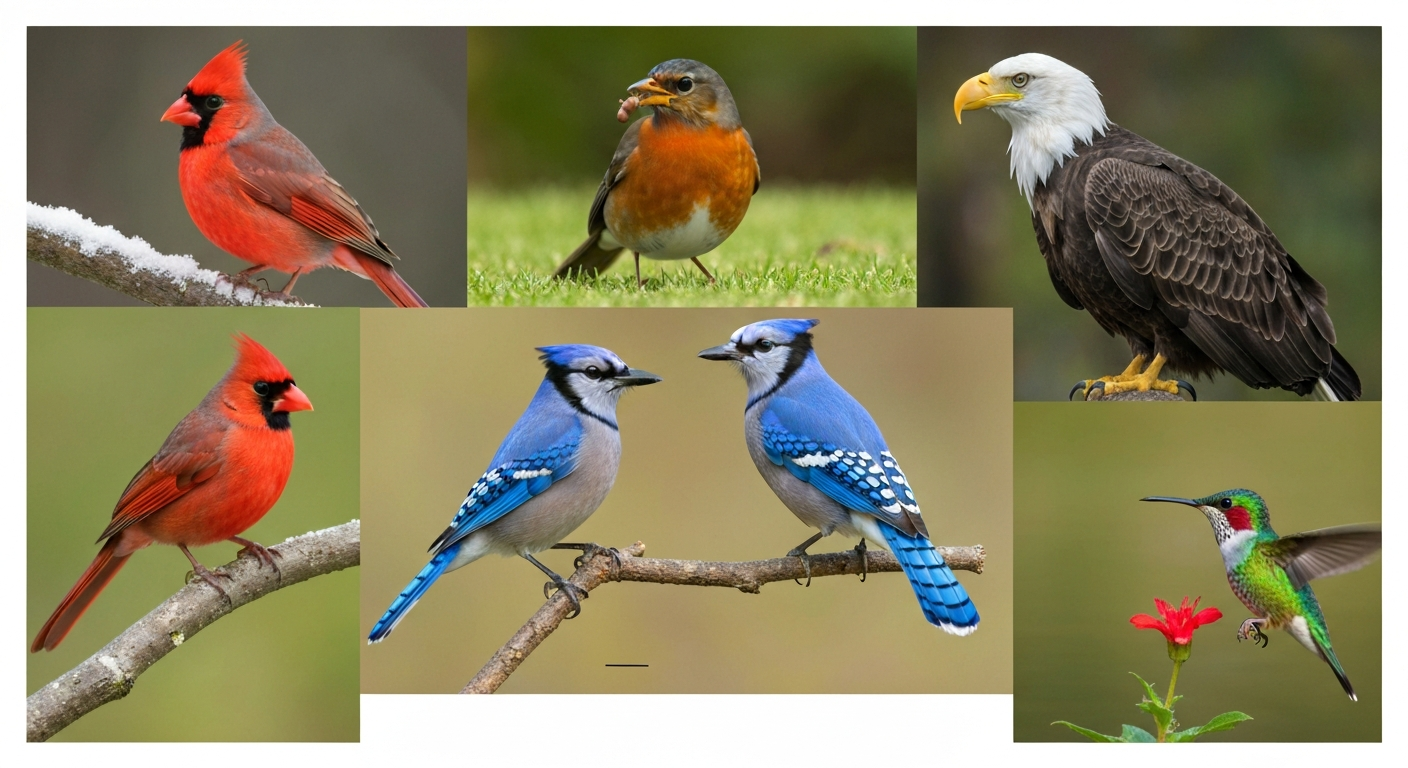
[Image: A male Northern Cardinal perched on a snow-covered feeder branch, vivid red plumage contrasting against white snow. Caption: The male Northern Cardinal is one of the most photographed backyard birds in North America. Its bright red plumage and year-round feeder presence make it instantly recognizable, even to non-birders.]
[Image: An American Robin pulling an earthworm from a lawn in early spring. Caption: The American Robin, Turdus migratorius, is often the first species new birders identify by name. Its orange-red breast and worm-hunting behavior on garden lawns make it a living symbol of spring across the continent.]
[Image: A Mallard pair resting at the edge of an urban park pond. Caption: The Mallard, Anas platyrhynchos, is arguably the most recognized duck species on Earth, present on every continent except Antarctica and a fixture in city parks and farm ponds alike.]
Top 10 pet bird names: a very different kind of list
Species lists and pet-name lists measure completely different things. The species list above is about which wild birds people encounter and recognize most often. A pet-bird name list tracks what owners actually call their parrots, cockatiels, budgies, and canaries, and the logic there is much more personal. Pet names draw from human naming trends, pop culture, and a bird's individual personality rather than ornithological frequency.
Current trends in pet bird naming lean heavily toward short, two-syllable names that a bird can eventually learn to associate with itself, names like Kiwi, Mango, Pepper, Charlie, Coco, Luna, Rio, Sunny, Peanut, and Skye. These names sit at the intersection of food words, color descriptors, travel associations (Rio, Skye), and classic human names (Charlie, Luna) that have crossed over into pet culture. Kiwi is perennially popular because it references both a fruit and an actual bird species (the flightless New Zealand kiwi), which gives it a neat double meaning for bird lovers.
What separates pet bird names from species names is intentionality. You don't choose to call your bird a 'Mourning Dove' because the name sounds sad, but you might deliberately name your cockatiel 'Sunny' because of its yellow crest. The phonetics matter too: birds respond best to names with hard consonants and bright vowel sounds, which is why names like Kiwi, Pepper, and Mango dominate. Soft, breathy names with lots of 's' or 'f' sounds tend to blend into background noise for a bird's ears.
Top 10 pet bird names right now
- Kiwi: fruit reference and bird species double meaning, bright vowel sounds
- Mango: tropical fruit, warm color association, popular for green and orange parrots
- Charlie: classic human name that has crossed firmly into pet culture
- Coco: short, repetitive syllables that many birds can vocalize
- Pepper: feisty personality implication, sharp consonants
- Luna: Spanish and Latin for moon, widely popular in both human and pet naming trends
- Sunny: color and mood descriptor, suits yellow or bright-plumaged birds
- Rio: travel association (Brazil, parrots), popularized by the animated film
- Peanut: affectionate food nickname, popular for small birds
- Skye: nature reference with open vowel sounds
If you're choosing a name for your pet bird and want more curated options with personality breakdowns, the dedicated top 10 pet bird names guide on this site goes considerably deeper into matching name style to species and temperament.
How top 10, top 20, top 50, and top 100 lists relate
People searching 'top 10 bird names,' 'top 20 bird names,' 'top 50 bird names,' and 'top 100 bird names' are all asking the same core question, but they want different levels of depth. The top 10 is for someone who wants the absolute shortlist, the birds every North American birder should know before they head outside. If you want a quick answer to what are the top 10 bird names, see the short-list version that follows here. That list is essentially the first 10 entries in this article: Robin, Cardinal, Mourning Dove, House Sparrow, Starling, Blue Jay, Red-winged Blackbird, Dark-eyed Junco, Mallard, and Canada Goose. All About Birds, European Starling (overview) notes that the European Starling (Sturnus vulgaris) is an introduced species and is among the continent’s most visible and abundant birds in towns and cities blank" rel="noopener noreferrer">All About Birds — European Starling (overview).
The top 20, which is what this article covers, fills in the next layer: familiar backyard and cultural icons that don't quite have the sheer encounter frequency of the top 10 but are still names virtually everyone knows. All About Birds, House Finch (overview) calls the House Finch a common backyard finch in towns and cities across much of North America and notes it's frequently among the first species to discover new feeders blank" rel="noopener noreferrer">All About Birds — House Finch (overview) calls the House Finch a common backyard finch in towns and cities across much of North America and notes it's frequently among the first species to discover new feeders.. House Finch, Song Sparrow, Downy Woodpecker, American Goldfinch, and American Crow round out the middle tier, while Bald Eagle, Barn Owl, Great Blue Heron, and Ruby-throated Hummingbird earn their places through symbolic weight and seasonal visibility rather than pure feeder-count numbers.
A top 50 list starts bringing in regional specialists: the Painted Bunting matters enormously in the American Southeast but is unknown to most Pacific Northwest birders. For a broader view that includes regional specialists and less common species, see our guide to the top 50 bird names. A top 100 list has to grapple with regional endemics, seasonal visitors, and birds that are famous mainly among dedicated hobbyists. The longer the list, the more it reflects hobbyist and regional knowledge rather than universal recognition. If you're interested in where the line falls, the top 50 bird names and top 100 bird names guides on this site map out exactly which species enter and exit as the list expands.
Why rankings vary depending on where you look
No two 'top 20 bird names' lists are identical, and that's not a problem with the data, it's a reflection of the fact that 'most recognized' can mean several different things. Here are the main reasons you'll see variation across sources.
- Geographic region: A list built from eBird data skews toward North American species because that's where the platform's reporting density is highest. A European list would substitute Robin (the European Robin, Erithacus rubecula) and House Sparrow near the top, but would swap out many North American endemics.
- Ranking criteria: Some lists rank by raw species abundance (how many individual birds exist). Others rank by checklist frequency (what percentage of birdwatchers report a species on a given outing). Others weight for cultural visibility, media presence, or search volume. Each method produces a slightly different order.
- Source methodology: A list produced by a field-guide publisher optimizes for teaching beginners, so it front-loads easy-to-identify birds. A list from a statistical ecologist might rank by population estimates. A list from a search-engine analyst ranks by what people type. This article combines encounter frequency with cultural recognition, which is why the Bald Eagle ranks higher than its pure feeder-count would suggest.
- Time period: Species populations shift. The Canada Goose's urban population has exploded over the past 40 years; it would have ranked far lower on a list compiled in 1980.
- What counts as a 'name': Some lists treat subspecies separately (the Audubon's Warbler and Myrtle Warbler are both Dark-eyed Junco relatives that were once split). This article uses current American Ornithological Society common-name standards, which keeps the list clean and comparable.
Where these names come from: etymology and multilingual variants
Bird common names in English are a fascinating patchwork of descriptive geography, color terms, behavior references, and borrowed words from Latin, French, and Indigenous languages. Breaking down a few of the top 20 reveals some genuinely surprising histories.
Descriptive and geographic names
The 'American' prefix on Robin, Crow, Goldfinch, and Cardinal was added largely by European settlers and ornithologists to distinguish North American species from their superficially similar European counterparts. The American Robin is not closely related to the European Robin despite the shared name and orange-breast appearance: early colonists named it for a familiar bird from home, a habit linguists call a 'transferred toponym.' The American Crow and the European Carrion Crow are genuinely close relatives, so the 'American' there is a geographic marker. 'Northern' in Northern Cardinal and Northern Mockingbird signals the species' range relative to tropical relatives.
Color and behavior names
The Blue Jay's name is straightforwardly descriptive: blue plumage plus 'jay,' a word borrowed from Old French 'geai' (pronounced roughly like the letter 'J'), which was used for noisy, showy birds. The Red-winged Blackbird does exactly what its name says, though technically the wing patch is more of a red and yellow epaulet. Mourning Dove takes its name from its mournful, low cooing sound, not from any funerary behavior. The Downy Woodpecker is named for the soft, downy feathers around its bill area, which distinguish it from the very similar Hairy Woodpecker.
Scientific names decoded
Scientific names often provide extra meaning that the common name doesn't. Mimus polyglottos, the Northern Mockingbird, literally means 'many-tongued mimic' in Greek and Latin: 'mimus' (mimic) plus 'polyglottos' (many-tongued, from 'poly' meaning many and 'glotta' meaning tongue). It is, objectively, one of the most accurate scientific names in all of ornithology. Turdus migratorius (American Robin) means 'migratory thrush,' which is exactly what it is. Haliaeetus leucocephalus (Bald Eagle) translates from Greek as 'white-headed sea eagle,' leucocephalus coming from 'leukos' (white) and 'kephalos' (head).
Multilingual variants for selected top 20 birds
| English Name | French | Spanish | German | Literal meaning of English name |
|---|---|---|---|---|
| American Robin | Merle d'Amérique | Zorzal migratorio | Wanderdrossel | American thrush (misnomer for thrush) |
| Northern Cardinal | Cardinal rouge | Cardenal norteño | Nördlicher Kardinal | Named for Catholic cardinal's red robes |
| Blue Jay | Geai bleu | Arrendajo azul | Blauhäher | Blue noisy bird (Old French 'geai') |
| Mallard | Canard colvert | Ánade real | Stockente | From Old French 'malart,' drake duck |
| Bald Eagle | Pygargue à tête blanche | Águila cabeza blanca | Weißkopfseeadler | 'Bald' from Old English 'balde' meaning white |
| Barn Owl | Effraie des clochers | Lechuza común | Schleiereule | Owl associated with barns and farm buildings |
| Mourning Dove | Tourterelle triste | Paloma llorona | Trauertaube | Named for its mournful cooing call |
| Northern Mockingbird | Moqueur polyglotte | Sinsonte norteño | Spottdrossel | Bird that mocks (mimics) other birds |
A few of these translations deserve extra attention. The French name for Mourning Dove, 'Tourterelle triste,' literally means 'sad turtledove,' which is beautifully melancholy and perfectly consistent with the English choice. The German name for Barn Owl, 'Schleiereule,' translates as 'veil owl,' a reference to the heart-shaped facial disc that looks like a pale veil, which is arguably more poetic than the utilitarian English 'Barn Owl.' 'Bald Eagle' confuses non-English speakers because the bird is clearly not bald: the 'bald' comes from an archaic Old English word 'balde' meaning white or shining, referring to the white head. That single etymology clears up more confusion than almost any other piece of bird-name trivia I've encountered.
Practical naming guidance for pet bird owners
Naming a pet bird well takes about five minutes of deliberate thinking and saves years of mild regret. Here's what I've learned from both personal experience and the naming conventions used by aviculturists and behavioral scientists.
Naming conventions that actually work
Two syllables is the sweet spot. Most parrots, cockatiels, and budgies can learn to recognize and eventually say names that are two syllables with a clear stress on the first (Mango, Kiwi, Pepper). Longer names tend to get shortened anyway: a bird named Alexandrina will end up being called Alex within a week. Keep the name distinct from common household commands: a bird named 'No' or 'Hey' is going to have a confusing life. Similarly, avoid names that rhyme with 'no,' 'go,' 'stay,' or other words you use for training.
Hard consonants (K, P, T, B) and bright open vowels (the sounds in 'ee,' 'ah,' 'oh') carry well across a room and cut through ambient noise. That's why Kiwi, Coco, Peanut, and Rio dominate pet-bird naming trends: they're acoustically optimized whether you realize it or not. Names with lots of sibilant sounds (hissing 's' or 'sh') tend to blend into background noise, which is why 'Sunshine' almost always gets shortened to 'Sunny.'
Species-specific considerations
For talking birds (African Grey Parrots, Amazons, some Cockatoos, Budgerigars), names with hard consonants and repeating syllables are especially worth considering because the bird may eventually say its own name. Coco and Kiwi are both extremely learnable for a talking parrot. For non-talking birds like canaries, finches, and doves, acoustics matter less and you can lean more heavily on meaning and personal resonance.
Name-selection checklist
- Is it one or two syllables? Shorter is almost always better for daily use.
- Does it have at least one hard consonant (K, P, T, B, D)? Hard sounds carry across a room.
- Does it avoid sounding like 'no,' 'go,' 'stay,' or other commands you use regularly?
- Does it suit the bird's species, color, or personality? A grey parrot named 'Sunny' works fine, but it also opens the door to a name that feels genuinely descriptive.
- Can you say it out loud without feeling embarrassed? You will say this name many times in front of houseguests.
- If your bird is a species with a recognizable common name (a Canary, a Cockatiel, a Parakeet), have you considered whether a name from natural nomenclature (Wren, Robin, Jay) might suit it?
- Have you let the bird's personality emerge before committing? Some owners wait three to five days before finalizing a name, which often produces a better match.
One approach I genuinely enjoy is using the etymology of wild bird names as inspiration. Naming a yellow canary 'Tristis' (from the American Goldfinch's species name, Spinus tristis, meaning 'sad' in Latin, which is ironic given how bright the bird is) gives you a name with depth and a story behind it. Naming a vocal African Grey 'Polyglot' is both a compliment and a scientific truth. These kinds of names work especially well if you're already drawn to the linguistic side of bird nomenclature.
FAQ
What is a good search-oriented title and meta description for an article on the top 20 bird names?
Title: "Top 20 Most Recognized Bird Names (Common Names, Notes & Pet-Name Trends)". Meta description (≤160 chars): "Discover the 20 most-recognized bird names with species notes, pet-name trends, etymology, and naming tips for bird lovers and pet owners."
Which 20 bird common names are most recognized (ranked list with brief species/context notes)?
Below is a widely useful ranked list (based on visibility in field guides, citizen-science checklists, and public familiarity). Each entry shows the common name and a one-line species/context note. 1. American Robin — widespread backyard thrush in North America (Turdus migratorius). 2. Northern Cardinal — bright, familiar backyard bird in much of the U.S. (Cardinalis cardinalis). 3. Mourning Dove — abundant, year-round feeder and suburban species (Zenaida macroura). 4. House Sparrow — very common human-associated bird, introduced in N. America (Passer domesticus). 5. European Starling — conspicuous, abundant introduced species in towns and cities (Sturnus vulgaris). 6. Blue Jay — distinctive, vocal woodland/urban corvid familiar to many (Cyanocitta cristata). 7. Red-winged Blackbird — common marsh/open-country blackbird (Agelaius phoeniceus). 8. Dark-eyed Junco — widespread wintering sparrow-like bird, often in flocks (Junco hyemalis). 9. Mallard — familiar pond duck seen in parks and wetlands (Anas platyrhynchos). 10. Canada Goose — large, conspicuous waterfowl common in parks/lakes (Branta canadensis). 11. House Finch — common backyard finch and early feeder visitor (Haemorhous mexicanus). 12. Song Sparrow — very common, widely distributed sparrow (Melospiza melodia). 13. Downy Woodpecker — the most common small woodpecker at feeders (Picoides pubescens). 14. American Goldfinch — widespread backyard finch often at thistle feeders (Spinus tristis). 15. American Crow — adaptable, widespread corvid seen in many habitats (Corvus brachyrhynchos). 16. Northern Mockingbird — common, vocal songster in many U.S. regions (Mimus polyglottos). 17. Great Blue Heron — large, familiar wading bird often seen near water (Ardea herodias). 18. Peregrine Falcon — widely recognized raptor known for speed and urban nesting (Falco peregrinus). 19. Bald Eagle — culturally iconic raptor and national symbol in the U.S. (Haliaeetus leucocephalus). 20. Hummingbird (Ruby-throated in East) — tiny, charismatic nectar-feeding birds popular in gardens (family Trochilidae; Ruby-throated Hummingbird, Archilochus colubris, common in eastern N. America). (Sources: Cornell Lab — All About Birds species pages; citizen-science frequency patterns.)
Can you provide a short table or quick-scan chart of the Top 20?
Quick-scan table (columns: Rank | Common Name | Short note): 1 American Robin — backyard thrush; 2 Northern Cardinal — bright backyard bird; 3 Mourning Dove — abundant feeder species; 4 House Sparrow — common human-associated bird; 5 European Starling — abundant urban bird; 6 Blue Jay — vocal woodland/urban bird; 7 Red-winged Blackbird — marsh/open-country blackbird; 8 Dark-eyed Junco — winter flocking sparrow-like bird; 9 Mallard — familiar pond duck; 10 Canada Goose — conspicuous waterfowl; 11 House Finch — common feeder finch; 12 Song Sparrow — widespread sparrow; 13 Downy Woodpecker — frequent feeder woodpecker; 14 American Goldfinch — thistle-feeder finch; 15 American Crow — adaptable corvid; 16 Northern Mockingbird — vocal songbird; 17 Great Blue Heron — large wading bird; 18 Peregrine Falcon — fast, urban-capable raptor; 19 Bald Eagle — iconic raptor; 20 Hummingbird (Ruby-throated east) — nectar feeder.
Which image(s) should be included and why?
Include at least one high-quality, properly licensed photograph that represents the list’s tone and audience—e.g., an American Robin in a suburban lawn (high familiarity) or a composite image showing a robin, cardinal, sparrow, and hummingbird. Use images with clear, captioned species IDs and photographic credits. Prefer Tier-1 sources or museum/field-guide licenses (Cornell Lab media or similar).
How do pet-bird naming trends differ from species/common-name popularity? (Top 10 pet bird names)
Pet-bird names reflect human preference and culture (short, affectionate names) rather than species frequency. A common top-10 list of pet-bird names (based on breeder and pet community sources) is: 1. Kiwi 2. Buddy 3. Charlie 4. Sunny 5. Bella 6. Tweety 7. Coco 8. Angel 9. Pepper 10. Mango. Note: trends vary by region, platform (Instagram vs. breeder lists), and species (parrots vs. finches). For parrots, human names (Charlie, Bella) and descriptive names (Sunny, Mango) are common; for small birds, onomatopoeic or birdy names (Tweety, Kiwi) are frequent.
How should the Top 20 be placed in context with sibling queries (top 10, top 50, top 100) and regional/source variation?
Context and variation: - Top lists depend on scope: 'Top 10' usually highlights the most visible backyard species; 'Top 50' expands to include regional and migratory species; 'Top 100' captures rarer but well-known birds globally. - Regional variation: lists differ by continent—e.g., starlings and house sparrows dominate urban lists in Europe; kingfishers, fantails, or honeyeaters appear in Australasian lists. - Source-driven variation: field guides, citizen-science datasets (eBird), and popular surveys weight sightings, checklists, and public familiarity differently. State your criteria (see next QA) when publishing a ranked list.