A "common bird name" is simply the everyday, plain-language name for a species, the kind you say out loud without needing a Latin dictionary. Robin. Peregrine Falcon. Blue Jay. These are common names, and they exist alongside (not instead of) scientific names. If you are trying to figure out which name is which, how to spell or capitalize one correctly, or how to pick a name for a pet bird, you are in the right place. This guide walks through all of it, in order, with concrete answers.
Bird Common Names: How to Find, Use, and Confirm Them

Maya Castellanos
14 Apr 2026
Common names vs. scientific names: what's the actual difference?
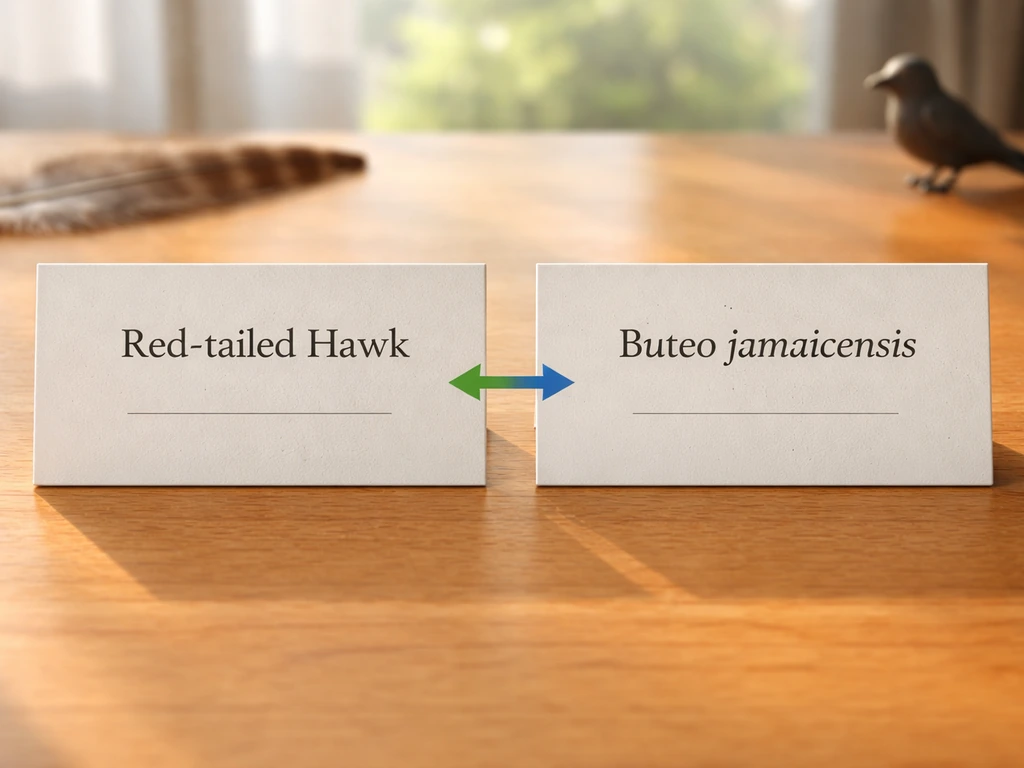
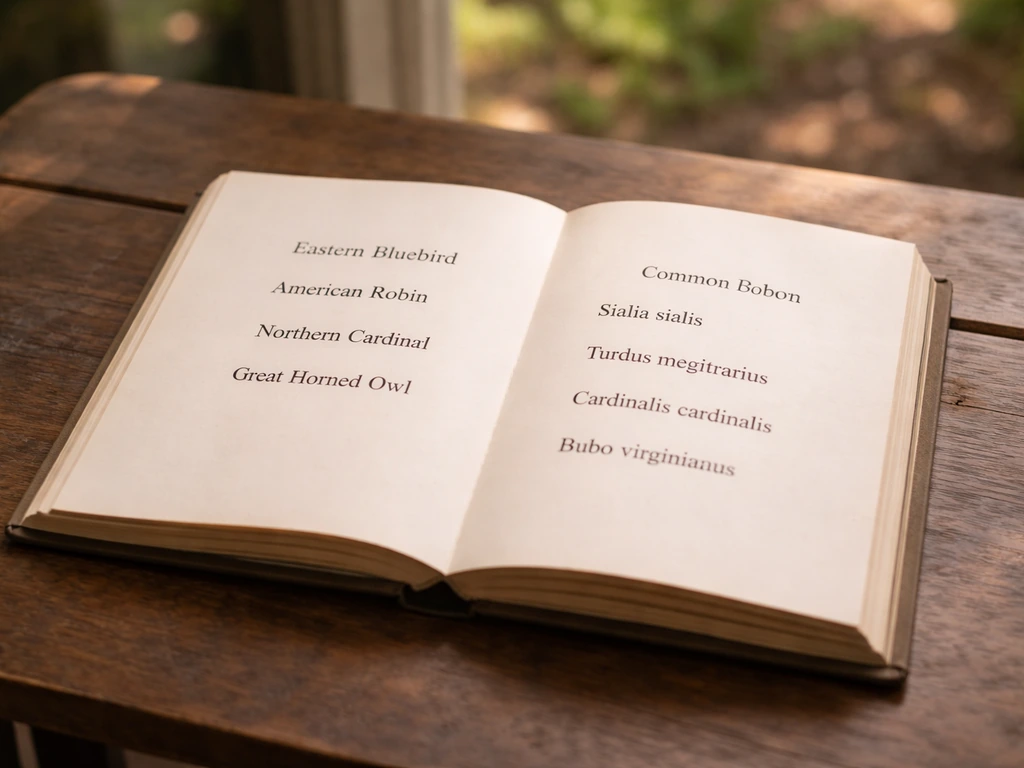
Every bird species has two kinds of names running in parallel. The scientific name (also called the binomial or Latin name) is fixed, internationally standardized, and formatted in italics with a capitalized genus and a lowercase species epithet, like Buteo jamaicensis for the Red-tailed Hawk. The common name is the plain-language version, determined largely by popular usage and curated by naming authorities. Merriam-Webster describes vernacular (common) names as the most familiar names of living things determined by popular usage, and it explicitly notes that one organism can have several common names and that different organisms can share the same common name. That last part is where the confusion starts.
If you are ever unsure what a bird's name actually means or how the word "bird" itself functions in these constructions, it helps to start with bird definition in english, which unpacks the term at the root level before you start layering on species-specific vocabulary. Once you have that foundation, the difference between a common name and a scientific name becomes much easier to keep straight.
The key practical distinction: the scientific name is global and species-specific, period. The common name is conversational, sometimes regional, and occasionally shared across multiple species. A "sparrow" in North America and a "sparrow" in the UK might not even be the same genus. That is normal, according to the International Ornithological Congress (IOC), which frames this overlap and variation as a feature of living language rather than a flaw. The IOC's standardized system tries to reduce that ambiguity at the official level, but regional usage keeps evolving regardless.
How common names get chosen and standardized
Common names are not just invented casually and left to drift. Multiple organizations actively curate them. The IOC World Bird List publishes recommended English names tied to each species entry alongside the corresponding scientific name. The AOS North American Classification Committee (NACC) arbitrates official names for birds in its region, with explicit rules about avoiding ambiguity, especially when a species is split into two and both daughters need distinct English names. The American Birding Association's Checklist Committee draws on both eBird/Clements and AOS/NACC, meaning there is a layered system of checks rather than a single decree from on high.
eBird uses the Clements Checklist as its default for English common names, though users can switch display languages and name variants in preferences. The platform even supports Quick Find codes, where a few letters of a partial common name return the right species, because partial-name lookups are a real workflow for both casual birders and researchers. This infrastructure shows just how seriously standardized naming is taken at the data level.
One important thing to understand: bird names are unregulated in the sense that no single global legal authority controls what you call a bird in everyday speech. But within scientific, journalistic, and conservation contexts, the authority checklists carry enormous practical weight, and using the wrong name in a CITES permit, for example, can create real documentation problems.
Finding the right common name without making a mix-up

The fastest reliable workflow is to pair the common name with the scientific name every time you look something up. eBird’s Help Center explains that you can find species profiles by typing a bird’s common or scientific name under “Explore Species.”. CITES identification guides instruct users to find the common name on a permit and then note the scientific name to confirm the correct species, for exactly this reason. USDA Forest Service species tables pair common and scientific names side by side in every row. If you only have one of the two, use the other to cross-check.
- Start with a known authority: the IOC World Bird List portal, eBird/Clements, or the AOS checklist. All three pair common names with scientific names in searchable formats.
- Search by partial name if you are unsure of spelling. eBird Mobile's Quick Find matches partial inputs and alternate regional names to the right species record.
- Confirm the scientific name matches what you expect. If you searched "common sparrow" and got Passer domesticus, you now know that is the House Sparrow in most English-language contexts.
- Check for regional variants. The same species may appear under a different common name in a UK field guide versus a North American one. The scientific name stays constant across both.
- For legal or permit contexts, always record both names. CITES regulations require species-level identification in documents, and common-name confusion is a documented source of errors.
If you want a ready-made reference to work from, a common bird names list organized by species is a great starting point. For a ranked view of which names appear most frequently across birding databases, the most common bird names resource shows you where the heaviest traffic is, which also tends to be where common-name confusion is most frequent.
Capitalization and grammar: the common vs. proper noun question
This comes up constantly, and the answer depends entirely on context. In everyday writing, bird species names used as official common names are treated as proper nouns and capitalized: Red-tailed Hawk, American Robin, Canada Goose. COSEWIC's guidelines state that the first letter of each word in a common name should be capitalized. The Carolina Bird Club's style guidelines say it plainly: capitalize the common names of bird species when the name is the full standard name as listed in an authoritative checklist. MLA Style Center notes that major bird organizations' editorial guidelines (such as those from the AOS and Audubon) typically require capitalizing common bird names in English capitalize the common names of bird species.
However, when you use the name generically (not referring to a specific species by its full official name), it drops to lowercase. "I saw a hawk today" is lowercase because you are using the word as a general noun. "I saw a Red-tailed Hawk today" is capitalized because Red-tailed Hawk is the species' full standardized name. The distinction mirrors how you treat other proper nouns: you capitalize "the President" when referring to the office, but not "a president" used generically.
Scientific names follow a separate rule: italicize them, capitalize only the genus. Buteo jamaicensis is always written that way, never Buteo Jamaicensis or buteo jamaicensis. Mixing up these formatting conventions is one of the most common errors in ornithological writing, and it matters because inconsistent styling can make a text look like it is referring to two different things.
If you are alphabetizing a list of species, the common bird names alphabetical format is the standard approach for printed field guides and checklists, with capitalized names sorted by first word.
Where common names come from: etymology and meaning
Most common bird names fall into a handful of descriptive categories, and once you recognize the pattern, the names start making intuitive sense. The AOS notes that many modern English bird names have origins in historical sources and reflect appearance, place of discovery, or habits, though sometimes with etymological logic that is now outdated or geographically inaccurate.
- Appearance: Red-tailed Hawk (the rusty tail), Yellow Warbler, Black-capped Chickadee. The name is a visual field mark.
- Sound: Killdeer (it really does call "kill-dee"), Chickadee (onomatopoeic from its chick-a-dee-dee-dee alarm call), Whip-poor-will.
- Behavior or habitat: Oystercatcher, Kingfisher, Roadrunner. The name is a compressed behavioral description.
- Place of discovery or range: Carolina Wren, Canada Goose, Tennessee Warbler (named where first collected, not necessarily where it breeds).
- Honorific (person's name): Wilson's Warbler, Bewick's Wren, Baird's Sparrow. Named after naturalists, explorers, or patrons.
- Indigenous or loan-word origin: Albatross (from Arabic al-qadus via Portuguese), Booby (from Spanish bobo, meaning fool), Flamingo (from Portuguese flamengo, meaning flame-colored).
The NACC's guidelines also describe precedence rules for historical and local-language names, including Hawaiian-language considerations, when committees choose between an established English name and a new proposal. This means etymology is not just academic trivia: it directly influences which name gets official recognition. The AOS acknowledges that some names persist even when the descriptive or geographic logic no longer holds, because stability in naming matters more than etymological precision once a name is widely adopted.
Understanding what a name actually means also sheds light on bird name is, in the sense that every name is a miniature story about how humans first encountered or categorized that species. The Tennessee Warbler was named in Tennessee but actually breeds mostly in Canada. The name stuck anyway, because by the time ornithologists sorted out the range, the name was already in widespread use.
Naming pet birds: practical style tips
When you bring a pet bird home, you are operating in two parallel naming systems at once. There is the species' official common name (African Grey Parrot, Budgerigar, Cockatiel) and then there is the individual name you give your specific bird. These are completely separate, and keeping them distinct matters more than most people realize.
The National Aviary's Name-A-Bird program is a useful model here: a chosen bird name is registered in the institution's official animal registry (ZIMS) after approval and remains the official name for the life of the bird at the facility. Your pet's personal name works the same way: it is stable, individual, and completely separate from the species taxonomy. USDA APHIS maintains its own list of recognized pet bird species under the Animal Welfare Regulations, and if your bird ever travels or requires veterinary paperwork, the species common name used in documents should match the standardized list, not your pet's nickname.
For choosing a personal name, the most practical guidance is to pick something short (two syllables tends to work best for bird cognition), easy to say consistently, and distinct from common command words. Many people find that bird names that could be human names work particularly well for parrots and corvids, partly because these birds respond to names used in human social contexts. Names like Jasper, Mango, Kiwi, or Rio land well in that sweet spot between memorable and trainable.
If you want inspiration beyond the obvious, best bird names in the world is worth browsing. It spans cultures and languages, which is useful if you want a name that reflects your bird's species origin, like a Brazilian name for a Blue-and-gold Macaw or a Hawaiian name for a bird you met in Honolulu. Just make sure the personal name you land on does not overlap confusingly with the species common name in everyday conversation.
| Naming Layer | Example | Who Uses It | Capitalization |
|---|---|---|---|
| Species common name | African Grey Parrot | Everyone: vets, breeders, regulators | Capitalized as a proper noun |
| Scientific name | Psittacus erithacus | Science, legal documents, CITES permits | Italicized, genus capitalized only |
| Individual pet name | Einstein, Mango, Jasper | Owner, household, vet records | Capitalized as a proper name |
| Informal nickname | "the grey," "my bird" | Casual everyday speech | Lowercase when used generically |
Bird common names in culture, sports, and wordplay
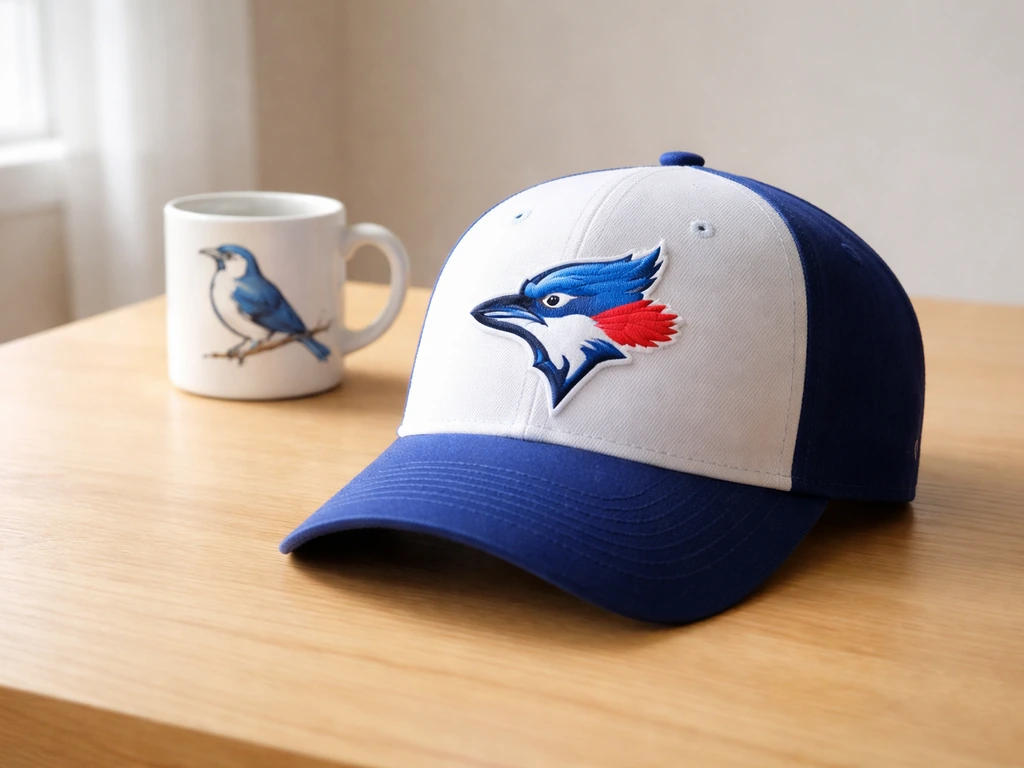
Bird common names have a life well beyond field guides. Sports teams, media franchises, and crossword constructors all borrow from the same vocabulary, and the names they choose are almost always the standardized English common name rather than any scientific or regional variant. This is partly because common names are already optimized for memorability, which is exactly what branding needs.
The Toronto Blue Jays are a canonical example. The team name was inspired partly by a preference for the color blue, and the bird it references, the Blue Jay (Cyanocitta cristata), is a familiar backyard species with a clean, punchy common name. Audubon has documented the cultural competition around bird-named sports teams, and All About Birds has written about how sports teams adopt bird names as mascot identities completely independent of scientific naming logic. A team called the "Blue Jay" does not need to know that its mascot has a complex social structure and a habit of mimicking hawk calls. The common name carries the cultural weight on its own.
In crosswords and wordplay, common bird names appear constantly because they tend to be short, vowel-rich, and phonetically interesting. "Emu," "ibis," "wren," "kite," and "lark" are crossword staples precisely because they fit neatly into grids and carry enough cultural familiarity that solvers recognize them. The fact that "lark" doubles as a verb meaning to engage in carefree adventure is no accident: many bird common names have drifted into figurative English usage because they were already embedded in everyday speech.
Multilingual contexts add another layer. The same species often has common names in a dozen languages, each reflecting a different descriptive tradition. The European Robin is Erithacus rubecula in Latin, but "robin rougegorge" in French (red-throat robin), "Rotkehlchen" in German (little red-throat), and "petirrojo" in Spanish (little red one). None of these are wrong. They are all common names doing what common names do: describing the bird in the terms that made sense to the people who named it first in that language. The scientific name is the anchor that lets you confirm all four names refer to the same bird.
Whether you are filling in a crossword, cheering for a team, or just trying to tell someone what bird landed on your feeder, the common name is the right tool. The scientific name is for when precision is legally or taxonomically required. Getting comfortable with both, and knowing which one to reach for in which situation, is the whole skill. At this point, you have everything you need to use these names correctly, look them up efficiently, and explain the difference to anyone who asks.
FAQ
How can I tell whether two different “common bird names” refer to the same species?
Treat the common names as hints, not proof. Open the pairing and confirm with the scientific name for each, then verify they match exactly (same binomial, same genus and species epithet). If you only have one name, search the other direction (common-to-scientific and then scientific-to-common) to avoid regional mismatches.
Why do some checklists use different English common names for the same bird?
English common names can change when committees update the official list, when species are split or “lumped,” or when two previously similar names would otherwise become ambiguous. If you are comparing older field guides or older datasets, look for a “current name” versus “former name” note in the source you are using, then map them to the latest IOC or NACC-aligned entry.
What’s the correct capitalization rule if I am writing in a style guide that doesn’t mention birds?
Use the article’s proper noun rule as your default: capitalize the full standardized species common name when it functions as that named taxon (for example, “I saw a Canada Goose”). Keep it lowercase when you mean the category generically (“I saw geese in the park”). If your text is more formal, apply the “each word capitalized” approach consistently for the standardized name.
When I italicize scientific names, should I also capitalize the species epithet?
No, only the genus is capitalized and the entire binomial is italicized in most conventional styles. The species epithet stays lowercase (for example, “Buteo jamaicensis,” not “Buteo Jamaicensis”). If you are using sentence case or all caps formatting in a headline, prioritize the capitalization pattern, but avoid removing italics unless your publisher requires it.
Is it safe to use a common name alone in scientific or conservation documentation?
Not if you need precision. Common names can overlap across species or vary by region, so documents that require correct identification should include both the common name and the scientific name. This is especially important for permits, species listings, and any records that could be audited later.
Why do “sparrow,” “finch,” or “hawk” sometimes cause confusion?
Because broad words often function as informal group terms. For example, “sparrow” can be a specific common name in some contexts, but it can also be used generically for multiple small passerines. When in doubt, require a complete species common name (not just the group word) or confirm via the scientific name.
What should I do if I can’t find my bird by the exact common name spelling?
Try partial-name search, alternate spellings, or related entries by searching for the scientific name you think is likely. Many databases support partial common-name lookup and name variants, but spelling differences can redirect you to the wrong taxon if the partial matches multiple species.
Can the same bird have several common names even within one country?
Yes. Common names can differ across regions, time periods, and checklist conventions, and some committees allow multiple accepted vernacular forms. The safest method is to anchor to the scientific name, then record the common name variant that matches your specific checklist or database display settings.
Should I list a pet bird using its species common name or my pet’s personal name in records?
For species-level paperwork, use the standardized species common name (the one that corresponds to the recognized species list), and keep your pet’s individual name separate. For training and day-to-day communication, your personal name is fine, but it should not replace the species identifier in veterinary or travel documents.
How do I choose a personal name for a pet bird without accidentally confusing it with the species common name?
Before you commit, check whether your chosen personal name matches or closely resembles the species common name used in everyday speech. If it does, the bird can still learn, but you will create ambiguity for humans in conversation and in written notes, especially when you say both names often in the same context.
What’s the best way to alphabetize a list of bird common names?
Use the standardized sorting rule your publication expects, but a common approach is to alphabetize by the first word of the capitalized common name. Watch out for prefixes like “North,” “New,” “American,” and “European,” since some styles treat them as sort keys while others treat them as part of the phrase.
Do bird common names have word origins that can affect which name becomes “official”?
Yes. Committee decisions can weigh historical and local-language considerations, and etymology sometimes influences whether a proposed English name replaces an established one. Still, once a name is widely used, stability often wins over “accuracy” of the original meaning, so expect older names to persist even if the etymology no longer matches current knowledge.