A common bird names list is simply a curated set of the everyday English (or local-language) names used to identify bird species, grouped in a way that makes sense for your purpose: finding birds you've seen, logging observations, choosing a name for a pet, or just satisfying curiosity. A quick bird definition in English is a good starting point when you're trying to learn the common names correctly. The trick is that 'common name' is deceptively loose.
Common Bird Names List: How to Build, Verify, and Use It

Maya Castellanos
7 May 2026

The same bird can have different names in the UK, the US, Australia, and Malaysia, and two completely different birds can share the same name depending on where you look. To actually use one of these lists reliably, you need to know which naming system it follows, which region it covers, and how to match a common name to the correct species when things get fuzzy.
What a common bird names list actually is (and how to use one)
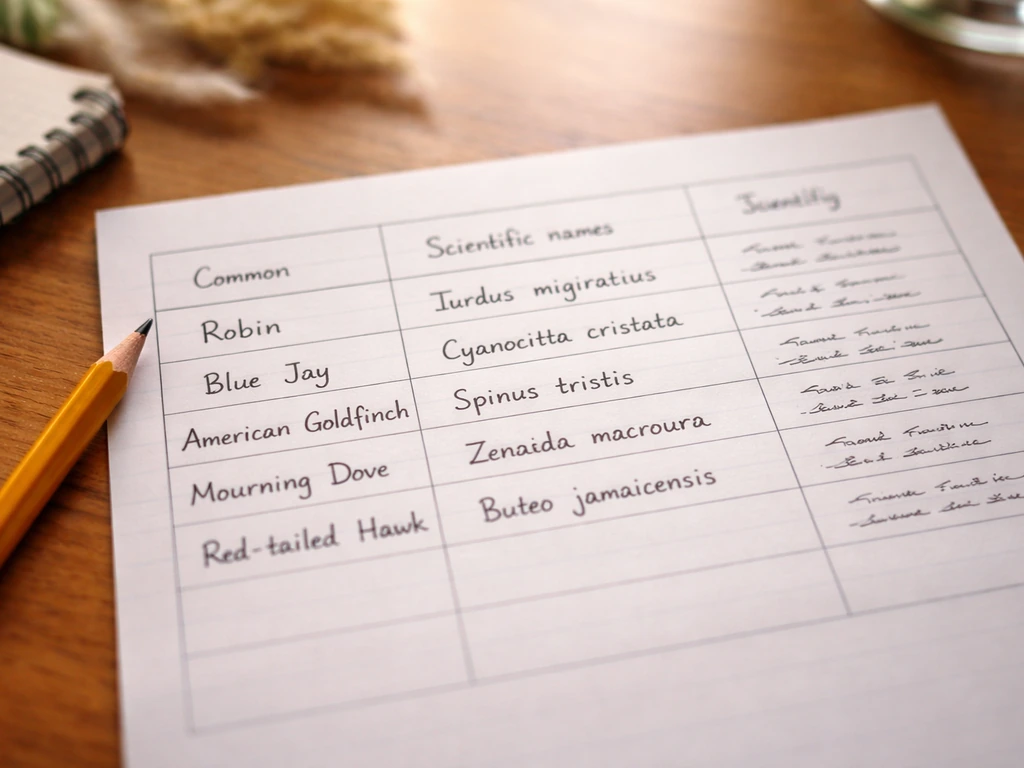
At its simplest, a common bird names list pairs everyday names with the species they refer to. But a good list does more than that. It tells you which taxonomy it follows (IOC, Clements, BirdLife, or another authority), which regional English variant it uses, and ideally includes the scientific name as an anchor so you can cross-reference without getting lost in translation. Think of the common name as the door and the scientific name as the address. The door is easier to say, but you need the address to be sure you've arrived at the right place.
When you're using a list for bird identification or logging sightings, precision really matters. eBird, one of the most widely used platforms for bird observation, is famously sensitive to exact common-name strings. If your spreadsheet says 'Cardinal' but eBird expects 'Northern Cardinal,' it won't make the match. That's not a bug; it's a feature of a system built around specificity. So whenever you're building a list for practical use, grab your names directly from the platform or taxonomy you'll be submitting to, not from a general web search.
eBird makes this fairly easy. You can download the current Clements Checklist as an Excel file directly from the eBird taxonomy page, which gives you a working crosswalk table of common names, scientific names, and family groupings all in one place. A Reddit r/birding thread also notes that birders can download the eBird taxonomic file (covering 11,000+ species) and that it is updated and re-posted yearly when building lists for eBird/Clements blank" rel="noopener noreferrer">download the current Clements Checklist as an Excel file directly from the eBird taxonomy page. It's the fastest shortcut I know for building a reliable local list from scratch.
Common bird species names organized by region and habitat
Because bird communities vary so much by geography and environment, the most useful way to organize a common-name list is by region or habitat. Here's a practical framework you can adapt. These are broad groupings to orient you; the exact species in each category will shift depending on your continent.
North America (common backyard and woodland birds)

- Northern Cardinal (Cardinalis cardinalis)
- American Robin (Turdus migratorius)
- Black-capped Chickadee (Poecile atricapillus)
- Downy Woodpecker (Dryobates pubescens)
- American Goldfinch (Spinus tristis)
- Dark-eyed Junco (Junco hyemalis)
- House Sparrow (Passer domesticus)
- Blue Jay (Cyanocitta cristata)
- Red-tailed Hawk (Buteo jamaicensis)
- Canada Goose (Branta canadensis)
Europe (garden and countryside birds)
- European Robin (Erithacus rubecula)
- Common Blackbird (Turdus merula)
- Blue Tit (Cyanistes caeruleus)
- Great Tit (Parus major)
- Common Chaffinch (Fringilla coelebs)
- Eurasian Magpie (Pica pica)
- Common Wood Pigeon (Columba palumbus)
- Barn Swallow (Hirundo rustica)
- Common Kestrel (Falco tinnunculus)
- Eurasian Wren (Troglodytes troglodytes)
Australia (widespread natives)

- Australian Magpie (Gymnorhina tibicen)
- Laughing Kookaburra (Dacelo novaeguineae)
- Sulphur-crested Cockatoo (Cacatua galerita)
- Rainbow Lorikeet (Trichoglossus moluccanus)
- Willie Wagtail (Rhipidura leucophrys)
- Eastern Rosella (Platycercus eximius)
- Common Myna (Acridotheres tristis)
- Superb Fairywren (Malurus cyaneus)
- Galah (Eolophus roseicapilla)
- Tawny Frogmouth (Podargus strigoides)
Wetland and coastal birds (global crossover)
- Great Egret (Ardea alba)
- Grey Heron (Ardea cinerea)
- Mallard (Anas platyrhynchos)
- Common Tern (Sterna hirundo)
- Osprey (Pandion haliaetus)
- Pied Avocet (Recurvirostra avosetta)
- Great Cormorant (Phalacrocorax carbo)
- Common Kingfisher (Alcedo atthis)
- Black-winged Stilt (Himantopus himantopus)
- Eurasian Spoonbill (Platalea leucorodia)
For building your own regional list beyond these starters, BirdLife International's DataZone is worth bookmarking. It integrates distribution data and species factsheets organized by BirdLife's taxonomy, so you can query by country or region and pull a credible species roster with standardized common names attached.
Common vs. scientific names: how to avoid the confusion
The core tension is this: scientific names (binomial Latin names like Turdus migratorius) are unique identifiers that don't change by region or language. Common names, on the other hand, are wonderfully human and wonderfully inconsistent. The same species can go by 'Snowy Owl' in North America and a completely different vernacular name in Scandinavia. Meanwhile, 'robin' in the US refers to a large thrush (the American Robin), while in the UK it means a much smaller, red-breasted bird from a totally different family.
The IOC World Bird List tackles this directly. It publishes explicit principles for English name construction, spelling, and standardization, and it flags cases where different species share the same global name (called name collisions). The IOC's online table includes columns for both English Name and Scientific Name, making it a reliable source for building a common-to-scientific crosswalk.
There's also the spelling variant issue. eBird notes that some regional name sets deliberately use different spellings: English Malaysia might use 'Grey' where North American English uses 'Gray.' Neither is wrong; they just reflect locale. This means if you're building a list that spans multiple regions, you need to encode the locale context, not just the name string.
| Common Name (US) | Common Name (UK/AU) | Scientific Name | Notes |
|---|---|---|---|
| American Robin | American Robin | Turdus migratorius | Different from European Robin |
| European Robin | Robin | Erithacus rubecula | Different family from American Robin |
| Snowy Owl | Snowy Owl | Bubo scandiacus | Consistent globally |
| Gray Catbird | Grey Catbird | Dumetella carolinensis | Spelling varies by locale |
| Northern Harrier | Hen Harrier | Circus hudsonius | Different common names, same or closely related species |
| Common Loon | Great Northern Diver | Gavia immer | Classic transatlantic name split |
The practical takeaway: whenever you need to confirm you're talking about the right bird, cross-reference the scientific name. It's the universal anchor. eBird, BirdLife DataZone, and the IOC World Bird List all let you search or filter by scientific name precisely for this reason.
Where bird names come from: etymology you can actually use
Common bird names are rarely random. Most of them tell a story about what the bird looks like, how it sounds, where it lives, or who first described it to a Western scientific audience. Once you start reading names as mini-descriptions, you'll remember species much more easily, and you'll start spotting patterns across the whole list.
Names based on appearance
Color and physical features dominate this category. 'Redstart' comes from Old English, where 'steort' meant tail, so a redstart is literally a red-tail. 'Robin Redbreast' is the same logic applied to the chest. The Blackcap (a warbler) just has a black cap. The Yellowhammer combines color with an old Germanic word for 'bunting.' These names were given by people who needed practical descriptions, not poetic flourishes, and they still work perfectly as field identification cues.
Names based on sound
Onomatopoeia is huge in bird naming. The Cuckoo is named for its call, full stop. The Chiffchaff (a small European warbler) is named for its repetitive two-note song that sounds exactly like 'chiff-chaff.' The Killdeer (a North American plover) screams something close to 'kill-deer' when alarmed. The Pewee, the Whooper Swan, the Towhee, the Chickadee: all acoustic portraits. If you hear a bird before you see it, the name itself is sometimes your best ID guide.
Names based on behavior or habitat
The Oystercatcher catches oysters (or mussels, mostly, but oystercatcher stuck). The Treecreeper creeps up trees. The Dipper dips repeatedly while standing in streams. The Kingfisher is, quite literally, a king among fishers. These functional names are some of the most honest in ornithology. They describe exactly what the bird does and where it does it, which makes them surprisingly useful as memory hooks when you're learning a new list.
Eponymous and explorer names
A big chunk of common names honor the people who first described or collected the species for science. Wilson's Warbler, Audubon's Warbler, Steller's Jay, Cooper's Hawk, Bewick's Wren: these all carry the names of naturalists. This naming tradition has become controversial in recent years because many honorees have complicated histories, and both the IOC and the American Ornithological Society have been actively revising some eponymous names toward descriptive alternatives.
If you notice a bird name changing in your lists, this is often why. The topic of whether bird names are regulated or freely changed is a genuinely interesting rabbit hole worth exploring. Many bird naming conventions are not formally regulated, which is why names can shift between regions and authorities regulated or freely changed.
Using common bird names to name your pet bird
One surprisingly popular use of a common bird names list is as inspiration for naming pet birds. If you have a parrot, cockatiel, canary, or finch, borrowing from species nomenclature gives the name a grounded feel and often a built-in story to tell. There are a few approaches that work especially well.
Using the species name directly
Sometimes the common name itself is great as a pet name. 'Kestrel,' 'Merlin,' 'Wren,' 'Jay,' 'Robin,' and 'Finch' all work beautifully as names for pet birds (or even people, as a sibling topic on bird names that could be human names covers in more depth). You can also use the same logic to find bird names that could be human names, since many common bird names overlap with familiar first-name patterns. They're short, memorable, and carry immediate personality. 'Kestrel' in particular has a wonderful sound and implies a kind of fierce elegance.
Mining etymology for a name with meaning
If you want something a little more original, dig into the etymology. A yellow bird named 'Hammer' (a nod to Yellowhammer) is quirky and interesting. A talkative parrot named 'Chiff' or 'Chaff' is a little playful. A bird with a red patch could be called 'Steort' (Old English for tail/start). This approach works especially well for enthusiasts who like names with a story behind them, which is exactly the kind of naming logic the best bird name lists support.
What to avoid
A few practical notes: avoid names that are so common they'll cause confusion at the vet (a parrot named 'Robin' might get mixed up with a client's dog), and skip names that are hard to call out clearly, since pet birds learn their names partly through the way you say them. Short names with hard consonants (K, T, B) tend to work best because parrots and parakeets find them easy to pick up. And if you're naming a bird after its species, double-check the common name is actually correct for your bird's species, since 'common names' vary enough that a Monk Parakeet might be called a Quaker Parrot in your region. Double-check the bird name is correct for your region and species, since common names vary enough to cause mix-ups.
Bird names in popular culture, sports, and wordplay
Common bird names punch well above their weight in popular culture. If you want a quick way to explore the best bird names in the world, start by looking at the most memorable common names and where they come from. Sports teams have long borrowed from bird iconography: the Baltimore Orioles, Philadelphia Eagles, Atlanta Hawks, Toronto Blue Jays, Arizona Cardinals, Seattle Seahawks, and Louisville Cardinals all trade on the immediate recognizability of common bird names. These names weren't chosen arbitrarily. They usually reflect something regional (the Baltimore Oriole is Maryland's state bird) or aspirational (eagles and hawks project power and precision).
In crosswords and word games, bird names are a staple. Short ones like EMU, JAY, TIT, and OWL appear constantly because of their vowel patterns. Slightly longer ones like ROBIN, WREN, SWIFT, and CRANE are favorites because they double as words or names in other contexts. This ambiguity is exactly what makes crossword constructors love them. If you're ever puzzling over a four-letter bird clue, 'IBIS,' 'WREN,' 'LARK,' 'RAIL,' and 'TERN' are your most reliable guesses.
Common bird names also surface in idioms and everyday language in ways most people don't consciously track. To 'crane your neck,' to 'parrot' someone, to act like an 'ostrich,' to be an 'early bird,' to 'hawk' your wares: birds are woven into English expression at a remarkably deep level. Understanding where a name comes from often explains the idiom, because the behavioral traits that gave a bird its name are the same traits that made it useful as a metaphor.
Literature and mythology add another layer. The raven, the albatross, the phoenix (mythological), the nightingale, and the crane all carry enormous cultural weight across multiple traditions. Knowing the common name puts you in touch with centuries of meaning. A bird identified on a list as 'Common Raven (Corvus corax)' carries Edgar Allan Poe, Norse mythology, and Tower of London lore all in two words. That's a lot packed into a common name, which is part of what makes building and using these lists so much richer than it first appears.
How to build your own reliable common bird names list today

Here's a practical step-by-step approach that pulls together everything above into something you can actually do right now.
- Choose your taxonomy: Pick one authority to follow. For most English-speaking users, either the IOC World Bird List or the Clements/eBird taxonomy works well. They differ at the margins, but either is internally consistent.
- Download a base list: The Clements Checklist is available as a free Excel download via the eBird taxonomy page. The IOC World Bird List table is available online with English Name and Scientific Name columns. Either gives you a starting crosswalk.
- Filter by region: Use eBird's regional name sets or BirdLife's DataZone to narrow your base list to the country or region you care about. This cuts thousands of species down to a manageable local set.
- Pick your language/locale variant: If you're working in English but outside North America, confirm whether your source uses 'Gray' or 'Grey,' 'Brent Goose' or 'Brant,' and so on. Encode the locale so your list is internally consistent.
- Add scientific names as anchors: Even if you only use common names day-to-day, include the scientific name column in your list. It's your verification layer when a common name causes confusion.
- Check for recent updates: eBird added and updated common names in 99 languages and regional dialects as recently as 2024. If your list is more than a year old, re-download it. Taxonomy changes and name revisions happen more often than most people expect.
- Test your list against the platform you'll use: If you're logging sightings in eBird, paste a sample of your names into the species search to confirm exact string matches before you rely on the whole list.
That process sounds like a lot, but once you've done it once for your region, the list is stable and reusable. The main thing to remember is that a common bird names list is only as reliable as the source and version it came from. Once you have a reliable list, you can sort common bird names alphabetically to make it easier to scan and find the species you mean.
For a deeper look at why common bird names vary and how to standardize them across regions, see our guide to bird common names. Ground it in a real taxonomy, cross-reference with scientific names when things get slippery, and you'll have a tool that's genuinely useful rather than a source of confusion.
FAQ
How do I tell which authority a “common bird names list” is using, and why does it matter?
Look for explicit checklist or taxonomy branding (for example, IOC, Clements, BirdLife) and a version or release date. Without that, “common name” matches can fail because each authority standardizes names and spelling slightly differently, including cases where two species share a name (name collisions).
What should I do when two different birds have the same common name in my region?
Treat the common name as ambiguous and use the scientific name as the disambiguation key. If you are logging sightings, store both fields (common name and scientific name) in your spreadsheet, and require a scientific name match before you consider the record confirmed.
Why do my eBird matches fail even when the common name looks correct?
Most failures come from exact string issues: missing “Northern” or “American” qualifiers, alternate regional spellings (gray vs grey), punctuation differences, or outdated name versions. Copy names from the exact platform dropdown or taxonomy table instead of retyping.
Can I rely on scientific names alone for a common bird names list?
Yes for identification and cross-referencing, but not for user-facing labeling. Many apps and field guides expect the common name in a specific regional English form, so your best workflow is scientific name as the internal key, plus the right common name as a display label.
What’s the best way to design my list if I travel across regions or submit to multiple platforms?
Use a locale-aware structure: include columns for region (or country), common name, and scientific name. Keep separate common-name spellings per locale, and do not assume one global “common name” string will be accepted everywhere.
How should I handle name changes when authorities revise English names or reclassify species?
Version your dataset. Record the checklist date or source version you used, and keep a small “alias” field for prior common names that might still appear in your older notes. When updating, remap by scientific name rather than by common name to prevent silent mislabeling.
When should I avoid using common names as pet names or everyday labels?
Avoid names that are extremely common or polysemous in your local language (for example, “Robin” can refer to different birds depending on region). Also consider training practicality, pick a name you can say consistently, and avoid names that could be confused with common commands or household pet names.
What’s a safe rule for deciding which common-name spelling to use (Gray vs Grey)?
Use the spelling associated with the regional English variant of your source checklist, not personal preference. If you are maintaining one cross-regional file, keep both spellings as separate aliases pointing to the same scientific name so lookups remain reliable.
If I’m building a list for a school or hobby group, how can I prevent mix-ups?
Require a “two-part confirmation” display: show common name plus scientific name on each row. For students or new birders, include a simple instruction to never confirm a species based on common name alone, especially for lookalikes and cases with name collisions.
How do I sort or search my common bird names list effectively?
Sort by scientific name for consistency, but also create a secondary index sorted by common name per region. If you expect lots of quick lookups, normalize text for searching (lowercase, remove extra spaces) while preserving the original display spelling in the final sheet.