The word 'bird' comes from blank" rel="noopener noreferrer">Old English 'bridd,' which originally meant a nestling or young bird, not a bird in general. Its ultimate origin is uncertain, with no clear cognates in other Germanic languages, making it one of English's genuine etymological mysteries. Over several centuries, 'bridd' shifted spelling to 'bird' and widened in meaning until it replaced the older word 'fowl' as the standard English term for any feathered, warm-blooded animal of class Aves.
Where Does the Word Bird Come From? Etymology Explained

Maya Castellanos
2 Jun 2026

Etymology basics: tracing 'bird' in English

Etymology is simply the study of where words come from and how their meanings have changed over time. When you look up 'bird' in a serious etymological dictionary like the Online Etymology Dictionary (Etymonline) or Merriam-Webster, you get a clear paper trail: Modern English 'bird' comes from Middle English 'brid' or 'bird,' which comes from Old English 'bridd.' That's the documented lineage. What you don't get is a tidy answer to what 'bridd' itself came from, because linguists genuinely don't know. The OED, Etymonline, and Wiktionary all flag the ultimate origin of Old English 'bridd' as uncertain, which is rare but not unheard of for such a common word.
One popular folk theory connected 'bird' to the words 'brood' and 'breed,' on the logic that a nestling is literally a creature being brooded. The OED examined this and rejected it as, in their words, 'quite inadmissible.' So if you've seen that explanation floating around, you can set it aside. The honest answer is that 'bridd' is a bit of a dead end, etymologically speaking, and that's okay. Not every word has a tidy ancestor.
Where 'bird' came from historically: Old and Middle English roots
In Old English, the everyday word for what we now call a bird was 'fugol,' which is the direct ancestor of the modern word 'fowl.' If you were an Anglo-Saxon speaker and you wanted to refer to a robin or a sparrow, you would almost certainly say 'fugol.' The word 'bridd' existed, but it carried a much narrower meaning: it referred specifically to a young bird, a hatchling, a nestling. Think of it as the Old English equivalent of 'chick,' not 'bird.'
The spelling you see in Middle English documents is typically 'brid,' with the modern spelling 'bird' not reliably attested until around 1419, according to the Middle English Dictionary. The earlier form 'brid' predominated in written texts until roughly 1475, after which 'bird' became the standard. This kind of spelling swap, where adjacent letters trade places, is a well-documented process in the history of English called metathesis. The same thing happened with 'hros' becoming 'horse' and 'thridda' becoming 'third.' So the jump from 'brid' to 'bird' is less a mystery than just standard phonological housekeeping.
As for Germanic cousins, 'bridd' stands notably alone. Most common English animal words have obvious relatives in German, Dutch, or the Scandinavian languages, but 'bridd' doesn't. That isolation is part of why its ultimate origin remains open. The Germanic root for birds in general was captured by the 'fugol' family, which survives in German as 'Vogel' and Dutch as 'vogel.' English took a different path and ended up promoting its narrow 'young bird' word to the general category, while 'fowl' gradually retreated to mean domesticated or game birds.
Early senses and meanings: how 'bird' evolved over time

The semantic journey of 'bird' is actually a great example of what linguists call broadening or generalization, the process where a word that starts with a specific, narrow meaning gradually expands to cover a wider category. Old English 'bridd' meant a nestling. The Middle English Dictionary shows that by the Middle English period, 'brid/bird' could mean 'a bird of any kind,' not just a young one, though the original 'nestling, fledgling, chick' sense stayed in use up to around 1400. So for a window of several centuries, the word carried both meanings at once.
The 'young creature' sense was also broader than you might expect. Old English and Middle English texts used 'bridd/brid' to refer to the young of other animals too, even to human children in some contexts. This supports the idea that 'bridd' was functioning as a general 'young or offspring' word before it narrowed and then re-widened specifically for birds. Linguistic history is often less linear than it looks.
There's also an interesting figurative extension from around 1200, where Middle English writers used 'bird' to mean a maiden, a young woman, or a woman of noble birth. If you meant “bird” as a nickname, you might be looking for the female celebrity known as Bird. This is connected by later writers to the original 'young creature' sense.
You can still see echoes of this usage in British slang, where 'bird' as a term for a woman has a long documented history. This figurative sense helps explain why the term where does the term bird for a woman come from came to be used for a young woman bird' as a term for a woman.
A bird whose name rhymes with love is also a common example people use when thinking about how names and language sounds interact. In some contexts, “bird” can also be used as slang, including a “bird female” nickname usage that has its own history bird for a woman. If you're curious about that particular thread, the term 'bird' for a woman has its own fascinating etymological trail worth exploring separately.
The big-picture arc looks like this: 'bridd' (nestling) in Old English, gradually widening to cover all young birds, then all birds generally, while the older 'fugol/fowl' became more restricted to specific contexts like poultry and game. By the time Early Modern English was being written, 'bird' had won the general category and 'fowl' had been relegated to a subset. The Encyclopaedia Britannica (1911) noted this shift clearly: 'bird' replaced 'fowl' as the generic English term, with an early functional split where 'bird' tended to apply to smaller creatures and 'fowl' to larger ones.
Name vs. word: why people ask about 'the word' and 'the name'
Searches for 'where does the word bird come from' and 'where does the name bird come from' are really asking the same thing, but the distinction between 'word' and 'name' is worth unpacking because it affects how you interpret answers. If you're also asking about “bird” as a person-related nickname, you might compare it with celebrity-nickname lookups like what celebrities nickname is bird.
If you mean the “bird” in a personal nickname context, that is a different kind of “name” usage than the etymology of the animal word itself (whose nickname is bird). If you are also wondering what rhymes with bird, that is a different angle on the same English word, not its etymological history. That same style of question often pops up with names as well, including “is there a poet named bird. ”.
Grammatically, 'bird' is a common noun, not a proper name. Common nouns refer to a category of things rather than a unique individual. 'Bird' names a class of animals, the same way 'tree' or 'river' names a class. It is not the official species name of any specific animal.
When people say 'the name bird,' they usually mean the common English label, which is exactly what this article is covering. In ornithology, there are two parallel naming systems: common names (everyday English labels like 'bird,' 'robin,' or 'blue jay') and scientific names (the Latin binomial system, like 'Turdus migratorius' for the American Robin).
Animal Diversity Web similarly notes that scientific names consist of a generic name (the group) plus a specific name (within that group), and that common names can be confusing because they vary scientific names are made from a generic name and a specific name. 'Bird' itself functions at the highest level of the common-name system as the root category noun.
It is not a scientific name for any taxon, though the class Aves is the formal scientific category that corresponds to what 'bird' means in everyday English.
So when you're asking where the name 'bird' comes from, you're really asking about the etymology of an English common noun that became the default category label for all feathered vertebrates. That's a word history question, not a taxonomy question, and the answer goes straight back to Old English 'bridd.'
Related terms and naming conventions: how 'bird' pairs with other English bird-words
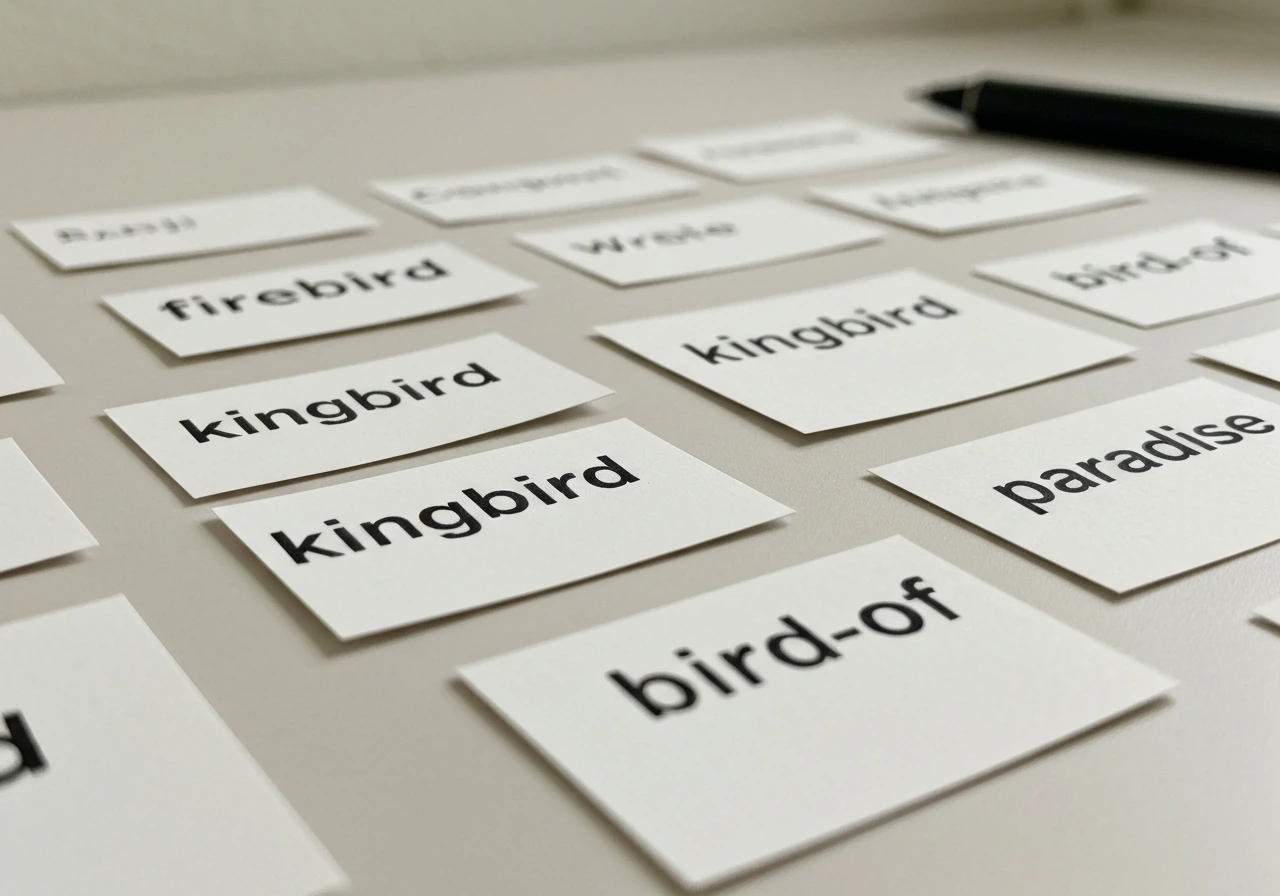
Because 'bird' became the generic category noun, it naturally became the building block for hundreds of compound names. Researchers analyzing the roughly 10,900 English common names in the eBird/Clements checklist found that bird names typically pair a generic label with descriptors covering physical traits, behavior, geography, or cultural references. 'Bird' itself shows up explicitly in compound names where the speaker wants to signal the category before adding the modifier that narrows it down.
Consider a few examples. 'Firebird' adds a color/element modifier ('fire,' for bright red-orange plumage) to the root 'bird.' 'Bird of paradise' uses a prepositional phrase as a modifier to describe the species' spectacular appearance. 'Thunderbird' and 'hummingbird' follow the same pattern. In each case, 'bird' is the anchor, the word that tells you what category of living thing you're dealing with, while the modifier does the work of narrowing to a particular species or group.
This contrasts with the older Germanic naming strategy, where 'fowl' (from 'fugol') still dominates some domains. Waterfowl, wildfowl, and poultry all use the 'fowl' root because those groups were labeled before 'bird' took over as the generic term. You can think of them as lexical fossils, preserved compound forms that reflect the earlier naming era when 'fugol' was the default word for any feathered creature.
| Term | Root | Era of dominance | Typical modern usage |
|---|---|---|---|
| bird | OE bridd (nestling) | Middle English onward | Generic term for all feathered vertebrates |
| fowl | OE fugol (any bird) | Old English | Now restricted to domesticated/game birds, waterfowl |
| firebird | fire + bird | Modern English | Compound: descriptor + generic category label |
| bird of paradise | bird + modifier phrase | Modern English | Compound: generic label + geographic/cultural modifier |
The naming conventions are also worth knowing if you're interested in why some bird names get capitalized and others don't. Style guides like the MLA recommend capitalizing formal English bird names (as in 'American Robin' versus 'a robin'), reflecting the distinction between a specific standardized name and a casual common-noun use. The root 'bird' itself, as a generic category, is never capitalized in standard usage. It's just a common noun doing its job.
Practical takeaways: how to look up and verify bird-name word origins
If you want to verify any bird-name etymology, including 'bird' itself, here are the sources worth trusting and how to use them. These are the same sources linguists and ornithologists actually use, and most are free.
- Etymonline (etymonline.com): The Online Etymology Dictionary is the best free starting point for any English word origin. It sources from the OED and other scholarly references, flags uncertain origins clearly, and gives you dated first attestations. Search 'bird' and you'll get the Old English 'bridd' entry in about 10 seconds.
- Merriam-Webster (merriam-webster.com): For a quick, authoritative definition that also notes historical forms. The entry for 'bird' explicitly lists Middle English 'brid/bird' from Old English 'bridd' and flags the archaic 'young of a feathered vertebrate' meaning.
- Middle English Dictionary, University of Michigan (quod.lib.umich.edu/m/middle-english-dictionary): This is the specialist resource for Middle English. If you want to know exactly when and how 'brid' vs 'bird' appeared in written documents, this is where to look. Free and searchable online.
- Wiktionary etymology sections: Not always the most complete, but Wiktionary's etymology sections follow scholarly consensus and trace the Old English and Proto-Germanic lineage clearly. Good for a fast sanity check.
- Oxford English Dictionary (oed.com): The gold standard, though it requires a subscription or library access. The OED gives full historical quotations showing how a word was used in context across centuries. If you're serious about a word's history, this is the definitive source.
- For scientific names specifically: the Animal Diversity Web (animaldiversity.org) and the BTO (bto.org) both explain how binomial nomenclature works and why common names differ from scientific names, which matters when researching species names rather than everyday English words.
A practical tip: when you read an etymology entry, always note whether the source distinguishes between a word's first written attestation and when it likely came into spoken use. 'Bird' is a good example where the spelling 'bird' wasn't reliably documented until 1419, but the word and its ancestor 'bridd' were clearly in use much earlier. Written records lag behind spoken language, and the oldest surviving texts don't capture everything. That gap matters when you're comparing dates across different word histories.
The bigger takeaway is this: 'bird' is one of those words where the etymology is both clear (Old English 'bridd,' nestling) and genuinely mysterious (ultimate pre-Old-English origin unknown). That's not a failure of scholarship. It means the word is old enough and isolated enough that the trail goes cold before it reaches a reconstructable Proto-Germanic or Proto-Indo-European root. When you see 'origin uncertain' in a reputable source, that's honesty, not laziness, and it's a useful reminder that not every word has a satisfying ancestor.
FAQ
Is “bird” related to “brood” or “breed,” or is that just a myth?
It is not a reliable connection. The folk idea links “bird” to nesting and “brood/breed,” but major reference works have treated that proposed relationship as inadmissible. A better way to remember the genuine history is the Old English ancestor “bridd,” which means a nestling or young bird, before it widened.
If “bird” is uncertain at the earliest stage, does that mean the whole etymology is uncertain?
No. The uncertainty is only at the ultimate origin before Old English. The documented chain from Modern English back through Middle English to Old English “bridd” is well supported by attested forms, while the deeper Proto-stage root is where linguists say the evidence stops.
Why do etymology sites sometimes list slightly different intermediate forms, like “brid” versus “bird”?
Because “brid” and “bird” reflect spelling conventions that changed during the Middle English to Early Modern transition. You may see different spellings depending on which century a source emphasizes and how it normalizes older manuscripts, so it helps to compare the attested date ranges rather than a single printed form.
Did “bird” mean “young bird” for a long time, and when did it become the generic word for all birds?
The broadening happened gradually over centuries. Sources describe a period when the word still had the “nestling/chick” sense while also covering birds in general. The timing varies by document type, so the safest approach is to treat “bridd” as starting narrow and then widening, not instantly flipping to the modern generic meaning.
Why does English have both “bird” and “fowl” when they both refer to birds?
They ended up diverging in usage. “Bird” became the default generic term as “bridd” broadened, while “fowl” stayed more tied to contexts like poultry, game, or category labels that preserve older “fugol” family naming. That is why modern compounds like “waterfowl” often use “fowl” instead of “bird.”
What’s the difference between the etymology of “bird” and the question “where does the name Bird come from”?
“Bird” in etymology usually means the common noun for the animal category. A “name” version could refer to a person’s nickname or surname, which may have different origins, such as an occupational reference, a nickname based on traits, or adoption from the common noun. Treat these as separate questions with different evidence.
When I see “bird” used to mean a woman in slang, is that the same history as the animal word?
They are connected to the older “young creature” sense of “bridd/brid” and later figurative uses. However, slang development is its own track, so exact dating and regional usage can differ from the animal-word timeline. If you care about the slang specifically, you need a source that focuses on that social usage rather than only the animal etymology.
Is “bird” ever used as a scientific name in ornithology?
No. In ornithology, “bird” is a common-name root and does not function as a Latin binomial or taxonomic scientific name. Scientific names use a separate system, for example a binomial species label, while “bird” remains a category word in everyday English.
Does the word “bird” ever get capitalized in ordinary English?
The generic word “bird” stays lowercase. Capitalization usually appears only when it is part of a standardized common name label (for example, “American Robin”), where style guides treat the full phrase as a proper-name-like unit. Capitalizing “bird” alone in running text is generally incorrect.
How can I verify an etymology claim without getting misled by publication dates or spelling?
Check whether the source distinguishes first written attestation from likely spoken use, and look at a date range rather than a single year. “Bird” is a good example because the “bird” spelling is not always reliably documented until later, even though the word’s ancestor was in use earlier.
Next Articles

Is There a Poet Named Bird? How to Verify and Disambiguate
Find if a poet named Bird exists: verify surname vs pen name, disambiguate sources, and confirm identities.

What Rhymes With Bird: Perfect and Slant Options
Perfect and slant rhymes for bird, plus tips to pick best options for poems and sample line testing.
Good Names for a Dodo Bird: Ideas and How to Pick
Cute, funny and elegant dodo bird names plus how to pick one, with language meanings for flightless island vibes.