A young bird is most commonly called a chick, and that single word covers everything from a newly hatched sparrow to a baby ostrich. If you need more precision, ornithologists and field guides use a chain of lifecycle terms: hatchling, nestling, fledgling, and juvenile, each describing a different developmental stage. On top of that, many species have their own dedicated names, so a young swan is a cygnet, a young turkey is a poult, and a young goose is a gosling. Read on and you will have every term you need, properly defined and spelled out with pronunciation notes.
Young One of Bird Is Called: Names for Baby Birds
Maya Castellanos
13 Aug 2026
The lifecycle in order: from egg to juvenile
Understanding when each term applies stops you from calling a fully feathered fledgling a 'hatchling' and getting corrected by every birder in the room. The Cornell Lab of Ornithology and the USGS both use standardized stage definitions, and they line up neatly with what most field guides describe.
| Stage | Term | Key signs | Typical timing (small songbirds) |
|---|---|---|---|
| 1 | Egg | Shell intact, incubating | Varies by species |
| 2 | Hatchling | Newly emerged; eyes often closed, little or no down | Day 0–3 after hatching |
| 3 | Nestling | In the nest, being brooded and fed; growing pin feathers | Roughly day 3–12 |
| 4 | Fledgling | Left or nearly left the nest; mostly feathered, still receives parental care | Around day 12–14 onward |
| 5 | Juvenile / Subadult | Independent of parents; not yet sexually mature; may show juvenile plumage | Weeks to months post-fledge |
A hatchling is the bird at the moment of emergence, often wet, helpless, and almost alien-looking. A nestling is technically defined as any young bird that has not abandoned the nest, so it cannot readily leave and still depends on its parents for warmth and food. The fledgling stage is where things get interesting, and where most people panic when they find a bird on the ground. A fledgling is not necessarily flying yet; it is simply post-nest. It may hop around on the ground, look a bit scraggly, and shriek for food, but its parents are almost certainly nearby. Wildlife rehabilitators make this distinction constantly because a fledgling on the ground usually does not need rescuing, while a nestling on the ground often does.
Timing varies enormously across species. Most small altricial songbirds like robins or sparrows fledge roughly 10 to 14 days after hatching. Barn owl chicks, by contrast, stay in the nest for around 50 to 55 days, and peregrine falcon chicks fledge at 35 to 42 days. Large raptors and seabirds can take months. That variability is why ornithologists lean on stage definitions rather than specific day counts when writing about development.
'Chick' as the general-purpose term
If you need one word that any English speaker will immediately understand, chick is it. Merriam-Webster lists chick both as a specific term for a young chicken and in the broader sense of any young bird. In everyday conversation, casual writing, and children's books, chick does most of the heavy lifting. You will hear wildlife rehabilitators say 'I have a chick here' even when the bird is a baby jay or a young kestrel.
The main exception is when you are talking about a species that has a well-established dedicated name. Saying 'duck chick' instead of 'duckling' sounds awkward to any fluent speaker, and no one calls a baby swan a 'swan chick' when the word cygnet exists. As a rule of thumb: if a species-specific name exists and is widely known, use it. Otherwise, chick works perfectly well.
Species-specific names at a glance
English has accumulated a surprisingly rich vocabulary of young-animal names, and birds are well represented. Some of these, like gosling and duckling, you have known since childhood. Others, like eyas or keet, feel almost like a secret code. Here is the full working list, with pronunciation notes in parentheses.
| Bird species | Young bird called | Adult male / Adult female notes |
|---|---|---|
| Chicken (domestic) | Chick / Pullet (young female) | Rooster or cock (male); hen (female) |
| Duck | Duckling | Drake (adult male); duck (adult female) |
| Goose | Gosling | Gander (adult male); goose (adult female) |
| Swan | Cygnet | Cob (adult male); pen (adult female) |
| Turkey | Poult | Tom or gobbler (adult male); hen (adult female) |
| Eagle | Eaglet | No sex-specific common name in general use |
| Owl | Owlet | No sex-specific common name in general use |
| Pigeon / Dove | Squab | Cock (male); hen (female) |
| Hawk / Falcon (falconry) | Eyas | Tiercel (male); falcon (female, especially in falconry) |
| Guinea fowl | Keet | Cock (male); hen (female) |
| Peacock (Peafowl) | Peachick | Peacock (male); peahen (female) |
| Penguin | Chick | No widely used sex-specific common name |
| Flamingo | Chick | No widely used sex-specific common name |
A quick note on eyas: this is primarily a falconry term for an unfledged nestling hawk or falcon, especially one taken from the nest for training. It appears in Shakespeare ('I would have thee gone, and yet no further than a wanton's bird... an eyas-musket') and shows up in crossword puzzles with pleasing regularity. The plural is eyases, and the pronunciation is EYE-us. If you are writing about raptors outside a falconry context, chick or nestling works just as well.
Farm and domestic bird vocabulary
If you spend any time around poultry farms or keeping backyard chickens, you quickly realize that the vocabulary around domestic birds is extremely specific about age and sex. Getting these terms right matters practically, not just linguistically.
- Chick: any very young domestic chicken, male or female, before sex can be easily determined
- Pullet: a young female chicken that has not yet begun laying eggs, typically under 20 to 22 weeks old. Pullet farms specifically raise these birds to point-of-lay before transferring them to layer or breeder operations.
- Cockerel: a young male chicken, roughly under one year old. Once he passes that threshold, he becomes a cock or rooster.
- Rooster / Cock: an adult male chicken. 'Rooster' is the preferred American English term; 'cock' is standard in British English and most of the rest of the world.
- Poult: a young turkey or, less commonly, a young gamebird such as a pheasant or partridge.
- Tom / Gobbler: an adult male turkey.
- Duckling: a young duck of either sex.
- Drake: an adult male duck. The transition from 'duckling' to 'drake' happens once the bird reaches sexual maturity and the male develops his characteristic plumage.
- Gosling: a young goose of either sex.
- Gander: an adult male goose.
The word pullet, incidentally, has a lovely etymology. It comes from Old French poulet, itself a diminutive of poule meaning 'hen,' and ultimately from Latin pullus, meaning 'young animal.' That same Latin root gives us poult, and it also lurks in the word 'poultry' itself. So every time you say 'poultry,' you are etymologically saying 'young-animal-ry,' which is both charming and slightly absurd.
Male, female, and age: when the same word shifts meaning
One thing that trips up language learners in particular is that the same bird gets different names depending on its age and sex combined. A duckling grows into either a duck (female) or a drake (male). A gosling grows into either a goose (female) or a gander (male). A poult grows into either a turkey hen or a tom. The young-bird name is sex-neutral in almost every case, which is handy: you do not need to know the sex of a cygnet to call it a cygnet.
The exception is the pullet, which is already gendered: it specifically means a young female chicken. A young male chicken is a cockerel, not a pullet. This distinction matters on commercial farms, where pullets and cockerels are sorted at hatch, and it matters if you are writing accurately about poultry.
Where birds live: habitat and home vocabulary
Knowing what young birds are called naturally leads to wondering where they spend those early weeks. A surprising number of distinct English words describe the places birds inhabit or use, and readers curious about bird nomenclature tend to bump into all of them eventually.
| Term | Definition | Typical context |
|---|---|---|
| Nest | A structure built or used by birds to lay eggs and raise young | Applies to almost all bird species; materials and structure vary enormously |
| Roost | A place where birds rest or sleep; also the act of resting there | Used for both wild birds (tree roosts) and domestic birds (perches in a coop) |
| Coop | An enclosed structure for keeping domestic poultry | Chickens, ducks, and similar farm birds |
| Aviary | A large enclosure allowing captive birds to fly within it | Zoos, bird sanctuaries, serious hobbyist setups |
| Dovecote / Dovecot | A purpose-built structure for housing domesticated pigeons or doves | Historical farms and estates; still used by pigeon fanciers |
| Rookery | A colony nesting site used by rooks or other colonial breeders; also used for penguin or seal colonies | Corvids, herons, seabirds, and some marine mammals |
If you want to explore the full range of places birds live and what each is properly called, that topic has its own dedicated coverage elsewhere on this site where the terminology goes into much greater depth. For a full glossary of terms for where a bird lives is called, see the site's dedicated page on habitat and home vocabulary.
Pronunciation and etymology for the terms readers always stumble over
Most of the common terms are phonetically transparent. 'Chick,' 'duckling,' 'gosling,' and 'eaglet' all read more or less as they sound. A few terms deserve special attention.
- Cygnet: pronounced SIG-net (the 'c' is silent, like in 'cyst'). From Old French cigne, meaning swan, itself from Latin cycnus and Greek kyknos. The diminutive suffix '-et' makes it literally 'little swan.'
- Poult: rhymes with 'colt,' so it is POHLT. From Old French poulet via Latin pullus. Used for young turkeys, pheasants, and other gamebirds.
- Eyas: EYE-us. A falconry term from Old French niais, meaning nestling bird, which was originally ni-as ('from the nest'). An early misdivision of the phrase 'a nias' as 'an eyas' gave us the modern spelling.
- Squab: SKWOB. A young, unfledged pigeon, particularly one raised for eating. The word's origin is uncertain but may relate to a Scandinavian root meaning 'soft' or 'loose-fleshed.'
- Fledgling: FLEJ-ling. From the Old English 'flycge,' meaning feathered and capable of flight. The '-ling' suffix is a diminutive, so it means roughly 'a little fledged one.'
- Owlet: OWL-et. Simply owl plus the diminutive suffix '-et,' on the same pattern as eaglet (eagle + -et) and cygnet (cigne + -et).
- Gosling: GOZ-ling. From Middle English gos (goose) plus the diminutive '-ling.' Shares that suffix with 'duckling' and 'fledgling.'
Practical tips for naming a pet bird
If you have arrived here because you have a new bird at home and you want to name it well, welcome to my favorite corner of avian vocabulary. Naming a pet bird is genuinely fun, and there are a few practical principles that make the process smoother. The site's dedicated pages on naming conventions and pet bird nomenclature go much deeper, but here is a solid starting checklist.
- Choose a name with one or two syllables. Birds respond better to sharp, distinct sounds. 'Pip,' 'Kiwi,' 'Coco,' or 'Sage' work better than 'Bartholomew.'
- Avoid names that rhyme with common commands. 'Joe' sounds too much like 'no,' which causes endless confusion during training.
- Consider the bird's species vocabulary. Naming a swan 'Cygnet' is either delightfully nerdy or confusing depending on your household; naming a baby pigeon 'Squab' is technically accurate but sounds like a meal.
- If your bird is still a chick or fledgling and you do not yet know the sex, pick a name that works for either, or wait. Many parrots and cockatiels cannot be reliably sexed by appearance alone.
- Check cultural and linguistic resonance. Names borrowed from other languages often have meanings that are either charming or accidentally unfortunate. The site's etymology section is a useful sanity check.
- Repeat the name consistently from day one. Birds associate sound patterns with context, so the sooner you establish the name, the faster it takes hold.
Suggested image for this article
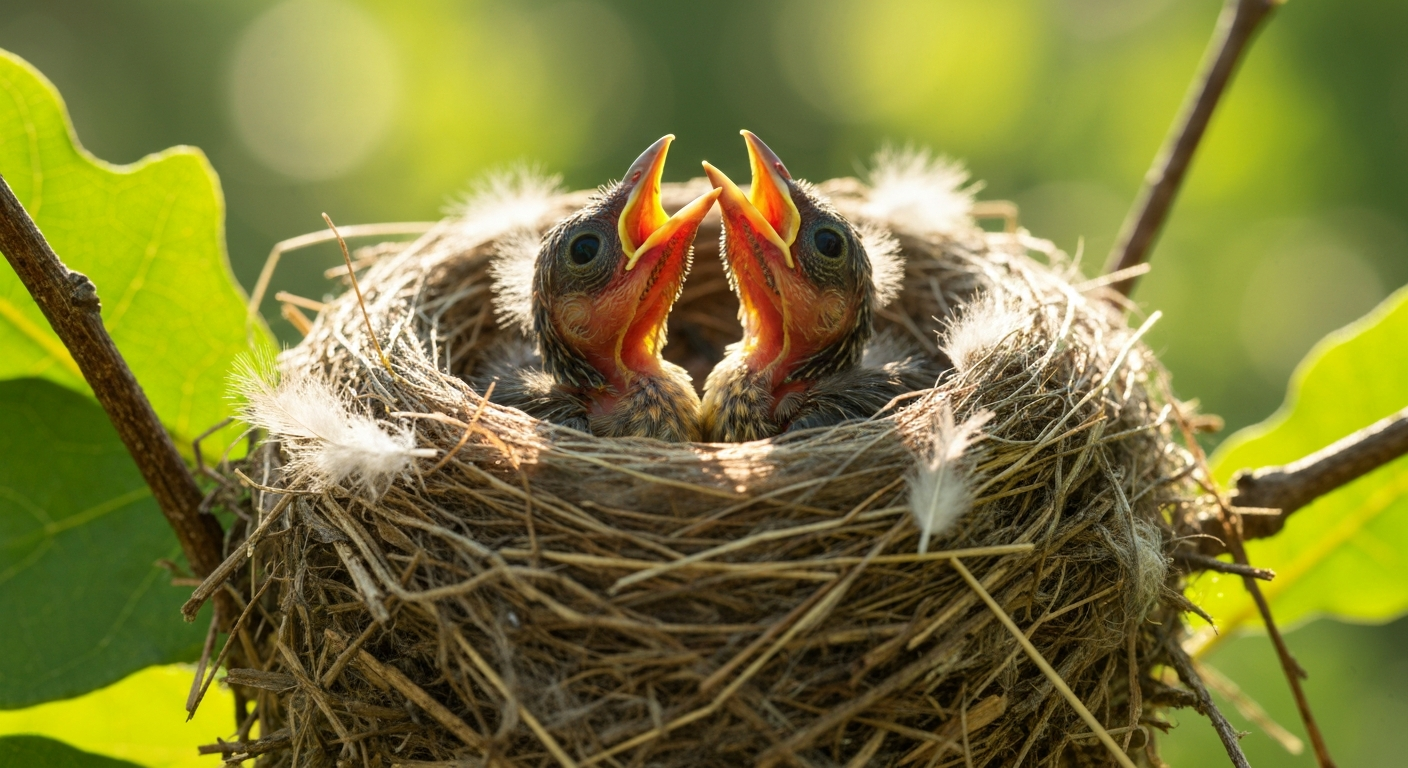
A close-up photograph of a nest containing two or three nestlings with open beaks, surrounded by natural nesting materials, works perfectly as the hero image for this article. Recommended alt text: 'Nestlings in a bird nest with open beaks, showing the early nestling stage of young bird development.' Suggested caption: 'Nestlings in a backyard nest: open-beaked, helpless, and entirely dependent on parental feeding. At this stage they are technically nestlings, not fledglings.' Source from Wikimedia Commons using a public domain or Creative Commons-licensed image, and include the required attribution (photographer name, license, and source URL) in the caption credit line. See Marking your work with a CC license, Creative Commons wiki (attribution best practices) for the standard attribution conventions to follow when crediting Creative Commons–licensed images Marking your work with a CC license — Creative Commons wiki (attribution best practices).
How this fits with other bird naming topics on this site
The vocabulary around young birds connects naturally to several other naming threads worth exploring. The specific terms for farm birds, including what a domestic bird is called and the correct names for adult male farm birds like roosters, drakes, and toms, build directly on what you have just read here. For more on this, see the page that explains what a male domestic bird is called and lists terms like rooster, drake, and tom. For detailed names and roles, see the guide on what a farm bird is called. If you are curious about birds by setting rather than age, the topic of what farm birds are specifically called rounds out the domestic poultry picture nicely. And the companion article on young bird names in English covers the broader linguistic patterns, including how other languages handle these diminutive terms, which is genuinely interesting if you are a language learner or work in translation.
Quick-reference recap: the names you need to remember
The general English term for a young bird is chick, but ornithology gives you a full lifecycle chain: hatchling (just hatched), nestling (in the nest), fledgling (post-nest, still dependent), and juvenile (independent but not yet mature). Individual species have dedicated names that are both more precise and more poetic, from the elegant cygnet and the Old French-rooted poult to the falconry-flavored eyas. Farm vocabulary adds age-and-sex distinctions like pullet, cockerel, and drake that matter practically on any working farm or backyard coop.
- Young bird (general): chick
- Lifecycle stages in order: hatchling, nestling, fledgling, juvenile
- Young chicken (female): pullet
- Young chicken (male): cockerel
- Young duck: duckling
- Young goose: gosling
- Young swan: cygnet (SIG-net)
- Young turkey or gamebird: poult (POHLT)
- Young eagle: eaglet
- Young owl: owlet
- Young pigeon (unfledged): squab
- Young hawk or falcon (falconry): eyas (EYE-us)
- Young guinea fowl: keet
- Young peafowl: peachick
- Adult male duck: drake
- Adult male goose: gander
- Adult male turkey: tom or gobbler
- Adult male chicken: rooster (American English) or cock (British English)
FAQ
What is a concise, SEO-friendly title and meta description for this article?
Title: What a Young Bird Is Called: Chick, Hatchling, Fledgling and Species Names Meta description: Clear guide to what baby birds are called—chick, hatchling, nestling, fledgling, plus species names and habitat terms.
Quick answer: What is the general English term for a young bird?
Quick answer: The short, reader-friendly common term is “chick.” Dictionaries and everyday usage use chick as a general label for baby birds (and specifically for young chickens). For precision, ornithologists use lifecycle-stage and species-specific names (hatchling, nestling, fledgling, poult, gosling, cygnet, etc.).
What are the standard lifecycle stages (egg → fledging) and their meanings?
Lifecycle stages (common outreach/field-guide usage): - Egg: embryo developing inside the shelled egg before hatching. - Hatchling: newly emerged from the egg; often naked or sparsely downed and fully dependent. - Nestling: still confined to and fed within the nest; cannot readily leave the nest. - Fledgling: recently left or left the nest but still dependent on parental care; has flight feathers or is learning to fly. - Juvenile / subadult: post‑fledging bird that is not yet sexually mature; plumage may differ from adults. Notes: Wildlife guidance distinguishes nestling (in‑nest) from fledgling (post‑nest); fledging age varies widely by species.
How can I tell the practical difference between a nestling and a fledgling?
Practical distinction used by wildlife professionals: - Nestling: remains in the nest, usually brooded and fed by parents, cannot move far or fly. - Fledgling: has more developed feathers, may be on branch or ground near nest, is learning to fly and still receives parental care. This distinction matters for decisions about ‘found baby bird’ interventions (Cornell All About Birds guidance).
What are common species-specific names for young birds (compact table)?
Species-specific names (common usage): - General: chick (any young bird in casual speech; especially chicken) - Chicken: chick (female immature chicken called pullet; male immature cockerel) - Duck: duckling (male/ female duckling both called ducklings; adult male = drake) - Goose: gosling (adult male = gander) - Swan: cygnet - Turkey: poult - Pigeon/dove: squab (young pigeon) - Quail/guinea fowl: chick / keet (guinea fowl keet) - Eagle: eaglet - Owl: owlet - Hawk/falcon (traditional/falconry): eyas (unfledged nestling) - Other gamebirds: poult (used for some grouse/ptarmigan) Notes: “pullet” specifically means a young female chicken (sex/age class); “poult” denotes a young turkey or similar gamebird. For ducks, ‘duckling’ applies to both sexes; ‘drake’ is the adult male.
What farm and domestic bird vocabulary should readers know (adult and young terms)?
Farm/domestic terms: - Chicken: rooster or cock (adult male), hen (adult female), cockerel (young male), pullet (young female), chick (young) - Duck: drake (adult male), duck (adult female), duckling (young) - Goose: gander (adult male), goose (adult female), gosling (young) - Turkey: tom (adult male), hen (adult female), poult (young) - Pigeon: cock/pigeon (male), hen (female), squab (young) Practical note: Poultry industry usage distinguishes pullet (rearing class for egg producers) and broiler/breeder terminology; extension literature uses these terms precisely.