
If you searched 'name meaning little bird,' there is a good chance you are thinking about one of a handful of specific names: Birdie (English), Zipporah or Tzipora (Hebrew), or less commonly Birdette (English elaboration) or Ptáček (Czech surname). Each of these lands on 'little bird' through a slightly different linguistic route, and which one applies to you depends entirely on the exact spelling, origin, and language family you are working with. Here is how to sort it out quickly.
Name Meaning Little Bird: Meanings, Origins, and How to Verify

Maya Castellanos
22 Mar 2026
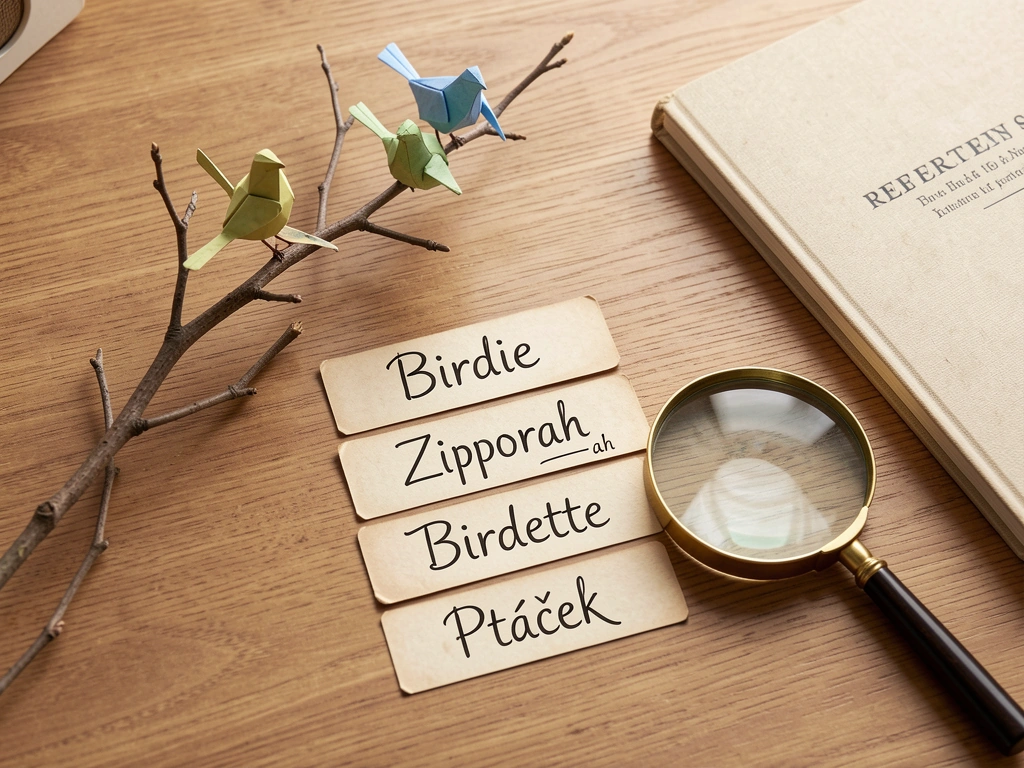
What 'little bird' could mean (and which names it usually points to)
The phrase 'little bird' in a name context almost always points to one of two things: a diminutive form built on a word for 'bird' (where the 'little' part comes from a suffix or from the diminutive register of the name), or a root word that already means something like 'small bird' or 'sparrow' in its original language. The most common candidates people are actually asking about are listed below, with a one-line summary of why each fits.
- Birdie: English pet-form of 'bird,' used as a given name with an affectionate, childlike 'little bird' feel.
- Zipporah / Tzipora / Tzipporah: Hebrew name (צִפּוֹרָה) rooted in the word tsippor, meaning 'bird' or 'little bird/sparrow.' This is Moses's wife in the Bible.
- Birdette: An English elaboration of 'bird' with a diminutive suffix, effectively spelling out 'little bird' structurally.
- Zippor: The masculine Hebrew form, meaning 'bird' or 'sparrow,' used as a biblical proper name.
- Ptáček: A Czech surname built from pták ('bird') plus a diminutive suffix, literally meaning 'little bird' or 'birdie.'
Of these, Zipporah is by far the most searched and the most historically documented. Birdie is the most commonly used as an actual given name in English-speaking contexts. If neither of those matches the name you have in mind, read on, because the meaning can shift a lot depending on language and spelling.
Language breakdown: bird + 'little/small' name meanings across cultures
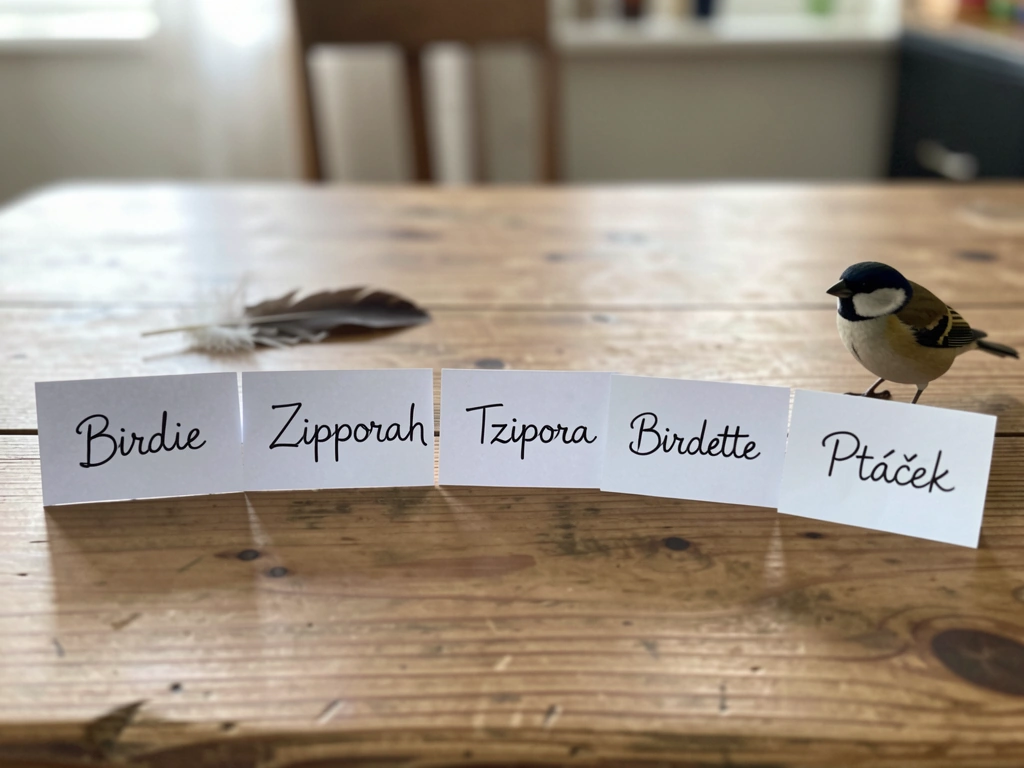
Names meaning 'little bird' or 'small bird' show up across multiple language families, and the word for 'bird' in each language is different enough that you would never guess the connection without knowing the source. Here is how the major candidates break down by culture and language.
| Name | Language/Origin | Literal Meaning | Notes |
|---|---|---|---|
| Birdie | English | Little bird / dear bird | Diminutive pet-form; used as a given name since the 19th century |
| Zipporah / Tzipora | Hebrew | Bird / little bird / sparrow | From tsippor (צִפּוֹר); biblical name, wife of Moses |
| Zippor | Hebrew | Bird / sparrow | Masculine form; father of Balak in the Bible |
| Birdette | English | Little bird | Elaborated form with diminutive suffix; rare as a given name |
| Ptáček | Czech | Little bird / birdie | Surname; pták + diminutive suffix; feminine form is Ptáčková |
| Bird | Old English | Young bird | From Old English 'brid'; occasionally used as a given name |
The Hebrew names are the richest in terms of documentation. Strong's Concordance glosses tsippor (צִפּוֹר) as 'bird, sparrow,' and adds the note 'a little bird (as hopping),' which is why so many baby-name sites translate Zipporah as 'little bird' specifically rather than just 'bird.' That nuance comes directly from the Hebrew root's connotation, not from marketers inventing a prettier meaning. The Czech and English cases are more straightforward: both use diminutive morphology to signal smallness.
It is also worth knowing that 'little bird' names sometimes overlap with names meaning dove, swallow, or sparrow, since those are all small birds and the root words often blur together in translation. If you are researching names in this broader territory, names meaning 'bird' more generally (like Ava, which some trace to a Latin root meaning 'bird') or names meaning a specific bird species are worth exploring separately.
Etymology explained in plain English (roots, nicknames, and variants)
Birdie and Bird
The Old English word 'brid' meant 'young bird' or 'chick,' and over time it shifted to 'bird' as we know it today. As a given name, Bird shows up occasionally in English records, carrying that 'young bird' sense from its Old English root. Birdie is the diminutive or pet-form of that, used affectionately the same way 'doggie' works: it is not a separate word, it is just a cuter, smaller-feeling version. The 'little' quality in Birdie comes entirely from the diminutive register and connotation, not from a different underlying root. Birdette pushes this further by adding a formal diminutive suffix (-ette), making the 'little bird' meaning structurally explicit.
Zipporah, Tzipora, and related Hebrew forms
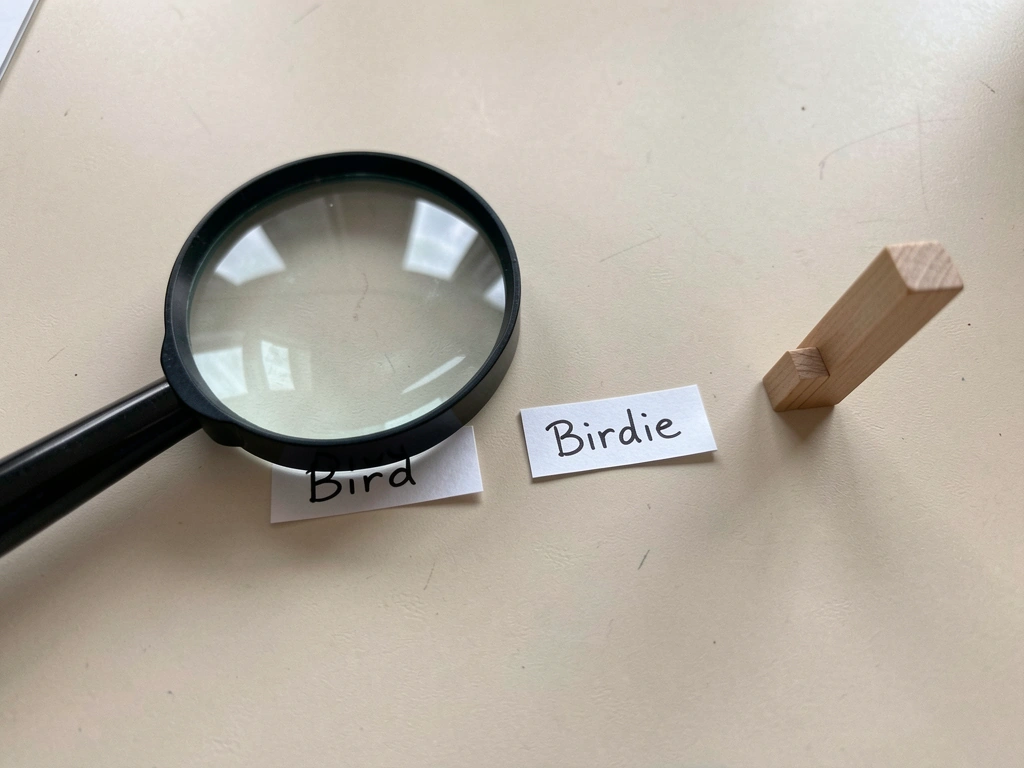
The Hebrew root here is צ-פ-ר (ts-p-r), which gives both the verb 'to chirp or twitter' and the noun tsippor (צִפּוֹר), meaning 'bird' or more specifically 'small bird, sparrow.' Zipporah (צִפּוֹרָה) is the feminine form, adding the Hebrew feminine ending -ah. The name appears in Exodus as Moses's wife, which gives it a very clear historical anchor: if someone asks you to verify this name's origin, you can point directly to Exodus 2:21 and Strong's number H6855. The variant spellings (Zipporah, Tzipora, Tzipporah, Tsipporah) all represent the same Hebrew name, just transliterated differently into English. The core meaning does not change across those spellings.
Ptáček (Czech)
In Czech, pták means 'bird,' and ptáček is its diminutive, meaning 'little bird' or 'birdie. Wiktionary describes ptáček as the diminutive of pták, glossing it as “birdie” or “birdling,” which matches the “little bird” meaning from Czech diminutive formation ptáček as the diminutive of pták, meaning “little bird”. ' The suffix -áček is a standard Czech diminutive marker, the same way -ette works in French-influenced English. As a surname, Ptáček is fairly common in the Czech Republic, and the feminine variant Ptáčková follows standard Czech grammatical gender rules for surnames. If you are researching this name, the diacritical marks matter: 'Ptacek' without the háček (the accent over the a and c) is just an anglicized spelling for use in countries where those characters are not standard, but etymologically it is the same name.
How to verify the meaning for your exact name (spelling, origin, pronunciation)
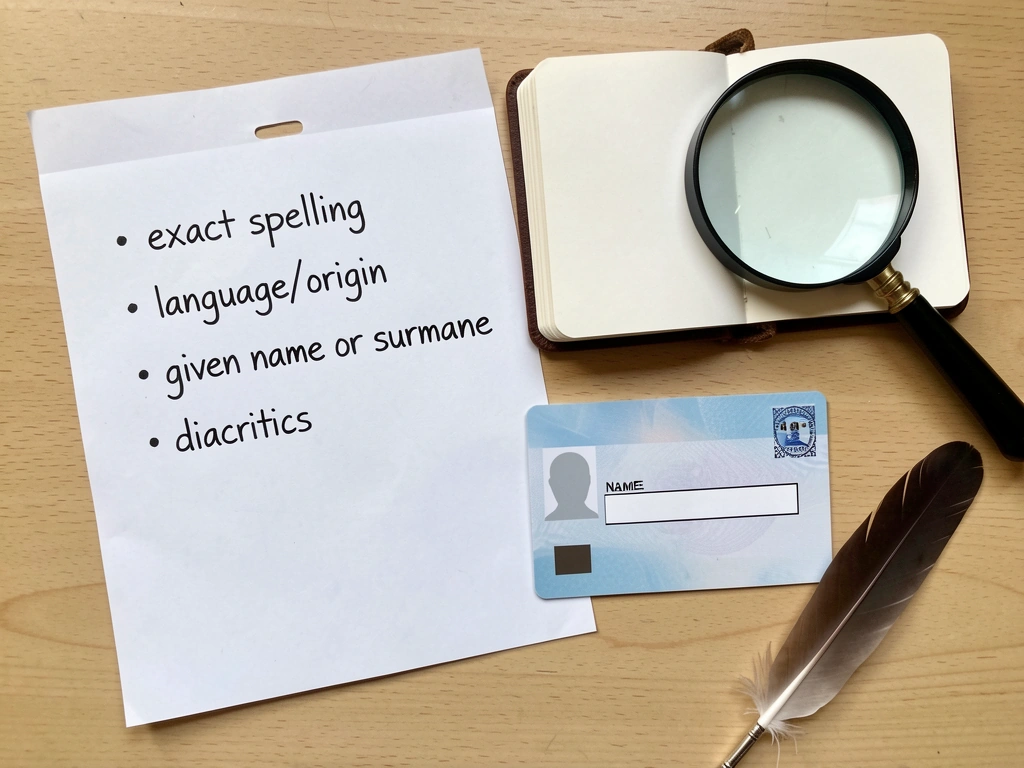
The single most important thing you can do to verify a name's meaning is pin down the exact spelling and the language of origin before you search. The same string of letters can come from completely different roots depending on whether the name is Hebrew, Greek, Old English, or Czech. Here is a quick checklist to work through.
- Get the exact spelling, including any accent marks, diacriticals, or alternate characters (like the č in Ptáček or the final -ah in Zipporah).
- Identify the language or cultural origin. Ask the person who gave you the name, check a birth certificate, or look at the family's documented heritage.
- Look up the name on Behind the Name (behindthename.com), which provides sourced etymology rather than marketing copy. For biblical names, cross-reference with Strong's Concordance.
- Check if the name is a nickname or pet-form of another name. Birdie, for example, is not a standalone ancient name; it is a diminutive, which means its meaning is tied to 'bird' rather than to any separate root.
- If the name has a known literary, scriptural, or historical bearer, look up that person. Zipporah in Exodus is a faster and more reliable anchor than any baby-name website.
- For surnames used as first names (like Bird or Ptáček), check surname etymology databases separately, since surname origins often differ from given-name origins.
Pronunciation can also be a clue. If a name is pronounced with a 'ts' sound at the start (like 'Tsip-POR-ah'), that is a strong indicator of a Hebrew transliteration, which will point you toward the tsippor root. If it sounds fully anglicized (like 'ZIP-or-ah'), you are dealing with the English rendering of the same Hebrew name, and the meaning is unchanged.
Common confusion: baby-name site meanings vs true etymology
This is where things get messy fast. Baby-name websites have a well-documented habit of simplifying, romanticizing, or just plain inventing the 'meaning' of a name to make it more marketable. 'Little bird' is a particularly common landing point because it sounds sweet and poetic, so sites sometimes apply it to names where the connection is thin or outright wrong. Here are the specific confusion points I see most often.
- Zipporah listed as 'little bird' vs just 'bird': Both are technically defensible. The Hebrew tsippor does carry a connotation of small birds (sparrows, not eagles), and Strong's specifically notes 'a little bird (as hopping).' So 'little bird' is a reasonable gloss, not an invention. But if a site lists it as 'beautiful bird' or 'free bird,' that is embellishment with no etymological basis.
- Names meaning 'bird' reframed as 'little bird': Sites sometimes apply 'little bird' to names that just mean 'bird,' using the diminutive frame to make the meaning sound cuter. Check whether the 'little' component is actually in the name's structure or just in the marketing.
- Completely unrelated names assigned 'little bird': Some names get tagged as 'little bird' based on loose phonetic similarity to a bird-related word in some language. If a site cannot tell you what specific root word the meaning comes from, that is a red flag.
- Character-based meanings: If a name became popular through a TV show, book, or film character named something bird-related, baby-name sites may list the character's symbolic meaning rather than the name's actual etymology. Always check whether the site is describing a root word or a pop culture association.
- Spelling variants treated as different names: Zipporah and Tzipora are not different names with different meanings; they are the same Hebrew name with different English transliterations. A site that gives them different meanings is almost certainly wrong about at least one of them.
The reliable test is simple: a trustworthy source will tell you the root word in the original language, what that word means, and how the name is formed from it. If a site just gives you a poetic English phrase with no linguistic backing, treat it as inspiration, not fact.
Practical next steps: what to check and how to research quickly
If you are trying to confirm the meaning of a specific name right now, here is the fastest path through the research without wasting time on unreliable sources.
- Start with Behind the Name for given names. It cites sources and explains whether a name is a diminutive, a direct borrowing, a biblical name, or a modern coinage. This one step eliminates most of the confusion.
- For Hebrew or biblical names specifically, go to Blue Letter Bible or BibleHub and search the Strong's number. For Zipporah, that is H6855. You will get the original Hebrew, the transliteration, and the lexical meaning directly from the root word.
- For Czech or Slavic surnames, Wiktionary's Czech and Slovak editions often have solid diminutive breakdowns. Search the base word (pták for bird) and look for the diminutive forms listed.
- For English names like Birdie or Birdette, check both Behind the Name and a historical given-name database like JSTOR or a university linguistics department page if you want to trace actual usage dates.
- If you are researching a family name passed down through generations, ask the oldest living relative for the spelling used in the country of origin. Anglicization strips diacriticals and can make Czech, Polish, or Hungarian names look completely different from their root forms.
- Write down these four details before you search: exact spelling, language/country of origin, whether it is a given name or surname, and any story you have heard about where the name came from. These four points will cut your research time in half.
One last note: if you are choosing a baby name and want something that genuinely means 'little bird,' Zipporah and Tzipora give you the most historically grounded option, with clear biblical documentation and a well-sourced root word. BibleHub’s Exodus 2:21 entry provides the biblical anchor text for Zipporah in context, which can help you cross-check the scriptural mention blank" rel="noopener noreferrer">Zipporah (Exodus 2:21). Birdie is the most intuitive and accessible English choice. If you are also exploring names that relate to birds in a broader way, you may want to look at names meaning bird or flight as well. Names meaning bird more generally can overlap in translation, but their roots and cultural associations are often different from the diminutive “little bird” names. If you want to explore names meaning fire bird more broadly (including names meaning a specific bird like a dove or a bird of prey), those are worth looking at as a separate category, since the etymology and cultural associations can be quite different from the diminutive 'little bird' names covered here. If you are looking specifically for names meaning bird of prey, that separate category can help you find options with the right bird-of-prey root and context.
FAQ
If my name is spelled differently, can the meaning of “little bird” still be the same?
Often yes for transliteration variants, but not always. For Hebrew names like Zipporah and Tzipora, spelling changes in English usually reflect the same Hebrew letters, so the “small bird” sense stays consistent. For other names, a spelling change can indicate a different root, so always verify the original-language form, not just the English letters.
How can I tell whether “little bird” comes from a diminutive suffix versus a “small bird” root?
Check the grammar and word formation described by a real linguistic source. A diminutive-based name (like Czech ptáček or English Birdie) typically signals smallness via morphology (a pet-form suffix). A root-based name (like Hebrew tsippor) may already mean “small bird/sparrow,” and the name form can add gender or other endings without changing that core meaning.
What if the pronunciation I hear does not match the Hebrew “ts” sound?
Pronunciation can vary by accent and country, so it is a clue, not a guarantee. If the name is claimed to be Hebrew but you never see the original Hebrew spelling (צִפּוֹר, צִפּוֹרָה) in explanations, be cautious. The most reliable confirmation still comes from the documented original form and name-building rules.
Are there names that mean “little bird” but are not actually related to Birdie or Zipporah?
Yes. “Little bird” is an easy poetic translation, so unrelated bird names can get lumped together in baby-name summaries. In particular, names that truly derive from dove, swallow, or sparrow roots may overlap in meaning when translated, but they are etymologically separate. Your verification should focus on the specific original word, not the shared English theme.
Can a name meaning “bird” be confused with “little bird” on purpose?
It can, because some sources simplify “small bird” to “bird,” or they add “little” to make the meaning feel more charming. If a source does not explain whether the “little” part is a diminutive suffix or part of the original noun, treat that as incomplete and look for the original-language root or a clear name-formation explanation.
What should I do if a baby-name site gives a “little bird” meaning but I cannot find the root word?
Use a two-step filter: first, confirm the original-language spelling, second, confirm the root definition and the exact formation (diminutive ending, feminine ending, or derived noun). If either piece is missing and the explanation is only a poetic sentence, consider it inspiration rather than evidence.
Does Zipporah always mean “little bird,” or can it mean something broader like “bird”?
In Hebrew, the noun tsippor is glossed as “bird, sparrow,” with a connotation of a small bird. Many sites choose “little bird” to reflect that smallness nuance, but the underlying idea is really “bird, especially a small bird/sparrow.” So “little bird” is usually a fair translation, but it is rooted in the “small” connotation rather than a separate diminutive suffix in the name itself.
If I see “Ptáček” versus “Ptacek,” is it the same name?
Most of the time, yes. Ptáček is the diacritic form, and Ptacek is typically an anglicized or simplified spelling for places where háček marks are omitted. The meaning comes from Czech diminutive morphology, so the relationship to “little bird” stays, but you should still recognize that the diacritics matter for accurate original spelling.
What about the surname Ptáček and the feminine Ptáčková, does that change the meaning?
The core diminutive root idea stays the same because it is built on pták meaning “bird.” The feminine variant Ptáčková follows Czech grammatical gender rules rather than changing the base “little bird” etymology. So you can treat the meaning as consistent, while recognizing the grammatical ending is what changes.
If I am choosing a baby name, how should I weigh “historical documentation” versus “literal meaning”?
You can do both, but separate them mentally. A historically anchored name like Zipporah has clear biblical usage and a well-attested root, which strengthens the meaning claim. Birdie is more straightforward to use in English as a pet-form, but its “little bird” effect comes from diminutive connotation rather than a single fixed original-word definition. If your goal is exact semantic meaning, prioritize names with clearly documented root words and formation rules.