In everyday English writing, common bird names like robin, blue jay, and bald eagle are not capitalized. They are common nouns, and common nouns stay lowercase unless they start a sentence. The only exception is when a bird's name contains a proper noun or adjective, like the word 'American' in American crow or a person's name in Steller's jay. Scientific (Latin) names follow completely different rules: the genus is capitalized and italicized, the species epithet is lowercase and italicized, full stop.
Are Bird Names Capitalized? English Rules and Examples

Maya Castellanos
27 Apr 2026
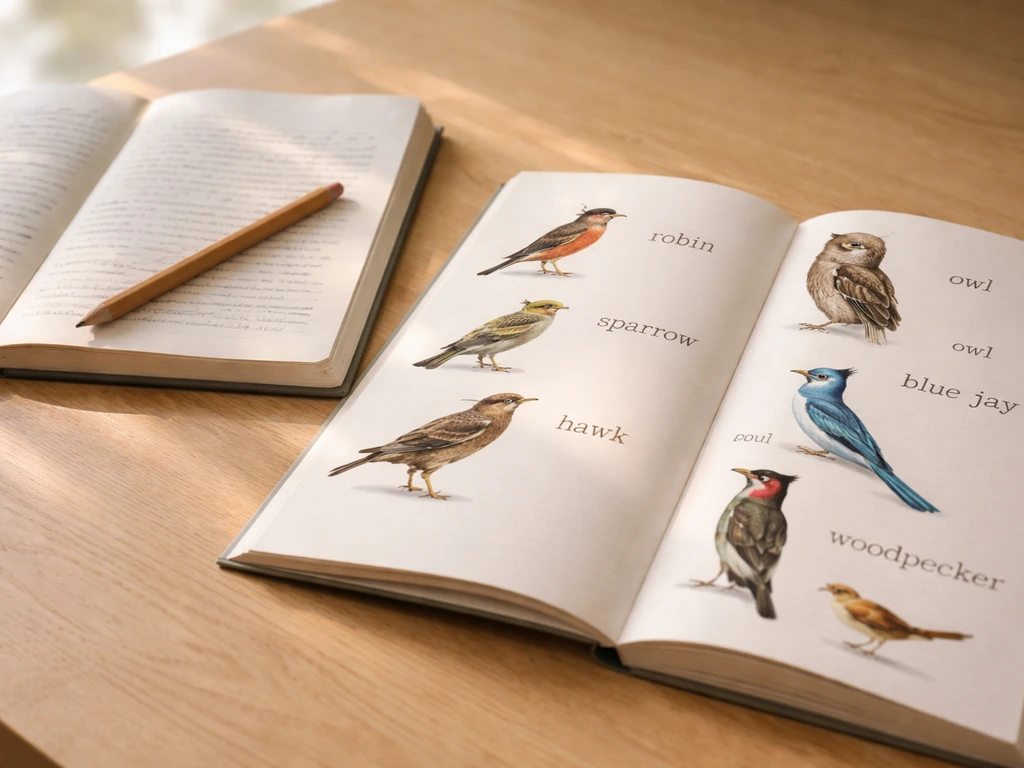
Capitalization rules for common bird names
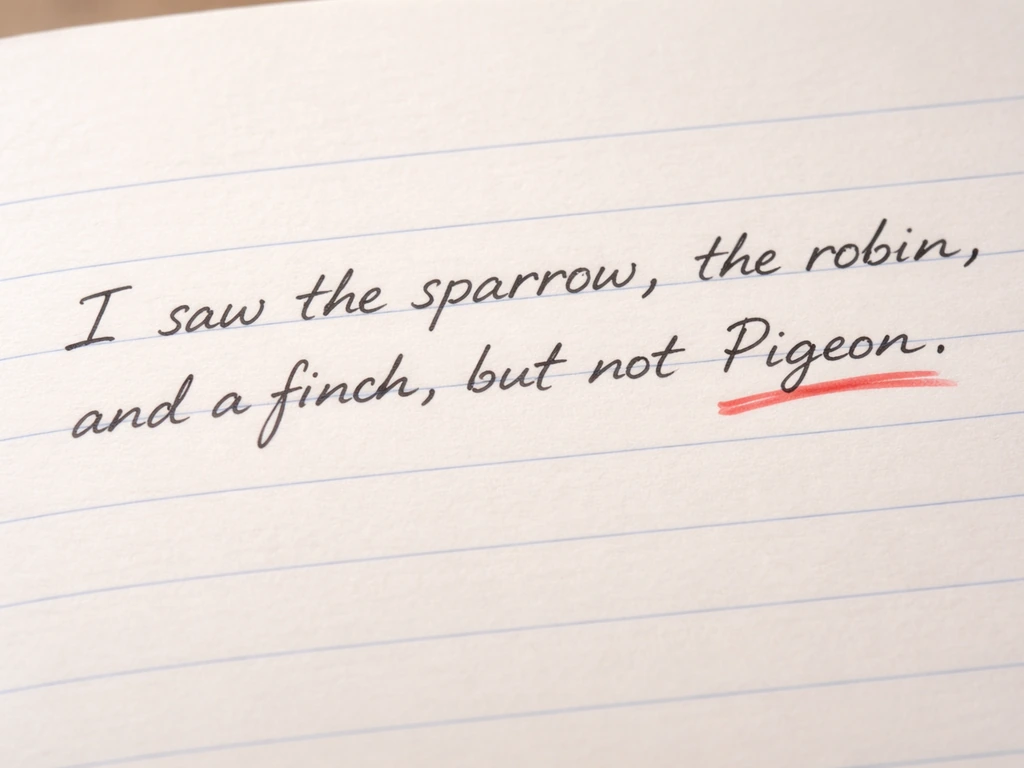
Most style guides, including Chicago and MLA, treat common bird names as ordinary common nouns. That means they go lowercase in a sentence just like 'dog,' 'tree,' or 'flower.' You would write 'I spotted a red-tailed hawk perched on the fence post' without any capital letters on 'red-tailed hawk.' Same goes for 'house sparrow,' 'barn owl,' 'common loon,' and hundreds of others. The name describes the bird; it is not a title or a proper noun.
Where it gets slightly more interesting is with names that include a proper noun or proper adjective as part of the common name. Chicago makes this explicit: capitalize only the proper-noun component, and leave the rest lowercase. So 'American crow' gets a capital A because 'American' is a proper adjective derived from a place name. 'African grey parrot' gets a capital A for the same reason. But 'crow' and 'parrot' themselves stay lowercase because they are just common nouns doing their job.
MLA adds a useful layer here by pointing out that eponymous bird names, ones named after a person, work the same way. 'Steller's jay' keeps a capital S because Georg Wilhelm Steller was a real person and his name is a proper noun. The word 'jay' does not get capitalized. This is not a special bird-world rule; it is just standard English capitalization applied consistently.
Capitalization rules for bird species vs informal bird names
There is a distinction worth drawing between a recognized, established common name and a casual informal description. An established common name like 'blue-footed booby' or 'little blue heron' is the accepted name for that species in English. Chicago still lowercases both of these in running prose, because neither contains a proper noun. An informal description like 'that big gray bird by the pond' is obviously not capitalized either, and nobody argues about that one.
Where writers get confused is with multiword species names, especially ones that feel official or formal. 'Bald eagle' feels like it should be capitalized because the bald eagle is the national bird of the United States and appears on official seals and flags. But in ordinary prose, 'bald eagle' is still lowercase. 'We watched a bald eagle hunt along the river.' No caps needed. If you are writing a formal scientific or ornithological publication, some style guides used specifically in those fields do capitalize all words in an established common name, but for general writing, Chicago and AP both go lowercase.
| Bird Name | Correct Lowercase Form | Why |
|---|---|---|
| Robin | robin | No proper noun component |
| Blue jay | blue jay | No proper noun component |
| Bald eagle | bald eagle | No proper noun component |
| American crow | American crow | 'American' is a proper adjective |
| Steller's jay | Steller's jay | 'Steller's' is an eponym (person's name) |
| African grey parrot | African grey parrot | 'African' is a proper adjective |
| Little blue heron | little blue heron | No proper noun component |
| Blue-footed booby | blue-footed booby | No proper noun component |
Common mistakes and quick fixes
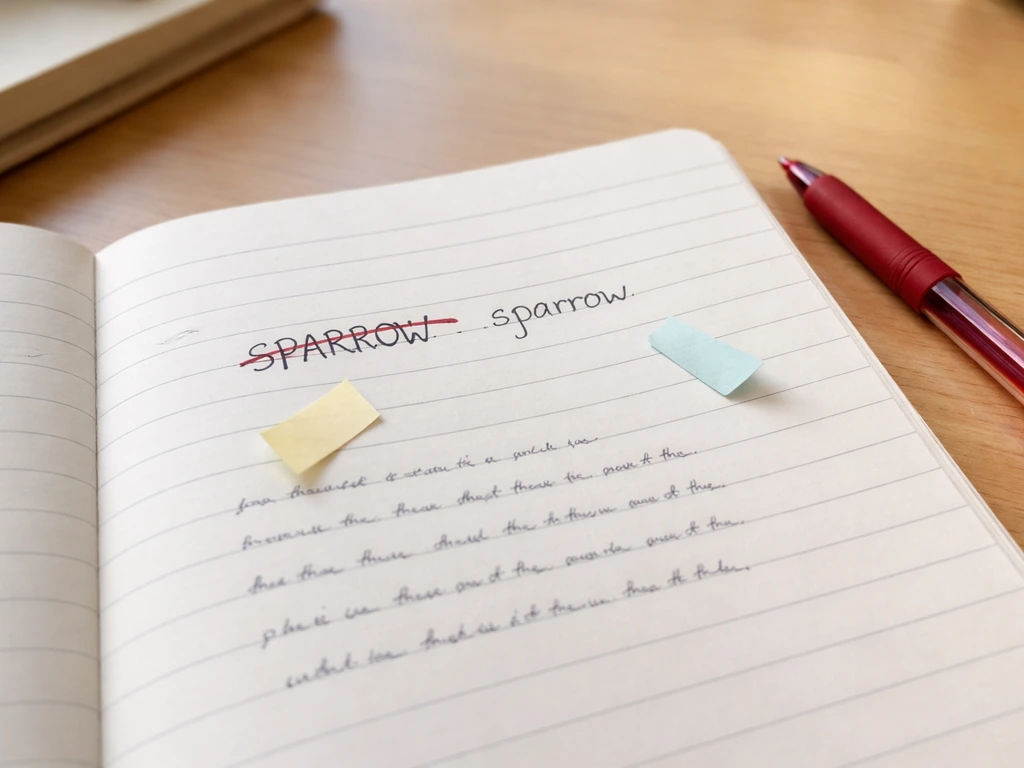
The most common mistake is capitalizing a bird name simply because it feels important or official. Writers do this constantly, especially with birds that carry cultural weight. You will see 'Bald Eagle,' 'Great Horned Owl,' and 'Red Cardinal' all over the internet, often on wildlife blogs, social media posts, and even some news articles. The same naming logic applies to the question of whether cardinals are named after the bird are cardinals named after the bird. None of those capitals are needed in general prose. Cardinals, including the Northern cardinal, are generally not capitalized in everyday prose. The birds are not proper nouns; they are not called 'the Great Horned Owl of the Smith Family.' They are just birds.
A second common mistake is applying ornithological journal style to general writing. Some birding publications do capitalize all established common names as a house style, partly to distinguish formal species names from casual descriptions. If you read enough field guides or birding magazines, you start thinking 'Northern Cardinal' is the rule everywhere. It is not. That is a specific house style for a specific audience. In a newspaper, a school essay, or a blog post, lowercase is correct.
The third mistake is going too far in the other direction and lowercasing a proper-noun component. Writing 'american crow' or 'steller's jay' without the capital on the proper-noun part is incorrect. The proper noun element always keeps its capital, even when the rest of the name stays lowercase.
- Capitalize bird names that contain a country, nationality, or region name: American robin, European starling, African grey parrot
- Capitalize eponymous bird names on the person's name only: Wilson's warbler, Cooper's hawk, Steller's jay
- Lowercase everything else: sparrow, pigeon, barn owl, great horned owl, bald eagle, blue jay
- Do not capitalize just because the bird feels culturally important or official
- Do not adopt ornithological-journal capitalization in general writing unless you are writing for that audience
Scientific (Latin) names vs common names: how capitalization differs
Scientific names operate under an entirely separate system called binomial nomenclature, and the capitalization rules are non-negotiable. Every species gets a two-part name: the genus comes first, capitalized and italicized, followed by the specific epithet, which is lowercase and also italicized. MLA specifies that binomial scientific names (genus plus species) are italicized, with the genus capitalized and the species epithet lowercased genus comes first, capitalized and italicized, followed by the specific epithet, which is lowercase and also italicized. So the bald eagle is Haliaeetus leucocephalus. 'Haliaeetus' is the genus (capital H, italics), and 'leucocephalus' is the species (all lowercase, italics). This format is consistent across every guide: Chicago, MLA, NIH, IUCN, AJE, and every major scientific publisher.
When you write a bird name in a piece of general writing and want to include the scientific name for clarity or precision, the convention is to give the common name first, then the scientific name in parentheses in italics: 'the bald eagle (Haliaeetus leucocephalus) is found throughout North America.' The IUCN style manual follows this exact pattern, and it works well for any context where you want to be both accessible and precise.
One wrinkle worth knowing: if you use the genus name on its own, without the species, it is still capitalized and italicized (for example, referring to 'Haliaeetus' as a group). But if a genus name has entered everyday English as a common word, it is treated as a common noun and loses both the capital and the italics. This is a rare situation for bird names in general writing, but it comes up in more technical contexts.
| Name Type | Example | Capitalization | Italics |
|---|---|---|---|
| Common name (no proper noun) | bald eagle | Lowercase | No |
| Common name (with proper adjective) | American crow | Capital on 'American' only | No |
| Common name (eponym) | Steller's jay | Capital on 'Steller's' only | No |
| Scientific genus | Haliaeetus | Capitalized | Yes |
| Scientific species epithet | leucocephalus | Lowercase | Yes |
| Full binomial | Haliaeetus leucocephalus | Genus capitalized, species lowercase | Yes (both) |
Special cases: pet bird names and written references
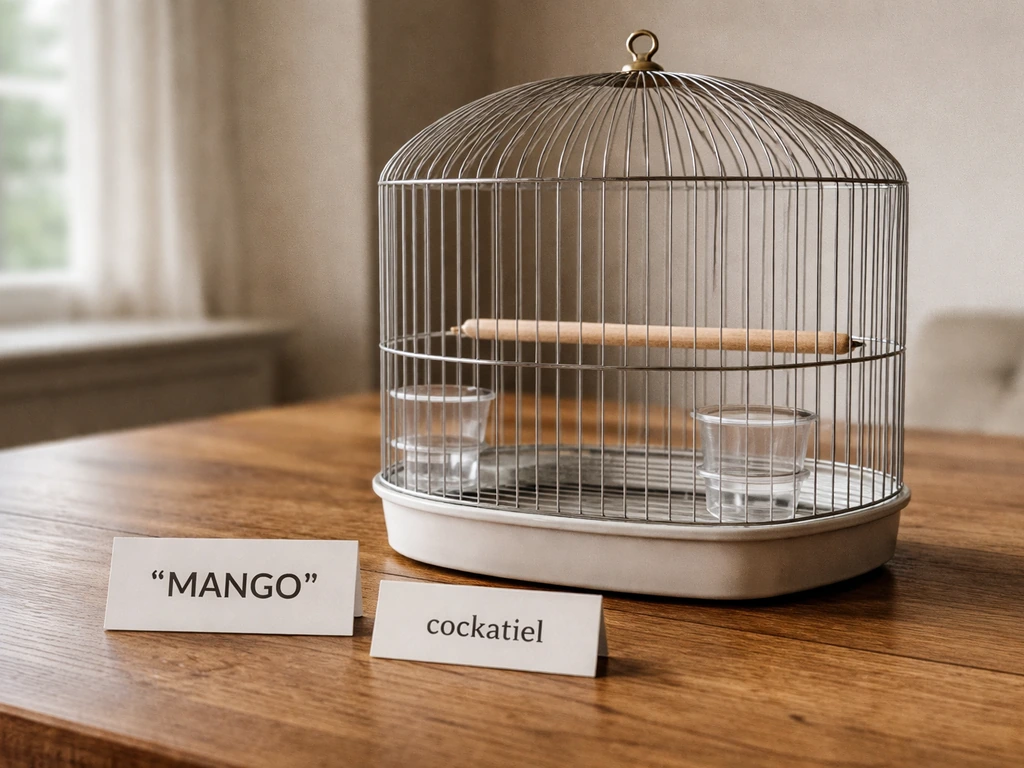
When you give a pet bird a name, that name is a proper noun and absolutely gets capitalized, just like any name you give a person or a pet dog. If your cockatiel is named Mango, you write Mango with a capital M every single time. 'I gave Mango fresh water this morning' is correct. The word 'cockatiel' itself stays lowercase because it is still a common noun describing the species; only the individual's personal name gets the capital.
This distinction trips people up when they write about their pets online. You might see someone write 'My Cockatiel, Mango, loves millet,' capitalizing 'Cockatiel' as if it were part of the name. It is not. The species name is not part of the pet's personal name; it is just a label for what kind of bird Mango is. The correct version is 'my cockatiel, Mango, loves millet.' Same principle applies for parrots, budgies, macaws, canaries, and any other pet bird species.
In written references, like books, articles, signage at zoos or aviaries, or educational materials, the temptation to capitalize for emphasis is strong. Zoo placards frequently say things like 'Bald Eagle (Haliaeetus leucocephalus)' with the capital on 'Bald.' This is a stylistic choice made for visual clarity and display purposes, not a grammatical rule. If you are writing general prose, you should follow standard lowercase conventions regardless of what the placard says. If you are writing display copy for an exhibit, you can follow whatever house style your institution uses.
It is also worth noting the relationship between bird names and proper nouns more broadly. In other words, the question of whether bird is a common noun comes down to whether it’s used as a general word for the animal is bird a common noun. That same idea applies when you ask, “Is <a data-article-id="23BFDF7E-1070-4B84-ABA9-B12110708483">bird a proper noun</a>? So for clarity, ask whether bird a proper noun fits the way you are using it in your sentence, rather than treating it as automatically capitalized. ” and compare how capitalization changes with context. A word like 'robin' is a common noun when referring to the bird, but 'Robin' is also a common human name and is always capitalized in that context. The same letter combination can be either a proper noun or a common noun depending on what it refers to. Context determines capitalization, not spelling. This is relevant especially for crossword clues, wordplay, and any writing that plays with the double meaning of bird names as human names.
A practical checklist and examples for everyday writing
Before you finalize anything you have written that includes bird names, run through this quick checklist. It covers the situations that come up most often and will catch the majority of capitalization errors.
- Is the bird name a common noun with no proper-noun components? If yes, lowercase the whole thing. (robin, pigeon, barn owl, great horned owl, bald eagle, blue jay, house sparrow)
- Does the name include a nationality, country, or regional adjective? Capitalize that word only, and lowercase the rest. (American robin, European starling, African grey parrot)
- Is the name based on a person's name (eponymous)? Capitalize the person's name component only. (Steller's jay, Wilson's warbler, Cooper's hawk, Anna's hummingbird)
- Are you writing a scientific or Latin name? Capitalize the genus, lowercase the species, italicize both.
- Is this a pet bird's individual name? Capitalize it as you would any personal name. Keep the species name lowercase.
- Are you writing for an ornithological journal with a house style of capitalizing all established common names? Follow that house style, but do not transfer it to general writing.
Here are correct examples you can use as models when you are unsure:
- A red-tailed hawk circled the field twice before landing.
- We counted three great blue herons along the shoreline.
- The American kestrel is North America's smallest falcon.
- She kept a journal entry about the Steller's jays raiding her campsite.
- The bald eagle (Haliaeetus leucocephalus) was delisted from the Endangered Species Act in 2007.
- My African grey parrot, Archie, learned to say 'good morning' within his first year.
- Cooper's hawks are remarkably agile hunters in dense woodland.
- A pair of Canada geese nested near the parking lot every spring.
- I watched a common loon dive and resurface over forty feet away.
Getting bird capitalization right is genuinely simple once you treat bird names the same way you treat any other English noun: lowercase unless there is a specific reason to capitalize. The “do you capitalize robin the bird” rule is just the everyday common-noun rule: lowercase unless it includes a proper-noun element or is used as a specific person’s name. That helps answer the question of whether bird names are proper nouns in everyday writing. To learn what makes a word a proper noun versus a common noun, it helps to see how bird names are treated in everyday writing. The most common reasons to capitalize are a proper adjective (American, European, African), a person's name embedded in the common name (Steller, Wilson, Cooper), or a pet bird's individual personal name. Everything else stays lowercase, no matter how majestic the bird.
FAQ
Do I capitalize “the” when it comes before a bird name (for example, “the Bald Eagle”)?
In standard prose, you do not capitalize the bird name just because “the” precedes it. You should write “the bald eagle,” not “the Bald Eagle,” unless your sentence is starting a new clause that requires capitalization for another reason (such as the first word of a sentence).
How should I write bird names in headings or titles?
Title case is a formatting choice, not a grammar change. If you are following a house style that capitalizes major words in headings, you may see “Bald Eagle,” but in running text the common-noun form stays lowercase (“bald eagle”). If you want to be safest across contexts, keep lowercase in normal sentences and apply title-case rules only to the heading itself.
What if a bird name starts a sentence, like “Robin visited my feeder”?
Only the first word of the sentence is capitalized. So you would write “Robin visited my feeder” if “robin” is being used as the bird common noun at the start of the sentence, but in the rest of the sentence it remains lowercase (“I’ve never seen a robin like this before”).
Are bird names capitalized in school worksheets, lab reports, or other institutional writing?
Not automatically. Unless the document uses a specific house style to capitalize established common names (common in some birding publications), general English rules apply, so the common bird name stays lowercase, with capitals reserved for embedded proper-noun elements (like “American crow”) and for personal names used in the common name.
Do I capitalize “bird” or “eagle” when used generically (for example, “bird of prey”)?
No, generic descriptive phrases are usually lowercase. Write “bird of prey,” “raptor,” “eagle species,” and similar phrases in lowercase when they are functioning as common nouns or noun phrases, not as a specific named species.
How do I format bird names when I include the scientific name, especially italics and parentheses?
Use the common name first, then put the scientific name in parentheses, with genus capitalized and italicized, and species epithet lowercase and italicized. Example pattern: “the bald eagle (Haliaeetus leucocephalus).” Keep the common-name capitalization consistent with general rules, meaning lowercase in running text.
What should I do if I am quoting someone who capitalized a bird name incorrectly?
Keep the quote exactly as written. If you need to correct it for your reader, you can use a brief bracketed clarification like “[sic]” for the original spelling, or add a short note outside the quotation. Don’t silently “fix” the capitalization inside a direct quote.
Is it correct to capitalize the species epithet in a scientific name when writing it in a sentence?
No. In binomial nomenclature, the genus is capitalized and italicized, while the species epithet is lowercase and italicized. Writing “Haliaeetus Leucocephalus” is incorrect; it should be “Haliaeetus leucocephalus.”
If a pet bird species word is used like a label, do I ever capitalize it (for example, “My Cockatiel”)?
Capitalize only the individual pet’s personal name. Species words used as labels remain lowercase. So you write “my cockatiel, Mango,” not “My Cockatiel, Mango,” unless Cockatiel is actually the pet’s chosen personal name.
How should I capitalize a bird name when it is also a human name, like “Robin” or “Taylor”?
Capitalization depends on what the word is referring to. If it is a person’s name, capitalize it (“Robin arrived”). If it is the bird, use lowercase in running prose (“a robin landed on the porch”).
Do I capitalize multiword bird names in emails or informal posts the same way as in essays?
Yes, unless you are using a special house style. In informal writing, common bird names still behave like common nouns, so keep them lowercase, capitalizing only embedded proper adjectives or person-derived components (like “American” or “Steller’s”), and using a capital only for the first word if it starts a sentence.