The slang term 'bird' meaning a woman is chiefly British English, and its modern form is recorded from at least 1915. It likely developed from soldier and working-class slang in the early twentieth century, though a parallel (and etymologically separate) medieval use of 'burd' or 'burde' for a maiden or young woman had existed in Middle English centuries earlier. The two threads are connected by accident as much as by design, which makes this one of the more tangled word histories in the English slang dictionary.
Where Does the Term 'Bird' for a Woman Come From? Origins & Use

Maya Castellanos
8 Aug 2026
What 'bird' actually means when applied to a woman
In contemporary British English, calling someone a 'bird' means you are referring to a girl or young woman, often specifically a girlfriend. Collins English Dictionary defines it plainly as 'a girl or young woman, esp. one's girlfriend.' You might hear it in a sentence like 'He's out with his bird tonight' or, more casually, 'She's a nice bird.' The word carries no fixed emotional charge on its own; context, tone, and the relationship between speaker and subject do all the heavy lifting when it comes to whether the word feels affectionate, neutral, or dismissive.
A few quick examples show the range of registers it can appear in: a working-class Liverpudlian might say 'That's my bird' with obvious pride, a 1960s pop lyric might refer to 'a pretty little bird,' and a casual put-down might frame the same word as condescending. The word 'bird' also turns up in the compound 'dolly bird,' a very specifically 1960s British term for an attractive, fashionably dressed young woman. That compound captures exactly the era when 'bird' was at its cultural peak.
The animal word 'bird' and its Old English roots
Before 'bird' meant anything like a woman, it went through a surprisingly humble origin story as an animal word. The Old English form was 'bridd,' which referred specifically to a young bird or nestling, not to a fully grown adult. See blank" rel="noopener noreferrer">Bird - Online Etymology Dictionary (Etymonline) for a summary noting Old English bridd ‘young bird’ and its later expansion in meaning. The broader word for any bird in Old English was 'fugol' (surviving in modern 'fowl'). Over time, 'bridd' expanded its meaning to cover birds of all ages, eventually displacing 'fugol' as the default word, and by Middle English the spelling had settled into something recognizable as 'bird.' If you want to go deep on that transformation, the general history of the word itself is worth exploring on its own terms. For common rhymes, see what rhymes with bird.
What matters for our purposes here is that the animal word and the slang sense for a woman are not as straightforwardly linked as people tend to assume. The animal word was doing its own thing for centuries, while the slang sense arrived through a different, twisting route.
How did an animal name become slang for a woman?
There are two separate pathways worth understanding, and the Online Etymology Dictionary and Eric Partridge's slang lexicography both point to this double-origin situation. For a concise answer to where the word 'bird' comes from, see our short guide on where does the word 'bird' come from. The first pathway is medieval: Middle English had a word 'burde' or 'burd,' meaning a maiden or young woman. This word appeared in ballads and poetry, and it survives in some Scottish dialect material documented by John Jamieson in his Etymological Dictionary of the Scottish Language. See An Etymological Dictionary of the Scottish Language, John Jamieson (Project Gutenberg) (entry: BURDE / BURD) for documented Scots uses of 'burd/burde' meaning 'maiden' blank" rel="noopener noreferrer">An Etymological Dictionary of the Scottish Language — John Jamieson (Project Gutenberg) (entry: BURDE / BURD). The catch is that 'burd/burde' was a different word etymologically, but it looked and sounded enough like 'bird' that later writers and readers conflated the two. You can find 'burd' in the Child Ballads, for example, where it is used as a respectful title for a young woman.
The second pathway is the modern slang revival, which the Oxford Dictionary of Word Origins and the Online Etymology Dictionary date to around 1915 and describe as likely independent of the medieval sense. This twentieth-century slang seems to have emerged from soldier cant, theatrical and working-class speech, and general urban slang rather than from any conscious echo of medieval poetry. Partridge's slang dictionaries tie some uses to forces slang and theatrical/cant usage, suggesting it spread through tightly knit social groups before entering general casual speech.
English has a long habit of applying bird names and bird-related words to women. 'Chick,' 'dove,' 'hen,' 'vixen' (borrowed from fox), 'lass' in a looser sense, all sit in this tradition. Linguists studying animal metaphors and gender note that bird metaphors applied to women appear across many languages and tend to emphasize youth, attractiveness, and sometimes fragility. Whether that framing is benevolent or reductive depends entirely on context, but the pattern itself is ancient and cross-cultural.
Early citations and a brief timeline
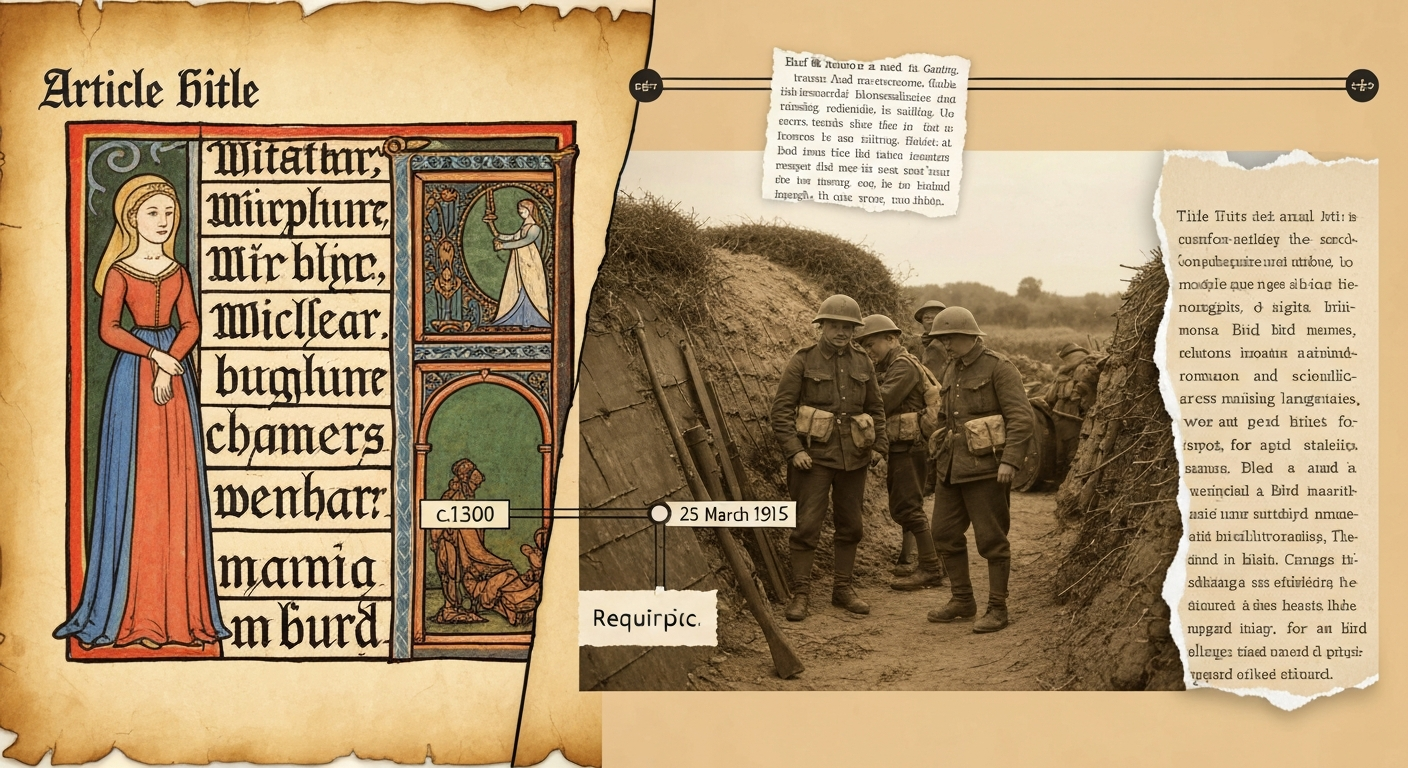
The earliest well-documented printed example of the modern slang sense comes from Patrick MacGill's wartime memoir The Amateur Army, published on March 25, 1915. MacGill, writing about army life, includes the line 'There's another bird there, and cawfee!' in a context that makes clear the word means a woman or girl. That is a useful anchor: it tells us the word was in active spoken use among British soldiers at least by the First World War, which strongly suggests it predates print by several years.
| Date | Source | Context / Usage |
|---|---|---|
| c.1300 (Middle English) | Ballads and poetry using 'burd/burde' | Maiden or young woman; etymologically distinct but visually/phonetically similar to 'bird' |
| 1550s–1700s (Scots) | Jamieson's Etymological Dictionary of the Scottish Language | 'Burd' as a form of address for a young woman in Scots dialect |
| 1915 | Patrick MacGill, The Amateur Army | First well-attested printed modern slang citation: 'There's another bird there' |
| 1960s | General British youth/fashion culture; 'dolly bird' compound | Peak popularization in Swinging London youth and fashion discourse |
| Late 20th–21st century | British National Corpus / corpora evidence | Concentrated in British sources; declines in prestige registers; persists in regional and informal speech |
The gap between the medieval 'burd' and the 1915 citation is not a continuous unbroken tradition. Most slang historians treat the twentieth-century sense as a fresh coinage that happened to land phonetically on top of the older word, rather than as a direct survival. That said, the medieval use does confirm that English speakers have reached for bird-like words when talking about young women for a very long time.
Who used it, and when
The clearest social profile for early twentieth-century use is British working-class and military speech. The MacGill citation is soldier language; Partridge's documentation points to theatrical and cant registers; and later Liverpool English Dictionary research places the word firmly in Scouse working-class speech as a sustained and revived usage. This is very much a word that traveled through tightly knit, predominantly male subcultures before reaching wider popular use.
The word's biggest cultural moment was the 1960s in Britain. Swinging London, the mod scene, and the explosion of pop journalism all gave 'bird' a sheen of trendy informality. Fashion writing of that era described models, shop girls, and pop-star girlfriends as birds with no apparent self-consciousness. The 'dolly bird' compound, describing an attractively dressed young woman in a very specific 1960s idiom, became almost a cliche of that period's style language. After the 1970s, the word began to feel slightly dated in younger urban speech, though it remained (and remains) alive in northern English dialects and in certain working-class registers.
British versus American usage: quite different birds
This is one area where British and American English diverge sharply. In British English, calling a woman a 'bird' is broadly understood and, depending on social context, may be perfectly unremarkable. In American English, 'bird' does not carry this slang meaning at all for most speakers. Americans developed their own parallel animal-based slang for young women, most notably 'chick,' which the Online Etymology Dictionary traces to its modern slang sense from around 1927, slightly later than the British 'bird' citation from 1915. Both words follow the same metaphorical logic (a young bird = a young woman), but they developed independently in different national varieties of English.
An American hearing a British person say 'She's a lovely bird' might initially think the speaker is talking about an actual animal. That misunderstanding itself tells you something interesting: the metaphor works because youth, lightness, and attractiveness are associated with birds in both cultures, but the slang crystallized differently on each side of the Atlantic.
Within British English, regional variation matters too. Liverpool English (Scouse) has been particularly associated with sustained use of 'bird' for a girlfriend or young woman, where it tends to carry a warm, familiar tone. In some other regional varieties, or in certain tones of voice, the same word can feel dismissive or reductive. The word itself is genuinely neutral in form; it is the delivery and context that push the meaning toward affection or condescension.
Affectionate, neutral, or derogatory: how tone shifts the meaning
One of the things that makes 'bird' interesting from a linguistic standpoint is how much semantic work the context has to do. The word itself is not inherently an insult, and it is not inherently a compliment. When a man in Liverpool says 'my bird' of his long-term partner, it often sounds warm and possessive in a genuinely fond way. When a dismissive comment in a professional setting refers to 'some bird in accounts,' the same word is doing something very different: it is flattening the subject's professional identity into a generic gendered category.
Research on animal metaphors and gender notes that words like 'bird,' 'chick,' 'hen,' and similar terms form a recurring pattern in which women are linguistically mapped onto animals in ways that can emphasize passivity, youth, or attractiveness while sidelining other qualities. That does not mean every use of 'bird' is hostile, but it does explain why many women find it reductive when used in professional or public contexts by people they do not know. The intimacy of the relationship between speaker and subject matters enormously here.
In contemporary usage, 'bird' is broadly understood to be old-fashioned in formal or professional settings and to belong primarily to casual, regional, or self-consciously retro speech. Younger British speakers are less likely to use it unironically than older generations, though it certainly has not vanished.
'Chick,' 'dove,' 'lass,' and the wider world of bird-based and gendered slang
It is worth putting 'bird' in company with its closest relatives, because comparing them shows you exactly what makes each one distinctive in tone and origin.
| Term | Origin / Register | Primary geography | Earliest modern slang citation | Typical tone |
|---|---|---|---|---|
| bird | British working-class / military cant; possible echo of medieval 'burd' | British English (especially northern England) | 1915 (MacGill, The Amateur Army) | Neutral to affectionate; can be dismissive depending on context |
| chick | American slang; parallel animal metaphor (young bird = young woman) | American English primarily | c.1927 (OED / Etymonline) | Neutral to flirtatious; often considered dated or mildly sexist today |
| dove | Poetic and Biblical tradition; associated with gentleness and peace | Both British and American | Literary/poetic rather than street slang | Affectionate, tender; usually applied to a beloved rather than a generic woman |
| hen | Scots and northern British dialect | Scottish and northern English | Long-established dialect term | Warm and familiar in Scottish English; can be patronizing elsewhere |
| lass | Norse-influenced northern English and Scots | Northern England and Scotland | Medieval onwards | Neutral to affectionate; class-marked as regional |
Of these, 'dove' sits in a notably different emotional register. Where 'bird' and 'chick' are casual labels, 'dove' is intimate and poetic, used for someone specifically beloved. It is worth noting that 'dove' rhymes with 'love,' which has made it a natural fit for song lyrics and poetry for centuries. 'Lass' meanwhile avoids the animal metaphor entirely and is purely a gendered regional word without the ornithological baggage, making it feel more neutral in northern English and Scots contexts where it is native.
The broader point is that English has layered up a remarkably dense collection of bird-related and animal-related words for women, and most of them carry strong regional and generational fingerprints. 'Bird' is recognizably British and mid-twentieth century; 'chick' is recognizably American and also of roughly the same vintage. Neither would feel at home in a formal setting today, but both survive comfortably in casual, familiar, and often nostalgic speech.
Famous 'Birds': where the nickname and the slang intersect
The word 'bird' as a nickname or surname also has a rich cultural life that overlaps interestingly with its slang history. The most famous human 'Bird' in music is Charlie Parker, the jazz saxophonist who was nicknamed 'Bird' or 'Yardbird' from the early 1940s, reportedly because of his love of chicken (yardbird was slang for chicken) rather than any connection to women's slang. Parker's nickname is entirely separate from the gendered usage we have been discussing, but it illustrates how 'bird' was circulating as a meaningful human label in broadly the same era. See one notable example in Parker, whose nickname is bird.
On the female side, the British singer known professionally as Birdy (born Jasmine Lucy van den Bogaerde) adopted a bird-derived stage name, though again without direct connection to the slang term. The name functions more as a nature metaphor for her vocal style than as a nod to the gendered slang. A well-known woman nicknamed 'Lady Bird' is Claudia 'Lady Bird' Johnson Lady Bird Johnson. There is also a poet who publishes under the name Bird, which is another cultural use of the label worth noting poet named Bird. There are also well-known people with the surname Bird, including writers and public figures, and exploring who carries Bird as a nickname opens up a fascinating corner of naming culture that sits neatly alongside the slang history rather than being the same thing.
Other 'bird' senses you might run into
While we are here, it is worth quickly flagging two other 'bird' senses in British slang that have nothing to do with women. 'Do bird' means to serve a prison sentence, and this comes from Cockney rhyming slang: birdlime rhymes with time, so birdlime was slang for a prison sentence, which shortened to bird. Green's Dictionary of Slang documents this chain with dated citations. Completely separate again is 'get the bird' or 'give someone the bird,' meaning to receive audience boos and hisses. That sense comes from theatrical slang in which an angry audience sounded like a flock of geese hissing, so getting 'the big bird' meant getting hissed off stage. Both of these senses can cause confusion when people first encounter them, and neither is related to the slang term for a woman.
Using the term today: a practical note
If you are a language learner or someone trying to calibrate when 'bird' is appropriate in contemporary British English, the honest answer is: tread carefully in any context where you do not know the people well. In casual conversation among friends where the register is already relaxed and informal, it is broadly understood and unlikely to cause serious offence. In professional, formal, or public contexts, it reads as dated and potentially dismissive. The safest guide is to notice whether the British people around you are actually using it and in what tone, rather than relying on a fixed rule.
From a purely linguistic standpoint, the word 'bird' meaning a woman is a genuine piece of English slang history: it has medieval echoes in the 'burd' of the ballads, a well-documented 1915 anchor, a 1960s cultural peak, and a slow retreat from the mainstream over the last few decades. That is a lifespan of over a century for the modern sense alone, which makes it considerably more durable than most slang. Language enthusiasts, etymology readers, and anyone curious about how words jump from animal names to human labels will find this particular word a very satisfying case study in how English works.
FAQ
What does the slang term “bird” mean when applied to a woman?
Definition and examples: - Short definition: In British informal speech, “bird” commonly means a girl or young woman (often a girlfriend or attractive young woman). It can be affectionate, neutral, or dismissive depending on context and tone. - Examples: “That’s his bird” (his girlfriend); “She’s a nice bird” (she’s a nice girl)—tone determines whether complimentary or objectifying. - Dictionary support: Modern dictionaries such as Collins list this as a British slang sense; slang dictionaries (Partridge, Green) document similar glosses.
Where does the animal word “bird” originally come from?
Etymology of the animal word: - Old English bridd originally meant a young bird. Middle English had burd/burde (from different roots) meaning ‘maiden, young woman’ in some dialects; those medieval senses are recorded in Scots and ballad material. - Modern English bird as the animal name comes from that Old English bridd lineage; however, the medieval human meaning (burd/burde) is often etymologically distinct and sometimes conflated in later accounts. - Sources: Online Etymology Dictionary, Jamieson (Scottish etymological material).
How did the animal word come to be applied to women in modern slang?
Paths to the modern slang sense: - Two partly separate strands: (1) Middle English/Scots burd/burde = maiden supplied an old lexical possibility for bird = woman; (2) a 20th‑century slang revival/adaptation used the animal word bird to mean young woman in British speech, especially working‑class and youth registers. - The modern slang sense (attested in print from the early 20th century) appears to be a popular/slang development rather than a straight descent from the medieval burd sense, though lexical history blends them in popular explanations. - Key references: OED summaries, Partridge, Etymonline.
When and where is the term first attested in English for this meaning?
Earliest printed citations and timeline: - 1915: A clearly attested early printed usage appears in Patrick MacGill’s The Amateur Army (1915), consistent with soldier/youth speech using “bird” to mean a woman. - Mid‑20th century: The term is widespread in British working‑class speech and popular culture; it peaks in some registers (e.g., 1960s ‘dolly‑bird’ fashion phrase). - Timeline (short list): - medieval: Middle English/Scots burd/burde = maiden (separate lineage; attested in ballads and dictionaries) - 1915: Patrick MacGill — early 20th‑century printed slang example - 1920s–1960s: increasing slang use in British papers, theatre/working speech; 1960s ‘dolly‑bird’ popularized in fashion/culture - late 20th–21st century: regional persistence, less frequent in prestige registers (see corpora for detailed counts) - Suggested corpus checks: BNC, COHA, Google Books for frequency and later examples.
What are the regional and social connotations of “bird” (British vs. American)?
Regional/social connotations: - British usage: Historically common in many parts of Britain (notably northern/working‑class areas such as Liverpool/Scouse). Can be neutral (girlfriend), affectionate, or mildly derogatory depending on speaker and context. - American usage: Much less common as general slang for a woman; American animal→woman slang more often uses “chick.” - Social nuance: In British working‑class registers, “bird” can be a normal familiar term; in more formal or feminist‑sensitive contexts it may be considered objectifying. Tone, relationship, and register determine acceptability. - Sources: regional dictionaries (Liverpool English Dictionary), Green’s Dictionary of Slang.
How does “bird” compare to related slang like “chick” and “dove”?
Comparisons to related slang: - Chick: U.S. slang for a young woman, attested in print from the 1920s–30s; parallels animal→woman metaphor but with different regional history (chick = mainly American; bird = mainly British historically). - Dove: Less common as a general slang label for a woman; more often used metaphorically to mean gentle/peaceful (and used as a name). “Dove” also allows easy rhyme-play with “love.” - Pattern: Animalizing metaphors (chick, bird, hen, vixen) are widespread in language and have been discussed in scholarship as part of gendered metaphor and potential objectification (see recent reviews on animalizing women).
Next Article
Which Celebrities Are Nicknamed 'Bird', Famous Examples
Which celebrities are nicknamed “Bird”? Charlie Parker, Larry Bird and others, origins, types, and reliable sources.