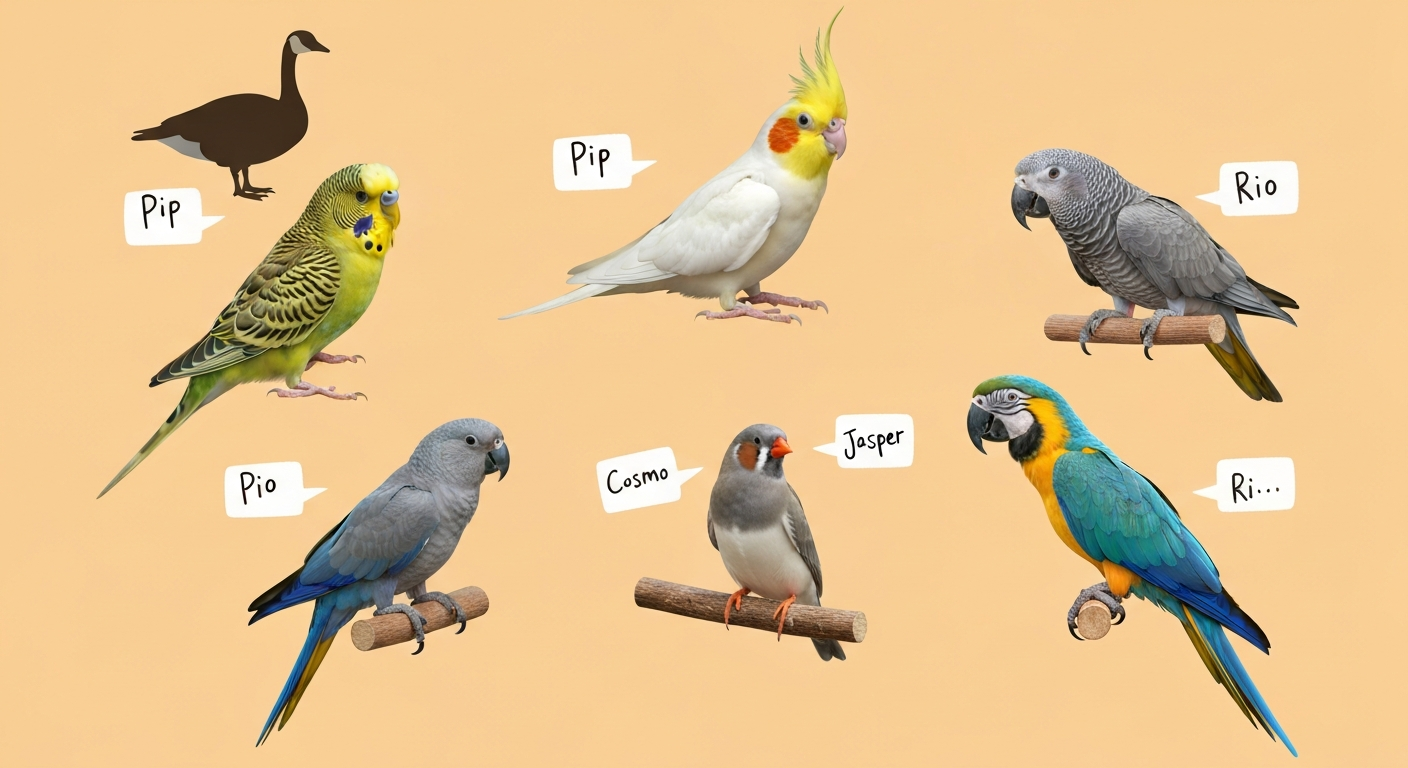
Pick a short name with a bright vowel sound, ideally one or two syllables, that feels natural to say out loud a dozen times a day. Something like Rio, Pip, Jasper, or Cosmo lands better on a bird's ears than something long and consonant-heavy. Male birds respond especially well to names that end in a vowel or a soft vowel-adjacent sound, because those shapes are easier for birds to perceive and, in the case of parrots and cockatiels, easier to mimic. That said, the 'best' name is the one you'll actually use consistently, so personality, color, and cultural meaning matter just as much as phonetics.
What Should I Name My Male Bird: 75+ Ideas, Naming Guide

Maya Castellanos
24 Jul 2026
Choosing a name for your male bird
Naming a male bird is one of those small decisions that turns out to be surprisingly sticky. You'll say this name hundreds of times, use it when training, use it when scolding (yes, that happens), and probably introduce your bird to guests using it for the next ten to twenty years. So while it's tempting to just go with the first cute word that pops into your head, a few minutes of deliberate thought will save you from months of mumbling through a name that never quite fit.
The good news is that the science actually helps here. Research into companion parrot behavior shows that birds produce and use name-phrases in social contexts, meaning they pick up on the shape and rhythm of the words you use most. The phonetic form of a name, its vowels, syllable count, and timbre, genuinely affects how quickly a bird learns to respond. This isn't just folk wisdom; it's backed by studies showing birds can discriminate between human speech sounds and internalize acoustic signatures. So the naming process is both a linguistic and a practical exercise.
A simple 3-step naming approach: decide, test, commit
I've landed on a three-step process that works whether you're naming your first budgie or your fifth African grey. It strips out the overthinking and gives you a real-world feedback loop.
- Decide: Narrow your shortlist to three to five names using the criteria below (species, size, color, voice, personality, cultural meaning). Say each name out loud ten times in a row. Cross off any that feel awkward or that you'd be embarrassed to call across a room.
- Test: Spend three to five days using your top choice exclusively. Say it every time you approach the bird, every time you offer food, every time you make eye contact. Watch for any head tilt, eye-pinning (in parrots), or movement toward you. These are early signs of name recognition.
- Commit: Once you notice even a flicker of response, you're done deliberating. Consistency from this point forward is what cements the name. Resist the urge to swap names after the first week; changing a bird's name is possible but takes patient retraining, as covered further below.
What to consider before you pick: 7 quick criteria
Run your candidate names through these seven filters. You don't need to tick every box, but the more boxes a name ticks, the better it tends to work in practice.
- Species: A name that suits a bold Amazon parrot may feel oversized on a delicate zebra finch. Match the name's energy to the bird's natural character.
- Sex: Male birds often carry bolder, stronger, or more regal names by convention, though plenty of owners happily break this rule. What matters is that the name feels intentional to you.
- Size: Large birds can carry weighty names like Magnus or Caesar. Tiny birds often suit names that feel small and nimble, like Pip, Dot, or Sprite.
- Color: Color-inspired names (Indigo, Russet, Ash, Blaze) are some of the most satisfying because they're descriptively accurate and visually memorable.
- Voice: A loud, operatic bird might suit a name like Figaro or Caruso. A quiet, whispery bird might suit something softer, like Fern or Milo.
- Personality: Research in behavioral ecology confirms that birds have consistent individual personalities, so a bold, curious bird deserves a name that reflects that energy. A shy, gentle bird might suit a calmer name.
- Cultural context: Names drawn from mythology, folklore, or other languages add depth and often come with interesting stories to tell visitors. Just make sure you understand the meaning and origin before using it, especially if it comes from a culture not your own.
Short names and phonetics: why they matter for training
There's a practical phonetics argument for keeping bird names short, and it goes deeper than convenience. Studies on avian speech perception show that birds can discriminate between consonant and vowel categories in human speech, which means the acoustic shape of a name isn't arbitrary to them. Bright, open vowels like the 'ee' in Remy or the 'oh' in Cosmo carry further and are easier for a bird to parse in a noisy environment. Names ending in a vowel sound also tend to be naturally higher in pitch at the end, which mimics the rising tonal patterns many birds use in contact calls.
For training purposes, one or two syllables is the sweet spot. Clicker-training protocols for birds, derived from positive reinforcement frameworks used widely in professional animal training, recommend using single, distinct cue words followed immediately by a marker (a click or a consistent verbal marker like 'yes') and a reward. Behavioral Management Programs to Promote Laboratory Animal Welfare (NCBI Bookshelf) endorses operant conditioning with positive reinforcement, including marker-based clicker protocols, as a welfare‑positive method for training birds. A name like 'Charlie' is easy to deliver crisply. A name like 'Lord Bartholomew the Magnificent' is not, no matter how fitting it feels. If you love a long name, use it as a full name for formal introductions but shorten it to a one-syllable call name for day-to-day training.
Repeating syllable names, such as Kiki, Coco, Dodo, or Momo, are popular for a reason. The repetition makes them naturally emphatic and easy to distinguish from surrounding speech. Parrots in particular seem to lock onto these patterns quickly, likely because the doubled syllable structure resembles the rhythmic contact calls many parrot species use naturally.
Curated name lists by category
Traditional male names
- Charlie
- Oscar
- Max
- George
- Henry
- Arthur
- Felix
- Leo
- Jasper
- Archie
Cute and playful names
- Pip
- Nibbles
- Biscuit
- Mochi
- Pudding
- Doodle
- Waffles
- Nugget
- Boba
- Sprout
Strong and bold names
- Titan
- Blaze
- Maverick
- Rex
- Caesar
- Storm
- Ajax
- Thor
- Cinder
- Hawk
Musical and artistic names
- Figaro
- Caruso
- Bowie
- Hendrix
- Lyric
- Riff
- Mozart
- Coda
- Jazz
- Tenor
Funny and punny names
- Squawkward
- Feather Locklear
- Birdie Sanders
- Cluck Norris
- Chirp Eastwood
- Tweety McTweetface
- Eggbert
- Wingston Churchill
- Polly Graph
- Flock Norris
Unisex names that work for males
- Rio
- Sage
- Indigo
- Sky
- Robin
- Ash
- Sunny
- Scout
- Coco
- Blue
Species-specific suggestions: parrots
Parrots are arguably the most name-conscious pets on the planet. Research on companion parrots has documented them producing and using human names in social contexts, sometimes even applying names to specific household members unprompted. This means parrots don't just learn to respond to their name; they can actively engage with it as a social signal. A parrot's name should ideally be something you'd enjoy hearing the bird say back to you, because that is a very real possibility.
For African greys, Amazons, macaws, and similar large parrots, names with strong consonants and open vowels work particularly well because these species can articulate them with impressive clarity. Names like Kiko, Juno, Nico, or Marco tend to come out sounding satisfyingly recognizable when parrots vocalize them. For smaller parrots like conures and lovebirds, something bright and short works best: Rio, Pip, Tico, or Zazu.
Culturally meaningful and good-luck names are especially popular for parrots across Asian and Latin American households, where parrots carry long symbolic traditions. For examples of cultural symbolism and good‑luck bird names across traditions, see How do parrots name each other? (The Environmental Literacy Council). The Chinese character 吉 (jí) means 'auspicious' or 'lucky,' and names like Ji or Jiro (from the Japanese for 'second son,' often given with hopes of prosperity) carry this weight elegantly. Kirin, drawn from the mythological East Asian creature associated with good fortune, is another strong choice for a regal parrot. For more on culturally meaningful bird names and their origins across traditions, the site's dedicated good-luck bird name section goes into considerable depth on etymology and symbolic context.
Species-specific suggestions: robins
The American robin is a loud, confident bird with a rich, rolling song that the Cornell Lab describes as a cheerily, cheer up, cheer up, cheery-o pattern. Male robins are famously territorial and vocal, which means a bold, resonant name suits them well. In British folklore, the robin is a symbol of comfort, hope, and winter resilience, often associated with Christmas and the returning spring. The name Robin itself has Germanic roots meaning 'fame-bright,' and using it as a bird's name carries a pleasing circularity.
- Robin (the obvious and perfectly fitting choice)
- Redbreast (playful, descriptive, nods to British folklore)
- Chester (Latin root meaning 'camp,' suits a territorial male)
- Rudy (from 'ruddy,' referencing the orange-red breast)
- Fife (a small flute, suits the robin's piping song)
- Merle (French for blackbird, but widely used for any thrush-type singer)
- Barrett (Old English, 'strife,' suits a feisty territorial male)
If you're looking for more naming ideas specifically designed for robins, including cultural references and wordplay options, the good names for a robin bird page on this site covers those angles in dedicated detail.
Species-specific suggestions: geese
Geese are big, loud, deeply social birds with strong flock identities. Canada geese in particular, as documented by BirdLife International, live in highly structured family groups and maintain lifelong pair bonds, which makes them unusually personable once they bond with a human keeper. A good goose name tends to be either proudly pompous (befitting their general attitude) or warmly folkloric.
The nursery rhyme 'Goosey Goosey Gander' is one of English-speaking culture's oldest goose references, dating to the 18th century with roots possibly in political satire. It's a natural inspiration for playful goose names. The phrase 'whither shall I wander' from that rhyme has its own interesting linguistic history, and the goosey goosey whither shall I wander bird name page on this site explores the rhyme's origins in detail if you want the full etymological backstory.
- Gander (the correct term for a male goose, and a fine name in itself)
- Goosey (affectionate, directly folkloric)
- Morton (Old English, 'settlement by the moor,' suits a wandering bird)
- Squire (pompous and fitting for a goose that acts like it owns the yard)
- Wellington (after the boots, but also has that grand British honk energy)
- Brigadier (for a goose with military bearing and zero patience for nonsense)
- Gosling (cute for a young male, tips the hat to the famous namesake too)
Species-specific suggestions: finches
Finches are small, quick, and melodic. Male zebra finches and Gouldian finches in particular are visually striking, with bright color patches that practically name themselves. Because finches aren't usually handled as directly as parrots, their name is used more by the owner for identification and affection than for call-response training. That frees you up to choose something purely delightful rather than optimizing for phonetic trainability.
- Finley (means 'fair-haired hero,' suits a bright-crowned finch)
- Stripes (for a zebra finch's characteristic markings)
- Thistle (finches famously love thistle seed)
- Sparrow (cross-species, but charming and widely used)
- Piccolo (Italian for 'small,' also a tiny flute: perfect for a melodic bird)
- Dot (simple, affectionate, suits a tiny bird)
- Saffron (for a yellow-tinged male Gouldian or canary finch)
- Chip (short, bright, sounds like a finch call)
Species-specific suggestions: cockatiels
Cockatiels sit in a sweet spot between finch and parrot. They're highly vocal, personality-rich, and develop surprisingly strong name recognition. Male cockatiels are especially expressive, using their crest and contact calls to communicate mood constantly. They respond well to names that carry an upbeat energy, something that ends on a rising note or an open vowel. They also have a tendency to whistle the opening bars of whatever tune you hum most often, so a name that's part of a musical phrase (like Figaro, lifted from Mozart's opera) can take on a charming double life.
- Sunny (quintessential, suits the yellow-faced lutino and the general cockatiel temperament)
- Cosmo (bright, rounded vowels, easy to recall)
- Pepper (for grey cockatiels with their salt-and-pepper coloring)
- Figaro (for the musical whistler)
- Whistler (descriptive and affectionate)
- Crest (tongue-in-cheek reference to their signature feature)
- Tofu (soft, playful, popular in the cockatiel community for pale or white birds)
- Nimbus (Latin for 'cloud,' suits a grey bird with a lofty attitude)
Good-luck and culturally meaningful names across cultures
Bird names drawn from auspicious traditions can carry wonderful stories. Here are some options from different cultural backgrounds, with brief origins so you know what you're working with before you use them.
| Name | Origin / Language | Meaning / Cultural Context | Best Suited For |
|---|---|---|---|
| Ji | Chinese (吉) | Auspicious, lucky; the character appears in countless good-fortune phrases | Parrots, any vibrant species |
| Kirin | Japanese/Chinese (麒麟) | Mythological creature associated with prosperity and good omens | Large parrots, macaws |
| Jiro | Japanese | Second son; traditionally a name given with hopes of fortune and longevity | Parrots, cockatiels |
| Asher | Hebrew | Happy, blessed, fortunate; a common given name with strong positive connotations | Any species |
| Felix | Latin | Happy, lucky; used across European languages and universally recognized | Cockatiels, parrots |
| Boden | Old Norse | Shelter, refuge; associated with protection and safety in Norse tradition | Geese, larger birds |
| Merlin | Welsh/Brythonic | From Myrddin; the legendary wizard, but also a small falcon species | Parrots, finches |
| Zephyr | Greek | West wind; associated with good fortune, gentle beginnings, and spring | Finches, cockatiels |
| Cai | Welsh/Vietnamese | Welsh: rejoicing; Vietnamese: talent or wealth depending on tone | Any species |
| Prosper | Latin/French | To cause to succeed; directly means thriving fortune | Large parrots, geese |
A note on cultural sensitivity: the American Ornithological Society has actively engaged with how naming practices in ornithology can carry unexamined cultural bias. The same thoughtfulness applies to pet names. If you're drawing a name from a culture that isn't your own, spend two minutes learning its actual meaning and context. You'll be able to tell the story properly, and you'll avoid accidentally using something that carries weight you didn't intend.
Multilingual and etymological options
One of the most satisfying ways to name a bird is to find a word in another language that describes exactly what you see or hear. Here are some options with pronunciations, origins, and what makes each one work for a male bird.
| Name | Language of Origin | Literal Meaning | Pronunciation Guide | Why It Works |
|---|---|---|---|---|
| Cielo | Italian/Spanish | Sky, heaven | CHEH-lo (Italian) / SYEH-lo (Spanish) | Open vowels, melodic feel, suits any blue or sky-colored bird |
| Luca | Latin via Italian | Light; from Lucius | LOO-kah | Bright, clean, universally familiar, easy for birds to recognize |
| Kestrel | Old French (cresserelle) | Refers to the falcon's rattling cry | KES-trel | Strong, evocative, suits a bold or fast-moving bird |
| Soren | Danish/Norse | Stern, severe; from Severinus | SOR-en | Quiet authority, suits a calm, watchful large bird |
| Remy | French | Oarsman; from Remigius | REM-ee | Ends on a bright 'ee' vowel, excellent phonetics for recall |
| Nico | Greek via Italian | Victory of the people; from Nicholas | NEE-ko | Short, bright, parrot-friendly sound profile |
| Taro | Japanese | Eldest son; connotations of strength and responsibility | TAH-ro | Simple, dignified, works across most species |
| Coda | Italian/Latin | Tail; in music, a concluding passage | KOH-dah | Musical, distinctive, suits a cockatiel or songbird |
| Bodhi | Sanskrit | Awakening, enlightenment | BOH-dee | Calm, two syllables, ends on a vowel, widely understood |
| Azur | French/Persian origin | Azure blue; from Persian lāzhward (lapis lazuli) | ah-ZYOOR | Suits blue parrots, hyacinth macaws, blue-and-gold macaws |
A quick DIY quiz to help you decide
If you're still stuck after browsing the lists above, a structured set of questions can cut through the noise. Tools like Typeform or Interact let you build branching personality quizzes that map your answers to name categories, which is genuinely useful when you're torn between options. The site also has a dedicated what should I name my bird quiz page that takes you through a structured decision tree if you want a more guided experience. But here's a quick paper version you can run through right now.
- What's the most striking thing about your bird right now? (Color → try color-based or language names. Voice → try musical names. Personality → try personality-matched names. Nothing yet, still young → try classic short names that grow with the bird.)
- How do you plan to interact with your bird? (Training and tricks → prioritize phonetic clarity, one to two syllables. Display or aviary bird, less hands-on → any name you love works. Daily companionship → pick something you genuinely enjoy saying.)
- Do you want the name to mean something? (Yes, something lucky or meaningful → see the good-luck and multilingual tables above. Yes, something funny → see the punny list. No, just a good sound → go with the traditional or cute lists.)
- What's your bird's species? (Parrot → bold, vowel-rich, short names work best. Cockatiel → upbeat, musical names. Robin or finch → descriptive or nature-inspired names. Goose → folkloric or pompous names.)
- Say your top three names out loud right now. Which one made you smile? That's your answer.
Testing names in real life: what to watch for
The testing phase is where theory meets feathers. Applied animal training literature is consistent on this point: short sessions, high-value reinforcers, and progressive generalization are the building blocks of reliable cue recognition. For name training specifically, that translates to a simple protocol. Say the name once, clearly, at a normal conversational volume, right before you do something the bird already enjoys: offering a favorite treat, opening the cage door, or beginning a play session. Do not repeat the name multiple times in a row before the bird responds; that teaches the bird to ignore the first few uses. Say it once, then deliver the good thing.
Do this consistently for five to seven days, across short sessions of two to three minutes each. Watch for orientation responses: the bird turns its head, makes eye contact, moves toward you, or vocalizes in return. These are confirmation that the name is being processed. Parrots and cockatiels, given their acoustic sensitivity (wild monk parakeets have been shown to carry individual 'voice-prints' across multiple call types), often show recognition faster than owners expect. Geese and finches, which are less domestically trained, may simply show habituation and comfort rather than active orientation.
If after ten days the bird shows no response at all, consider whether the name might be acoustically too similar to sounds already common in the environment (a name like 'Beep' in a household with lots of electronics, for example). A slight phonetic adjustment can make a meaningful difference.
When and how to change a bird's name
Changing a bird's name is entirely possible and sometimes necessary, especially if you've adopted a bird that came with a name that doesn't work for you, or if a name you chose in week one just never felt right. The general approach is to use the old name and the new name together for a transition period: 'Marco... Cosmo. Cosmo. Good bird.' After about a week of pairing them, drop the old name and use only the new one. The bird's association transfers because you've been bridging the two sounds consistently.
Avoid changing a bird's name more than once if you can help it. Every transition asks the bird to discard a learned association and build a new one, which takes time and consistent positive reinforcement. If you're genuinely uncertain between two names, go back to the testing phase rather than cycling through multiple names in quick succession.
One practical note from the welfare side: if you've adopted a rescue bird and its previous name is associated with stress or negative interactions (some rescue birds will visibly react to their old name with anxiety), prioritize a clean break rather than a gradual transition. Use the bridging method but keep the old name period brief, maybe two to three days, before committing fully to the new name.
Deeper dives: nomenclature, etymology, and cultural references
If this article has sparked an interest in where bird names actually come from, and it tends to, there's a lot more to explore on this site. The linguistic layers behind bird nomenclature are genuinely fascinating: scientific Latin and Greek names often encode centuries of natural history observation, while common names in English, French, Mandarin, and other languages reflect local folklore, color perception, and cultural symbolism in ways that don't always map neatly onto each other.
For culturally meaningful options, the good-luck bird name section covers auspicious naming traditions from Chinese, Japanese, Celtic, and other cultural frameworks in much greater depth than is possible here. The good names for a robin bird page is worth visiting if you're naming a robin specifically, with a fuller treatment of British and American folkloric associations. And if the goose naming tangent caught your attention, the goosey goosey whither shall I wander bird name page traces the nursery rhyme's surprising linguistic and political history.
On the nomenclature side, the American Ornithological Society's ongoing work on revising English bird names in light of cultural sensitivity is a live conversation in the birding world. Understanding why birds get the names they do, both the scientific binomials and the common names, gives you a much richer vocabulary to draw from when naming your own bird.
Finding the name that fits you both
The best male bird name is short enough to use in training, meaningful enough to feel intentional, and easy enough to say that you'll never hesitate before calling it out. It might come from a Latin dictionary, a nursery rhyme, a favorite musician, or simply the way your bird tilted its head the first time you met. What matters is that it's yours, both of yours, used consistently from day one and said with genuine affection every time.
Don't overthink the final decision. You've checked the phonetics, browsed the categories, considered the cultural context, and run the quiz. Pick the name that made you smile when you said it out loud, follow the three-step decide-test-commit process, and let the bird do the rest. They're remarkably good at making a name feel inevitable, once they've decided it belongs to them.
FAQ
What primary scholarly sources should I consult to support species‑specific naming and phonetics guidance for parrots and other pet birds?
Use peer‑reviewed studies on parrot vocal learning and name use (e.g., PLOS ONE 'Name use by companion parrots'), research on vocal signatures/voice‑prints in wild parrots (Royal Society Open Science), and comparative auditory/perception literature showing birds can perceive human speech sounds (ScienceDirect chapter). These establish that some species can learn short human names and that phonetic shape/timbre matters.
Which husbandry, welfare, and training references are necessary to include practical, welfare‑safe name‑training protocols?
Cite welfare and behavioral‑management sources (NCBI Bookshelf on Behavioral Management Programs), applied clicker‑training curricula (Karen Pryor Clicker Training resources), and zoo/handling best‑practice reviews (Frontiers PMC). Also include veterinary and husbandry standards (Merck Veterinary Manual) for species‑appropriate timelines and welfare caveats when training or testing names.
What species‑level natural‑history and behavioural resources should inform species‑specific name suggestions (parrots, robins, geese, finches, cockatiels)?
Reference authoritative species accounts such as Cornell Lab 'All About Birds' pages, BirdLife/National Geographic species factsheets, and BirdLife International materials for sociality, typical calls, size, and vocal behaviour. Use these to match name categories (e.g., flock‑oriented names for geese, musical names for songbirds).
What onomastic and etymological sources are recommended for multilingual name meanings and origins?
Use vetted onomastic sources like Behind the Name for personal‑name etymologies, and reliable lexicons/wiktionary entries for single‑word or character meanings (e.g., Chinese character 吉 'auspicious'). Verify with multiple language dictionaries for accuracy and correct transliteration.
Which cultural‑symbolism and ethical naming resources are needed when recommending culturally meaningful or 'good luck' names?
Cite cultural‑symbolism summaries (Environmental Literacy Council, academic folklore sources) for regional bird symbolism (e.g., robins in British folklore). Include naming‑ethics and nomenclature guidance (American Ornithological Society English Bird Names Committee) to flag cultural bias and advise respectful use of cultural names.
What concrete empirical and theoretical questions must be answered to craft a clear naming approach section?
Answer these: Which species reliably learn human vocal cues and under what conditions? What phonetic shapes (syllable count, consonant/vowel patterns, repetition) are easiest for different species? How do age, socialization and human interaction level affect learnability? What welfare/timing constraints should owners follow when introducing names?