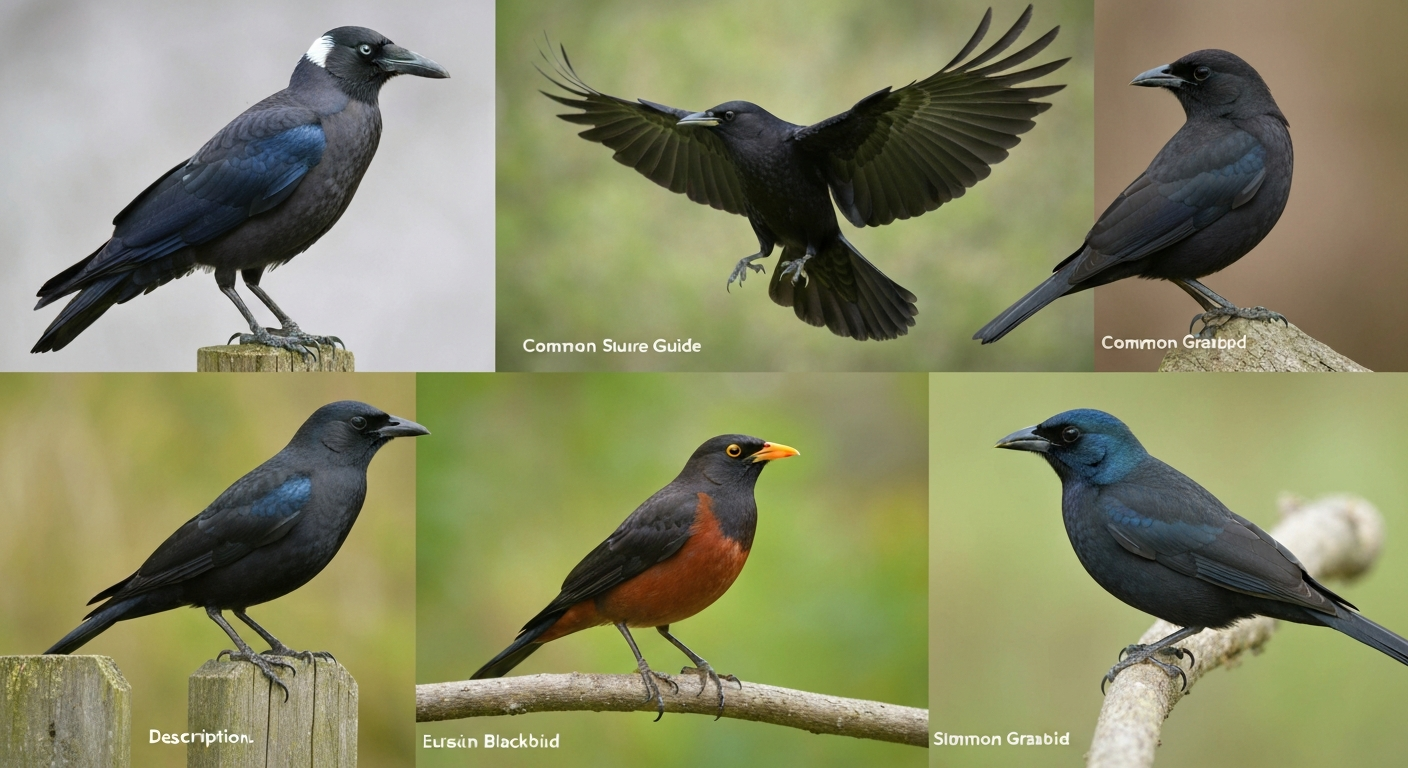
The most commonly seen all-black bird in North America is the American Crow (Corvus brachyrhynchos), while in Europe it is the Eurasian Blackbird (Turdus merula) for gardens and the Carrion Crow (Corvus corone) for open country. Globally, the answer depends entirely on where you saw the bird, how big it was, and what it was doing. This guide walks you through a step-by-step identification workflow, regional species lists, a quick-reference table, and naming ideas for pet-bird owners, so you can pin down the exact black bird you spotted.
Which Is the Black Bird Name? ID Guide to Common Black Birds
Maya Castellanos
23 Jul 2026
How to use this guide
This article is built for three types of readers. First, casual observers who just saw a black bird and want a name for it fast. Second, bird enthusiasts digging into nomenclature, etymology, and regional taxonomy. Third, pet-bird owners browsing for naming ideas with a dark or sleek aesthetic. You do not need to read this from top to bottom. If you want a quick ID, jump straight to the identification workflow and then the regional list for your area. If you are here for naming a pet or learning about the word 'blackbird,' skip to those sections near the end.
Throughout the article, species entries follow this convention: common name first, then scientific name in italics, then key ID notes. Plumage descriptions default to adult breeding plumage because that is the most consistently documented and the most likely match for what you saw. Where juveniles or females look dramatically different, I flag it explicitly. Range information is drawn from IOC World Bird List taxonomy and BirdLife International DataZone.
Step-by-step: how to identify a black bird you just saw
Color alone will not get you to a species name. Two birds can both look solidly black and be completely unrelated. Work through these eight steps in order, and by step five or six most black birds will narrow to one or two candidates.
- Size: Compare the bird to something you know. Was it closer in size to a sparrow, a pigeon, a crow, or a goose? Even a rough estimate (small, medium, large) eliminates most candidates immediately.
- Silhouette and posture: How did it carry itself? Upright and alert like a starling, hunched and heavy like a raven, or slender and horizontal like a grackle? Silhouette is one of the most reliable field clues.
- Bill shape and size: Thick and seed-cracking? Long and probing? Hooked and predatory? Straight and thin? Bill shape reflects diet and is species-diagnostic even at a distance.
- Tail length and shape: Was the tail short and squared, long and wedge-shaped, long and keel-shaped, or forked? A wedge-shaped tail in flight is the single best field mark separating a Common Raven from an American Crow.
- Leg color and posture: Pink legs? Yellow legs? Does it walk, hop, or wade? Leg details are often overlooked but helpful when the bird is on the ground.
- Behavior and foraging mode: Was it picking through leaf litter, probing soil, catching insects in flight, scavenging roadkill, or raiding a nest? Behavioral ecology narrows candidates quickly.
- Habitat and microhabitat: Dense woodland, open farmland, urban park, coastal mudflat, rainforest edge? Most black birds have distinct habitat preferences even when their ranges overlap.
- Vocalizations: The call is often the fastest ID tool of all. A harsh 'caw' versus a deep 'kronk' versus a liquid whistled phrase are entirely different sounds, and recordings are freely available on xeno-canto and the Macaulay Library to compare against your memory.
This workflow follows field-tested methodology used by Cornell Lab's Bird Academy and the approach popularized by the Crossley ID guides, which emphasize shape and proportion over color first, then add pattern, iridescence, and voice to separate lookalikes. A bird you saw only briefly is best placed against a silhouette first, then confirmed with any other detail you can recall.
Quick-reference: common all-black and mostly-black bird species worldwide
| Common Name | Scientific Name | Key ID Marks | Range |
|---|---|---|---|
| American Crow | Corvus brachyrhynchos | All black; squared tail in flight; nasal 'caw' | North America |
| Common Raven | Corvus corax | All black; wedge-shaped tail; heavy bill; deep 'kronk' | North America, Europe, Asia, North Africa |
| Common Grackle | Quiscalus quiscula | Long keel-shaped tail; iridescent purple-blue head; pale yellow eye | Eastern/Central North America |
| Brewer's Blackbird | Euphagus cyanocephalus | Male: iridescent blue-green; pale eye; shorter tail than grackle | Western/Central North America |
| Rusty Blackbird | Euphagus carolinus | Male breeding: all black; rusty edges in non-breeding; pale eye | North America (boreal/wetland) |
| Purple Martin | Progne subis | Male: glossy blue-black all over; largest North American swallow; forked tail | North America (migratory) |
| Eurasian Blackbird | Turdus merula | Male: all black with orange-yellow bill and eye ring; female brown | Europe, Asia, introduced Australasia |
| Carrion Crow | Corvus corone | All black; rounded tail; heavy black bill | Western Europe, Central Asia |
| Common Starling | Sturnus vulgaris | Short tail; triangular silhouette in flight; iridescent spots in breeding plumage | Europe, Asia, introduced widely |
| Eurasian Jackdaw | Coloeus monedula | Small crow; pale grey nape and eye; sociable | Europe, West Asia |
| Pied Crow | Corvus albus | Black with white breast/collar; familiar near human habitation | Sub-Saharan Africa |
| Greater Blue-eared Starling | Lamprotornis chalybaeus | Intense metallic blue-green; yellow-orange eye; glossy | Sub-Saharan Africa |
| Australian Raven | Corvus coronoides | All black; throat hackles; wailing call | Australia |
| Satin Bowerbird (male) | Ptilonorhynchus violaceus | Glossy blue-black; violet-blue eye; stout pale bill | Eastern Australia |
| Oriental Magpie-Robin (male) | Copsychus saularis | Black head, back, throat; white belly and wing patch | South/Southeast Asia |
Black birds that look alike: how to tell them apart
The most common ID mistakes happen within regions where several black species overlap. Here are the most frequent confusion pairs with the exact features that separate them.
| Species Pair | Size Difference | Bill | Tail Shape | Key Vocal Difference | Best Clincher |
|---|---|---|---|---|---|
| American Crow vs Common Raven | Raven roughly twice the mass | Raven: heavier, curved culmen; Crow: straight | Raven: wedge; Crow: square/fan | Crow: 'caw'; Raven: deep hollow 'kronk' | Tail shape in flight + call |
| Common Grackle vs Brewer's Blackbird | Grackle larger | Grackle: longer, slightly decurved; Brewer's: shorter, straight | Grackle: long keel; Brewer's: moderate | Grackle: harsh 'readle-eak'; Brewer's: squeaky 'chek' | Tail length + eye color (both pale but grackle tail is diagnostic) |
| Eurasian Blackbird vs Carrion Crow | Crow much larger | Crow: heavy black; Blackbird male: orange-yellow | Similar length proportionally | Blackbird: fluty melodic song; Crow: flat 'caw' | Bill color + size |
| Common Starling vs Eurasian Blackbird (female/juv) | Similar size | Starling: long, straight, pointed; Blackbird: short, curved | Starling: short; Blackbird: moderate | Starling: complex mimicry/whistles; Blackbird: rich fluting | Bill length and shape in hand or close view |
| Australian Raven vs other Australian corvids | Subtle size overlaps | Raven: longer, heavier | All similar | Raven: wailing descending 'ahhhh'; others differ | Throat hackles + call |
Black birds by region
North America
If you are in North America and saw a large all-black bird, your top candidates are the American Crow and the Common Raven. Crows are familiar, social, and widespread in urban areas, farmland, and woodland edges across the continent. Ravens prefer wilder, more open landscapes including mountains, coasts, and boreal forest, though they do appear in cities in the west. For medium-sized glossy black birds at a feeder or in a marsh, look at Brewer's Blackbird (western bias) and Rusty Blackbird (eastern wetlands in migration). Common Grackles have that distinctive long, keel-shaped tail that flares in flight, a feature no other North American blackbird shares. If you saw a black swallow-sized bird swooping gracefully overhead in summer, it was almost certainly a male Purple Martin.
Europe
In a European garden, the bird singing a rich fluty song from a rooftop at dusk is almost certainly a male Eurasian Blackbird. Its orange-yellow bill is unmistakable once you know it. For larger all-black birds in fields and roadsides, the Carrion Crow is the default across most of western and central Europe. The Common Starling is technically iridescent, not pure black, but in poor light or at distance it reads as a small, short-tailed black bird strutting across a lawn. The Eurasian Jackdaw is smaller than a crow and always shows that contrasting grey nape and the pale, almost ghostly eye. In coastal and cliff habitats of the north and west, look also for the all-black Chough (Pyrrhocorax pyrrhocorax), a corvid with a distinctive red bill and red legs.
Africa
Africa's most familiar 'black' bird near towns and roadsides is the Pied Crow, which is not fully black but is the continent's default large dark corvid. Its white chest and collar are clear in good light, but at dusk or distance it can look mostly dark. For genuinely glossy iridescent black birds in woodland and savanna, the Lamprotornis glossy starlings are the group to focus on. The Greater Blue-eared Starling is a common representative: intensely metallic blue-green with a bright orange-yellow eye, it can look black in shadow and electric in sunlight. Fan-tailed Ravens (Corvus rhipidurus) are also widespread in rocky and arid zones of northeast Africa.
Asia
Across South and Southeast Asia, the Oriental Magpie-Robin is one of the most familiar garden birds, and the male is strikingly black on the head, back, and throat with a clean white underside. While it is not fully black, the black portions dominate in shade. For fully dark corvids, the House Crow (Corvus splendens) is ubiquitous around human settlements across South Asia and has spread through port cities globally. The Large-billed Crow (Corvus macrorhynchos) is the primary all-black crow across much of continental Asia and Japan. In forested regions of the east, Crested Myna (Acridotheres cristatellus) presents as a black starling with a white wing patch.
Australasia
Australia has five black corvid species that are genuinely difficult to separate in the field, with the Australian Raven being the largest and most widespread. Its long throat hackles and distinctive wailing, drawn-out call are the best separators from the similar Australian Crow and Little Raven. The male Satin Bowerbird is one of the most visually striking black birds anywhere: glossy blue-black plumage that shifts intensity with the angle of light, paired with those vivid violet-blue eyes. New Zealand adds the New Zealand Fantail in its black morph (Rhipidura fuliginosa) and the NZ Falcon in dim light, though full-black species are rarer there than in Australia.
When the black bird is not all black: sex, age, and plumage variation
Many birds that are renowned for being black only look that way as adult males in breeding condition. The female Eurasian Blackbird is brown with soft streaking on the breast, not black at all. Female Common Grackles are duller and smaller than the iridescent males. Female and juvenile Purple Martins are pale-bellied, with only the adult male wearing the full glossy blue-black. Rusty Blackbirds in non-breeding plumage acquire rusty-brown feather edges that give them a completely different appearance from the clean-black breeding male. Brewer's Blackbird females are plain grey-brown.
Juvenile birds complicate IDs further. Young corvids often appear duller and more brownish-black than adults, with pink gape flanges visible at close range. Young Common Starlings are plain grey-brown through much of their first autumn, bearing no resemblance to the iridescent adult. When recording a sighting, note whether the bird could have been a juvenile or a female, especially if it looked dull or mottled rather than glossy black. Field guides document these plumage sequences with terms like 'juvenile,' 'first-winter,' and 'eclipse' (the latter mainly for ducks), and consulting species accounts on Cornell's Birds of the World or All About Birds will show you exactly what each age and sex looks like.
What does 'blackbird' actually mean? Names, etymology, and pronunciation
The word 'blackbird' as a stand-alone common name formally belongs to the Eurasian Blackbird, Turdus merula. 'Turdus' is Latin for thrush, and 'merula' is the classical Latin word for blackbird, going back to at least the first century CE in Roman texts. Pronounce the species name as TUR-duss meh-ROO-lah. In everyday British English, 'the blackbird in the garden' almost certainly means this species, nothing else.
In North America, 'blackbirds' as a group refers to the Icteridae family, which includes grackles, Red-winged Blackbirds, orioles, meadowlarks, and cowbirds, many of which are not predominantly black at all. The family name 'Icteridae' derives from the Greek 'ikteros,' meaning jaundice or yellowing, referencing the yellow in many family members rather than the black. This is a good reminder that a bird named 'blackbird' may not be black, and a bird that is entirely black may not be called a blackbird.
The genus Corvus, covering crows and ravens, comes from the Latin for raven, itself echoing the bird's call. 'Raven' in English descends from Old Norse 'hrafn.' 'Crow' traces to Old English 'crawe,' also imitative of the call. The jackdaw's genus name Coloeus is from the Greek 'koloios,' a type of jackdaw. Scientific names encode centuries of observation, and even a rough familiarity with them reveals something about how each species was first understood.
How to get a good ID from the community: what to share when asking
If you post a sighting on a birding forum, eBird, or social media for help, the more detail you give the faster and more accurate the answers will be. Here is exactly what experienced birders need from you.
- Location: Country, region, and habitat type (garden, wetland, forest, coastline). Even just 'suburban London' versus 'rural Montana' eliminates dozens of species.
- Date and time of day: Seasonal context matters enormously. A glossy black bird in a North American marsh in October could be a Rusty Blackbird; in June it probably is not.
- Size comparison: 'About the size of a pigeon' is much more useful than 'medium-sized.'
- Photos: Multiple angles if possible. A photo from directly below in flight showing tail shape is often the most diagnostic single image you can take. Side-on perched shots showing bill shape are the second most useful.
- Behavior: What was it doing when you noticed it? Singing from a high perch, foraging on the ground, flying over in a flock, or following cattle?
- Call: Even a rough description like 'harsh repeated caw,' 'liquid whistling song,' or 'clicking and chattering' helps significantly. If you can record it on your phone, do so.
- Flock size and composition: Was the bird alone, in a pair, or in a large flock? Were other species mixed in?
- Any non-black features: Did you notice any white, brown, grey, or coloured patches, even briefly? Bill or leg colour?
For photo IDs, natural light from the side gives the best colour and structure information. Avoid strong backlight unless you want a silhouette, though a clean backlit silhouette can actually be excellent for shape. Upload the original file if possible rather than a compressed screenshot, since fine feather detail is often diagnostic.
Naming your black-coloured pet bird
If you have a black or dark-feathered pet bird and want a name that matches the look, there are several directions you can take. Classic names lean on the colour itself or on famous black birds in mythology and literature. Pop-culture names pull from films, cartoons, and music. Cute names soften the dramatic colour with something playful. If you’re wondering what is the cutest bird name, check the cute names section for short, playful options. For dozens of playful options and examples, see our guide on what are cute bird names. Gendered names let you match the bird's sex if you know it.
Classic and mythology-inspired names
- Raven: the quintessential literary black bird, from Poe's famous poem to Norse mythology where Odin's ravens Huginn and Muninn flew the world
- Merlin: Arthurian wizard, but also a small falcon with dark plumage and an ominous reputation
- Corvus: the Latin genus name for crows and ravens; elegant and classical
- Onyx: the jet-black gemstone
- Midnight: self-explanatory, evokes darkness without being gloomy
- Shadow: works well for darker, quieter birds
- Dusk: a softer take on dark colours
- Erebus: the Greek primordial deity of darkness, for a bird with dramatic presence
Cute names for a black bird
- Ink: short, punchy, and instantly visual
- Cinder: charcoal-dark but warm-sounding
- Pepper: especially good for a black bird with bright eyes
- Smudge: great for a bird with slightly mixed dark plumage
- Licorice: playful, sweet, and distinctly black
- Pebble: small and dark, good for a quiet, unassuming bird
- Noir: French for black, adds a bit of flair
Gendered name ideas
- Male: Huginn, Muninn, Magnus, Drake, Zorro, Obsidian, Coal, Jet
- Female: Luna, Nyx, Vesper, Morrigan (Celtic goddess associated with crows), Selene, Raven, Ebony, Lyra
Pop-culture names
- Hitchcock: a nod to The Birds, the classic thriller featuring flocks of attacking crows and other species
- Vantablack: the darkest artificial material ever made, now a name for the darkest bird
- Morticia: sleek, dark, and theatrical
- Kylo: for the dark-side enthusiasts in the room
- Salem: the black cat from Sabrina, but it works equally well for a bird
- Maleficent: the shape-shifting crow-obsessed villain from Sleeping Beauty
For deeper naming inspiration, the site also covers good pet bird names broadly, best female bird names with gendered lists, and what are cute bird names with themed suggestions spanning colours, personalities, and pop culture. If your bird has a particular cultural connection, such as a cartoon or film character associated with a bird, there are also pages on the Froot Loops bird name (Toucan Sam) and the Bugs Bunny bird name for fans of animated bird characters.
What photos to take for a black bird ID
When you are trying to photograph a black bird for identification, the challenge is that black plumage absorbs light unevenly, so what looks like a featureless silhouette to a camera often has diagnostic iridescence, bill colour, and feather texture visible to the naked eye. Here are the photo types that give the most ID information.
- Side-on perched shot in soft natural light: reveals overall proportions, bill shape, leg colour, and any iridescence in the plumage
- Tail-on or front-on perched shot: shows bill width and depth, and any facial markings (eye colour, bare skin patches)
- Flight shot from below: shows tail shape (wedge vs squared vs forked), wing shape, and wing-tip projection
- Flight shot from above or the side: shows wing formula and back pattern
- Close detail of bill and eye: even a blurred close crop can reveal bill colour and eye colour, both highly diagnostic
- Habitat context shot: a wider shot showing what the bird was standing on or near, to establish habitat
For photos hosted on Wikimedia Commons or shared from the Macaulay Library archive, always check the file page for license details before reuse. Macaulay Library – a scientific media archive for birds (Cornell Lab) is a primary repository for curated photos, audio and video and lists contributor usage rights on each media file page. Macaulay Library materials have contributor usage rights listed per item, and Wikimedia Commons files carry per-file license metadata such as CC BY or CC0.
Quick field checklist: take this outside with you
- How big is it? (sparrow / starling / pigeon / crow / raven / larger)
- What shape is the tail in flight? (square, wedge, keel, forked, rounded)
- What does the bill look like? (short and thick, long and thin, hooked, straight, curved down)
- Any colour other than black? (bill colour, eye colour, leg colour, wing patches, breast colour)
- How does it move? (hops, walks, swoops, soars, wades)
- What habitat? (garden, woodland, open field, coast, wetland, mountain)
- What does it sound like? (harsh, melodic, clicking, deep, nasal)
- Is it alone or in a group? How large is the group?
- What is the date, your location, and the time of day?
- Any photos or audio recordings captured?
Related topics worth exploring on this site
Black is just one corner of bird colour and nomenclature. If your interest runs to other colours, the page on which is the green bird name covers the parallel world of green-plumaged species with the same ID approach. The broader which bird name page provides a general framework for identifying any species by name, not just dark-coloured birds. See the which bird name page for a general framework to identify any species by name, not just dark-coloured birds. If you landed here looking for naming inspiration for a pet, the good pet bird names and best female bird names pages offer curated themed lists, and the pages on what are cute bird names and what is the cutest bird name go deep on playful and endearing options. For fans of pop-culture bird names, the page on what is the Froot Loops bird name (it is Toucan Sam, for the record) and the bugs bunny bird name page are worth a read for the cultural context they provide.
What to do after you identify your black bird
Once you have a species name, log your sighting on eBird (ebird.org), the global citizen-science database run by Cornell Lab of Ornithology. Your record contributes to real population and distribution science, and eBird's species maps will also show you whether your sighting was expected or unexpected for your location and time of year, which is itself a useful ID check. Unexpected species flags are reviewed by local experts.
If you want to develop your ID skills further, joining a local birding group is the fastest route. Most regions have a bird club or natural history society that runs guided walks, and seeing how experienced observers work through an ID in real time teaches more in an afternoon than weeks of solo study. National societies such as the RSPB (UK), Audubon (USA), BirdLife Australia, and their equivalents in other countries offer member resources, hotlines, and forums. For audio-based learning, xeno-canto and the Macaulay Library are the best free archives for practising call recognition, which is often the single fastest ID skill you can build.
FAQ
What is a good, search-friendly title and concise meta description for this article?
Title: Which Black Bird Is That? Identification Guide to Common All- or Mostly-Black Birds Worldwide. Meta description: Quick illustrated guide to identifying common black birds by size, shape, bill, tail, behavior, habitat and call, plus quick-reference species table, regional lists, name origins, and pet-name ideas.
What step-by-step workflow should I use to identify a black bird I saw?
1) Estimate size (compare to a benchmark: sparrow, starling, pigeon, crow). 2) Note silhouette/profile (neck length, posture, tail length/shape). 3) Examine bill shape and size (thin, pointed; thick; long decurved; stout corvid bill). 4) Look at tail: long/keel-shaped, square, wedge, forked. 5) Check leg color and posture (long legs, perching vs ground‑walker). 6) Watch behavior (foraging method, flocking, flight pattern). 7) Record habitat (woodland, wetland, urban, farmland). 8) Listen for calls (harsh caw, bubbly warble, metallic notes). Use shape and proportions first, then color/iridescence and voice to narrow choices.
Which black-or-nearly-black species should I first consider (quick-reference)?
Frequently encountered widespread species to check first: - American Crow (Corvus brachyrhynchos): large, stout bill, square tail in flight, cawing. - Common Raven (Corvus corax): very large, heavy bill, wedge tail, deep croak. - Common Grackle (Quiscalus quiscula): long keel tail, iridescent head, long bill. - Brewer's Blackbird (Euphagus cyanocephalus): medium, straight bill, male glossy head, female browner. - Eurasian Blackbird (Turdus merula): medium thrush shape, slim bill, melodious song. - Common Starling (Sturnus vulgaris) (non-breeding often speckled): chunky, short tail, pointed bill. - Purple Martin (Progne subis): large swallow, glossy dark, forked tail. (Use local field guides or Birds of the World for regional presence and adult plumage notes.)
Can you provide a comparison table of key ID marks for common black species?
Comparison (summary): - American Crow (Corvus brachyrhynchos): size pigeon-to-raven, thick bill, square tail, plain black. - Common Raven (Corvus corax): very large, massive bill, wedge tail, shaggy throat. - Common Grackle (Quiscalus quiscula): long keel tail, iridescent head, long bill, yellow eye (adult). - Brewer's Blackbird (Euphagus cyanocephalus): medium, glossy male head, brownish female, pale eye in males. - Eurasian Blackbird (Turdus merula): thrush silhouette, slim bill, melodious song. - Common Starling (Sturnus vulgaris): compact, short tail, triangular wings, speckled in winter. Note: use size, tail shape and bill as primary separators; check eye color and iridescence where visible.
Which black bird species are most likely in North America, Europe, Africa, Asia and Australasia?
Region-focused likely species (examples): - North America: American Crow, Common Raven, Common Grackle, Brewer's Blackbird, Rusty Blackbird, Purple Martin. - Europe: Eurasian Blackbird, Carrion Crow, Common Starling, Eurasian Jackdaw. - Africa: Pied Crow, various glossy starlings (Lamprotornis spp.), some corvids and cormorants in coastal areas. - Asia: Oriental Magpie-Robin (male), House Crow/Large-billed Crow complexes, regional glossy starlings. - Australasia: Australian Raven, Satin Bowerbird (male), local corvids and cormorants. Use national atlases, BirdLife and regional field guides to confirm local ranges and seasonal occurrences.
How do sexual dimorphism, age and seasonal plumage affect identification?
Many 'black' species are sexually dimorphic or have juveniles/non-breeding plumages that are duller or patterned. Example: male Purple Martins and some starlings are glossy dark while females/juveniles are paler or brownish. Juveniles often have streaks or scallops that hide an adult's blackness. Always note age/sex when possible and consult species accounts (All About Birds / Birds of the World) for plumage sequences before committing to an ID.