
The 'Liver' in 'Liver Bird' is pronounced /ˈlaɪvə/ (rhymes with 'diver'), while the 'Liver' in 'Liverpool' is pronounced /ˈlɪv.ə/ (rhymes with 'giver'). They look identical on paper but come from completely separate words with separate sound histories, which is exactly why they trip people up. The place name Liverpool derives from an Old English word meaning thick or clotted water, while the Liver Bird took its name centuries later from the city's seal device, by a roundabout route involving heraldry, seaweed, and some creative folk etymology. In short: same spelling, different origins, different vowels.
Why Liver in Liver Bird and Liverpool Sound Different

Maya Castellanos
20 Jul 2026
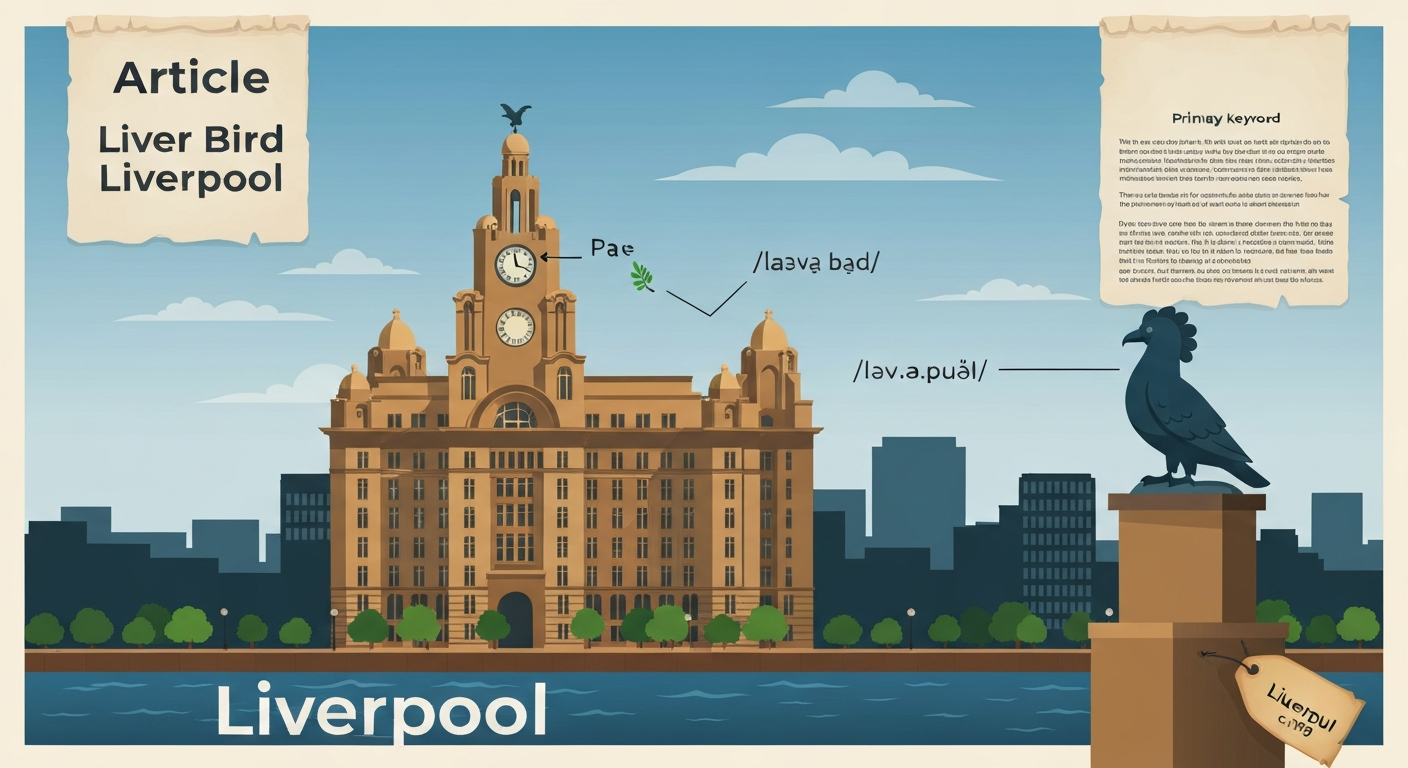
The two pronunciations side by side
Here is the clearest way to see the distinction. The Oxford Learner's Dictionary lists 'Liver Bird' as /ˈlaɪvə bɜːd/, with the long diphthong /aɪ/ in the first syllable, exactly as in the word 'alive'. The Cambridge Dictionary lists Liverpool as /ˈlɪv.ə.puːl/ in British English and /ˈlɪv.ɚ.puːl/ in American English, using the short /ɪ/ vowel, exactly as in the word 'live wire' or the digestive organ 'liver'. Collins Dictionary lists the organ 'liver' as /ˈlɪv.ə(r)/ and provides an audio pronunciation Collins Dictionary lists the organ 'liver' as /ˈlɪv.ə(r)/ and provides an audio pronunciation.. Those two vowels, /aɪ/ and /ɪ/, are the heart of the mismatch.
| Term | IPA (British English) | First syllable sounds like | Vowel type |
|---|---|---|---|
| Liver Bird (the emblem) | /ˈlaɪvə bɜːd/ | 'diver', 'alive' | Long diphthong /aɪ/ |
| Liverpool (the city) | /ˈlɪv.ə.puːl/ | 'liver' (the organ), 'giver' | Short monophthong /ɪ/ |
| Liver (the organ) | /ˈlɪv.ə/ | 'giver', 'river' | Short monophthong /ɪ/ |
It is worth noting that the Scouse accent (Liverpool English) has its own distinctive phonology, with contact-related features including lenited plosives, shifted vowel qualities, and prosodic patterns that differ markedly from Received Pronunciation. A fluent Scouser saying 'Liverpool' or 'Liver Bird' may not match the dictionary IPA exactly. But the standard reference forms above are what learners' dictionaries, pronunciation guides, and heraldic texts consistently record, and they are the best baseline for understanding why the two words diverge.
How Liverpool got its name: the earliest spellings and what they tell us
The place name Liverpool is genuinely old. The earliest surviving written record is Liuerpul, dating to roughly 1190 to 1194. From there the documentary trail is rich: Liuerpul again in 1207, Liuerpol in the Pipe Rolls of 1211, Litherpol around 1222 to 1226, Leuerepul in 1229, Lyuerpole in 1346, and LeuerpoU in 1393. That long sequence of medieval spellings is the raw material that place-name scholars work from, and it points consistently to a two-part Old English compound.
The scholarly consensus, established by Eilert Ekwall and reinforced by the English Place-Name Society (EPNS) and the Cambridge Dictionary of English Place-Names, reads the compound as Old English lifer, meaning thick or coagulated (water), combined with pol, meaning pool or creek. Online Etymology Dictionary, Liverpool (summarises O.E. lifer + pol; cites place-name literature) Online Etymology Dictionary — Liverpool (summarises O.E. lifer + pol; cites place-name literature). The best translation is something like 'pool with thick, muddy water', which is descriptive rather than glamorous but makes perfect geographical sense for a tidal inlet on the Mersey. The Old English word lifer is related to lifrig or M.E. livered, meaning clotted or coagulated, the same root that gives us the digestive organ 'liver' (because of its dense texture). That is why the place name carries the short /ɪ/ vowel: it descends from a short Old English vowel, not from any bird name.
Where the Liver Bird name actually comes from
The bird is a much later story, and an entertainingly convoluted one. Liverpool's earliest surviving common seal impression dates to 1352, and it already shows a bird-with-branch device. Nobody in medieval Liverpool seems to have been particularly anxious about what species the bird was supposed to be. By the 17th century, civic records were calling it either a 'Cormorant' or a 'leaver', the latter spelling appearing in municipal inventories of plate (1611) and on the mace (1668). That word 'leaver' is a key piece of the puzzle.
'Leaver' or 'lever' was an early modern English name (ultimately derived from Old French laver, meaning to wash) for laver seaweed, the greenish-black edible seaweed. The bird on the city seal was depicted holding a sprig of exactly this plant in its beak. When the College of Arms formally granted Liverpool its municipal arms on 22 March 1797 (the request came from Mayor Clayton Tarleton in August 1796), the official blazon was recorded as 'Argent, a cormorant, in the beak a branch of laver'. The word laver in that blazon is a canting allusion, a heraldic pun on the city's name. Heraldic writers including John Vinycomb described the resulting creature as a 'Liver (Cormorant)', combining the laver-seaweed connection with the place name into a single portmanteau nickname.
So the Liver Bird's name is essentially a folk-heraldic compound: laver (the seaweed, pronounced /ˈleɪvə/ in English, with the long diphthong) got contracted and respelled as 'Liver', dragging the /aɪ/ vowel along with it. That is why 'Liver' in 'Liver Bird' sounds like 'laver' or 'diver', while 'Liver' in 'Liverpool' sounds like the organ. The National Museums Liverpool and the Museum of Liverpool both reinforce this reading, displaying Liver Bird artefacts and describing the emblem explicitly as a cormorant-like figure holding laver seaweed.
The linguistics behind the mismatch: sound change, dialect, and spelling
English spelling is famously unreliable as a guide to pronunciation, and this case is a textbook illustration of why. The same four-letter sequence L-I-V-E-R maps onto two different sound histories. In the place name, the vowel descends from Old English short /i/ (in lifer), which became Modern English short /ɪ/ through regular development. In the bird's name, the vowel came in via the word laver, which carried a long /eɪ/ or /aɪ/ diphthong reflecting its Old French ancestry. When 'laver-bird' was compressed and respelled as 'Liver Bird', the diphthong was preserved in spoken tradition even though the spelling converged with the unrelated word 'liver'.
There is also a dialect and register layer. Place names tend to be phonologically conservative: speakers keep pronouncing Liverpool with /ɪ/ because that is how the name has always been transmitted locally, regardless of what the spelling might suggest. The compound 'Liver Bird', by contrast, entered the standard lexicon relatively late (post-1797 heraldic formalisation at the earliest as a fixed phrase) and was always associated with the laver/leaver pronunciation strand. When the two forms ended up spelled identically, the divergent pronunciations were already too entrenched to merge. Sociophonetic research on Liverpool English (Scouse) confirms that local phonological features are robust and long-standing, which further insulates the place name's vowel from any drift toward the bird-name pronunciation.
A quick timeline showing the two names diverge
- c. 1190: Liuerpul appears in documentary records as the place name, derived from Old English lifer (thick water) + pol (pool). Short /ɪ/ vowel established.
- 1352: Earliest surviving common seal impression shows a bird-with-branch device but no standard name for the bird yet.
- 1611: Municipal plate inventory refers to the city bird as a 'Cormorant' or 'leaver' (the seaweed-related name).
- 1668: The mace inscription repeats the 'leaver' or 'Cormorant' identification of the civic bird.
- 22 March 1797: College of Arms formally grants municipal arms; the official blazon reads 'a cormorant, in the beak a branch of laver'. The laver connection is now heraldically canonical.
- 19th–20th centuries: 'Liver Bird' becomes the standard popular name for the device; the laver-derived /aɪ/ vowel is embedded in the compound. The divergence from Liverpool's /ɪ/ is now fully visible in spelling but already long-established in speech.
Is Liverpool named after the Liver Bird? The direct answer
No, and the timeline above makes this clear. Liverpool's name predates any recorded association with a bird by at least 160 years. The place name is from Old English and means 'pool with thick or clotted water'. The bird device on the seal appeared in the 14th century, acquired the nickname 'leaver' or 'Liver' through a heraldic pun on the city name, and was eventually formalised as a cormorant in 1797. The relationship runs the other direction: the Liver Bird was named (indirectly) after Liverpool, not the other way around. The seaweed-laver pun in the 1797 blazon was deliberately constructed as a reference to the city's name, which is how canting arms work. The question of whether Liverpool is named after the Liver Bird is worth exploring in its own right, and the answer, backed by the documentary spelling record and EPNS scholarship, is a clear no.
Case study: why Alcatraz is named after a bird
Liverpool is far from the only place whose name has a bird-related backstory that needs unpicking. Alcatraz Island in San Francisco Bay is a compelling parallel. The name comes from Spanish alcatraz, which in early modern Spanish referred to a pelican or large seabird (the word itself derives from Arabic al-qadus, meaning the bucket or the vessel, a reference to the pelican's pouch). Spanish explorers charted the island in the 18th century and named it La Isla de los Alcatraces, meaning Island of the Pelicans, because of the seabirds nesting there. Later English usage shortened it to Alcatraz and the avian etymology was largely forgotten by the general public, much as the laver-seaweed origin of 'Liver Bird' faded from common knowledge. In both cases, a perfectly descriptive bird-related name became so embedded in a place's identity that the original meaning became invisible.
The linguistic journey of 'alcatraz' is also interesting because the word's bird identity shifted over time: in modern Spanish, alcatraz most often refers to a gannet or booby rather than a pelican, and in English the word migrated entirely from ornithological vocabulary to becoming synonymous with the prison. That kind of semantic drift, where a bird name gets attached to a place and then loses its avian meaning entirely, is something you see repeatedly in place-name etymology across many languages.
Case study: the turkey's real name and how it got it
While we are on the subject of bird names that make no geographical or etymological sense at first glance, the turkey is a spectacular example. The bird's scientific name is Meleagris gallopavo, but the common English name 'turkey' is a misnomer born of a classic case of trading-route confusion. When the guinea fowl (Numida meleagris) was first imported into Europe via Ottoman Turkish merchants in the 16th century, English speakers called it the 'turkey fowl' or 'Turkey bird', associating it with the trade routes through the Ottoman Empire. When New World explorers brought back the genuinely American bird (what we now call the turkey proper), English speakers assumed it was the same bird they had already named, or at least applied the same label by analogy. For more on the bird's naming and its scientific name, see what is the real name of turkey bird. The name stuck to the American species, which is why a bird native to North America ended up with a name that points to the Ottoman Empire.
It is a reminder that common bird names are often historical accidents rather than logical descriptions. The Liver Bird's name is an accident of heraldic punning; the turkey's name is an accident of trade geography; and, as the Alcatraz case shows, even place names can lose their bird-derived meanings entirely within a few generations. Bird naming, whether for wild species, civic emblems, or pet birds, is rarely as straightforward as it looks on paper.
Why this matters for anyone interested in bird names
I find the Liver Bird story genuinely useful as a teaching example precisely because it contains so many of the mechanisms that create confusing bird names in one compact package: folk etymology, heraldic punning, spelling convergence, vowel history, and the tendency for civic symbols to take on lives of their own independent of their original meaning. If you are working through other bird-name puzzles, whether you are trying to figure out what a riddle about a long-necked bird is pointing at, or wondering why a particular species has a common name that seems to contradict its scientific one, the same toolkit applies. See the related example titled "it has a long neck a name of a bird" for another concise bird-name puzzle. Ask first what language the name came from, then check the earliest spellings, then look at what sound changes might have occurred between the source word and the modern form.
- The Liver Bird's /aɪ/ vowel comes from laver (seaweed), not from the place name Liverpool.
- Liverpool's /ɪ/ vowel comes from Old English lifer (thick water), established by c. 1190.
- The 1797 College of Arms blazon is the canonical source for the laver-seaweed connection in the bird's name.
- Place names are phonologically conservative: local pronunciation tradition locks in vowel quality independently of spelling.
- The same four-letter string L-I-V-E-R can carry two different vowel sounds because it has two independent etymological histories.
If you enjoy untangling this kind of linguistic knot, the etymology of other civic and geographical bird names rewards the same close attention. The routes by which bird names travel from observation to heraldry to place name to popular culture are rarely direct, and the detours are usually the most interesting part.
FAQ
Why does the "Liver" in "Liver Bird" sound different from the "Liver" in "Liverpool"?
They are pronounced differently because they represent two distinct lexical and prosodic usages that have followed separate pronunciation traditions. In the compound name "Liver Bird" the first element is pronounced /ˈlaɪvə/ (diphthong like "lie") in standard references (Oxford Learner’s Dictionaries). The place-name "Liverpool" preserves the short-v vowel /ˈlɪvə.puːl/ (like the organ "liver") in standard British pronunciation (Cambridge Dictionary, Collins). Historical spelling evidence and place-name etymology show Liverpool comes from Old English lifer/lifrig + pol ‘pool’ meaning a muddy or thick pool — unrelated to any bird — so the town-name’s short vowel is historically grounded (see Wall 1970; Ekwall/EPNS summaries). Meanwhile the two-word label "Liver Bird" is a later English compound whose pronunciation follows modern lexical patterns that favor /aɪ/ in that fixed name (Oxford Learner’s Dictionaries). Local accent variation (Scouse) can add further differences, but standard references record the forms above (Cambridge; OED summaries cited in place-name literature).
What are the IPA pronunciations for each form?
Standard reference pronunciations: "Liverpool" (UK) /ˈlɪv.ə.puːl/ (US /ˈlɪv.ɚ.puːl/) and the word "liver" (organ) /ˈlɪv.ə(r)/. The set phrase "Liver Bird" is given as /ˈlaɪvə bɜːd/ in learners’ dictionaries (Oxford Learner’s Dictionaries). Cambridge and Collins provide the standard pronunciations for the place-name and the organ respectively.
Is Liverpool named after the Liver Bird?
No. Scholarly place-name evidence shows Liverpool derives from Old English lifer/lifrig 'thick, clotted' + pol 'pool', meaning a muddy or turbid pool; this etymology (Ekwall/EPNS summaries) predates any reliable bird-derivation. The city’s bird device appears early in civic seals (surviving seal impressions from the 14th century and municipal records) and was likely a visual emblem that later generated folk-etymological links between the town-name and a bird. Municipal and heraldic sources from the 17th–18th centuries describe the bird (often called a cormorant) and by 1797 the College of Arms blazoned it as a cormorant bearing a sprig of laver — a symbolic (canting) device rather than the historical source of the placename (Wall 1970; British Museum catalogue; municipal records).
How do historical spellings support the etymology of Liverpool (not the bird)?
Medieval documentary spellings recorded in county records and charter editions show forms like Liuerpul (c.1190–1194), Liuerpul (1207), Liuerpol (1211), Litherpol (c.1222–1226), Leuerepul (1229), Lyuerpole (1346), and LeuerpoU (1393). These forms point to Old English lifer/lifrig + pol (pool) rather than any Old English bird-name; place-name scholars (Ekwall, EPNS, and county record editors) base the 'muddy pool' etymology on this corpus of spellings (see Wall 1970; published charters and Farrer editions).
How did the civic bird come to be associated with the name if the name predates the bird association?
The bird motif appears on medieval civic seals (14th-century impressions survive) and in municipal plate and inventories from the 17th century. The presence of a bird on city insignia invited folk explanation and canting symbolism (linking the bird with 'laver' seaweed and with the town-name). Over time the emblem was described as a cormorant-like bird and popularly called the "Liver Bird;" heraldic grants (1797) formalised the device. So the emblem and popular name developed after the placename; the emblem did not name the town (Wall 1970; British Museum; National Museums Liverpool).
Could dialects (like Scouse) cause the pronunciation mismatch?
Dialectal variation (Liverpool English, "Scouse") does affect vowel quality and prosody and can alter how compound names are realised in local speech, but the primary mismatch here is lexical: standard lexical pronunciations recorded in dictionaries treat "Liver Bird" and "Liverpool" differently (/ˈlaɪvə/ vs /ˈlɪvə/). Scholarly descriptions of Liverpool English document local phonetic differences but do not change the standard etymological explanation for the vowel histories (Journal of the International Phonetic Association: Liverpool English). Local accent may make both forms sound more similar or different to unfamiliar listeners, but it doesn't change the historical origins recorded in place-name studies.
Next Articles
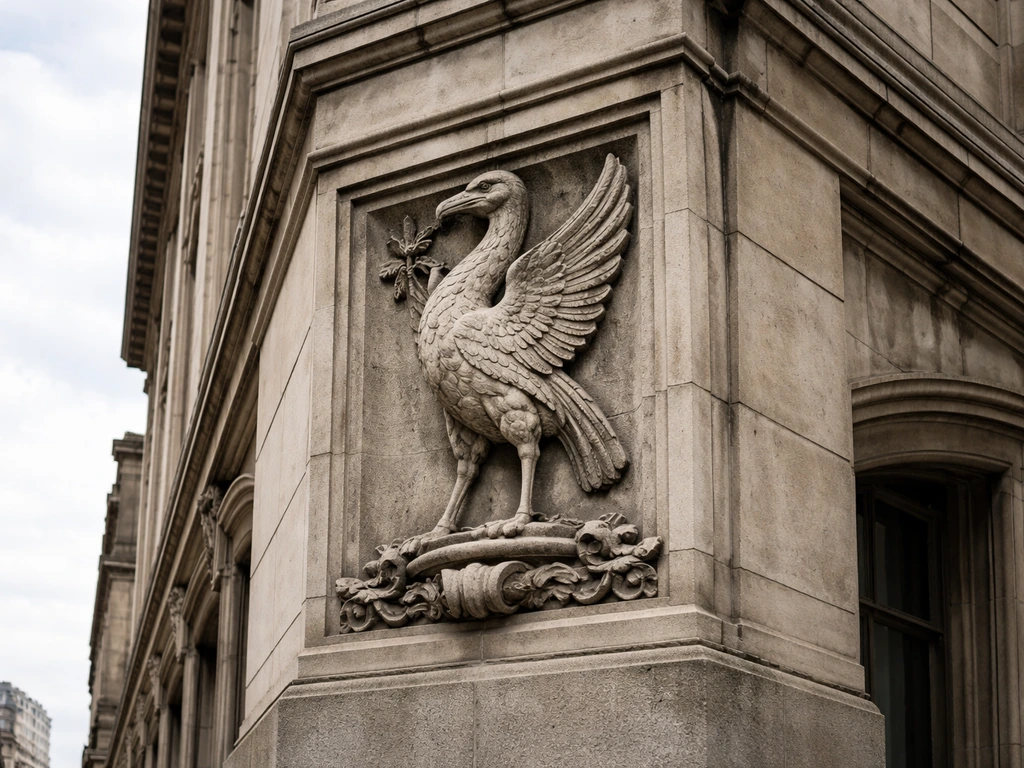
Is Liverpool Named After the Liver Bird? The Facts and Etymology
No, Liverpool is not named after the Liver bird. Learn the emblem’s origin and the real etymology of Liverpool.

Alcatraz Island Named After What Bird? Name Etymology
Find which bird Alcatraz derives from, tracing Spanish Portuguese roots and clearing similar name confusions.
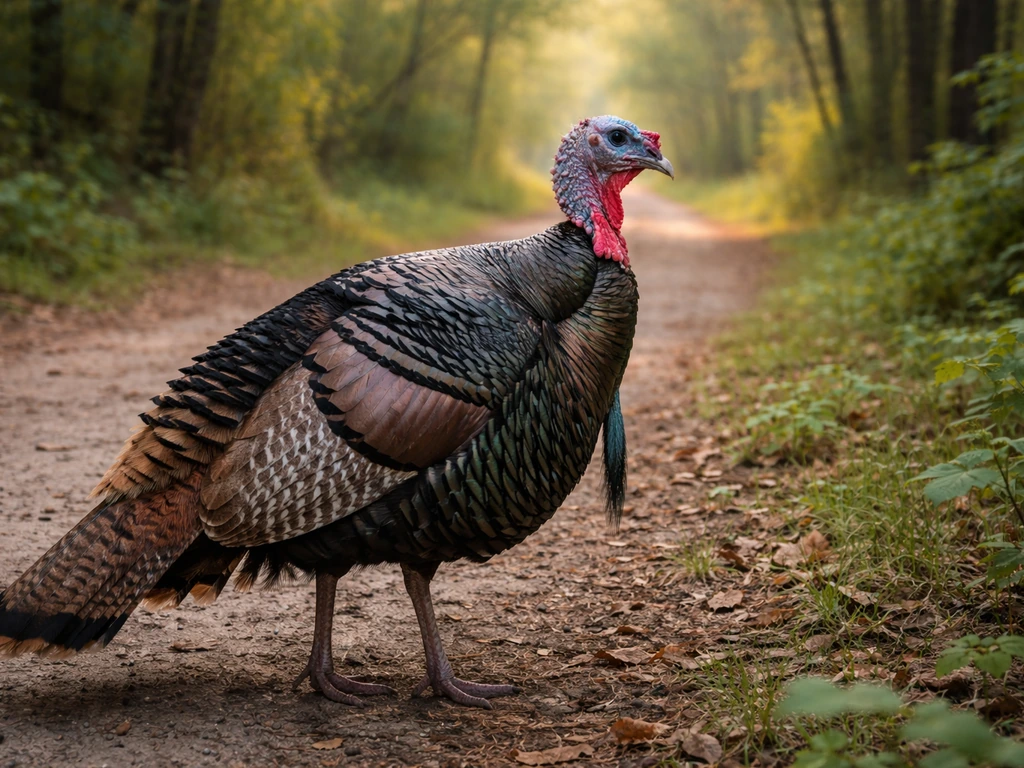
What Is the Real Name of Turkey Bird
Discover what “turkey bird” really means, including the correct common and scientific names and how to verify the specie