
The real name of the turkey bird is Meleagris gallopavo, which carries the standard common name "Wild Turkey" (or just "turkey" when referring to the domesticated form). If someone asks you for the "real name" and wants the full scientific binomial, that's it: Meleagris gallopavo, first formally described by Linnaeus. The U.S. Fish and Wildlife Service, the USDA Forest Service, Cornell Lab of Ornithology, and the FDA all agree on this. So if you've been wondering whether there's some other, more official-sounding name hiding behind the word "turkey," there isn't. That's the bird.
What Is the Real Name of Turkey Bird

Maya Castellanos
23 Jun 2026
What people usually mean by "turkey bird" (and why it gets confusing)
The phrase "turkey bird" itself is a bit of informal doubling, like saying "tuna fish." Most people typing it into a search bar are either curious about the common Thanksgiving bird's scientific identity, or they've heard a regional nickname somewhere and want to know what species it refers to. A smaller group might have encountered a bird casually called a "turkey" that isn't actually one, and they're trying to sort it out.
The confusion has real sources. Britannica points out that several unrelated birds carry "turkey" in their common names: the brush turkey (a megapode), the Australian bustard (sometimes called "bush turkey"), the water turkey (actually a snakebird or anhinga), and the turkey vulture. None of these are true turkeys. They borrowed the name because of a passing resemblance, a behavioral quirk, or just the chaotic way English bird names evolved. So when someone says "turkey bird," they might genuinely be looking at one of those lookalikes and not realize it.
The correct standard common name and scientific name
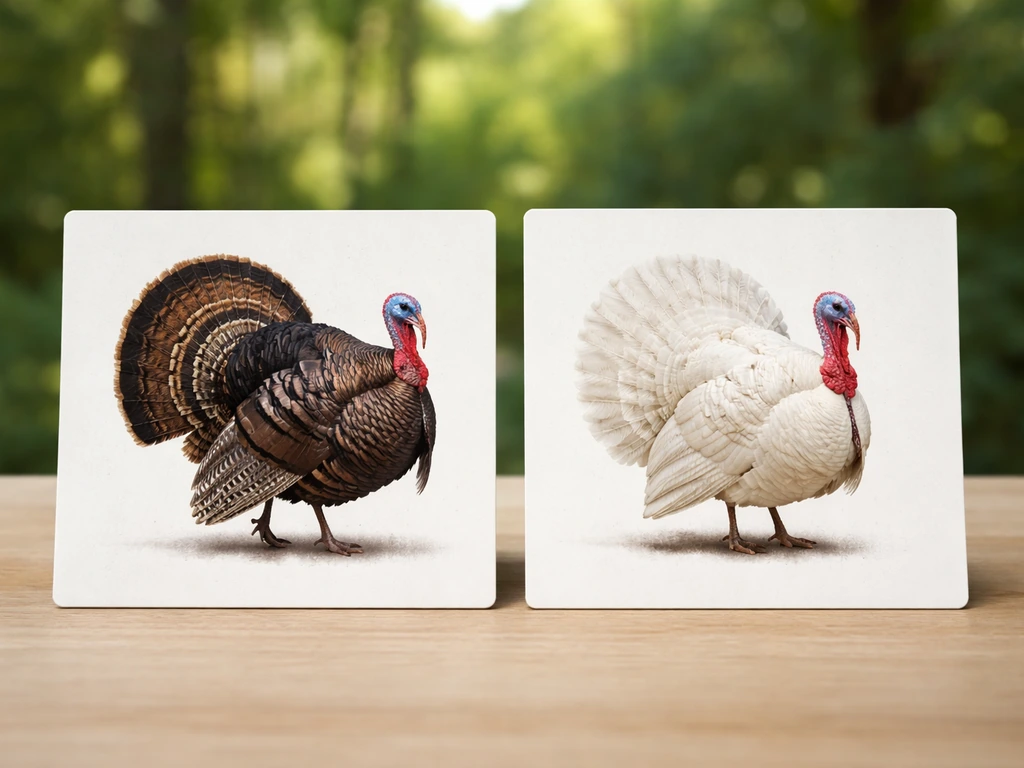
There are actually two living species in the genus Meleagris, and both are legitimately called turkeys. Here's how they break down:
| Common Name | Scientific Name | Where Found |
|---|---|---|
| Wild Turkey (and domestic turkey) | Meleagris gallopavo | Native to North America; domesticated worldwide |
| Ocellated Turkey | Meleagris ocellata | Yucatan Peninsula and parts of Central America |
When someone types "turkey bird" without any other context, they almost certainly mean Meleagris gallopavo. This is the bird that became the dominant domesticated poultry species, the one on your Thanksgiving table, and the one strutting through North American forests and backyards. The ocellated turkey is a real species with a genuinely stunning, iridescent appearance, but it's not what most people are picturing. The FDA, ITIS (the Integrated Taxonomic Information System), and wildlife agencies all formally use Meleagris gallopavo as the current and accepted scientific name for the common turkey.
Synonyms and regional nicknames you might be running into
Different communities and contexts use different names for Meleagris gallopavo, which is part of why the "real name" question comes up. Here are the most common ones:
- Wild Turkey: the standard wildlife and ornithological common name used by Cornell Lab, the U.S. Fish and Wildlife Service, and most field guides
- Domestic turkey or farm turkey: the same species (Meleagris gallopavo) after thousands of years of selective breeding, now raised for food worldwide
- Gobbler or tom: informal names specifically for adult male turkeys, referencing the distinctive gobbling call males use to attract mates
- Jake: a young male turkey in its first year, widely used by hunters and wildlife observers
- Jenny or hen: an adult female turkey
- Turkey cock / turkeycock: an archaic English term for a male turkey, historically important because it's where the name "turkey" itself comes from (more on that below)
- Turkey hen / turkeyhen: the female counterpart in older English usage
- Bronze turkey: a common domesticated breed variety named for its coloring, not a separate species
In some parts of the world, especially in pet and aviary contexts, you might also see "turkey" applied loosely to large, impressive birds that aren't in the genus Meleagris at all. Brush turkeys (family Megapodiidae) are popular in Australian aviaries and backyards and look vaguely turkey-like. If someone gave you a bird described as a "turkey" in a pet context outside North America, that's worth checking carefully against appearance and origin details.
How to confirm which bird you're actually looking at

If you're trying to verify that what you're seeing, owning, or reading about is actually Meleagris gallopavo and not a lookalike, here are the most reliable checks.
Visual field marks
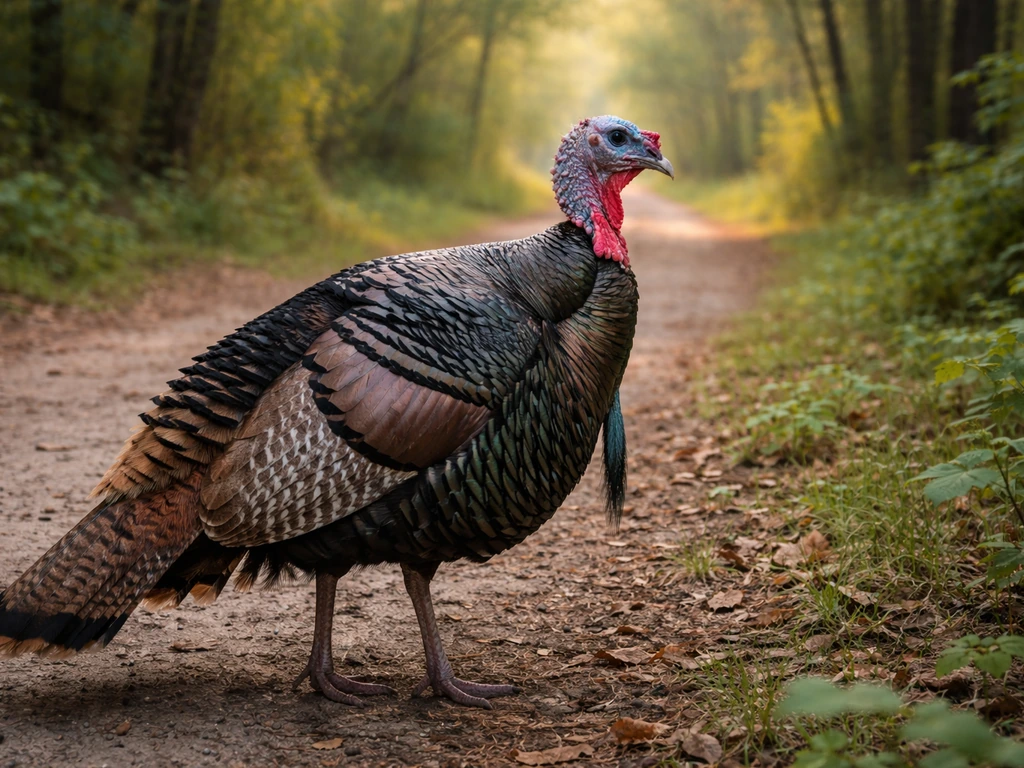
A displaying male wild turkey is one of the more dramatic birds in North America. Cornell Lab describes them as looking "almost spherical" when fully puffed, with a bare, warty head that flushes red and blue, a fan of tail feathers spread wide, and a dangling fleshy "snood" over the beak. The rump and tail feathers are broadly tipped with rusty or white. Gobblers (adult males) have tail feathers tipped with black. Hens are smaller and considerably duller in color, with less prominent head ornamentation.
Wild turkeys are noticeably slimmer than domestic ones. Some people in an online discussion also point to label/appearance differences such as how wild versus domestic turkeys look, including differences in features like head and body proportions wild turkeys are noticeably slimmer than domestic ones.
The Pennsylvania Game Commission describes wild birds as having a smaller head relative to body size, a longer neck, rangier legs, and smaller fleshy head/neck adornments compared to farmed domestic turkeys. A wild turkey also has the characteristic long neck and bare head, which can help you distinguish it from similar birds. If your bird looks like a feathered bowling ball with tiny legs, it's almost certainly a domestic breed.
If it looks lean and alert and can actually run fast, it's wild.
Location cues
Wild Meleagris gallopavo is native to North America, and populations now exist across most of the continental United States, parts of Canada, and Mexico. If you're spotting a large, dark, ground-foraging bird with a bare red head in North America, wild turkey is a strong candidate. In Central America's Yucatan region, the ocellated turkey (Meleagris ocellata) takes over, and it looks quite different: iridescent blue-green body feathers, orange-tipped tail spots, and a bright blue head with orange-red nodules.
Label and product checks

If you're looking at a cage tag, a meat product label, a zoo placard, or wildlife paperwork, the scientific name Meleagris gallopavo should appear for any officially documented common turkey. The FDA explicitly references this binomial in regulated turkey meat product documentation, so it's the name that carries legal and regulatory weight. If a label says only "turkey" without a scientific name and you need to verify species for aviary, wildlife, or food-safety reasons, cross-check it against eBird's Wild Turkey species page or the U.S. Fish and Wildlife Service's species profile, both of which list Meleagris gallopavo as the verified name.
Watch out for these look-alikes
- Turkey vulture (Cathartes aura): dark plumage, bare red head, whitish beak, white legs. Often mistaken for a turkey at distance, especially when perched with wings spread. It's a large raptor, not related to turkeys at all.
- Brush turkey (Alectura lathami): an Australian megapode. It has a bare red head and dark body feathers, which triggers the "turkey" association, but it belongs to an entirely different bird family.
- Ocellated turkey (Meleagris ocellata): a genuine turkey species but easily distinguished by its iridescent coloring and limited range in the Yucatan Peninsula.
- Helmeted guineafowl (Numida meleagris): historically called "turkey" in early English texts. Note that meleagris appears in both the guineafowl species name and the turkey genus name, a direct artifact of the naming confusion covered below.
Where the word "turkey" actually comes from
This is genuinely one of the stranger naming stories in English bird vocabulary, and it's directly relevant to understanding why the "real name" question exists in the first place.
The word turkey entered English around the 1540s, but it wasn't applied to the American bird at first. According to Etymonline and Oxford Learner's Dictionaries, the original "turkeycock" and "turkeyhen" referred to the helmeted guineafowl (Numida meleagris), a West African bird that was imported into Europe via Ottoman-controlled trade routes, essentially passing through the geographic area then associated with Turkey. The bird got named after the place it seemed to come from, from an English speaker's perspective.
Then, in the 1550s, European explorers started encountering the North American bird. It looked broadly similar to the guineafowl they already called a "turkey," and the name got transferred, apparently by mistake or at least by loose association. The American bird stuck with the name permanently. Meanwhile, the guineafowl lost it. Collins Dictionary's etymology note captures this shift: "turkey cock" first meant guineafowl, then the American bird took over the label. All About Birds (Cornell Lab) puts it plainly: the English name "Wild Turkey" is likely a holdover from early shipping routes that passed through Turkey on the way to European markets.
The Latin genus name Meleagris adds another layer to this. Meleagris was the classical Greek and Latin word for guineafowl. When Linnaeus formally named the turkey genus in 1758, he used Meleagris, which is why both the genus name for turkeys (Meleagris) and the species name for guineafowl (Numida meleagris) share that root. They're not related species, but they're forever tangled in the naming history. It's a bit like how Alcatraz Island got its name from a bird (the pelican), and like many bird-place name connections, the original association has become more famous than the reason behind it.
Your next-step checklist for confirming the right name
If you want to be sure you've got the right bird and the right name, work through these steps in order: And that same kind of pronunciation confusion is why people ask about “liver bird” versus “Liverpool.” pronounced differently.
- Start with the scientific name: Meleagris gallopavo is the accepted binomial for the common (wild and domestic) turkey. If you see this on a label, a field guide, or a zoo placard, you have your answer.
- Check the common name format: wildlife agencies and ornithological databases use "Wild Turkey" as the formal common name. "Turkey" alone is acceptable in casual use. If something is labeled "brush turkey," "water turkey," or "turkey vulture," that's a different species entirely.
- Look at the bird's head and size: bare red-and-blue skin on the head, a snood, and a fan-tail are wild turkey traits. A fully bare red head with a whitish bill on a large dark soaring bird is a turkey vulture, not a turkey.
- Check geographic range: Meleagris gallopavo is a North American bird. If you're in the Yucatan or Central America, you might be looking at the ocellated turkey (Meleagris ocellata) instead.
- Verify on eBird or All About Birds: search "Wild Turkey" on eBird or Cornell Lab's All About Birds site. Both list Meleagris gallopavo with photos, range maps, and behavior notes for side-by-side comparison with what you're seeing.
- For product labels or aviary paperwork: cross-check against the U.S. Fish and Wildlife Service species profile or FDA documentation, both of which use Meleagris gallopavo as the formal reference name for turkey.
- If you're in a pet or aviary context and the bird was described as a "turkey" by a seller: ask specifically whether it is Meleagris gallopavo or another species. Brush turkeys and ocellated turkeys have very different care requirements and legal statuses.
Bird names carry a lot of historical baggage, as anyone who has looked into how Liverpool got its name from a mysterious bird, or how Alcatraz tied its identity to a pelican, will recognize. You might be wondering the same kind of thing with another city and a bird, for example whether Liverpool is named after the Liver Bird is Liverpool named after the Liver Bird.
The turkey is actually a textbook case of a name that traveled from the wrong continent, attached itself to the wrong species, and then stuck so firmly that nobody bothered to fix it for the next 500 years. The "real name" question makes perfect sense given that history. And now you have the answer: Meleagris gallopavo, common name Wild Turkey, with an etymology that runs through guineafowl, Ottoman trade routes, and one of the more productive mix-ups in ornithological history.
FAQ
Is “turkey” enough, or do I need the full scientific name?
Yes, but only when you mean the species. The scientific binomial is Meleagris gallopavo, while “turkey” alone is an English common name that can be ambiguous in other contexts (for example, turkey vulture, brush turkey). If you need the “real name” for identification, always use the full binomial.
If I say “wild turkey,” am I automatically talking about Meleagris gallopavo?
“Wild turkey” is usually used for Meleagris gallopavo, but the term can still be sloppy in casual speech if someone is talking about farmed birds. For a clear distinction, treat Meleagris gallopavo as the species, then use context terms like wild versus domestic based on behavior and origin.
Could the “real name” be something other than Meleagris gallopavo?
No. There are two living species in Meleagris, and the second is the ocellated turkey (Meleagris ocellata). If you’re in Central America, you may be looking at ocellata, so location and visual cues matter more than the word “turkey” by itself.
What if someone is using “turkey bird” as slang, not a species question?
The pronunciation doesn’t change the name, but it can change what people think they are asking. If someone says “turkey bird” but they really mean “turkey” as in the food, or “turkey” as in a different animal with “turkey” in its common name, you need to clarify whether they want the species in the genus Meleagris or simply the most common bird name.
How can I verify the species when a product label only says “turkey”?
Use the scientific name on labels, papers, or placards whenever possible. If a label just says “turkey” and you need verification, look for other identifiers (origin, species info, production or regulatory statements). Relying only on the word “turkey” can mislead you into assuming it is Meleagris gallopavo.
What are the most common mistakes people make when distinguishing wild vs domestic turkey?
If you’re comparing birds, focus on core field marks rather than only size. Wild Meleagris gallopavo typically has a slimmer body, longer neck, rangier legs, and a bare, warty head with a snood on males. A “feathered bowling ball” with small legs is more consistent with domestic breeds.
How often do people mix up Meleagris gallopavo with other “turkey”-named animals?
Yes, several unrelated animals include “turkey” in common names, so you should treat those as different species entirely. For example, a turkey vulture is not in Meleagris, and a brush turkey is from a different family. If you only search “turkey bird,” you can end up with the wrong animal.
What should I do if an article or guide never states the scientific name?
When a source provides only a common name, don’t assume it maps cleanly to a single species. Confirm the scientific binomial, or at minimum the region and description, since Meleagris gallopavo is the dominant “wild turkey” species in North America but not the only “turkey” that exists.
If I’m not in North America, how do I avoid assuming it’s gallopavo?
If your bird looks like it might be ocellated (central Mexico to Central America), don’t force it into gallopavo. Compare the distinctive iridescent body, tail spotting, and head color pattern associated with Meleagris ocellata, and use geography as a primary check.
Next Articles
Good Names for a Dodo Bird: Ideas and How to Pick
Cute, funny and elegant dodo bird names plus how to pick one, with language meanings for flightless island vibes.
How to Pronounce Dodo Bird Correctly in English
Learn standard and US UK pronunciation of dodo bird, with syllables, stress, etymology, and practice drills.
How Did the Dodo Bird Get Its Name? Discovery and Etymology
See who first documented the dodo and who coined its name, plus the etymology of dodo with common myths.