Birds get a lot of names. A baby chicken is a chick, blank" rel="noopener noreferrer">a male duck is a drake, a young swan is a cygnet, and the scientific name for your backyard pigeon is Columba livia, but in everyday conversation, most people just say 'pigeon.' The phrase 'bird is called' turns up in search engines because people want quick, reliable answers to questions like: What is a female goose called? What is a young hawk called? What do you name a pet cockatiel? This article pulls all of that together: age and sex terms, size and group labels, home and nesting vocabulary, common versus scientific names, etymology, pet-naming tips, and a few cultural detours along the way.
What a Bird Is Called: Names, Ages, Homes, Pet Tips, Culture

Maya Castellanos
12 Jul 2026
'Bird is called', everyday questions versus technical naming
When someone types 'a baby bird is called' or 'a male duck is called,' they are asking about vernacular terminology, the everyday English words that describe a bird's age, sex, or role. These are different from scientific names, which are the Latinized binomial labels governed by the International Code of Zoological Nomenclature (ICZN). Both systems matter, but they serve different audiences. A poultry farmer cares whether a bird is a pullet or a hen because it affects egg production records. A birdwatcher cares whether a bird is a fledgling or a juvenile because it affects identification. A taxonomist cares whether the goose is Anser anser or Branta canadensis because common names like 'wild goose' are far too vague.
The confusion is understandable. English has borrowed bird vocabulary from Old Norse ('gander' for a male goose), Old French ('cygnet' for a young swan, from Latin cygnus), and even falconry jargon ('eyas' for a nestling hawk). Add regional dialect, culinary terms, and breed-specific usage, and one species can accumulate a surprisingly long list of names before you even touch the Latin. This article untangles the most useful terms so you have a single reference to return to.
How common (everyday) bird names work
Common names, also called vernacular names, are the informal names that most people actually use. They are practical, language-specific, and often wonderfully descriptive. The House Sparrow is named for where it lives. The Red-tailed Hawk is named for what you can see on it at a distance. The Whip-poor-will is named for what it sounds like. That descriptive logic makes common names easy to remember, but it also means they shift between regions, languages, and time periods. What Australians call a 'magpie' is not the same bird as what Europeans call a 'magpie.' That is the core limitation of vernacular naming.
In the United States, the American Ornithological Society publishes a standardized list of English names for North American birds, which is why field guides consistently write 'Canada Goose' rather than 'Canadian Goose.' Those capitalized common names function almost like proper nouns, a deliberate attempt to reduce ambiguity. Still, official or not, common names remain regional and language-dependent in a way that scientific names are not.
Scientific names: the binomial system and why it matters
Scientific naming follows the binomial nomenclature system introduced by Carl Linnaeus in the 18th century. Every species gets exactly two Latinized words: a genus name (capitalized) and a species epithet (lowercase), both written in italics. The Mallard is Anas platyrhynchos, Anas meaning 'duck' in Latin, and platyrhynchos meaning 'flat-billed' from Greek. The House Sparrow is Passer domesticus, 'house sparrow' in reasonably plain Latin. Once you learn to read the roots, scientific names are often more descriptive than common ones.
Scientific names are governed by the ICZN for animals, which sets strict rules about priority (the oldest validly published name wins), synonymy (when two names turn out to refer to the same species), and format. This means that no matter what language you speak, a Red-tailed Hawk is Buteo jamaicensis in Beijing, Berlin, and Buenos Aires. Domesticated chickens are typically cited as Gallus gallus domesticus, noting their descent from the Red Junglefowl (Gallus gallus). The Mute Swan is Cygnus olor, a name whose etymology connects directly to the English word 'cygnet.' For a much deeper look at binomial rules, ranks, and how names get changed over time, the scientific nomenclature pages on this site cover the full system.
General age- and sex-specific bird terms: a quick reference
Before diving into species-specific vocabulary, it helps to know the general life-stage terms used across ornithology. See the Handbook of Bird Biology, Bird Academy (Cornell Lab of Ornithology) for the Cornell Lab's standard life-stage definitions Handbook of Bird Biology — Bird Academy (Cornell Lab of Ornithology). The Cornell Lab of Ornithology's Handbook of Bird Biology describes a standard progression from egg to adult, and their public-facing NestWatch resources define the most commonly confused stages: a nestling is a very young bird still in the nest with few or no flight feathers, unable to grip a perch reliably; a fledgling has left the nest, is often fluffy and awkward, can hop and perch, but is still fed and guarded by its parents. The sex terms below are more species-specific, but a few apply broadly.
| Term | Definition | Applies to |
|---|---|---|
| Chick / hatchling | Newly hatched bird | Most species (general) |
| Nestling | Young bird still in the nest, minimal flight feathers | Most altricial species |
| Fledgling | Young bird recently left the nest, still dependent on parents | Most species |
| Juvenile | First full set of feathers after fledgling stage | Most species |
| Subadult | Not yet in full adult plumage | Many species (especially raptors) |
| Hen | Adult female bird | Chickens, turkeys, some others |
| Rooster / cock | Adult male chicken | Chickens specifically |
| Drake | Adult male duck | Ducks |
| Gander | Adult male goose | Geese |
| Cob | Adult male swan | Swans |
| Pen | Adult female swan | Swans |
Age- and sex-specific names by species
Each major bird group has developed its own specialized vocabulary, much of it rooted in agricultural history or falconry tradition. A few of these terms, 'squab,' 'gosling,' 'cygnet', have become genuinely famous beyond birding circles. Here is a species-by-species breakdown of the most useful terms.
| Species / Group | Young | Adult Female | Adult Male | Notes |
|---|---|---|---|---|
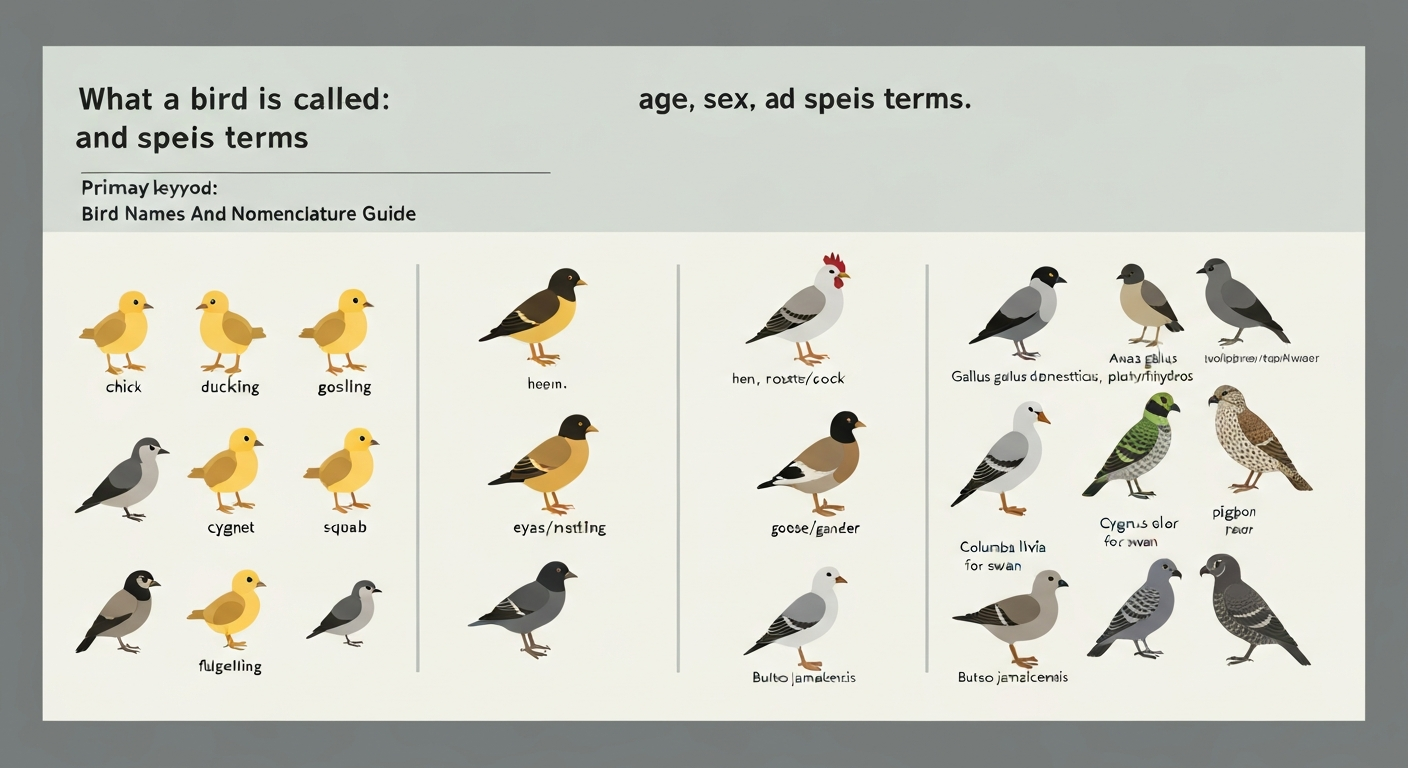
| Chicken (Gallus gallus domesticus) | Chick | Hen (adult); Pullet (under 1 year) | Rooster / Cock (adult); Cockerel (under 1 year) | Capon = castrated male |
| Duck (e.g., Mallard, Anas platyrhynchos) | Duckling | Duck / hen | Drake | 'Drake' from Old English draca |
| Goose (e.g., Greylag, Anser anser) | Gosling | Goose | Gander | 'Gosling' from 'goose' + diminutive suffix |
| Swan (e.g., Mute Swan, Cygnus olor) | Cygnet | Pen | Cob | 'Cygnet' from Latin/French cygne |
| Pigeon (Rock Pigeon, Columba livia) | Squab (fledgling / culinary) | Hen | Cock | Squab ≈ 4 weeks old, pre-fledge |
| Raptors (hawks, eagles, falcons) | Eyas / eyass (nestling, esp. falconry) | Varies by species | Varies by species | 'Eyas' from Old French niais |
| Passerines (sparrows, finches, etc.) | Chick / nestling / fledgling | Varies (hen in some) | Varies (cock in some) | No single universal sex term |
A note on pullets and cockerels: U.S. university extension services (including Oregon State and Nebraska Extension) define the one-year threshold consistently, a pullet becomes a hen and a cockerel becomes a rooster at approximately 12 months. This distinction matters in 4-H fair classifications and in commercial poultry records. The 'squab' term for a young pigeon has both a culinary and an ornithological use: in common culinary practice it refers to a young pigeon of about four weeks, consistent with Merriam-Webster's definition of squab as a fledgling bird.
Size and group classifications: from wrens to raptors
English uses both taxonomic labels and informal size-comparison terms to classify birds. Field guides from Cornell Lab routinely include a 'Relative Size' label on species pages, 'sparrow-sized,' 'robin-sized,' 'crow-sized', as an identification shortcut. For quick lookups on what a small bird is called, see the small bird is called guide for size-based naming and common terms. These are not official taxonomic terms, but they are genuinely useful in the field. The taxonomic group names, on the other hand, do have formal definitions.
Small-bird terms
- Passerine: any member of the order Passeriformes, the perching birds — the largest bird order, containing more than 6,000 species including sparrows, finches, warblers, crows, and starlings.
- Songbird: a more specific label for the oscine passerines, the subgroup with a complex vocal apparatus (syrinx) used for learned song. Not all passerines are songbirds in this strict sense.
- Sparrow-sized: a relative-size description used in field guides; the House Sparrow (Passer domesticus) is about 16 cm (6.3 in) long and serves as the benchmark.
- Wren: any small passerine in the family Troglodytidae (in the Americas) or the Eurasian Wren (Troglodytes troglodytes); the name is often used informally to mean 'tiny brown bird.'
- Finch: a member of the family Fringillidae, characterized by a stout seed-cracking bill; also used loosely for other small, seed-eating passerines.
Broader group terms
- Raptor: a functional group (not a single taxonomic order) covering birds of prey — hawks, eagles, falcons, owls, and vultures. The term comes from Latin rapere, 'to seize.'
- Waterfowl: the family Anatidae — ducks, geese, and swans. In North American hunting regulations, 'waterfowl' has a specific legal meaning covering migratory duck and goose species.
- Wading bird: herons, egrets, and allies that feed by standing in shallow water — a functional grouping rather than a single taxonomic family.
- Seabird: another functional grouping for birds that spend most of their life at sea (albatrosses, petrels, auks, and others).
The Cornell Lab's eBird and Clements Checklist are the standard reference points for current taxonomic groupings. These get updated periodically as genetic analysis reshapes relationships between families, which is why the classification of some groups (like the 'Old World sparrows' versus 'New World sparrows') has changed over time.
Where birds live: nests, roosts, aeries, and rookeries
English has a satisfying variety of words for bird homes and gathering places, each with its own nuance. Using 'nest' when you mean 'roost' is a common mistake worth clearing up, a nest is specifically where eggs are laid and young are raised; most birds do not sleep in their nests year-round. Here is the full set. If you want to know what the home of a bird is called, see the nesting vocabulary page for a short glossary.
| Term | Definition | Typical association |
|---|---|---|
| Nest | Structure where eggs are laid and young are raised | All breeding birds; shape varies enormously by species |
| Roost | A place where birds rest or sleep (not necessarily a nest) | Starlings, crows, swallows; communal roosts can involve millions of birds |
| Aerie / eyrie / eyry | High, lofty nest of a bird of prey (eagle, hawk, etc.) | Eagles, ospreys, large hawks; 'eyrie' is the chiefly British spelling |
| Rookery | A breeding colony; originally used for rooks (corvids), now also applied to colonial waterbirds (herons, penguins) | Herons, rooks, gannets, penguins |
| Aviary | An enclosed structure for keeping birds in captivity | Zoos, bird parks, large pet enclosures |
The variant spellings of aerie are worth noting: Merriam-Webster lists aery, aerie, eyrie, and eyry as all acceptable. 'Aerie' dominates in American English; 'eyrie' is more common in British English. Both trace back to medieval Latin area (a flat open surface) via Old French aire. Given the regal associations, it is no surprise that 'aerie' has been adopted for everything from mountain resort names to corporate headquarters branding. The topic of bird homes and colonial nesting behavior connects naturally to a broader look at nesting vocabulary on this site.
Etymology and cross-language naming: where bird words come from
Bird names are a remarkable record of cultural contact. English has pulled vocabulary from Old Norse, Old French, Latin, Greek, and Welsh to describe birds that were already well-known before formal taxonomy existed. A few highlights:
- Gander (adult male goose): from Old English gandra, related to Old Norse gás (goose). The word has been in English since at least the 10th century.
- Cygnet (young swan): from Old French cygne, from Latin cygnus, from Greek kyknos. The swan's scientific genus name, Cygnus, preserves the same root.
- Drake (male duck): from Old English draca or Low German drake; the etymology is debated, but the word has been in English since the Middle Ages.
- Eyas (nestling raptor): from Old French niais ('a nestling hawk taken from the nest'), which became 'an eyas' in English through a process called wrong division — people misheard 'a nias' as 'an eyas.'
- Raptor: from Latin raptor, 'one who seizes,' from rapere. The same root gives English 'rapture,' 'rapacious,' and 'rapt.'
- Passerine: from Latin passer, 'sparrow,' which is also the genus name of the House Sparrow (Passer domesticus).
- Finch: from Old English finc, related to German Fink and Dutch vink — all descended from a Proto-Germanic root that may have imitated the bird's call.
- Squab: possibly from Swedish dialect squabb ('fat, flabby'), first used in English in the 17th century for both an unfledged pigeon and a short, plump person.
Cross-language bird names offer a fascinating window into which birds mattered enough to borrow words for. The scientific genus Anser (geese) is Latin for goose; Buteo (buzzards and the Red-tailed Hawk) comes from Latin buteo, a type of hawk; and the species epithet jamaicensis in Buteo jamaicensis reflects where the type specimen was first described, Jamaica, even though the Red-tailed Hawk is now known to range across North America. Scientific names often preserve historical geography or the name of the collector who first described the specimen, making them small stories frozen in Latin. The etymology pages on this site go much deeper into these naming histories.
Naming a pet bird: practical tips and species-specific ideas
Choosing a name for a pet bird is genuinely fun, but a few practical considerations make the process easier. First, birds tend to respond better to names with one or two syllables and a sharp consonant or bright vowel, 'Kiwi,' 'Pico,' 'Pip,' 'Zazu.' That is not a hard rule, but it reflects how parrots and corvids pick up sounds. Second, if you know your bird's sex, you can lean into sexed names; if you do not (which is common with many parrot species unless DNA-tested), a neutral name avoids the mild awkwardness of calling your male bird 'Princess' for fifteen years.
Sexed versus neutral name options
| Species | Sexed female names (examples) | Sexed male names (examples) | Neutral names (examples) |
|---|---|---|---|
| Budgerigar (parakeet) | Pippa, Daisy, Wren | Kiwi, Cosmo, Buddy | Sky, Sunny, Pixel |
| Cockatiel | Pearl, Cleo, Luna | Charlie, Pico, Rio | Storm, Sage, Biscuit |
| African Grey Parrot | Athena, Iris, Cleo | Einstein, Darwin, Merlin | Ash, Echo, Pebble |
| Canary | Saffron, Goldie, Lyric | Caruso, Sol, Canto | Lemon, Sunny, Birdie |
| Lovebird | Rosie, Peach, Coral | Mango, Cheddar, Pepper | Pip, Blossom, Tango |
| Cockatoo | Duchess, Pearl, Bella | Captain, Monty, Sterling | Cloud, Powder, Snowdrop |
Beyond the individual name, many keepers enjoy names that reference the bird's species or scientific genus. Naming an African Grey 'Psitt' (a playful nod to order Psittaciformes), or calling a pet corvid 'Corvus' after its genus, adds a layer of linguistic wit that fellow bird enthusiasts will appreciate. If you have a pigeon named 'Columba' or a swan named 'Cygnus,' you have essentially given your bird a name that is simultaneously Latin, poetic, and correct. The pet-naming guide pages on this site offer much longer species-specific lists and advice on training birds to respond to their names.
Bird names in culture: idioms, teams, and pop culture
Birds have infiltrated everyday English in ways that go far beyond ornithology. Idioms built on bird names are everywhere: 'a little bird told me,' 'the early bird catches the worm,' 'birds of a feather flock together,' 'killing two birds with one stone,' 'a bird in the hand is worth two in the bush.' Most of these date to at least the 16th century and remain in active use. The phrase 'for the birds', meaning worthless or contemptible, is a more recent Americanism, first recorded in the 1940s.
Sports teams have long borrowed bird names for their power, speed, or regional identity. The Baltimore Ravens (NFL) took their name from Edgar Allan Poe's famous poem; the Philadelphia Eagles and Atlanta Falcons go for predatory menace; the Toronto Blue Jays and St. Louis Cardinals go for color and regional bird association. In basketball, the Atlanta Hawks and the New Orleans Pelicans round out a surprisingly ornithological league. In literature, birds carry enormous symbolic weight: Poe's raven, Keats's nightingale, Coleridge's albatross, Harper Lee's mockingbird, and Suzanne Collins's mockingjay. The mockingbird is particularly interesting here, a real species (the Northern Mockingbird, Mimus polyglottos, whose epithet means 'many-tongued mimic') pressed into service as a literary symbol of innocence.
On the wordplay side, 'cygnet' and 'signet' (a small seal for wax) are homophones in most accents, causing gentle confusion in crosswords. 'Egret' sounds like 'regret,' which the poet Wendy Cope turned into a famous two-line poem. And the word 'robin,' used informally for a round-bellied small bird in both Britain (European Robin, Erithacus rubecula) and North America (American Robin, Turdus migratorius), refers to two unrelated species, a perfect illustration of why common names need context.
Quick-reference cheat sheet: all tables at a glance
Here are the core reference tables consolidated for quick lookup, useful if you need to settle a dinner-table argument or fill in a crossword clue.
Age and sex terms by species
| Species | Young | Female | Male |
|---|---|---|---|
| Chicken | Chick; pullet (young female); cockerel (young male) | Hen | Rooster / Cock |
| Duck | Duckling | Duck / hen | Drake |
| Goose | Gosling | Goose | Gander |
| Swan | Cygnet | Pen | Cob |
| Pigeon | Squab (fledgling) | Hen | Cock |
| Raptor | Eyas / eyass | Varies by species | Varies by species |
Bird home and colony terms
| Term | Meaning | Used for |
|---|---|---|
| Nest | Structure for eggs and young | All breeding birds |
| Roost | Resting or sleeping place | Most birds; often communal |
| Aerie / eyrie | High nest of a bird of prey | Eagles, hawks, ospreys |
| Rookery | Breeding colony | Herons, rooks, penguins, gannets |
| Aviary | Enclosed captive-bird structure | Zoos, pet facilities |
Size and group labels
| Label | What it covers | Formal or informal? |
|---|---|---|
| Passerine | All members of order Passeriformes (perching birds) | Formal taxonomic order |
| Songbird | Oscine passerines with complex learned song | Semi-formal functional group |
| Raptor | Birds of prey: hawks, eagles, falcons, owls, vultures | Informal functional group |
| Waterfowl | Ducks, geese, swans (family Anatidae) | Informal; legal in hunting regulations |
| Sparrow-sized | Relative size ≈ 16 cm / House Sparrow scale | Informal field-guide term |
| Wading bird | Herons, egrets, stilts (functional group) | Informal functional group |
Suggested image: labeled species comparison
A useful illustrative image for this article would be a labeled composite photograph showing three bird types side by side: a domestic chicken (Gallus gallus domesticus) with callouts for 'hen,' 'rooster,' and 'chick'; a Mallard duck (Anas platyrhynchos) with callouts for 'drake' (male) and 'duck' (female); and a small passerine such as a House Sparrow (Passer domesticus) with a callout indicating 'passerine / sparrow-sized. For a quick lookup of what a male bird is called across common species, see the male bird is called guide. ' A caption reading something like 'Three everyday birds, three naming systems: poultry vocabulary, waterfowl terms, and passerine classification' would orient the reader quickly to the article's range. A secondary image showing a bald eagle at its aerie with a 'nestling (eyas)' callout would complement the raptor and home-terms sections well.
Where to go next on this site
This article covers the broad landscape of how birds get their names, but several topics deserve much more space than a single reference article can give them. The scientific nomenclature pages here go deeper into the ICZN rules, how names are formally proposed and challenged, and what happens when two taxonomists publish different names for the same species in the same year. The etymology section explores individual word histories in the kind of detail that rewards curiosity, tracing 'pelican' back through Latin and Greek to a Macedonian root, or following 'albatross' through Spanish and Portuguese to Arabic al-qadus. And the pet-naming guides offer species-by-species name lists, advice on gender-neutral options, and guidance on choosing names that your bird will actually learn to recognize.
If you arrived here looking for something more specific, what a young bird is called at different life stages, what a female bird is called across species, what a male bird is called in waterfowl versus passerines, what a small bird is called in formal taxonomy, or what the home of a bird is called in ornithological usage, each of those topics has its own dedicated page on this site with extended examples and deeper context. Bird naming turns out to be a surprisingly rich subject, and there is always more to find.
FAQ
What does the phrase “bird is called” usually mean in everyday and technical contexts?
Everyday: it asks for a bird’s common or colloquial name (e.g., “That small gray bird is called a sparrow”). Technical/ornithological: it requests the accepted common name or the scientific (binomial) name used in field guides and checklists (e.g., “This species is called the Mallard, Anas platyrhynchos”). In practice, "called" can mean vernacular name, an age/sex term (e.g., chick, drake), or a group/home term (rookery, aviary). For deeper reading see pages on scientific names, etymology, and pet-naming guides.
What are the standard English life-stage terms for birds?
Common life stages used in ornithology (general sequence): egg → hatchling/chick → nestling → fledgling → juvenile → subadult → adult. Cornell Lab sources define 'nestling' as a very young bird still confined to a nest and 'fledgling' as a young that has left the nest but is not yet fully independent (Handbook of Bird Biology / NestWatch).
What age- and sex-specific names do common species use? (quick reference)
Short table (Species : Young : Adult female : Adult male / notes) - Chicken: chick : hen (adult female) : rooster/cock (adult male); pullet = young female <1 yr; cockerel = young male <1 yr; capon = castrated male. - Duck (Anatidae, e.g., Mallard): duckling : duck (female commonly called duck) : drake (male). - Goose (Anatidae): gosling : goose (female) : gander (male). - Swan (Cygnus spp.): cygnet : pen (female) : cob (male; cob used but less universal). - Pigeon (Rock Pigeon): squab (young/fledgling; culinary term) : hen (female) : cock (male) or simply pigeon. - Raptor (hawk/falcon): eyas (specialized term for nestling taken for falconry) : often no widely used gendered common names beyond 'male/female' in field guides. - Passerines (songbirds, e.g., sparrow, robin): chick/fledgling : typically 'male/female' or sex-specific common names only in a few species (many passerines lack special adult sex names).
How are small-bird and size/group classifications named (passerine, songbird, waterfowl, raptor)?
Key group terms and meanings: - Passerine (Order Passeriformes): perching birds; includes most 'small' backyard birds and songbirds. - Songbird (oscine passerine): passerines that learn complex songs (common field-guide term). - Waterfowl (Family Anatidae): ducks, geese, swans. - Raptor / bird of prey (functional group): hawks, eagles, falcons, owls, vultures (predatory birds). Field guides often use size comparisons in plain language (e.g., 'sparrow-sized', 'robin-sized') for quick ID.
What words describe where birds live, nest, or gather?
Common home/colony terms (brief table): - Nest: structure where eggs are laid and young reared. - Roost: place where birds sleep or rest (can be communal). - Aerie / Eyrie (variant spellings aery, aerie): high nest of a raptor or eagle. - Rookery: breeding colony, especially for colonial waterbirds or colonial corvids. - Aviary: an enclosed structure for keeping birds in captivity. Dictionaries list canonical definitions and variant spellings (aerie/aery/eyrie).
How do common names differ from scientific (binomial) names and what are the basic rules?
Differences and rules: - Common names: vernacular, vary by language/region/authority, can be ambiguous (e.g., 'robin' means different species in Europe vs. North America). - Scientific names: binomial (Genus species), Latinized, standardized worldwide, governed by the International Code of Zoological Nomenclature (ICZN). They uniquely identify taxa (e.g., Mallard = Anas platyrhynchos; Rock Pigeon = Columba livia; Chicken/domestic fowl derived from Gallus gallus). Use scientific names for clarity across languages and in technical writing.
Next Articles
Small Bird Is Called: Common Names and How to Identify
Common names for a small bird and quick identification tips by size, habitat, calls, plus meaning vs scientific names.
Male Bird Is Called What: Names for Different Species
Learn the male bird terms like cock, drake, bull, and stag, plus how to choose the right one by species and use.
Female bird is called what Find the right term for any species
Find what a female bird is called and how to choose the right term by species, gender, and region.