If you want a female name that genuinely means 'bird,' the short answer is: it depends on whether you want a name that literally comes from a bird word (like Lark, from the Old English bird name) or one whose root is a specific bird in another language (like Paloma, from Latin palumbus, 'dove'). Both are valid, but they are not the same thing, and a lot of popular name blogs blur that line badly. This guide cuts through the noise, gives you a curated list with real etymology, explains how to verify claims yourself, and helps you pick a name fast, whether it's for a baby girl or a female pet bird.
Female Names Meaning Bird: Dove, Lark, Swallow and More

Maya Castellanos
21 Apr 2026
What 'a name meaning bird' actually means (and what it doesn't)
There are two very different things people mean when they say a name 'means bird.' The first, and most trustworthy, is a direct lexical connection: the name is literally the bird word, or is derived from it. Lark is the English word for the songbird. Paloma comes from Latin palumbus (dove). Yona/Yonah is the Hebrew word for dove or pigeon and became a given name directly from that word. These connections are verifiable in dictionary-grade etymology sources.
The second type is indirect or imagistic: a name meaning 'swift,' 'song,' 'light,' or 'queen' that someone on a name blog links to bird imagery. These connections are often real in a cultural sense but are not bird-word etymologies. Calling them 'bird names' is a stretch. When you see a list that includes names meaning 'free' or 'heavenly' in the bird category, be skeptical. For the purposes of this guide, we focus on names with a documented bird-word root, with a short note where indirect connections are genuinely interesting.
Female names that mean specific birds
Here are the names with the strongest, most verifiable bird-word etymologies, grouped by bird type. These are the ones worth committing to.
Dove names
Dove-derived names are the richest category for female given names. Yona (also spelled Yonah or Jonah in its masculine biblical form) comes directly from the Hebrew יּוֹנָה, the word for dove or pigeon. It has been used as a feminine given name in Hebrew-speaking communities and is one of the clearest 'bird word becomes given name' examples in the Semitic tradition. Paloma is the Spanish feminine name derived from Latin palumbus, meaning dove, and it's one of the most popular feminine 'bird names' in use today across Spanish-speaking countries. It's elegant, unambiguous, and the bird connection is fully documented.
Jemima is a trickier case. It's traditionally said to mean 'dove' in Hebrew, and that claim appears widely. However, Behind the Name flags that it may actually relate to the Hebrew word yomam, meaning 'daytime,' not dove. That documented uncertainty is worth knowing before you commit to 'Jemima means dove' in a birth announcement. Use Yona or Paloma if the dove meaning is the whole point.
Lark names
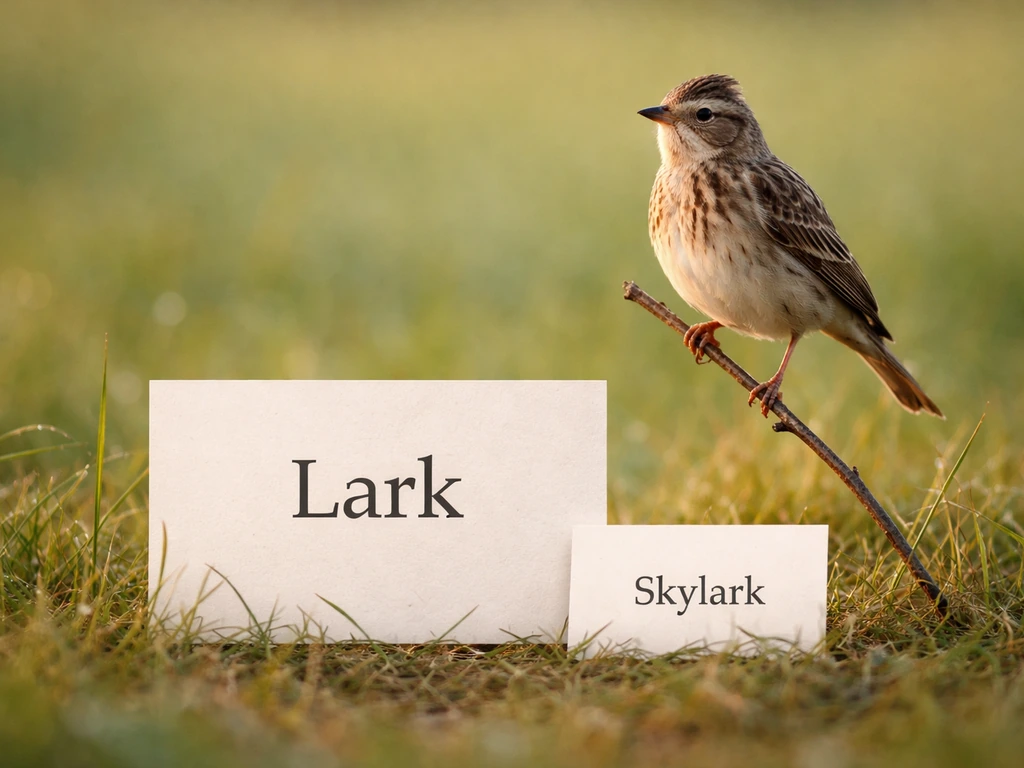
Lark itself is used as a given name directly from the English bird word, and Behind the Name confirms it plainly: 'From the English word for the type of songbird.' The etymological chain behind the English word goes Middle English lark/laveroc, Old English lāwerce or lǣwerce, back to Proto-Germanic *laiwarikā. It's a well-documented bird word with a long lineage. Alouette is the French equivalent: derived from French alouette, meaning lark or skylark. It's feminine in feel (especially for English speakers, thanks to the folk song) and the bird connection is solid. Lærke is the Danish feminine given name taken directly from the Danish word for lark. If you're drawn to Scandinavian naming traditions, Lærke is a clean, authentic choice.
Sparrow and swallow names
Sparrow as a given name comes from the Old English word spearwa, and Behind the Name traces it precisely that way: 'From the name of the bird, ultimately from Old English spearwa. EtymOnline’s etymology for “sparrow” similarly traces the Middle English “sparwe” back to Old English “spearwa,” ultimately from Proto-Germanic *sparwan Sparrow as a given name comes from the Old English word spearwa.
If you are looking specifically for male names meaning bird, you can use the same “bird word root” approach and then filter by the culture and language that the name comes from. ' It's used for both boys and girls today but leans gender-neutral. Swallow is used less frequently as a given name, but it has a documented Old English bird-word root (swealwe), with cognates across Germanic languages: Old Icelandic svala, Dutch zwaluw, German Schwalbe.
Historically it appeared as a nickname for someone resembling or moving like a swallow. It's unusual as a modern given name but entirely traceable.
Other bird-derived female names
| Name | Bird | Language/Root | Notes |
|---|---|---|---|
| Yona / Yonah | Dove / Pigeon | Hebrew (יּוֹנָה) | Direct bird-word origin; also the root of the biblical name Jonah |
| Paloma | Dove | Spanish / Latin palumbus | Common feminine name in Spanish-speaking countries |
| Lark | Lark / Skylark | English (Old English lāwerce) | Used directly as a given name |
| Lærke | Lark | Danish | Taken from the Danish bird word |
| Alouette | Lark / Skylark | French alouette | Feminine feel; well-known via folk song |
| Sparrow | Sparrow | English (Old English spearwa) | Gender-neutral in modern use |
| Jemima | Dove (disputed) | Hebrew (etymology uncertain) | Traditional claim; may relate to 'daytime' instead |
| Robin | Robin | English / Germanic | From the bird name; feminine use widespread in English |
| Teal | Teal duck | English (Middle English tele) | Color and bird name combined; modern given name use |
| Merle / Merla | Blackbird | French / Latin merula | Merla is the feminine form; Merle used for both sexes |
Etymology deep-dive: how to read a 'bird meaning' claim
Etymology is a paper trail. When a source says a name 'means bird,' there should be a traceable path: the given name comes from a word in language X, that word means a specific bird, and here is the older form of that word. The more of that chain a source shows, the more trustworthy the claim. Behind the Name is the most reliable free resource for given-name etymology because it cites established academic references including the Oxford Dictionary of English Christian Names and the Dictionary of Medieval Names from European Sources. It also flags uncertainty explicitly, as it does with Jemima. That kind of editorial honesty is a green flag.
Wiktionary is genuinely useful for bird-word etymology (not name etymology specifically), because it traces the word itself. For example, Wiktionary's entry for 'lark' shows the Middle English and Old English forms, then Proto-Germanic *laiwarikā, which lets you independently confirm that the English word 'lark' is ancient and not a recent invention. When a name claims to come from a bird word, checking the bird word's own etymology on Wiktionary gives you a second independent angle.
Names that come from other languages need one extra step: confirming the bird word in the source language. Paloma is easy because palumbus is well-documented Latin for dove or pigeon. Alouette is easy because alouette is the standard French word for lark and appears in any French dictionary. Where it gets murky is with names from languages less familiar to English readers, especially names pulled from Sanskrit, Japanese, Korean, Arabic, or Hebrew, where transliteration variants can create confusion.
For Korean names meaning bird, the best approach is to look at the specific native word behind the name and confirm how its meaning is represented in Hangul or Hanja Korean bird-word given names. If you're looking specifically for Arabic names meaning bird, double-check the original Arabic bird word and how transliteration changed it into the spelling you see today.
If you want Japanese names meaning bird, pay special attention to kanji readings and how transliteration affects the claimed bird origin. For those traditions, the bird-meaning names in Japanese, Korean, Arabic, and Hebrew naming systems each deserve their own treatment, and the linguistic rules differ significantly from the European examples here.
One name worth examining as a 'don't overclaim' example is Aviana. It sounds bird-like, and it contains the Latin root avis (bird), but the name itself has multiple documented origins and cannot be straightforwardly called 'a name that means bird' without heavy qualification. Avis, on the other hand, does come directly from the Latin word for bird and is cleaner for that purpose if you want a Latin-root bird name for a girl.
Naming female pet birds with these names
One genuinely fun application of bird-meaning human names is using them for female pet birds. A name like Paloma on a female cockatiel or a dove is quietly clever: it's a real Spanish girl's name and it literally means the bird she is. Lark on a female canary or budgie works the same way. These names land well because they have an everyday human feel while still being a little wink to anyone who knows the etymology.
If you're choosing a name for a female parrot, songbird, or raptor, matching the name's 'vibe' to the species makes the name feel right. Talking parrots like African greys, macaws, ring-necked parakeets, and cockatoos are vocal and social, so names with a musical or communicative feel fit well. Yona, Alouette, and Lark all carry that energy. For raptors (hawks, falcons, owls kept in falconry), names with a sharper, more compact sound tend to work better than flowing multi-syllable names. Teal, Merle, or even Sparrow carry that crispness.
A quick note on behavior and sex: research on companion parrot vocal mimicry shows that speech ability does not vary consistently by the bird's sex the way people sometimes assume. A female African grey is not more or less likely to talk than a male simply because of her sex. So don't let 'she's a girl bird' drive you toward a softer or more delicate-sounding name unless you genuinely prefer it. Pick what fits the individual bird's personality.
Quick name-to-species matching guide
| Name | Best for | Why it works |
|---|---|---|
| Paloma | Doves, pigeons, soft-natured cockatiels | Literally means dove; elegant and calm in sound |
| Lark | Canaries, budgies, female finches | English songbird name; upbeat and short |
| Alouette | Parakeets, lovebirds, social parrots | Musical French lark name; playful feel |
| Yona | Doves, pigeons, gentle cockatiels | Hebrew for dove; soft and easy to call out |
| Teal | Female ducks, parakeets with teal coloring | Color + bird name; modern and punchy |
| Merle | Blackbirds, dark-feathered female parrots | Means blackbird in French; sophisticated |
| Sparrow | Small active birds: budgies, parrotlets | Energetic bird; suits quick, lively personalities |
| Robin | Female robins, friendly hand-tamed birds | Direct bird name; familiar and warm |
| Lærke | Canaries, female larks, European species | Danish for lark; unusual and pretty for a songbird |
How to verify the etymology and resolve conflicting sources

The single biggest problem with bird-meaning name lists online is that they copy each other without checking the original claim. Here is a practical workflow for verifying any name you find:
- Check Behind the Name first. If the name has an entry, read the full etymology section, not just the one-line meaning. Note whether the site flags any uncertainty (as it does with Jemima). Behind the Name draws on academic name-etymology references, so an entry there carries more weight than a random baby-name blog.
- Look up the bird word itself on Wiktionary. If a name is claimed to come from, say, the French word for lark, check that alouette is actually the French word for lark (it is) and trace its own etymology. This cross-checks the claim from the word's side rather than the name's side.
- Search for the name on Wikipedia. Wikipedia name entries often give language of origin and root word. For Paloma, the entry clearly states derivation from Latin palumbus. For Lærke, it says 'taken from the Danish word for the bird.' These are quick independent confirmations.
- When sources disagree on meaning, check whether the disagreement is about the bird word or something else entirely. With Jemima, the dispute is whether the Hebrew root is yonah (dove) or yomam (daytime), which is a documented linguistic debate, not a blog making things up. That kind of disagreement means you should not use the name as a 'definite dove name.'
- For names in non-Latin scripts (Hebrew, Arabic, Japanese, Korean, Greek), look for the native-script form of the name and the native-script bird word and compare them. A claim that a name means 'bird' in Arabic or Korean is much more verifiable once you can see the root word written in its own script.
- Treat any list that includes names meaning 'free,' 'heaven,' or 'swift' in a 'bird names' roundup as a yellow flag. Those may be culturally bird-adjacent but they are not bird-word etymologies. Filter them out if you need a name with a genuine bird-word root.
Spelling variants are a related challenge. Yona, Yonah, Jonah, and Jona all trace to the same Hebrew root but have different usage histories and gendered conventions in different communities. Yona is the form most commonly used as a feminine given name in modern Hebrew. Alouette versus Alouetta, Lærke versus Laerke (the simplified form for non-Danish keyboards): these variants don't change the etymology but they do affect how the name reads in different countries. Decide which spelling convention works for your context before committing.
Pick the right name fast: shortlists by bird type, vibe, and origin
If you're short on time, here are targeted shortlists so you can land on a name today.
By specific bird
- Dove: Paloma (Spanish/Latin), Yona or Yonah (Hebrew)
- Lark / Skylark: Lark (English), Lærke (Danish), Alouette (French)
- Sparrow: Sparrow (English, Old English spearwa)
- Swallow: Swallow (English, Old English swealwe, rare as a given name)
- Robin: Robin (English, directly from the bird)
- Blackbird / Merle: Merle or Merla (French/Latin merula)
- Teal: Teal (English, both bird and color)
By style: classic vs. modern
- Classic / traditional: Paloma, Yona, Jemima (with the caveat about the disputed etymology), Robin, Merle
- Modern / fresh: Lark, Sparrow, Teal, Wren (from the bird; short and sharp)
- Romantic / literary: Alouette, Lærke, Paloma
By cultural/language origin
- Hebrew: Yona, Yonah
- Spanish / Latin: Paloma
- French: Alouette, Merle
- English (Old English roots): Lark, Sparrow, Robin, Teal, Swallow, Wren
- Danish / Scandinavian: Lærke
- For names rooted in Greek, Japanese, Korean, Arabic, or Hebrew naming traditions, the bird-naming conventions and verifiable bird-word names differ significantly and are worth exploring as separate topics within those linguistic traditions.
Your next-step search workflow
If none of the names above feel quite right, here is how to find more without falling into unreliable blog territory. Go to Behind the Name's search page and use the meaning filter to search for the specific bird you want (try 'dove,' 'lark,' 'sparrow,' 'swift,' 'crane,' 'heron').
If you meant the specific phrase "the bird Hermes is my name," treat it as a unique cultural or creative reference and verify it in the original source rather than assuming it follows the standard bird-word name pattern. Read each result's full entry and note whether the source is a direct bird-word derivation or a looser cultural association. Cross-check any interesting find on Wiktionary for the bird word itself and on Wikipedia for the name's entry if one exists.
If you're exploring names from a specific language tradition, such as Japanese, Korean, Arabic, or Greek, those naming systems have their own bird-meaning names with distinct etymological rules, and each tradition rewards focused research rather than generic 'names meaning bird' lists. If you are exploring Greek name meaning bird options, use the Greek-language bird word as your starting point and then verify the name’s specific etymology.
The bottom line is that the strongest female names with genuine bird-word etymology are Paloma (dove, Spanish/Latin), Yona (dove, Hebrew), Lark (lark, English), blank" rel="noopener noreferrer">Lærke (lark, Danish), Alouette (lark, French), Sparrow (sparrow, English), Robin (robin, English), and Merle (blackbird, French). These are the ones you can confidently say 'this name means this bird in this language' without a footnote full of caveats. Start there, verify with the workflow above, and you'll have a name with real linguistic weight behind it.
FAQ
How can I tell if “means bird” is literal etymology or just bird-themed imagery?
Check whether the name is directly derived from a specific bird word in a named language (for example, “derived from Latin palumbus meaning dove”). If the claim instead points to vague qualities like “freedom,” “heavenly,” or “queen” without naming the bird word, treat it as an imagistic interpretation, not a lexical one.
Are spelling variants like Yona and Yonah the same name etymologically?
Often yes, but usage can differ. Yona is commonly the modern feminine form in Hebrew contexts, while Jonah is typically the better-known masculine biblical spelling in English usage. Your spelling choice affects gender conventions and how likely people are to accept the “bird-word” explanation.
What if a baby name site says a name means “dove,” but sources disagree?
Look for the earliest and language-specific root they cite. If multiple entries suggest different Hebrew roots, you should decide whether the “bird meaning” is essential for you. Names with an unambiguous bird-word root (like Paloma for dove) are safer than ones with disputed semantics (like the alternative discussion around Jemima).
Can I use Wiktionary to verify the bird word even if it is not a name page?
Yes. Verify the bird word’s own etymology first (for example, confirm the historical forms behind “lark” in English). Then check that the given name entry claims a derivation from that same bird word, not just a shared bird nickname or later association.
If a name comes from Latin “avis” (bird), does that automatically mean it means a specific bird like dove or lark?
Not automatically. A Latin “avis” root means “bird” generally, not a particular species. For a name that clearly maps to a specific bird (dove, lark, sparrow), you want a root tied to that exact bird term, not a broad “bird” word.
For non-European names, what is the most reliable verification method?
Confirm the original native word and its writing system, then map how it is represented in transliteration. For Korean, prioritize the Hangul or Hanja form behind the name, for Arabic confirm the original Arabic bird term and its spelling-to-Latin transcription, and for Japanese check which kanji are used and their readings.
Do bird-meaning names always match the bird’s gender in real life pets?
No. Sex of the bird should not guide the name’s “softness” or “talkativeness.” Companion parrot vocal ability does not follow sex reliably, so pick the name based on the individual bird’s personality and your aesthetic preferences rather than assuming “female birds talk differently.”
Is it okay to choose a name for a pet based on vibe if the etymology is indirect?
It can be totally fine for pet naming, but be consistent about your goal. If you want a genuine bird-word etymology, stick to names with a direct lexical derivation. If you mainly want the cultural or aesthetic bird connection, you can use broader associations, just avoid presenting them as literal “means bird.”
What is the easiest “workflow” to avoid copy-pasted blog errors when I find a new name?
Start by identifying the exact bird word the claim uses (dove, lark, sparrow, etc.). Then verify that the name derives from that bird word in a specific language, check the name’s full etymology entry in a reference source, and cross-check the bird word itself on a dictionary-style etymology page.
If I want a more complete list than what the article provides, how do I search without going too broad?
Use a meaning filter tied to the specific bird you want (dove, lark, sparrow, crane, heron). After you get results, open each full entry and categorize it as direct bird-word derivation versus looser cultural association, then only keep the direct ones if “literal means bird” is your requirement.