The surname Bird is almost certainly English in origin, derived from the Old English word bridd, meaning a young bird or nestling. In practice, it was most likely handed down as a nickname: someone in medieval England got called 'Bird' because of a birdlike quality, a lively or quick personality, maybe a distinctive singing voice, or simply because the word stuck as a personal epithet. That nickname eventually calcified into a hereditary family name, which is exactly how a huge chunk of English surnames came to exist.
Where Does the Last Name Bird Come From? Origins & Research

Maya Castellanos
6 Jun 2026
The most likely origins of the surname Bird
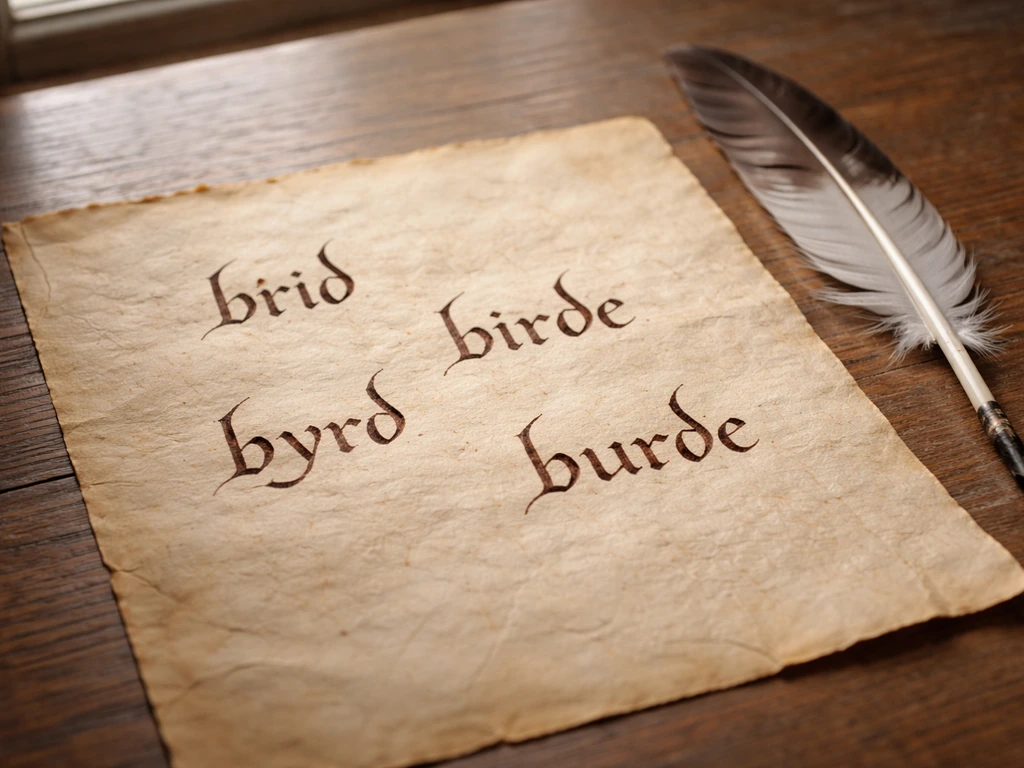
Most reputable surname references agree on the same basic story: Bird comes from Middle English brid or birde (and its spelling variants byrd, birde, burde), all of which trace back to Old English bridd. The word originally meant a young bird, specifically a nestling or fledgling, rather than the catch-all 'bird' we use today. The broader meaning of 'any bird' developed gradually over the medieval period.
Etymologists are honest that the ultimate root of bridd itself is uncertain, meaning we can't trace it confidently to a Proto-Germanic or Proto-Indo-European ancestor the way we can with many other Old English words. That's a small mystery at the deep end, but it doesn't really affect how the surname works.
There's also a secondary pathway worth knowing about: a small number of surname sources suggest Bird could occasionally be occupational, referring to a bird catcher or handler. This is plausible but treated as a secondary explanation, not the primary one. The cleaner occupational surname for bird-catching in English records is Fowler, which comes from Old English fugolere and was used explicitly for hunters and catchers of wild birds.
One close occupational parallel is the surname Fowler, which comes from Old English fugolere and was used for hunters and catchers of wild birds Fowler comes from Old English fugolere and was used for hunters and catchers of wild birds. If Bird were primarily occupational, you'd expect more documentary evidence tying early Bird families to that trade, the way Fowler records tend to show up alongside the trade itself.
So treat the occupational angle as a hypothesis worth testing for your specific line, not a settled fact.
Bird as a nickname: how a word becomes a family name
Nickname surnames are one of the biggest categories in English surname history, and the logic is pretty intuitive once you see it. Somebody in a village got called 'the Bird' or just 'Bird' for a reason that made sense to their neighbors, and that label passed to their children, and then their grandchildren, and eventually nobody remembered why Great-Great-Grandfather Thomas was called Bird in the first place. It just became the family name.
The qualities that might earn someone a bird nickname in medieval England include being lively or energetic (the way small birds appear), having a distinctive or pleasant singing voice, being physically slight or quick, or simply being associated with birds in some way in daily life. In later Middle and Early Modern English, 'bird' also carried the meaning of a girl or young woman in British usage, a sense that survives in informal British English today. There's also a closely related medieval poetic word, burd, used specifically to mean a young woman or maiden. These overlapping meanings make it entirely possible that some Bird surnames were given to women, or to men known for a connection to a woman nicknamed 'Bird,' before passing down as a family name.
Where Bird families historically turn up

The surname Bird is concentrated in England, which lines up with its Old English and Middle English roots. Distribution data from surname databases shows meaningful clusters across England, with the name appearing in historical tax records, parish registers, and census data going back several centuries. The UK National Archives holds pre-1689 taxation records, including poll taxes, that list individual householders by name and are some of the best early sources for spotting surname spellings before parish registers became standard.
There are also Irish associations with the closely related spelling Byrd. Some surname references describe Byrd as being of English and Irish origin, which most likely reflects English settler families who brought the name into Ireland, or in some cases an anglicization of an Irish name that sounded similar. Because Byrd is sometimes treated as an English and Irish surname, it is worth checking your family’s specific records in Ireland rather than assuming an Irish origin from the spelling alone. If your Bird line has roots in Ireland, treat those suggestions as a hypothesis to test against actual Irish civil and parish records rather than a confirmed fact, because the evidentiary quality varies considerably across sources.
One more possibility worth knowing: in communities where European immigrants anglicized their surnames, 'Bird' sometimes appeared as a translation of a native-language word meaning bird. The most common example is Vogel, the German and Dutch word for bird, which Ashkenazic Jewish families sometimes anglicized to Bird or translated into the English equivalent. Similarly, surnames like Loiseau (French) or Ptacek (Czech) mean bird in their respective languages. So if your Bird ancestors appear suddenly in records around the time of immigration from continental Europe or within a Jewish community context, it's worth asking whether 'Bird' is a translation rather than a native English surname passed down from medieval England.
Spelling variants and related surnames to track down
This is where genealogical research on Bird gets interesting, because the same name shows up under several spellings in historical records and you need to know which ones belong to your family and which are genuinely different surnames.
| Spelling | Relationship to Bird | Notes for researchers |
|---|---|---|
| Bird | Core form | Standard modern spelling; most common in English records |
| Byrd | Direct variant | Same linguistic root; Wikipedia explicitly calls it a variant of Bird; also associated with American records (e.g., the Byrd political family of Virginia) |
| Burd | Possible variant or distinct name | Shares medieval spelling forms (brid/burde) but 'burd' also existed as a poetic word for 'young woman/maiden'; verify via records whether a Burd entry is your Bird line or a different origin |
| Bride | Possible variant | Some medieval forms of brid/birde overlap phonetically with Bride; treat with caution and confirm via records |
| Fowler | Distinct occupational surname | Means bird-catcher/hunter; NOT a variant of Bird, but relevant if testing an occupational hypothesis for your Bird ancestors |
The key takeaway is that Byrd and Bird are almost certainly the same family name spelled differently, and you should search for both when going through old records. Burd is trickier: it shares some medieval spelling history with Bird but it can also be a completely separate name with a different meaning, so always confirm with record context rather than assuming they're the same. And if you're researching a Bird line that might have occupational roots, look into Fowler separately as a contrast, not as a variant.
How to research your own Bird ancestry today

The most useful thing you can do before diving into databases is to gather the basic details you already know: the approximate birth years and locations of the oldest Bird ancestors you can name, and any variant spellings that appear in documents you already have (a death certificate, an old census entry, a family Bible). Even a rough decade and a county name will dramatically focus your search.
- Start with civil registration records (England and Wales from 1837, Ireland from 1864) to build back through the 19th century. These are on Findmypast, Ancestry, and FreeREG for free transcriptions.
- Move into parish registers once you're pre-1837. Findmypast's parish baptisms dataset covers 1538 to 2005 and is searchable by county and parish. Use wildcard searches (e.g., Brd or Bid) to catch variant spellings because early scribes were inconsistent.
- Search for Bird, Byrd, and Burd simultaneously. Don't assume the spelling was consistent across generations, especially before the 19th century.
- Use the UK National Archives' pre-1689 taxation records, including poll taxes and subsidy rolls, to find early instances of the surname in specific counties. These can anchor your family line geographically well before parish registers begin.
- Record the exact spelling in every document you find, along with the parish or county, the event date, and the names of any witnesses, godparents, or relatives listed. That contextual detail is what lets you link records across generations confidently.
- If you have evidence of Irish roots, search Irish civil records (General Register Office Ireland) and Catholic parish registers via IrishGenealogy.ie and Ancestry. If you're testing whether your Bird line is an anglicization of an Irish name, look for contemporaneous records that use both forms.
- If you have evidence of a European immigrant background or a Jewish community connection, check whether the surname appears in records alongside clearly non-English names that could indicate a translation. Vogel, Loiseau, and Ptacek are the most common equivalents to look for.
One practical tip: when you search Findmypast or Ancestry for Bird in early records, filter by county first if you can. A Bird family from Kent and a Bird family from Yorkshire may have no connection at all despite sharing the same surname, and narrowing by geography early saves you from building a tree that merges two entirely separate lines.
What the name Bird carries culturally and linguistically
Beyond the genealogical paperwork, there's something genuinely evocative about a surname that comes from the word for a young bird. Bird as an English word has always carried associations with freedom, lightness, and song, which is probably part of why it worked so well as a personal epithet in medieval England. The nickname stuck because it said something about how a person moved through the world, or at least how their neighbors perceived them.
The overlap with the British English meaning of 'bird' as a term for a girl or young woman adds another layer. Some Bird surnames may have started as terms of endearment or social labels rather than comments on birdlike behavior specifically. Medieval English was flexible that way, and the line between a nickname for a lively person and a fond term for a young woman was not always sharp when the same word covered both meanings.
It's also worth noting that across many languages, bird-meaning surnames follow the same pattern: they start as nicknames or descriptive terms and become hereditary family names. Vogel in German and Dutch, Loiseau in French, and Ptacek in Czech all traveled roughly the same road as the English Bird. That parallel across languages and cultures suggests that 'bird' as a personal label resonated with people broadly, not just in medieval England.
If you're interested in how this plays out across surnames in different languages, the broader world of last names meaning bird is a fascinating rabbit hole, and the same goes for the wider category of surnames meaning bird across European traditions. If you're also curious about surnames meaning bird in general (not just Bird), comparing related last names can help you interpret translations and nickname patterns across European traditions last names meaning bird.
If you want the bird last name meaning beyond this English surname, it helps to compare how similar bird-name surnames developed across different languages and regions. If you want more context beyond the surname Bird itself, exploring last names meaning bird across European languages can help you compare patterns and origins.
For the specifically English surname Bird, the meaning lands somewhere between lively, small, quick, and songful. Whether that description fits your Bird ancestors is something only the records can tell you, but it's a more interesting label to carry through history than most.
FAQ
Is Byrd always the same family name as Bird, or could it be something else?
In English records, spelling was not standardized, so Bird can appear as Byrd, Burde, Birde, Bythe, or even more unusual forms. Your best safeguard is to search with the known variants you already have in family documents, then broaden outward only if the geography and approximate time period match.
How can I tell if my Bird ancestors had an occupational origin (bird catcher) instead of a nickname origin?
It is possible for Bird to be occupational, but in most research it is treated as a secondary hypothesis. To test it for your line, look for evidence that clusters with bird-catching or handling, for example references to hunting, fowling, markets selling birds, or neighbors with clearly occupational surnames like Fowler.
Could the surname Bird have started with a female nickname rather than a male nickname?
Yes. The nickname path can apply to women too, because medieval usage of “bird” overlapped with terms for young women. When you see an early Bird surname attached to a woman in parish or tax records, treat it as consistent with nickname origins, not as a sign you must be looking for a male ancestor’s surname later.
If my DNA matches another Bird family, does that guarantee we share the same ancestor?
Not necessarily. Bird-family lines can be unrelated even if they share the same spelling, especially across different English counties. If two Bird clusters appear far apart or in different time windows, your research should treat them as separate until you can connect them through contiguous records (same residence, same family group, consistent witnesses, or repeated given-name patterns).
Should I assume Burd is just an alternate spelling of Bird in every case?
Burd and Bird can be connected in some medieval spelling situations, but they can also represent different names. The practical approach is to confirm with surrounding context, such as the record type (court, parish, tax), the co-occurrence of other surnames in the same family, and whether the same household later records consistently use Bird versus Burd.
What clues suggest that Bird might be a translation or anglicized version of a non-English bird surname?
Yes, if you suspect translation or anglicization, focus on the timing and community context. Look for immigration or naturalization hints, association with continental-language surnames in nearby records, and consistent transitions (for example Vogel or Loiseau appearing shortly before Bird). Then check whether neighbors or marriage partners suggest the same community origin.
What’s the fastest way to avoid mixing up multiple Bird families in the same region?
When you find Bird entries, don’t rely on surname alone. Cross-check given names, ages, spouse names, and occupational or location descriptors, and prefer records with explicit household structure (marriage registers, baptism families, census household listings). This reduces the risk of merging two different Bird families with the same name in the same general period.
What search approach works best when using databases for the surname Bird?
Start with a targeted search strategy: list known variants (at minimum Bird and Byrd, plus any variants found in your own documents), then search within the county and approximate decade of your earliest confirmed ancestor. Broad “anywhere, all years” searches often create false matches because Bird is common enough to generate unrelated hits.
Are tax records (like early poll taxes) reliable for establishing early Bird spellings and relationships?
In early English sources, spellings and record coverage vary, so you may need multiple evidence types. Poll taxes and similar pre-parish sources can be valuable for surname spelling, but you should still corroborate with parish registers or later censuses to confirm family continuity across generations.
Next Articles
Surnames Meaning Bird: How to Research Bird Name Origins
Research surnames meaning bird by tracing bird roots, occupations, and variants to verify true etymology by region

Last Names Meaning Bird: How to Research Your Surname
Trace your surname tied to bird names with roots, language shifts, and records to confirm the etymology.

Good Names for a Dodo Bird: Ideas and How to Pick
Cute, funny and elegant dodo bird names plus how to pick one, with language meanings for flightless island vibes.