If you want a quick alphabetical list of common bird names, here it is: this guide runs A–Z through widely recognized English bird names, pairs each one with its scientific name and primary range, and adds a short etymology note so you know where the name actually came from. Whether you are settling a pub debate, researching a species, choosing a name for a pet bird, or just satisfying a late-night curiosity, you are in the right place.
Common Bird Names Alphabetical: A–Z List & Etymology Guide

Maya Castellanos
17 Jul 2026
What this guide covers and who it is for
This article is a practical reference, not a textbook. It is aimed at three kinds of readers: bird enthusiasts who want to double-check a species name or range, pet-bird owners who are looking for meaningful name ideas, and language learners or curious people who enjoy etymology and word origins. You will find the A–Z table (the main event), a plain-English explanation of what a 'common name' actually means, a look at why the same bird sometimes carries half a dozen different names, and a section on bird names that cross over into human names. Scroll straight to the table if that is all you need, or read through the earlier sections for context that makes the table more useful.
What exactly is a bird?
Before naming them, it helps to define them. In English, the word 'bird' traces back to the Old English 'bridd,' originally meaning a young bird or nestling, which gradually replaced the older 'fugol' (the ancestor of the German 'Vogel'). The Merriam-Webster sense is clean: a bird is any warm-blooded, feathered, egg-laying vertebrate of the class Aves, characterized by a beak with no teeth, a lightweight skeleton, and (in most living species) the ability to fly. There are roughly 10,700 recognized living species, depending on which taxonomy you follow. The IOC World Bird List, which is updated twice a year and was at version 15.2 as of April 2026, is one of the most widely used global checklists, alongside the Clements/eBird taxonomy maintained by the Cornell Lab of Ornithology.
What counts as a 'common name'?
A common name is simply the everyday, non-Latin name used for a species in a given language. Read the short definition in the section on what a bird name is. See the A–Z list of bird common names for one widely used English name per letter. Common names are not governed by any formal code. Note that bird names are unregulated, there is no formal authority controlling common English names, which is why multiple synonyms can coexist for the same species. The International Code of Zoological Nomenclature (ICZN) regulates scientific names with strict rules about publication, priority, and authorship, but it says nothing about what you call a bird in English, French, or Tagalog. That regulatory gap matters more than most people realize, and I will get to it shortly. For this article, I am using standard English common names as published in the IOC World Bird List and cross-referenced against the American Ornithological Society (AOS) checklist for North and Middle American species and blank" rel="noopener noreferrer">the British Ornithologists' Union (BOU) British List for UK usage. Where names differ between sources, I note it. The A–Z table covers one representative and widely recognized species per letter, selected for global familiarity or cultural weight.
Why the same bird has so many names
Here is something that trips up newcomers: common names are completely unregulated, so the same species can legally carry dozens of different English names simultaneously. The Northern Cardinal is also called the Redbird or Virginia Nightingale in some older American usage. What British birders call a Robin (Erithacus rubecula) is an entirely different species from the American Robin (Turdus migratorius). The Eurasian Sparrowhawk in the UK becomes the European Sparrowhawk in some texts, and in North America people use 'sparrowhawk' as a casual name for the American Kestrel, which is not a hawk at all. Regional traditions, colonial history, settler naming patterns, and simple confusion all drive this divergence. The IOC has done significant work to standardize English names globally, but local usage stubbornly persists, and there is no body with the authority to force a change.
Politics also plays a role. In 2023, the American Ornithological Society announced it would rename all North American bird species that carry human names (eponyms), partly because several of those namesakes held troubling historical legacies. That project is still underway as of mid-2026. It is a real-world example of how common names shift with social context in a way that scientific names, which require formal taxonomic review, generally do not.
How common names connect to scientific names
Every recognized bird species has exactly one valid scientific name, formatted in binomial nomenclature: a genus name (capitalized) followed by a species epithet (lowercase), both in italics. For example, the Barn Swallow is Hirundo rustica, where 'Hirundo' is Latin for swallow and 'rustica' means rural or of the countryside. Scientific names are stable across languages, which is their great advantage. If you write 'Hirundo rustica,' a researcher in Brazil, Japan, or Germany knows exactly which bird you mean. If you write 'Barn Swallow,' there is a small chance of regional confusion.
When should you prefer scientific names? Use them in formal writing, in species identification contexts where regional synonyms are a real risk, and when communicating across language barriers. For casual conversation, birdwatching lists, and pet-naming contexts, common names are perfectly fine. Tools like Avibase let you look up a common name in any language and instantly see the accepted scientific name and all its synonyms, which is enormously useful when translating field guides or verifying that two people are talking about the same bird.
Etymology, language, and how to say these names
Bird names are a surprisingly rich window into history. Many English common names come from the bird's sound: Cuckoo, Chiffchaff, and Killdeer are all onomatopoeic. Others describe appearance: Redstart (from Old English 'steort,' meaning tail), Yellowhammer (from Old English 'amore,' a type of bunting, not the tool), and Wheatear (awkwardly, from 'white arse,' describing its pale rump). Some names are borrowed wholesale from other languages: Flamingo comes from Portuguese 'flamingo,' itself likely from Latin 'flamma' (flame) for its color. Albatross traces through Portuguese 'alcatraz' and Arabic 'al-qādūs' (a water wheel or pelican). The standard reference I use for scientific-name etymologies is James A. Jobling's 'Helm Dictionary of Scientific Bird Names,' which gives genus- and species-level Latin and Greek meanings in readable form.
For pronunciation, English bird names follow standard English phonics with a few traps. Phoebe is FEE-bee, not foe-EE-bay (the scientific name Sayornis phoebe is from Greek mythology). Ptarmigan is TAR-mi-gun, with the initial 'p' silent (from Scottish Gaelic 'tàrmachan'). Anhinga is an-HIN-ga, from a Tupi word in Brazilian Portuguese. I include pronunciation notes in the table below where the name is commonly mispronounced.
A–Z common bird names: the reference table
The table below lists one widely recognized common bird name per letter, A through Z. For a ready-to-use common bird names list, see the A–Z table below. Scientific names follow IOC World Bird List v15.2 (April 2026) unless noted. Range tags are simplified to primary region for quick reference. Etymology notes draw from Jobling's dictionary, the OED, and Merriam-Webster for common names. Pronunciation tags appear in square brackets for tricky names.
| Letter | Common Name | Scientific Name | Primary Range | Etymology / Notes |
|---|---|---|---|---|
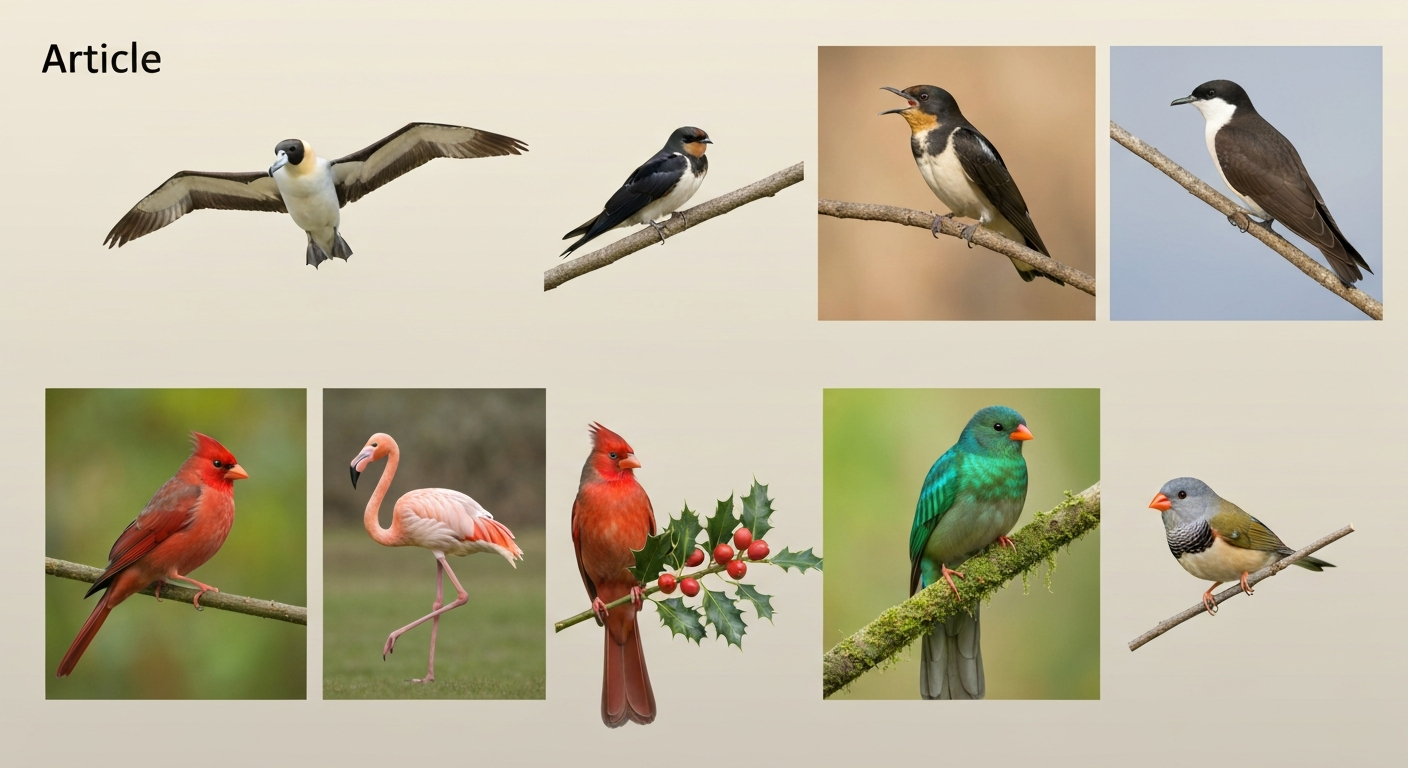
| A | Albatross (Wandering) [AL-buh-tross] | Diomedea exulans | Southern Ocean, sub-Antarctic | From Portuguese 'alcatraz' via Arabic 'al-qādūs' (water wheel/pelican); 'exulans' is Latin for wandering or exiled. |
| B | Barn Swallow | Hirundo rustica | Worldwide (breeds N. Hemisphere) | 'Hirundo' is Latin for swallow; 'rustica' means rural. Name reflects its habit of nesting in farm buildings. |
| C | Common Cuckoo [KOO-koo] | Cuculus canorus | Europe, Asia; winters in Africa | Pure onomatopoeia — the name mimics its two-note call. 'Canorus' is Latin for melodious. |
| D | Downy Woodpecker | Dryobates pubescens | North America | 'Downy' refers to the soft feathers at the base of the bill. 'Dryobates' = Greek for tree-walker; 'pubescens' = downy or hairy. |
| E | Eurasian Eagle-Owl | Bubo bubo | Europe, Asia | 'Bubo' is Latin for the Great Horned Owl or Eagle-Owl, itself echoing the bird's deep hooting call. Europe's largest owl. |
| F | Flamingo (Greater) [fluh-MING-go] | Phoenicopterus roseus | Africa, S. Europe, S. Asia | From Portuguese 'flamingo,' likely via Latin 'flamma' (flame) for the pink-red plumage. 'Phoenicopterus' = Greek for crimson-winged. |
| G | Great Blue Heron | Ardea herodias | North America, Central America | 'Ardea' is Latin for heron; 'herodias' from Greek 'herodios,' also meaning heron. The largest North American heron. |
| H | House Sparrow | Passer domesticus | Worldwide (introduced globally) | 'Passer' is the classical Latin word for sparrow; 'domesticus' means of the household. One of the most widely distributed birds on Earth. |
| I | Indian Peafowl (Peacock) | Pavo cristatus | Indian subcontinent; feral worldwide | 'Pavo' is Latin for peacock, from a Sanskrit root. 'Cristatus' means crested. The source of the English word 'peacock' (via Old English 'pea' + 'cock'). |
| J | Japanese Crane (Red-crowned Crane) [juh-PA-neez] | Grus japonensis | E. Asia (Japan, China, Korea) | 'Grus' is Latin for crane. 'Japonensis' means 'of Japan.' A symbol of longevity in Japanese and Chinese culture. |
| K | Killdeer [KIL-deer] | Charadrius vociferus | North and Central America | Onomatopoeic: the bird's piercing call sounds like 'kill-deer.' 'Vociferus' is Latin for loud or clamorous. |
| L | Laughing Kookaburra [KOO-kuh-bur-uh] | Dacelo novaeguineae | Eastern Australia | From Wiradjuri (Australian Aboriginal) 'guuguubarra,' mimicking the call. 'Dacelo' is an anagram of 'alcedo' (kingfisher). Kookaburra is a kingfisher. |
| M | Mallard | Anas platyrhynchos | Northern Hemisphere; introduced widely | From Old French 'malart' or 'mallart,' meaning wild drake. 'Platyrhynchos' = Greek for flat-billed. |
| N | Northern Cardinal | Cardinalis cardinalis | Eastern North America, Central America | Named for the vivid red plumage of the male, likened to a Catholic cardinal's robes. From Latin 'cardinalis' (principal, chief). |
| O | Osprey [OS-pray] | Pandion haliaetus | Worldwide (near water) | From Old French 'ospreit,' itself from Medieval Latin 'avis prede' (bird of prey). 'Haliaetus' = Greek for sea-eagle. |
| P | Puffin (Atlantic) [PUF-in] | Fratercula arctica | North Atlantic coasts | Origin uncertain; possibly from 'puff' (cured puffin meat, considered a delicacy) or from the bird's rotund, puffed appearance. 'Fratercula' = Latin for little friar (the black-and-white coloring). |
| Q | Quetzal (Resplendent) [ket-SAHL] | Pharomachrus mocinno | Central America (cloud forests) | From Nahuatl 'quetzalli,' meaning precious feather or tail feather. The long tail feathers were sacred to the Aztec and Maya. National bird of Guatemala. |
| R | Robin (American) | Turdus migratorius | North America | Named by settlers after the familiar European Robin, for the orange-red breast. 'Turdus' = Latin for thrush; 'migratorius' = migratory. A thrush, not a true robin. |
| S | Snowy Owl | Bubo scandiacus | Arctic tundra; irrupts south in winter | Named for its white plumage matching Arctic snow. 'Scandiacus' refers to Scandinavia. Made globally famous by J.K. Rowling's character Hedwig. |
| T | Tufted Puffin | Fratercula cirrhata | North Pacific Ocean | 'Tufted' for the golden feather tufts on the head in breeding plumage. 'Cirrhata' is Latin for tufted or fringed. |
| U | Umbrella Bird (Amazonian) [um-BREL-uh] | Cephalopterus ornatus | Amazon basin, South America | Named for the large, umbrella-like crest that spreads over its bill. 'Cephalopterus' = Greek for head-wing; 'ornatus' = adorned. |
| V | Vulture (Turkey) | Cathartes aura | Americas (widespread) | 'Turkey' for its bare red head, resembling a Turkey's. 'Cathartes' = Greek for purifier (it cleans carrion). 'Aura' is Latinized from Tupinambá 'urubú-catinga.' |
| W | Wandering Albatross | Diomedea exulans | Southern Ocean | See entry A. 'Diomedea' honors Diomedes, the Greek hero whose companions were mythologically transformed into birds. The largest wingspan of any living bird (up to 3.5 m). |
| X | Xenops (Plain) [ZEE-nops] | Xenops minutus | Mexico to South America | From Greek 'xenos' (strange) + 'ops' (face/appearance). 'Minutus' = small. A small, bark-gleaning furnariid with an upturned bill. |
| Y | Yellow Warbler | Setophaga petechia | North and Central America, Caribbean | Named for its bright yellow plumage, the most extensively yellow warbler in North America. 'Setophaga' = Greek for moth-eater; 'petechia' refers to small red spots on the female's breast. |
| Z | Zebra Finch | Taeniopygia guttata | Australia; popular worldwide as a pet bird | Named for the zebra-like black-and-white barring on the male's throat. 'Taeniopygia' = Greek for banded rump; 'guttata' = spotted. One of the most studied birds in behavioral science. |
The most commonly seen and reported birds worldwide
Observation frequency, measured through large-scale datasets like eBird (which has logged over 1.8 billion bird sightings from citizen scientists), gives a reasonable proxy for which birds people actually encounter most often. The species below consistently appear among the most frequently reported across multiple continents. For a curated list of the most common bird names, see the related reference page on most common bird names. They are not exotic or rare, which is precisely why they matter to most readers.
- House Sparrow (Passer domesticus) — arguably the most globally widespread bird, present on every inhabited continent
- European Starling (Sturnus vulgaris) — introduced to North America in the 1890s; now one of the most reported species in eBird for North America
- American Robin (Turdus migratorius) — consistently the most reported bird in many eastern US eBird counts
- Barn Swallow (Hirundo rustica) — the world's most widely distributed swallow, breeding across the entire Northern Hemisphere
- Rock Pigeon / Feral Pigeon (Columba livia) — found in virtually every city on Earth
- Mallard (Anas platyrhynchos) — the most familiar duck across the Northern Hemisphere
- Common Starling (same as European Starling) — also a dominant species in UK and European reporting
- Great Tit (Parus major) — among the most reported garden birds across Europe and Asia
- Northern Cardinal (Cardinalis cardinalis) — the most popular backyard bird in eastern North America by feeder surveys
- Common Blackbird (Turdus merula) — one of the most recognized and reported birds in UK and European gardens
The most appealing bird names for pet birds
Choosing a name for a pet bird is genuinely fun, and if you are drawn to names that carry meaning, bird species names offer a rich source of inspiration. For a curated list of the best bird names in the world to inspire your pet's name, see our recommendations. The Zebra Finch (end of the A–Z table) is a good example: its name is vivid, easy to say, and carries a satisfying visual meaning. Below are species whose common names translate into strong, resonant pet names, organized by what makes them appealing.
| Species Common Name | Why It Works as a Pet Name | Scientific Name |
|---|---|---|
| Indigo Bunting | Rich color name; sounds elegant and distinctive | Passerina cyanea |
| Kestrel | Sharp, one-syllable feel; associated with speed and precision | Falco tinnunculus |
| Lark | Short, bright, musical connotation; Old English 'lawerce' | Alauda arvensis |
| Merlin | Legendary name (Arthurian + the small falcon); punchy and memorable | Falco columbarius |
| Oriole | Melodic; from Latin 'aureolus' (golden) | Icterus galbula |
| Pippin | Informal name for Pippit species; playful and soft-sounding | Anthus spp. |
| Quill | Informal shortening linked to feather; one syllable, easy to call out | (generic; not a species name) |
| Robin | Warm and familiar; long established as both a bird and a human name | Erithacus rubecula / Turdus migratorius |
| Sable | Used for dark plumage morph birds; elegant and short | (color term; used in several species) |
| Teal | A color name from the Common Teal; calm, modern-sounding | Anas crecca |
Bird names that also work as human names
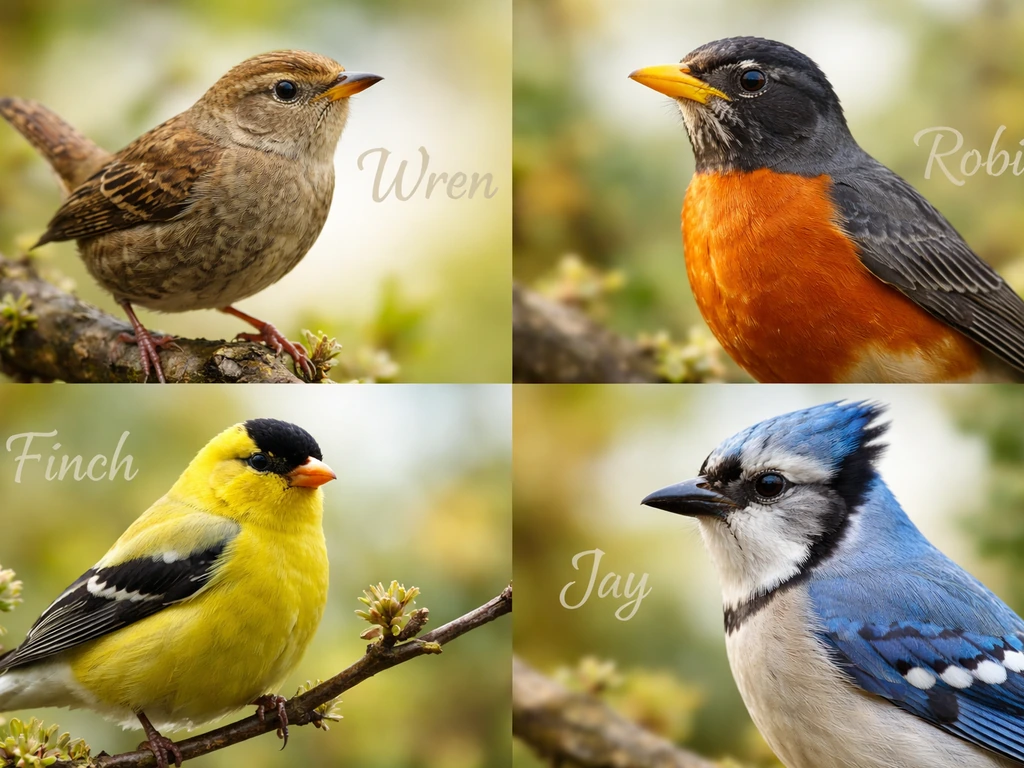
Some bird names make the jump to human names so naturally that most people do not realize the avian connection. Robin is the clearest example: it was a medieval diminutive of Robert in English, but its long association with the European Robin made the bird and the name feel inseparable. Jay is another: it is both a common name for corvids in the genus Cyanocitta and Garrulus, and a given name with no connection to birds at all (it comes from the letter J). Martin is the name of several swallow-related species (Purple Martin, Sand Martin) and a classic European given name derived from the Latin 'Martinus.' Phoebe is a flycatcher genus (Sayornis phoebe, the Eastern Phoebe) and a Greek name meaning bright or radiant. Robin, Jay, Martin, and Phoebe all appear regularly on given-name popularity charts, which tells you how thoroughly these crossovers have blended into mainstream naming culture. Get started with Google Trends – Trends Help (Google) documents that Google Trends lets you compare and export search interest by term, region, and timeframe (CSV export/embedding), making it suitable for measuring relative public interest in common‑name search terms and regional interest patterns.
- Robin — European Robin (Erithacus rubecula) and American Robin (Turdus migratorius); human name from medieval English
- Jay — Eurasian Jay (Garrulus glandarius) and Blue Jay (Cyanocitta cristata); human name from the letter J
- Martin — Purple Martin (Progne subis) and Sand Martin (Riparia riparia); from Latin Martinus
- Phoebe — Eastern Phoebe (Sayornis phoebe); from Greek mythology (Titan goddess of bright intellect)
- Merlin — Merlin falcon (Falco columbarius); also Arthurian wizard; from Welsh 'Myrddin'
- Lark — Eurasian Skylark (Alauda arvensis); used as a poetic given name meaning cheerful or carefree
- Raven — Common Raven (Corvus corax); increasingly popular as a given name in English-speaking countries
- Wren — Eurasian Wren (Troglodytes troglodytes); a short, strong given name rising in popularity
- Drake — the male Mallard; used as a masculine given name, now also famous as the name of the rapper
- Crane — several Grus species; an English surname and occasionally a given name
Comparing the main bird name databases: which one to use
If you are looking up species names for anything more than casual interest, knowing which database to use makes a real difference. The four most practical options are the IOC World Bird List, the Clements/eBird checklist from Cornell, BirdLife International's taxonomy, and Avibase. The Clements Checklist (Cornell Lab of Ornithology) is a widely used global taxonomy maintained by Cornell, providing downloadable Clements spreadsheets and annual update notes and releases. They do not always agree, particularly on species splits and lumps, which is why the same bird occasionally carries different scientific names in different sources.
| Database | Best Used For | Update Frequency | Coverage | Free Access? |
|---|---|---|---|---|
| IOC World Bird List (v15.2, 2026) | Standard global English common names; nomenclature reference | Twice per year | ~11,000 species globally | Yes (CC-BY license) |
| Clements/eBird Checklist (Cornell) | eBird observation data; North American emphasis | Annually (v2024 released Oct 2024) | ~10,700 species globally | Yes (downloadable spreadsheet) |
| BirdLife International DataZone | Conservation status, IUCN Red List linkage, range maps | Ongoing (tied to IUCN cycles) | ~11,000 species globally | Yes (species factsheets free) |
| Avibase | Multilingual name variants, synonym crosswalk, regional lists | Ongoing aggregation | ~10,000 species, >20,000 subspecies | Yes (web interface + exports) |
My default for this article is the IOC list, because its English common names are the most globally standardized and the list is updated frequently. For North American species specifically, I cross-check against the AOS checklist. For British names, I check the BOU British List. If you find a name discrepancy between sources, Avibase is the fastest way to see all the synonyms at once and confirm which taxonomy each belongs to.
A note on images, sounds, and media for bird names
If you are building your own bird reference or want to verify you have identified a species correctly, two media repositories stand out. The Cornell Lab's Macaulay Library is the largest scientifically verified archive of bird photos, videos, and audio, and it provides clear licensing terms for each asset. Xeno-canto is the go-to community archive for bird vocalizations globally, with each recording carrying its own license metadata. Both are worth bookmarking if you are moving beyond name lookup into actual species identification.
Quick tips for using this reference
- If the common name you know does not appear here, search Avibase with your regional name to find the accepted IOC name and scientific match
- Scientific names are the safest anchor: if someone disputes a common name, the binomial settles it
- Pet-bird naming: species names, color terms, and mythology-linked names (Merlin, Phoebe, Indigo) tend to age well and have conversational depth
- For North American birds, the AOS checklist and All About Birds (Cornell) are the most authoritative and reader-friendly combination
- For UK birds, the BOU British List and the RSPB species pages use consistent British English naming
- Pronunciation guides matter most for X, Q, and P entries (Xenops = ZEE-nops; Quetzal = ket-SAHL; Ptarmigan = TAR-mi-gun)
FAQ
What are the authoritative primary data sources to compile an A–Z reference of widely used common bird names with scientific names and region tags?
Use global and regional checklists and databases as primary authorities: IOC World Bird List (standard English common names and taxonomy), Clements Checklist / eBird (Cornell Lab) for an alternate widely used taxonomy, BirdLife International and IUCN Red List for range summaries and conservation status, Avibase for multilingual/common-name variants and crosswalks, AOS North & Middle American Check‑list for North American nomenclature, and BOU/British List for UK usage. For occurrence verification use eBird EBD and GBIF occurrence records. For scientific‑name validation use the ICZN and primary checklist authorities (IOC/Clements/BirdLife).
Which resources are best for etymology, name meanings and historical usage of scientific and common names?
For scientific-name etymology use Jobling’s The Helm Dictionary of Scientific Bird Names. For English vernacular etymology and historical citations use Oxford English Dictionary and Merriam‑Webster. For multilingual vernacular origins consult Avibase entries and regional checklists, plus published field guides and regional name authorities (AOS, BOU).
What media sources and licensing checks are required for publication‑ready photos, audio and pronunciation clips?
Use Cornell’s Macaulay Library and All About Birds for photographs and media with clear citation and usage rules. Use Xeno‑canto for vocalization recordings (check license metadata per recording). Confirm license terms (CC BY, CC0 or restricted) and obtain required credits or permissions. Record pronunciation clips in‑house or use licensed audio; include IPA and simple respelling for text pronunciation guidance. Include media metadata (photographer/recorder, date, source URL, license).
How should I resolve conflicts between different taxonomies and multiple accepted common names for the same species?
Adopt and state a primary taxonomic authority (e.g., IOC v15.x or Clements v2024) for the article’s canonical list. Use Avibase and checklist compare tools to map synonyms and alternate common names; include alternate names in parenthetical fields and link to the mapped scientific name. For regional pages cite the regional authority (AOS for North America, BOU for Britain). Document choices in a Methodology box and provide version numbers and dates for all checklists used. Cite checklists (IOC/Clements/AOS/BOU) and Avibase crosswalk outputs for provenance. Provide scientific names (author/year) verified with ICZN rules where necessary.
What specific research tasks produce accurate region tags and range summaries for each common name entry?
Tasks: (1) Query IUCN species pages for downloadable range maps and standardized range text; (2) Use BirdLife factsheets for distribution summaries and regional status; (3) Cross‑check occurrence density and recent records via eBird EBD and GBIF occurrence counts filtered by region/country; (4) Flag vagrant vs. resident status from regional checklists (AOS/BOU) and field guides. Record data sources and dates for each range tag (e.g., ‘North America (breeding), Central America (migrant)’ with citations).
How can I produce objective popularity and ‘most common’ rankings for world bird names suitable for SEO and citation?
Combine multiple metrics and disclose methodology: (a) global observation frequency — sum eBird reporting rates and GBIF occurrence counts normalized by observation effort; (b) web search interest — use Google Trends CSV exports for relative search volume by term/region/timeframe; (c) media presence — count Macaulay Library media items and Xeno‑canto recordings per species. Create a composite score (weighted, e.g., 50% eBird/GBIF, 30% Google Trends, 20% media counts), document weights and timeframe, then rank species by composite score. Provide raw metric tables and links to data exports for reproducibility. Cite eBird, GBIF and Google Trends for methods and data access.
Next Articles

Bird Names Are Unregulated: What That Means and How to Verify
Learn why bird names seem unregulated, how scientific names work, and how to verify correct labels fast.

Bird Name Is: How to Identify, Verify, and Understand Names
Identify the bird, verify its common and scientific name, and decode naming origins and regional name differences.
Bird Names That Could Be Human Names: Lists and How to Pick
Curated bird names that could work as human names, with pronunciation, meanings, and tips to pick the right one.