The secretary bird got its name because its long black crest feathers look exactly like the quill pens that 18th and 19th-century clerks used to tuck behind their ears. In The Century Dictionary (prepared under William Dwight Whitney’s supervision), the entry for “[secretary-bird](https://upload. wikimedia. org/wikipedia/commons/7/7a/TheCenturydictionary-anencyclopediclexiconoftheEnglishlanguage-preparedunderthesuperintendenceofWilliamDwightWhitney%28IAcenturydictipt1900whituoft%29.
How Did the Secretary Bird Get Its Name

Maya Castellanos
17 May 2026
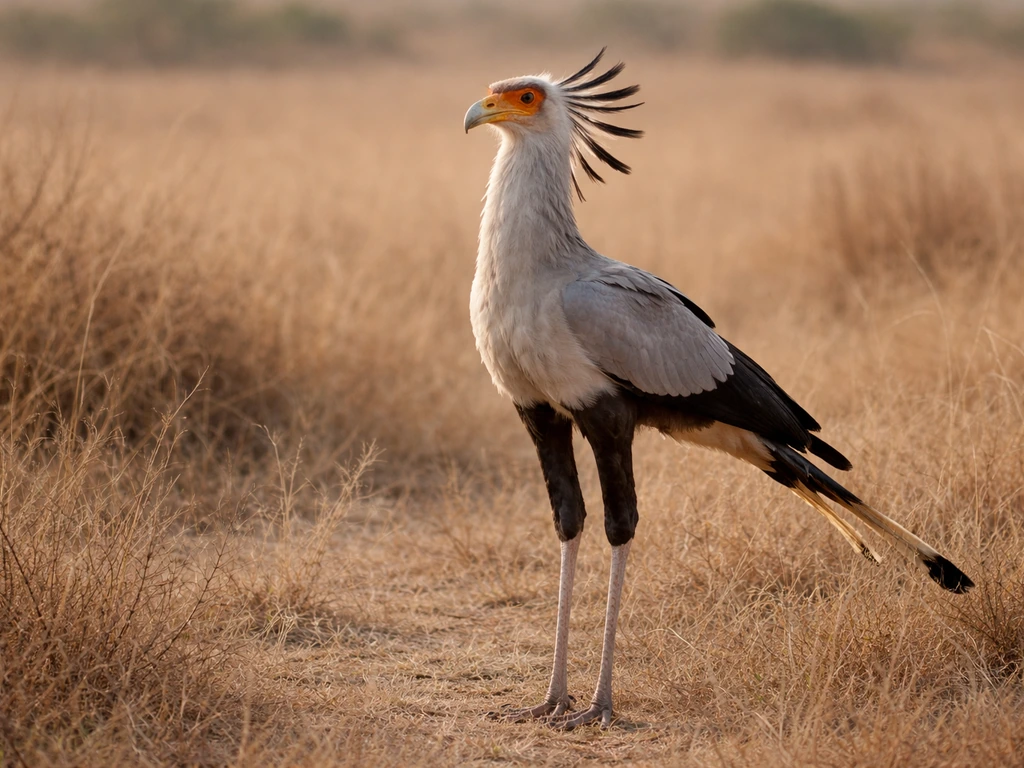
pdf)” describes the name in the traditional quill-pen resemblance sense connected to “Secretary” and also discusses the related Sagittarius/Vosmaer naming background. That's it. The bird wasn't named for any job it performs, any behavior resembling office work, or any clever bureaucratic metaphor. Someone looked at this tall, upright African raptor with a crown of dark plumes fanning out behind its head and thought: that bird looks like a clerk with a bunch of quills sticking up over its ear.
The name stuck, and it's been in English use at least since 1824, when Merriam-Webster records its first known written appearance.
What we mean by 'secretary bird'
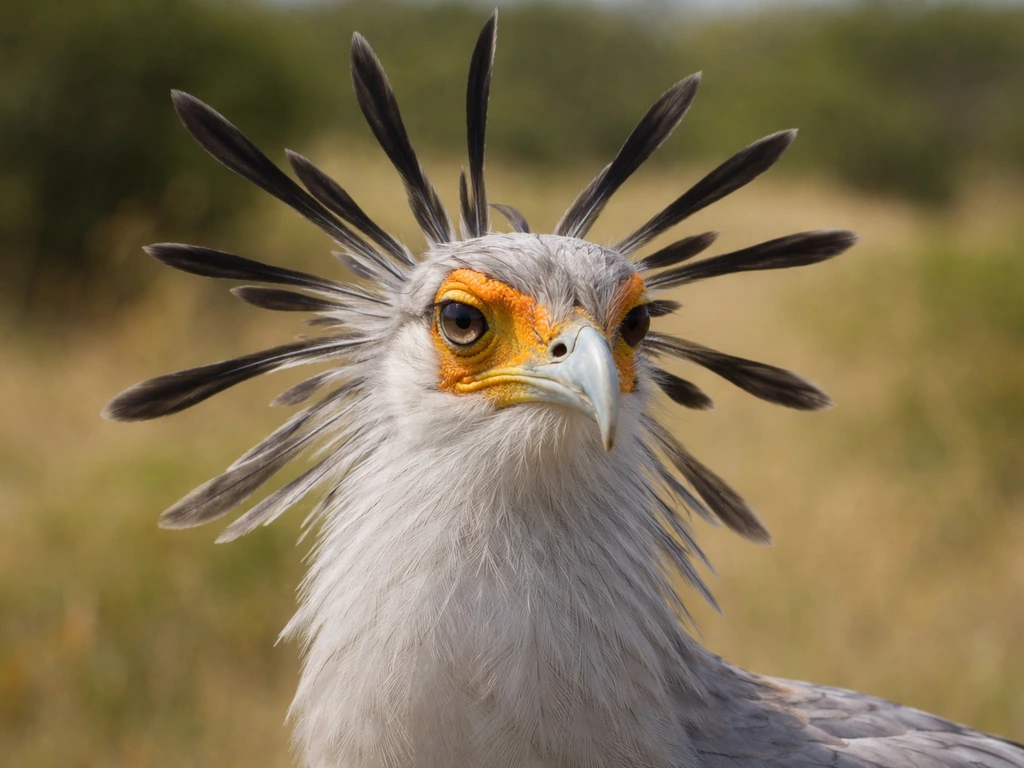
Just to make sure we're all looking at the same animal: the secretary bird (Sagittarius serpentarius) is a large, long-legged bird of prey native to the dry open grasslands and savannas of sub-Saharan Africa. It's the only living member of the family Sagittaridae. Britannica describes it as roughly 1.2 metres (about 3.9 feet) tall with a wingspan of around 2.1 metres (nearly 7 feet). It walks upright on those impossibly long legs, hunting on foot rather than from the air, which makes it look almost stately. It's also famous for stomping venomous snakes to death, which is reflected in its scientific species name, serpentarius, meaning 'of serpents' or 'snake handler.'
The most visually striking feature, for our purposes, is the crest: about 20 long black feathers that fan out from the back of the bird's head. Britannica specifically describes them as making the bird 'appear to be carrying quill pens behind its ears.' That visual is the entire foundation of the name, so keep it in mind.
The origin story: quill pens behind the ear
The core naming logic is visual and almost embarrassingly simple once you see it. Historical secretaries and court clerks, especially in 18th and 19th-century Europe, were commonly depicted tucking quill pens above their ears when not actively writing. It was the equivalent of a modern office worker clicking a pen into their shirt pocket. The secretary bird's crest feathers, fanning out in a spray of long dark plumes behind and above the head, mimicked that image closely enough that early European naturalists and travelers to southern Africa seized on the comparison.
Merriam-Webster is direct about this in their etymology note, describing the name as 'probably from the resemblance of its crest to a bunch of quill pens stuck behind the ear.' The 1911 Encyclopaedia Britannica goes further, stating that the English name 'Secretary' is derived from 'the fancied resemblance of these feathers to the pens which a clerk is supposed to stick above his ear.' The word 'fancied' is worth pausing on here: it means the resemblance was imaginative, a visual metaphor that someone decided to make official by attaching it to the bird's name. That's how a lot of bird names work, and it's a reminder that naming often reflects the observer's cultural moment as much as the animal itself.
Historical context: how a court clerk ended up in a bird name

To appreciate why this comparison made immediate sense to 18th-century Europeans, it helps to know what the word 'secretary' meant at the time. The Online Etymology Dictionary (Etymonline) traces 'secretary' back through Medieval Latin to 'secretarius,' meaning a confidential officer or one entrusted with private matters, derived from 'secretum' (secret). By the 1700s, a secretary was primarily a writing clerk or administrative official, almost always associated with pens, ink, and paper. The image of a quill pen over the ear was so culturally legible as a marker of clerical work that it needed no explanation.
Etymonline records the secretary bird name as 'said to be so called (1786)' in reference to the crest resembling 'a pen stuck over the ear,' placing the nickname firmly in the late 18th century. Etymonline notes that the secretary bird is “said to be so called (1786)” because its crest resembles “a pen stuck over the ear.”. Dutch naturalist Arnout Vosmaer had described the bird in 1769 based on a specimen sent to Holland from the Cape of Good Hope, so European naturalists were beginning to formalize their observations of this species in exactly the period when the 'secretary' comparison would have felt natural and witty.
The Cape of Good Hope connection matters here. European travelers and naturalists arriving in southern Africa encountered this bird standing tall on the open plains, crest feathers fanned out, and the visual punchline was apparently irresistible. The naming happened in a colonial natural-history context, where European observers catalogued new species by comparing them to familiar images from their own world. A clerk with quills behind the ear was a very familiar image in 18th-century Europe.
The 'Sagittarius' detour: how the scientific name adds a twist
Here's where the naming history gets a little more tangled, in a way that's worth knowing if you want the full picture. The bird's genus name, Sagittarius, means 'archer' in Latin. According to the 1911 Encyclopaedia Britannica, at the Cape of Good Hope the bird was originally known as 'Sagittarius' (the Archer), a reference to its striding, purposeful walk, as if marching forward like a bowman. That name was associated with Vosmaer's early description.
The same 1911 source explains that 'Sagittarius' was then 'corrupted into' the Latin form 'Secretarius,' which sounded similar enough phonetically but carried the entirely different meaning of 'secretary/clerk.' From 'Secretarius,' it was a short step to the English 'Secretary Bird.' The 1911 Britannica is clear that whatever the route through which 'secretarius' entered the picture, the English name 'Secretary' is 'really derived' from the visual comparison to the quill-pen-carrying clerk, not from the Sagittarius/archer lineage. So you get two overlapping naming threads: an archer name that was misheard or adapted into a clerk name, and a genuine visual metaphor that independently explained and reinforced the English common name.
How the term functions in English (the linguistic side)
In English, 'secretary bird' operates as a compound common name, the same structural pattern used for hundreds of bird species where a descriptive or associative word precedes 'bird' to identify the species. You'll see it written both as two words ('secretary bird') and as one ('secretarybird'), and both forms appear in authoritative sources. The U. If you are wondering how do you call a bird like this, the common name is the secretary bird.
S. Fish and Wildlife Service uses the one-word form 'Secretarybird' as the accepted common name. Merriam-Webster lists it as two words. Neither version is wrong; this kind of spelling variation is extremely common in English bird nomenclature, as anyone familiar with the ongoing debates around bird name formatting will recognize.
The naming pattern itself, using an occupational or human-role word to describe a bird based on visual appearance, is actually quite well-represented in bird names. If you've ever wondered why bird names sometimes feel odd or unexpected (a theme worth exploring on its own), the answer usually involves exactly this kind of reasoning: someone saw something that reminded them of a person, a tool, or a cultural practice, and the name traveled from that moment into formal usage. The secretary bird is a particularly well-documented example of that process.
Common misconceptions (and why they don't hold up)
A few wrong explanations for the name circulate online, and they're worth clearing up. Maybe you are actually asking whether there is a bird called boobies, since that name sounds similar to 'secretary bird' but refers to a different group of birds. The same kind of “name based on appearance” curiosity is behind questions like why is the middle finger called the bird.
- The bird is named for a 'secretary' job it performs: this is the most common misunderstanding. The name has nothing to do with the bird's behavior or any role it plays. It's entirely about appearance, specifically the crest feathers that look like quill pens tucked behind the ear.
- The name comes from the Arabic for 'hunter bird' or 'falcon': Wiktionary notes this alternative hypothesis, but it isn't supported by the major authoritative references. Merriam-Webster, the 1911 Encyclopaedia Britannica, and Etymonline all converge on the quill-pen-resemblance explanation without mentioning an Arabic origin.
- The 'Sagittarius' name and 'secretary' name mean the same thing: they don't. 'Sagittarius' means archer; 'secretarius/secretary' means clerk or confidential writer. The 1911 Britannica explicitly addresses this, explaining that 'Sagittarius' was phonetically corrupted toward 'Secretarius' but that the English 'Secretary' name is independently grounded in the visual crest comparison.
- The bird was named after a specific person called 'Secretary': there's no evidence for this. The name is a descriptive common noun, not a proper name or honorific, which is consistent with how it appears in every major reference.
The quill-pen explanation isn't just the most widely accepted one, it's also the one that makes intuitive sense when you look at the bird. This same pattern helps answer the question of why the secretary bird is named the way it is quill-pen explanation. Stand a secretary bird next to an illustration of an 18th-century court clerk with quills fanning out above the ear, and the naming logic becomes obvious. If you’re wondering why a bird is called a bird at all, the same idea of visual metaphors and old naming habits often explains it secretary bird. That's usually a reliable sign you've found the right explanation.
How to verify this yourself
If you want to confirm the etymology rather than just taking my word for it, here are the specific places to look and exactly what to look for in each source.
| Source | Where to look | What you'll find |
|---|---|---|
| Merriam-Webster (merriam-webster.com) | Search 'secretary bird'; check the etymology line | "probably from the resemblance of its crest to a bunch of quill pens stuck behind the ear"; first known use listed as 1824 |
| Britannica (britannica.com) | Search 'secretary bird'; read the physical description paragraph | Crest feathers making the bird "appear to be carrying quill pens behind its ears" |
| Etymonline (etymonline.com) | Search 'secretary'; scroll to the bird reference | "said to be so called (1786)" with crest resembling "a pen stuck over the ear" |
| 1911 Encyclopaedia Britannica (via Wikisource) | Search 'Secretary-bird' on Wikisource | Explicit statement that the name 'Secretary' is derived from "the fancied resemblance of these feathers to the pens which a clerk is supposed to stick above his ear" |
| U.S. Fish and Wildlife Service (fws.gov) | Search 'Secretarybird' | Confirms the accepted common name spelling and the scientific name Sagittarius serpentarius |
Between Merriam-Webster for the dictionary-level etymology, Etymonline for the broader word history, and the 1911 Britannica on Wikisource for the historical narrative (including the Sagittarius/Secretarius corruption story), you'll have a thorough, well-sourced picture of exactly how the name developed. For the scientific name backstory, the Wikipedia article on the secretarybird also provides a solid starting point and points toward Vosmaer's 1769 description, which is the earliest European formal account of the species.
If you find yourself enjoying this kind of naming detective work, the secretary bird is just one example of a wider pattern in bird nomenclature where visual metaphors, cultural assumptions, and occasionally garbled phonetics all collide to produce names that look arbitrary until you pull the thread. The scientific name Sagittarius serpentarius is itself a small story within a story: an archer that hunts serpents, which is actually a fairly accurate description of what this bird does on the African savanna every day.
FAQ
Is the secretary bird named because it does “secretary” work like writing?
It is a descriptive nickname from a visual resemblance, not a reference to any job the bird does (for example, it is not connected to offices or writing). The name comes from how the crest feathers look like quill pens tucked behind a clerk’s ear.
What feature of the secretary bird matters most for the name explanation?
The crest is the key. Without that fan of long black feathers behind and above the head, the quill-pen comparison becomes much weaker, and most of the naming evidence would not make intuitive sense.
Does the scientific name (Sagittarius serpentarius) also explain the “secretary” part?
No, the species name and the English name are not the same naming mechanism. “Secretary bird” comes from the crest resemblance, while “serpentarius” reflects hunting serpents.
Why do I sometimes see it written as “secretary bird” and other times as “Secretarybird”?
Spelling can vary because English bird common names are inconsistent. In practice, you will see both “secretary bird” (two words) and “Secretarybird” (one word), and reputable authorities use both.
Could the name come from a location or person instead of the feathers?
It is not one of the common cases where a bird is named after a place, a person, or a modern behavior. The strongest case is culturally based on a specific look, the quill-like crest tied to 18th and 19th-century clerk imagery.
What should I do with the “Sagittarius” to “secretarius” confusion mentioned in some histories?
The “Sagittarius” versus “secretarius” mix-up is mostly about how Latinized names may have shifted in historical paperwork and interpretation. The English “secretary” common name is still ultimately justified by the quill-pen crest resemblance, not by the archer meaning.
How can I verify the explanation for myself without relying on sources?
A good self-check is to compare the bird’s crest directly to a depiction of a clerk or court official with quills tucked above the ear. If the crest looks like that, you are looking at the intended naming metaphor.
Does this naming story depend on European cultural habits at the time?
Yes, the name reflects an observer’s cultural reference point. If a culture did not have the “quills behind the ear” visual association, the metaphor might not sound witty or even obvious, even if the bird looks the same.
How confident should I be in the etymology, given that some accounts use cautious wording?
Yes. Many common names originate from “said to be” observations by travelers and naturalists, which can involve informal attribution. That said, the crest-as-quills explanation is repeatedly supported and matches the bird’s most distinctive feature.