The middle finger is called "the bird" because the gesture is referred to by the slang phrase "flipping the bird" or "giving someone the bird," where "bird" functions as a euphemism for the obscene hand signal itself. The short answer is that the word "bird" gradually shifted from meaning a theatrical boo (specifically the hissing of a goose) to becoming a polite stand-in for the rude middle-finger gesture in American English, especially from the 1960s onward. It's a fascinating piece of slang etymology, and if you love the way language borrows from the animal kingdom to name human behavior, it fits right in with a whole tradition of gesture-and-creature wordplay.
Why Is the Middle Finger Called the Bird

Maya Castellanos
18 Apr 2026

What "the bird" actually means as slang
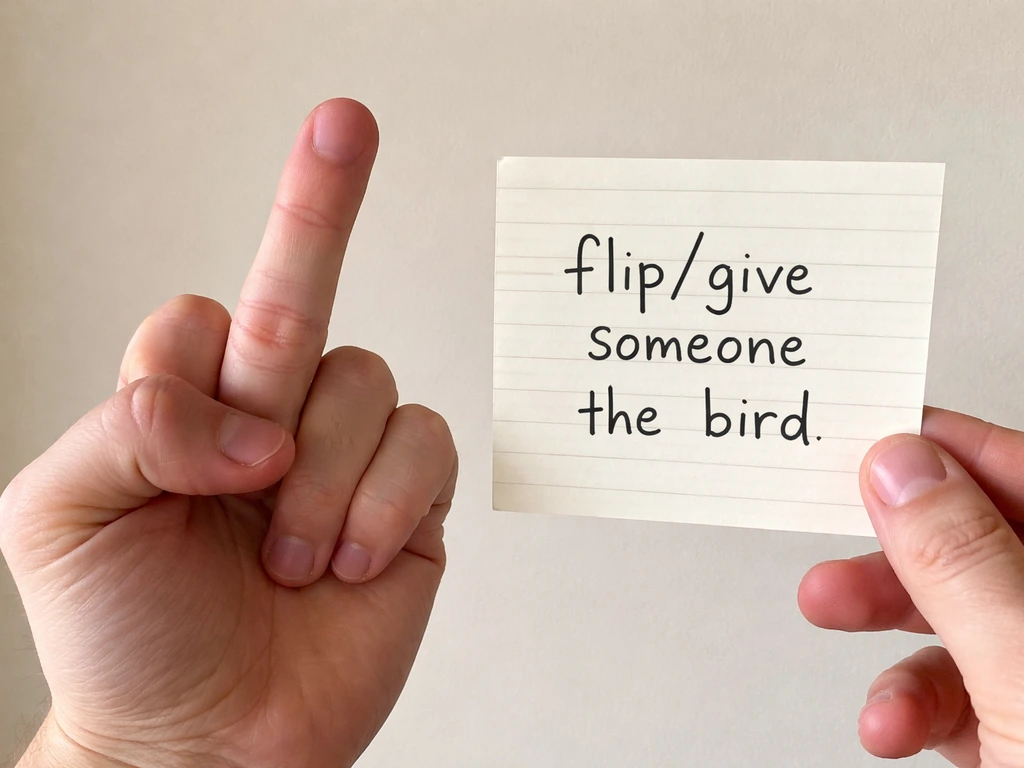
Both Merriam-Webster and Cambridge Dictionary define the phrases "flip someone the bird" and "give someone the bird" the same way: to make an obscene hand gesture at someone by extending the middle finger while the other fingers are curled down. The key thing to understand is that "the bird" is a euphemism, a polite or socially acceptable word swapped in for something ruder. You're not literally referencing any species of bird. The word "bird" here is doing the same job that "the finger" does in "give someone the finger," and all three major variants (flip the bird, give the bird, flip someone off) are treated as synonyms in modern English dictionaries and lexicons like Wiktionary and Green's Dictionary of Slang.
Green's Dictionary of Slang is particularly useful here because it traces multiple senses of "bird" across time and shows exactly when and how the word entered gesture-related idiom territory. The modern middle-finger meaning is distinct from earlier uses of "the bird," and Green's separates them carefully. So if you look up "bird" in a slang dictionary and see multiple numbered definitions, the middle-finger meaning is a later development, not the original one.
Where the "bird" label came from
The origin story most supported by historical evidence runs something like this: before "the bird" meant a rude hand gesture, it meant getting booed off stage. In nineteenth-century British theatrical slang, "giving someone the big bird" meant an audience hissing at a performer, and the bird in question was a goose. Geese hiss, audiences hiss, so the crowd became a metaphorical goose. Slang dictionaries from around 1890, including the multi-volume reference "Slang and Its Analogues," documented this sense explicitly: "to get or give the big bird" meant to be hissed on the stage.
The Oxford Dictionary of Idioms also includes "give someone the bird" in this older sense of booing or jeering at a performer, which shows the phrase had a well-established life before the middle-finger meaning arrived. The shift toward the gesture-specific meaning appears to have happened somewhere around the mid-twentieth century in American slang, with the earliest reliably dated printed uses of "flipping the bird" as a middle-finger reference appearing around the 1960s. If you are wondering how the secretary bird got its name, the same kind of naming and word-shift stories can show you why specific phrases stick flipping the bird. A 1967 issue of Broadside has been cited in linguistic discussions as an early print example, though as researchers on forums like English Language and Usage Stack Exchange have pointed out, nailing down the absolute first use requires careful primary-source work.
Atlas Obscura has covered this transition in detail and even had to issue a correction when earlier claims about the first written instance of the phrase turned out to need adjustment, which tells you something important: popular etymology sites can get this wrong. If you see a confident-sounding claim that "the bird" definitely originated in ancient Rome or medieval England because of archers or some other vivid story, treat it with healthy skepticism unless it comes with verifiable dated sources.
The goose-to-gesture pipeline

The most plausible explanation for how "the bird" moved from stage-hissing slang to middle-finger slang is a transfer of meaning through shared context: both the theatrical boo and the rude gesture are insults directed at a person, both involve a kind of public dismissal, and both already lived in informal spoken language. Once American slang adopted the middle-finger gesture as a mainstream insult in the mid-twentieth century, it borrowed the pre-existing "bird" label from theatrical slang because it fit: giving someone the bird was already understood as a cutting-down gesture. The hand signal just gave the phrase a new, more physical expression.
How the gesture and its name spread across cultures
The middle-finger gesture itself is ancient, appearing in Greek and Roman sources, and Wikipedia notes that Jesse Sheidlower traced development of the American "giving the finger" expression back to the 1890s in the United States. But the "bird" label as a name for the gesture is specifically an English-language development, and it spread through American pop culture, entertainment, and media, particularly from the 1960s onward. That timing lines up with the gesture becoming more visible in American public life, sports, and film.
Across other languages and cultures, the middle-finger gesture exists (and is understood as rude in most Western contexts), but the specific "bird" label does not translate. Other languages have their own distinct slang terms for the gesture, and none of them appear to use a bird metaphor in the same way. Targeted searches for direct equivalents in French, Spanish, German, or Russian do not produce a matching "bird" idiom for this gesture, which means the "bird" framing is genuinely English-specific and largely American in origin. What does travel across cultures is the gesture itself, which is recognizable globally even if the local vocabulary for it differs.
Related idioms and what people actually mean
English has a small cluster of phrases that all point to the same gesture. Knowing these helps you interpret the slang correctly depending on who's using it and where.
| Phrase | Meaning | Register/Region |
|---|---|---|
| Flip someone the bird | Make the middle-finger gesture at someone | Informal, American English |
| Give someone the bird | Same gesture, or (older) to boo/hiss at someone | Informal, American and British English |
| Give someone the finger | Middle-finger gesture | Informal, broadly English-speaking |
| Flip someone off | Middle-finger gesture | Informal, American English |
| The one-finger salute | Ironic/humorous term for the same gesture | Informal, widely understood |
| Give someone the bone | Same gesture (less common variant) | Informal, slang (documented in Green's) |
One important regional note: in British English, "give someone the bird" historically carried the theatrical booing sense more strongly, and Collins marks some usage distinctions between US and UK contexts. Collins English Dictionary defines “give someone the bird” as telling someone rudely to depart and/or scoffing at them by hissing, noting an older sense older theatrical booing sense. If you're reading older British text and see "gave him the bird," it might not be referring to a hand gesture at all but to being dismissed or jeered. Context usually makes it clear, but it's worth knowing the older meaning exists.
Why we name gestures after animals at all

This is where things get genuinely interesting from a linguistic standpoint. Naming a human gesture after an animal is not unusual at all; it's part of a broader pattern where animals serve as stand-ins for human behaviors, especially rude or expressive ones. The goose-hissing connection behind "the bird" is a good example: the animal's sound (hissing) mapped onto a human social behavior (booing), and then the animal's name got attached to the behavior itself. This is called semantic transfer, where a word slides from one meaning to another because the two meanings share an emotional or functional quality.
Gesture-and-animal metaphors appear in other languages too, though rarely with direct parallels. The broader principle is that animals are vivid, memorable, and culturally loaded, which makes them natural anchors for slang. If you've spent any time looking into why bird names are so weird, you'll recognize this mechanism immediately: namers reach for the most striking, memorable, or contextually funny reference available, and animals almost always qualify. The same instinct that gives us oddly named bird species gives us "the bird" as slang for a rude hand gesture. If you are also wondering about why a specific bird has a memorable name, the same “semantic transfer” idea can help explain questions like “secretary bird why named” as well.
It's also worth noting that using an animal metaphor acts as a linguistic buffer. Calling it "the bird" instead of describing the gesture directly makes it easier to use in print, on television, or in polite conversation. Euphemism by animal metaphor is surprisingly common across languages, even if the specific animals and gestures differ.
How to talk about it without causing confusion
If you're using or explaining the phrase "giving someone the bird" in a context where the audience might not be American English speakers, or where they might know the older theatrical meaning, a quick clarification goes a long way. Ginger Software’s phrase page explains that “flip the bird” refers to a rude gesture made by extending the middle finger. The easiest move is to pair the phrase with a visual or contextual cue, or simply say "the middle-finger gesture" if you need to be unambiguous. The phrase is widely understood in American English-speaking contexts with no clarification needed, but in British English or in academic writing, the older booing sense can still surface.
If you're writing about the gesture for a general audience (say, in an article, a language lesson, or a cultural explainer), the safest approach is to define the phrase on first use and note that "the bird" functions as a euphemism. That is also why people sometimes ask why is a bird called a bird when they first encounter the slang. People also ask, “is there a bird called boobies,” but that term refers to a real seabird, not the slang phrase. This also helps avoid an entirely different confusion: in plenty of other contexts, "bird" just means an actual bird, and on a site dedicated to bird names and nomenclature, that distinction matters more than usual. If you mean a real bird, its scientific name is determined by taxonomy, such as genus and species actual bird.
For anyone who wants to dig into the etymology seriously, the most reliable sources to check are Merriam-Webster, Cambridge Dictionary, Green's Dictionary of Slang (for historical slang specifically), and the Oxford Dictionary of Idioms. These give you dated, sourced entries rather than plausible-sounding stories. Popular etymology sites can be a helpful starting point, but their claimed timelines need cross-checking against digitized newspaper archives or verified dictionary entries before you cite them confidently.
Quick reference: what to remember
- "The bird" is a euphemism for the middle-finger gesture, not a reference to any actual bird species.
- The phrase evolved from "give the big bird" (theatrical booing, goose-hissing) in the 19th century to a middle-finger gesture label in mid-20th century American slang.
- Earliest reliably dated printed uses of "flipping the bird" as a gesture reference appear around the 1960s; single-origin claims need primary-source verification.
- British English retains more awareness of the older "booing" sense, so regional context matters when interpreting the phrase.
- The gesture itself travels across cultures, but the "bird" label is an English-language (primarily American) development with no direct bird-named equivalent in other major languages.
- For credible sourcing, use Merriam-Webster, Cambridge, Green's Dictionary of Slang, or the Oxford Dictionary of Idioms rather than popular etymology sites alone.
FAQ
Does “the bird” literally mean a goose or another bird?
No. In this idiom, “the bird” is a euphemism, you are not referring to a goose or any other species. If you want to be extra clear, use “middle-finger gesture” instead of the slang term.
Could “give someone the bird” ever mean something other than the hand gesture?
Often, but not always in older British contexts. In British English, “give someone the bird” can sometimes mean getting jeered or booed, so check whether the passage is about theater, crowds, or performers rather than about the hand.
Are “flip the bird,” “flip someone off,” and “give someone the finger” the same thing?
Yes. People may say “flip someone off,” “give him the finger,” or “flip the bird.” Dictionaries generally treat these as functionally equivalent modern expressions, but the exact wording can signal tone, region, or formality.
How can I tell from context which “bird” meaning is intended?
Context matters. If “bird” appears alongside words like “boo,” “jeer,” “stage,” “audience,” or “performance,” it may be using the older theatrical sense rather than the gesture. If you see “middle finger,” “hand,” “gesture,” or a description of fingers, it is almost certainly the gesture.
Does the “bird” name prove that the middle-finger gesture started in the nineteenth century?
Avoid repeating it as if it were the origin of the gesture. The hand signal itself is older and appears in classical references, while “the bird” label is an English slang development that attached to the insult later. Separating “gesture history” from “bird-label history” prevents a common misunderstanding.
What should I do when translating this idiom into another language?
The “bird” label is English-specific, but other languages may still use the same gesture. If you translate “the bird” literally into another language, it can land wrong, because many languages have their own local slang terms for the gesture.
Is it safe to use “the bird” in writing, or should I spell out the gesture?
Yes. In most cases it is treated as obscene or insulting, and it can escalate quickly. If you are writing or explaining it, choose euphemized phrasing like “the rude hand signal” and define it once, then stick to the clearer term “middle-finger gesture” afterward.
How do I verify claims about the earliest written use of “flipping the bird”?
When discussing first-use claims, don’t rely on a single blog or social-media thread. Compare dictionary entries that include dated citations (especially historical slang references), and if the article claims a “first ever” date, look for primary print evidence.
Next Articles
What Is the Scientific Name for a Bird? How to Find It
Learn how every bird species gets a unique genus-species scientific name and how to find it from common clues.
How Do You Call a Bird A Practical Guide to Names
Get the right name for a bird or pet: identify species, choose common or scientific names, and learn name meanings.
Good Names for a Dodo Bird: Ideas and How to Pick
Cute, funny and elegant dodo bird names plus how to pick one, with language meanings for flightless island vibes.