English speakers say 'tuna fish' because 'tuna' alone can feel ambiguous in certain contexts, especially when you're talking about canned food rather than a living animal. 'Chicken,' on the other hand, has been a fully self-contained word for the animal (and the meat) for so long that nobody needs to add 'bird' to clarify anything. It would sound strange, almost comically redundant. The difference comes down to how deeply a word is embedded in the language, what listeners expect from word order, and whether adding a category label actually does any useful work.
Why Do People Say Tuna Fish but Not Chicken Bird?

Maya Castellanos
5 Jun 2026
How English compound nouns handle categories
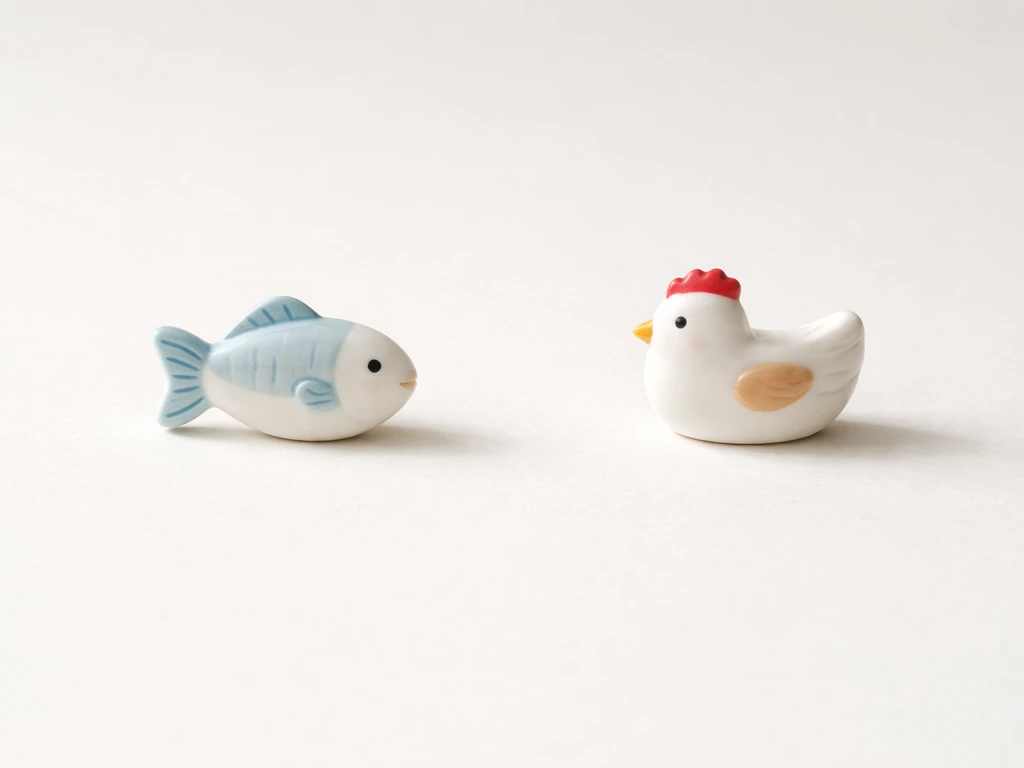
English loves to build compound nouns by stacking a descriptive word in front of a category head: swordfish, starfish, catfish. The category head (fish, bird, snake) tells you what class of thing you're dealing with, and the descriptor tells you which one. Linguists call this an endocentric compound: the head word carries the core meaning, and everything in front of it narrows that meaning down. 'Songbird' works the same way. The head is 'bird,' and 'song' tells you what kind. You can see the same logic in 'hummingbird,' which is so well-established that Merriam-Webster treats it as a single lexicalized word, even though 'bird' is baked right into it.
The 'X fish' pattern is particularly productive in English because the word 'fish' covers an enormous range of creatures that share almost no obvious visual similarity to a casual observer. Swordfish, blowfish, and pufferfish don't look much like each other, so the 'fish' head actively does explanatory work every time it appears. It tells the listener: whatever this thing is, it lives in water and is a fish. That constant clarification earned the pattern a permanent place in everyday speech.
With 'tuna fish' specifically, there's an interesting historical wrinkle. Wikipedia notes that the phrase is partly a calque, or loan translation, from the German 'Thunfisch.' When canned tuna became a mass-market product in the United States, the compound 'tuna fish' got attached to the packaged food, and it stuck. Cambridge Dictionary and Collins both show that 'tuna (fish)' is treated as a variant form of the same noun, not a separate construction. Merriam-Webster even lists 'tuna fish' as its own noun entry, specifically for the canned or cooked flesh. So part of what you're hearing when someone says 'tuna fish' is the echo of a product name that has been repeated on millions of sandwich menus and tin cans for over a century.
Lexicalized common names: why 'chicken' doesn't need 'bird'
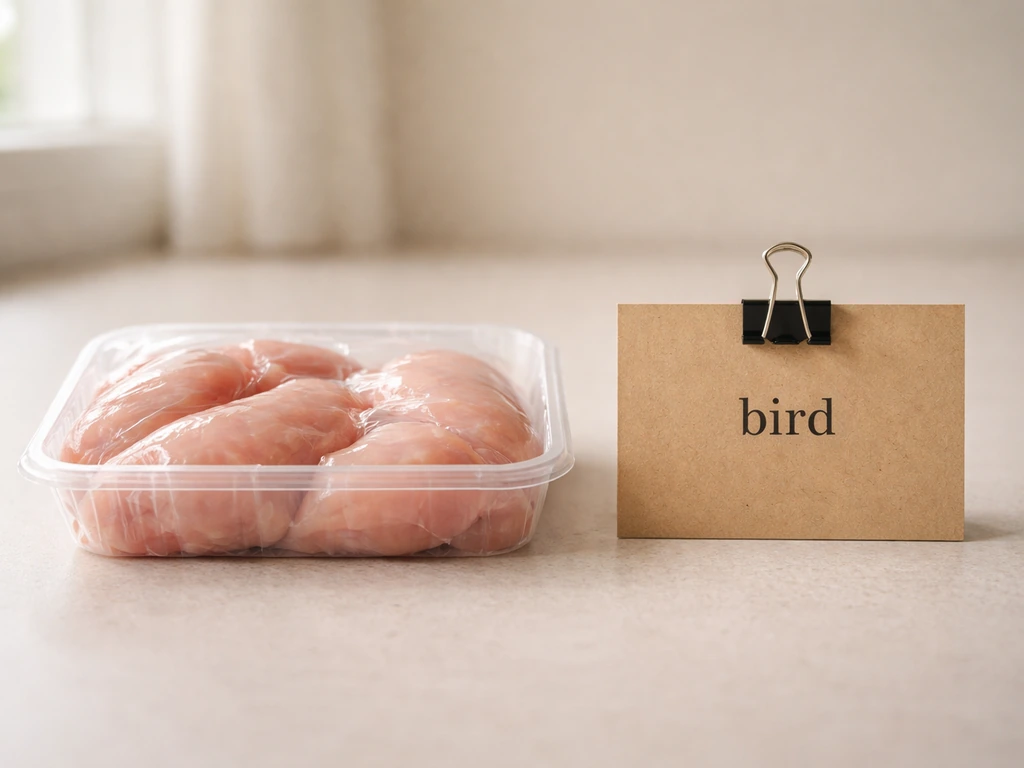
A word becomes lexicalized when it stops feeling like a description and starts feeling like a name. 'Chicken' hit that milestone a very long time ago. Britannica describes the chicken as a specific domesticated species (Gallus gallus) with over 60 breeds, but in everyday English the word 'chicken' does triple duty: it names the animal, the meat, and a whole category of culinary experience. Nobody has to guess what a chicken is. The word carries its entire meaning package on its own.
Compare that with something like 'tuna.' If someone says 'I had tuna for lunch,' most listeners picture a sandwich or a can. The animal itself, a large open-ocean predator, rarely enters the mental image. The word 'tuna' is still doing some disambiguation work depending on context, which is exactly why 'tuna fish' persists as an option when someone wants to signal the whole-animal or the aquatic context rather than the food product. 'Chicken bird,' by contrast, would signal nothing useful. Everyone already knows a chicken is a bird. Adding 'bird' creates redundancy without adding clarity.
This is the same reason bird-keeping resources like Oregon Humane's new bird guides refer to species as 'cockatiel' rather than 'cockatiel bird.' The common name is already a complete, standardized unit. Ornithology.com puts it plainly: a common name is established specifically to eliminate confusion among species. The category label is already implicit. Stacking 'bird' on top would just be noise.
Word order and listener expectations: what sounds natural and why
Part of what makes 'tuna fish' sound natural and 'chicken bird' sound weird is listener expectation. In English, when a category head appears in a compound noun, the head comes last. That's why 'songbird' works and 'birdsong' means something completely different. Your brain is trained to wait for the head word before it locks in the category. With 'tuna fish,' that expectation is satisfied: 'fish' arrives at the end and confirms the category. The whole thing sounds like a tidy compound.
'Chicken bird' violates the expectation in a subtle way. 'Chicken' is already a fully resolved animal name. Appending 'bird' afterward doesn't refine the meaning the way a head word should. Instead, it just repeats information the listener already had. It's the kind of phrasing that makes people pause and think, 'Wait, are you describing something specific, or are you just saying chicken twice?' The redundancy lands awkwardly, which is precisely why linguists sometimes call phrases like 'tuna fish' pleonastic when the 'fish' part isn't doing much extra work. Wikipedia's entry on pleonasm flags 'tuna fish' as technically redundant for exactly this reason, though it also notes that the phrase earns its place by distinguishing the canned product from the live animal.
When 'bird' does get used anyway

That said, 'bird' absolutely gets used as a category label in English. It just follows different rules. You'll hear it as a general class term ('I saw a strange bird in the garden'), in formal compound phrases ('bird of prey' is listed in Merriam-Webster, Cambridge, and Oxford Learner's Dictionaries as a standard classificatory noun phrase), and built directly into species names like 'hummingbird,' 'lyrebird,' or 'frigatebird.' In all these cases, 'bird' is doing real work: it's either the main noun acting as a category placeholder, or it's the head of a compound that needs it to make sense.
You also encounter 'chicken bird' in some specific folklore, regional dialect, and slang contexts. In certain African and Caribbean traditions, the term has been applied to specific species people associate with chickens or chicken-like behavior. In wordplay and pop culture, pairing 'chicken' with 'bird' is sometimes done deliberately for comic or emphatic effect, much like saying 'the turkey bird' to sound folksy or ironic. The turkey naming story is a good parallel here: the bird that became 'turkey' in English went through a whole tangle of geographical confusion and naming convention shifts before the name stuck. That same kind of naming tangle is why people sometimes wonder whether Turkey is named after the bird turkey naming story. In the U.S., Turkey and Turkey-headed terms often come up as examples of how bird-related words get repurposed in naming turkey naming story. The turkey name is often traced back through early descriptions and later regional usage until it became the standard word turkey naming story. That kind of cultural layering is exactly how language ends up with its quirks.
Pet naming is another space where 'bird' appears as a descriptor. Someone naming a pet might call it 'my little bird' as a term of affection without intending any taxonomic precision. In that context, 'bird' isn't a compound head or a category clarifier; it's a familiar shorthand that signals a relationship. That's a completely different grammatical job.
Clarity rules: when adding a category word actually helps
The core rule is simple: add a category word when the base noun genuinely might be misunderstood without it. 'Tuna fish' earns its existence because 'tuna' floats between two meanings: the animal and the canned product. Oxford Learner’s Dictionaries defines tuna as a noun and explicitly includes “(also tuna fish),” treating it as a variant form of the same word meaning a large sea fish used for food. The fish clarification helps in some contexts. 'Chicken bird' fails this test because 'chicken' has no ambiguity that 'bird' resolves. Knowing that a chicken is a bird adds zero practical information for a listener.
Here's a way to apply this test yourself. Ask: does removing the category word create any real confusion? 'Tuna sandwich' versus 'tuna fish sandwich' is a close call, but some people feel 'tuna fish sandwich' is clearer about the filling being fish-based. 'Chicken sandwich' versus 'chicken bird sandwich' is not even a debate. Nobody needs the extra word. The same logic applies across animal names in English: 'clam chowder' doesn't need 'clam shellfish chowder,' and 'lobster bisque' doesn't need 'lobster crustacean bisque.' The category information is already locked into the base noun.
| Phrase | Category head doing work? | Sounds natural? | Why |
|---|---|---|---|
| Tuna fish | Somewhat: clarifies fish vs. canned product | Yes, established usage | Lexicalized compound with historical and product-labeling roots |
| Chicken bird | No: 'chicken' already names the animal fully | No, sounds redundant | Adding 'bird' repeats known information without clarifying anything |
| Bird of prey | Yes: 'bird' is the category head | Yes, standard phrase | Formal classificatory compound where 'bird' is the primary noun |
| Hummingbird | Yes: 'bird' is the compound head | Yes, fully lexicalized | Established species name with 'bird' fused into the word |
| Songbird | Yes: 'bird' is the category head | Yes, standard word | Endocentric compound where 'bird' defines the class |
Practical naming guidance for bird enthusiasts and pet-bird naming
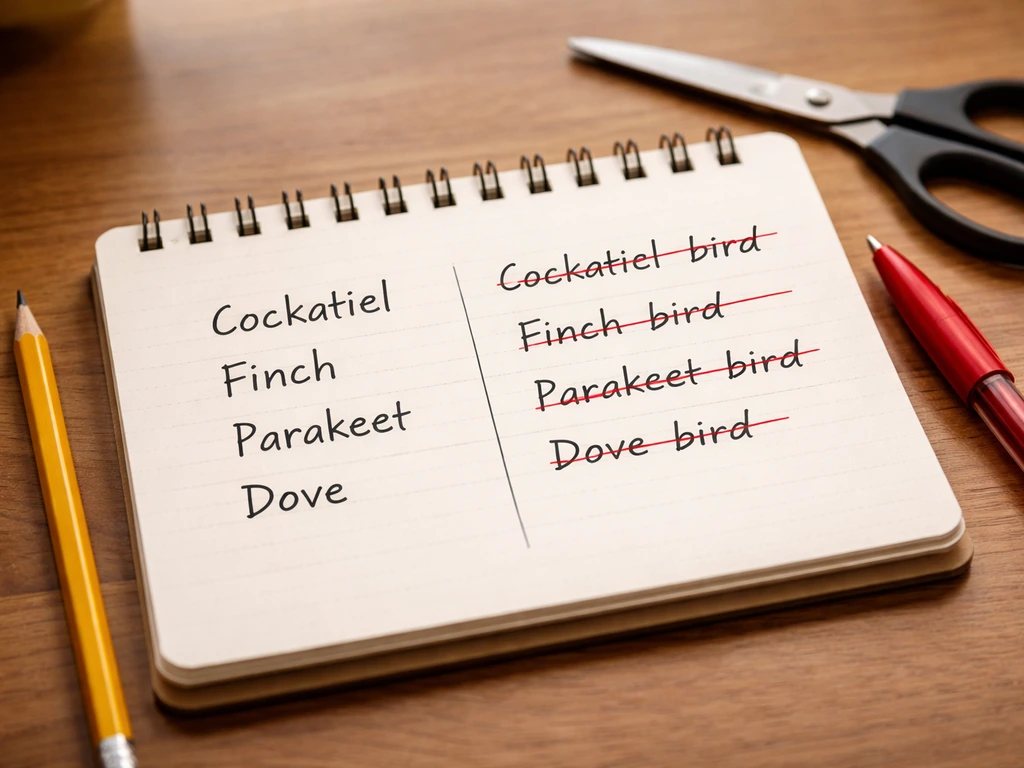
If you're naming a pet bird or writing about bird species in plain language, the same clarity principles apply. Use the established common name as a self-contained unit. 'Cockatiel' is the name. 'Cockatiel bird' is not. The American Birding Association, eBird, and the British Trust for Ornithology all maintain standardized common names precisely because those names are meant to be complete and unambiguous on their own. You don't improve them by appending 'bird.' You only create noise.
When you're choosing a name for a pet bird, though, the rules relax considerably. Pet names are personal, playful, and don't need to follow ornithological convention. But it's worth understanding that the species name (cockatiel, lovebird, macaw) already signals 'bird' to any listener. A name that plays on the species name, like calling your lovebird 'Valentino' or your macaw 'Captain,' works because it pairs a known bird noun with something personal. Adding 'bird' somewhere in a pet's name usually only works as intentional playfulness, not as a clarifying move.
Quick guidelines for natural bird phrasing
- Use established common names as single units: 'robin,' 'finch,' 'hummingbird,' not 'robin bird' or 'hummingbird bird.'
- Add 'bird' as a category label only when you genuinely need a placeholder: 'I saw a bird I didn't recognize' is correct and clear.
- Use compound species names as they appear in standard references (AOS checklist, eBird, BTO): those names are already the full, correct form.
- When writing or speaking about the class of animals broadly, 'bird' alone is the right category word, not 'bird animal' or any other stacked form.
- Test any phrasing with the clarity question: does the extra word prevent confusion, or does it just repeat information? If it repeats, cut it.
- For pet names, feel free to be playful, but know that you're departing from naming convention rather than following it.
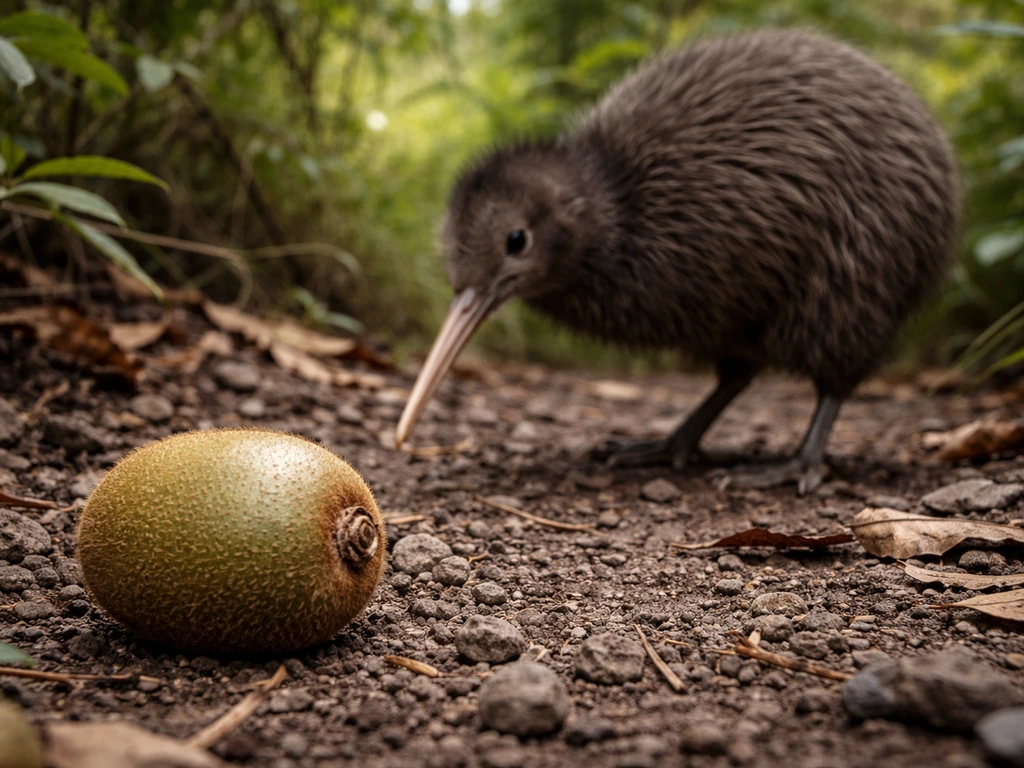
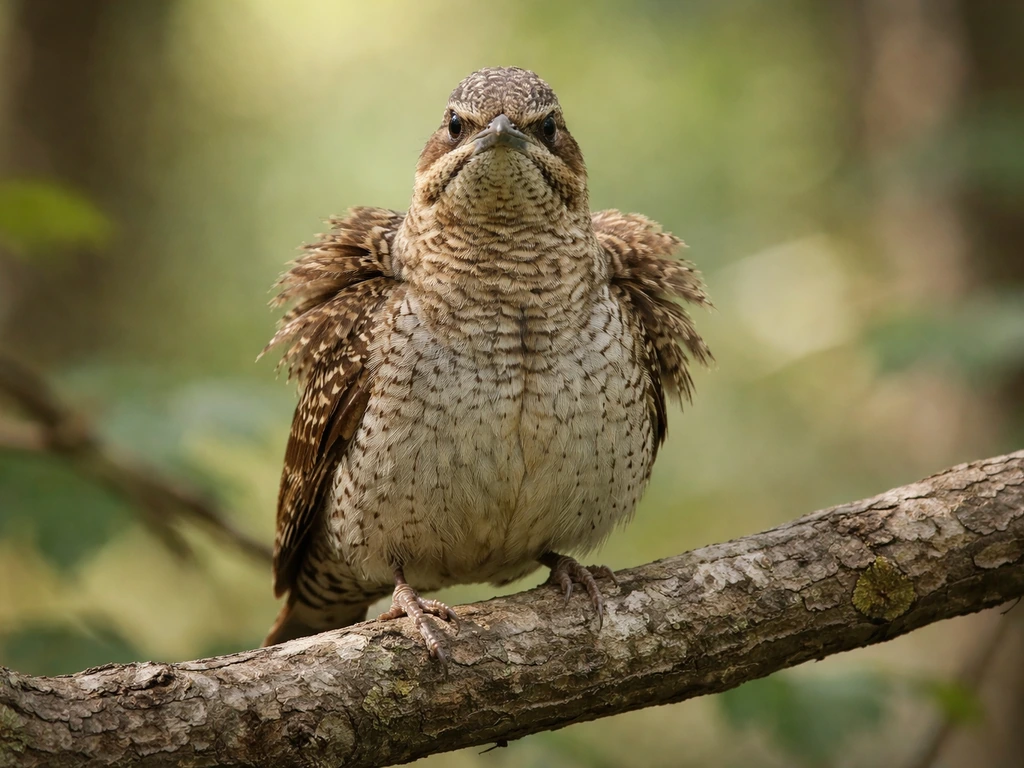
The bottom line is that language naming patterns are driven by what listeners actually need to hear. 'Tuna fish' persists because it has a long product history and occasionally helps distinguish the animal from the canned food. 'Chicken bird' never took off because chicken, as a word, has always carried its full meaning without any help. English bird names work the same way: they are complete, conventional units, shaped over time by birding communities, ornithological standards, and everyday use. Understanding that logic makes it much easier to speak and write about birds naturally, name your pets well, and recognize when a bit of folk etymology or cultural quirk is behind a phrase that otherwise seems to break the rules. Throstle is an old-fashioned name that refers to a type of bird. You can see a similar naming question in folk etymology, for example whether the kiwi fruit is the bird’s namesake.
FAQ
Is “chicken bird” ever correct English, or is it always wrong?
It is not standard in everyday English as a literal phrase. People might use “chicken bird” only for deliberate wordplay, translation humor, or to echo a specific slang or folklore usage, but it is not the way standard English names animals.
Why does “tuna fish” feel clearer than just “tuna,” but “chicken” already feels clear?
“Tuna” often points to food in common conversation, especially in restaurant and grocery contexts, so adding “fish” can remind listeners you mean the animal species (or the aquatic category) as well. “Chicken” already reliably covers both the animal and the meat in everyday speech, so adding “bird” rarely disambiguates anything.
Do other “X fish” phrases work the same way as “tuna fish”?
Yes, many work because “fish” acts as a useful category word when the X-part alone might not immediately cue “aquatic animal” (for example, “pufferfish” and “blowfish” are species names where “fish” reinforces the domain). Whether you keep “fish” depends on whether the base word is ambiguous to listeners in context.
Would “chicken bird sandwich” also sound redundant in the same way?
For most listeners, yes. “Chicken sandwich” already identifies the food type. Adding “bird” does not add helpful information, so the phrase sounds like awkward emphasis or a joke rather than a natural clarification.
When does “bird” get added legitimately in English?
“Bird” is added when it is part of a conventional compound pattern where listeners expect the category head (for example, “bird of prey,” “songbird,” or names ending in “-bird”). In those cases, “bird” is doing structural or classificatory work, not repeating an already-resolved word.
Could someone say “chicken” is also a compound, and that’s why it needs no “bird”?
Not in the same way. “Chicken” is already an established single lexical item for the animal and the meat category. The reason “tuna fish” exists is closer to product naming and context-based ambiguity, not to the grammar of building new compounds.
Is “tuna fish” considered pleonastic, or is it still a useful distinction?
It can be both. “Fish” can be redundant in a strictly logical sense, but it is still useful pragmatically because it signals the aquatic animal category or distinguishes the canned product from the live animal in certain contexts. That practical function is why the phrase survives despite the redundancy.
Why do some dictionaries list “tuna fish” as its own noun entry?
Lexicalized phrases like this become treated as conventional units because speakers repeatedly use them in the same way. Once a phrase is consistently used to mean “canned or cooked tuna flesh,” dictionary editors may capture it as a separate noun sense.
Does the same naming logic apply to seafood like “clam chowder” or “lobster bisque”?
Generally, yes. Those bases are already strongly associated with the relevant animal or ingredient category in food contexts, so adding a broader category word (like “clam shellfish” or “lobster crustacean”) would often be unnecessary and would typically sound overly technical or clunky.
What’s a good rule of thumb for deciding whether to add a category word like “bird” or “fish”?
Use the “remove-test” from the article: if dropping the category word does not create confusion for a typical listener in that context, you usually do not need it. If the base noun is meaningfully ambiguous (animal vs. product, species vs. generic term), adding the category can help.
If I’m naming a pet, should I avoid forms like “cockatiel bird” or “macaw bird”?
For clarity to other people, it’s usually unnecessary because the species name already signals “bird.” Pet names can be playful, so you can do it intentionally for style, but if the goal is clear communication (especially in a vet or adoption context), stick to the established common name.
What should I do if I hear “chicken bird” in a story or translation?
Treat it as a contextual choice, not as a universal rule. If it appears in a specific cultural reference, dialect, or joke, you may want to interpret it as emphasis or a local naming convention rather than as incorrect grammar.