
The home of a bird is most commonly called a nest, but that single word only scratches the surface. Eastern Bluebird (nest box guidance), NestWatch / Cornell Lab of Ornithology notes that Practical man‑made housing terms, 'nest box' / 'birdhouse': conservation organizations (NestWatch, Audubon, RSPB) provide species‑specific plans and placement guidance (entrance‑hole size, mounting height, orientation and predator protection) because correct dimensions and siting strongly affect occupancy and nesting success Eastern Bluebird (nest box guidance) — NestWatch / Cornell Lab of Ornithology. Depending on the species, the behavior, and the context, a bird's home might also be called a roost, an eyrie, a cavity, a burrow, a rookery, a heronry, a nest box, an aviary, or simply a cage. Each term has a specific meaning, and choosing the right one tells you a lot about how a bird actually lives.
What the Home of a Bird Is Called: Nest, Roost, Eyrie & More

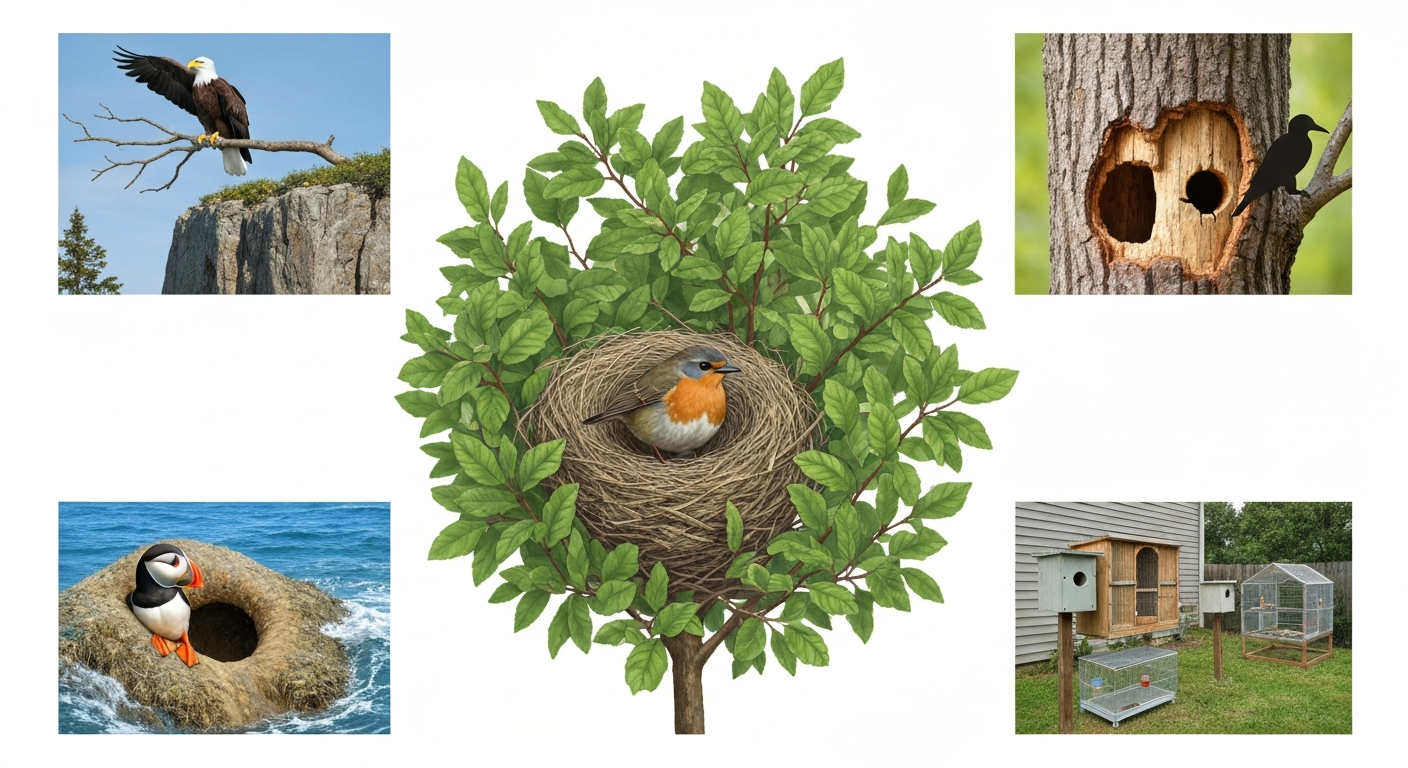
Quick overview of terms for bird homes
English has built up a surprisingly rich vocabulary for bird homes, partly because birds are so wildly varied in how they nest, roost, and take shelter. A swallow plastering mud to a barn rafter, an eagle perched on a cliff-top platform it has added to for thirty years, a woodpecker chiseling out a hollow in a dead oak, a penguin huddle on Antarctic ice: these are all bird homes, but none of them is quite the same thing. Here is a fast map of the main terms before we go deeper into each one.
- Nest: a structure where eggs are laid and young are raised
- Roost: any site used for resting or sleeping, especially outside breeding season
- Eyrie (also aerie): the large platform nest of a bird of prey, typically on a cliff or tall tree
- Cavity: a hollow in a tree or rock used for nesting or shelter
- Burrow: a tunnel or underground chamber used by some ground-nesting species
- Rookery / heronry: a communal breeding colony, originally for rooks, now widely applied
- Nest box / birdhouse: a man-made structure that substitutes for a natural cavity
- Aviary: a large enclosure designed to house captive birds
- Cage: a smaller enclosure for keeping individual or small groups of pet birds
- Perch: a branch, rod, or ledge where a bird rests, inside a cage or in the wild
Plain definitions for every major term
Nest
A nest is the structure a bird builds, excavates, or occupies in order to lay eggs and raise young. Cornell Lab of Ornithology defines it as the structure used to lay eggs and raise young, and that definition includes everything from a simple scrape in the gravel to an intricately woven cup of spider silk and lichen. Some species never build anything recognizable as a structure at all: a Killdeer makes a scrape directly on bare ground, while a Baltimore Oriole weaves a hanging pouch that can take two weeks to complete. The word nest comes from Old English nest, related to the Latin nidus (which is where the slightly fancier word nidification, meaning nest-building, originates). In many European languages the connection is easy to spot: German Nest, French nid, Spanish nido, Italian nido, all from the same Latin root.
Roost
A roost is any place where a bird settles to rest or sleep. Merriam-Webster defines the verb to roost as 'to settle on a roost: to perch,' and the noun as the place or support where birds roost. Crucially, a roost is not necessarily a nest. A starling flock descending on a reed bed for the night is roosting, not nesting. The word comes from Old English hrost, meaning the framework of a roof or a hen's perch, which nicely captures the original domestic image of chickens settling on a beam above the straw.
Eyrie (or aerie)
An eyrie (spelled aerie in American English) is the large platform nest of an eagle, falcon, or other bird of prey, typically built on a cliff ledge or at the top of a tall tree. Merriam-Webster records eyrie as the chiefly British spelling and aerie as the standard American one. Both trace back to Old French aire and Medieval Latin area, meaning simply the nest of a bird of prey. The eyrie spelling is believed to have emerged from a Middle English misreading connecting it to ey, an old word for egg. Either way, the term carries a sense of height, power, and inaccessibility that the plain word nest does not.
Cavity
A cavity is a hollow space in a tree trunk, branch, or rock face that a bird uses for nesting or shelter. Primary cavity nesters, like woodpeckers, excavate their own holes. Secondary cavity nesters, like bluebirds, owls, and many ducks, move into cavities created by other species or formed by rot and decay. The loss of old trees with natural cavities is one of the main reasons nest boxes have become such an important conservation tool.
Burrow
A burrow is a tunnel or underground chamber used as a nesting or resting site. Several species dig their own burrows: the Kingfisher tunnels into riverbanks, sometimes digging a shaft over 60 cm (about 24 inches) deep. Others, like the Burrowing Owl, take over abandoned mammal burrows rather than excavating from scratch. Puffins also nest in burrows, which helps protect eggs and chicks from aerial predators.
Rookery and heronry
A rookery is the nesting or breeding place of a colony of birds (or seals, originally applied to rooks, the noisy corvids that nest in treetop clusters). The term has since expanded to cover penguin colonies, seabird breeding grounds, and mixed colonial waterbird sites. A heronry is specifically a breeding colony of herons or egrets, and Merriam-Webster lists it as an established noun meaning 'a heron rookery.' In practice, birdwatchers and conservationists use both words somewhat interchangeably when describing large mixed waterbird colonies.
Nest box and birdhouse
A nest box is a man-made structure that mimics a natural tree cavity. In conservation circles it is almost always called a nest box; in everyday speech, especially in the United States, people tend to say birdhouse. The RSPB and Cornell's NestWatch program both publish species-specific guidance on entrance-hole diameter, internal dimensions, mounting height, and orientation because those details genuinely determine whether birds will use the box and successfully raise young. For example, an entrance hole of 28 mm suits a Blue Tit, while a 50 mm hole is right for a European Starling. Getting that detail wrong by just a few millimetres can mean the difference between a nesting bluebird and an empty box.
Aviary
An aviary is a large enclosure, usually free-flight on the inside, designed to house many birds at once. The word comes directly from the Latin aviarium, from avis (bird), the same root that gives us words like avian, aviation, and aviculture. A properly designed aviary allows birds to fly, exercise, and in many cases breed naturally. Public zoos, wildlife rehabilitation centres, and dedicated bird keepers all use aviaries.
Cage
A cage is a smaller enclosed structure for keeping individual birds or small groups. From the Old French cage and Latin cavea (hollow, enclosure), it shares a root with the word cave and with the Spanish jaula. For pet bird welfare, avicultural authorities recommend cages large enough for a bird to fully extend both wings simultaneously and to take at least a few short hops or flight steps, with species-appropriate perch diameters and enrichment.
Perch
A perch is any branch, rod, ledge, or surface where a bird stands or rests. It is not a home on its own, but it is an essential feature of every bird home, wild or captive. The word comes from Old French perche and Latin pertica, meaning a long staff or pole. Inside a cage or aviary, perch variety, including different diameters and textures, is important for foot health.
Where specific birds actually live: species examples
Abstract definitions are useful, but the most memorable way to understand bird home vocabulary is to walk through real species. Here is how the terms map onto actual birds you are likely to know or encounter.
| Bird | Home term | Key features |
|---|---|---|
| Bald Eagle / Golden Eagle | Eyrie (aerie) | Large stick platform on cliff or tall tree; can weigh over 900 kg after years of additions |
| Rook | Rookery | Treetop colony, often with dozens to hundreds of pairs nesting close together |
| Grey Heron / Great Blue Heron | Heronry (rookery) | Tree-top or reed-bed colony; shared colonial site used year after year |
| Penguin | Colony / rookery | Ground-level colony on ice, rock, or burrow depending on species |
| Woodpecker | Cavity | Self-excavated hole in a dead or living tree; reused by other species after abandonment |
| Eastern Bluebird | Cavity / nest box | Natural tree cavities or man-made nest boxes; entrance hole ~38 mm (1.5 in) |
| Burrowing Owl | Burrow | Usually adopts abandoned mammal burrows; can excavate its own |
| Common Kingfisher | Burrow | Digs a tunnel up to 60+ cm into a riverbank; chamber at the end lined with fish bones |
| Ruby-throated Hummingbird | Cup nest | Tiny, deep cup of plant fibres bound with spider silk; often on a downward-sloping branch |
| Killdeer | Scrape | Bare hollow scraped in gravel, grass, or dirt; no added material beyond a few pebbles |
| Common Starling | Communal roost | Murmuration roost sites in reed beds or tree stands, sometimes millions of birds |
Colony terms: rookeries, heronries, and communal roosts
When birds gather in large groups at a shared site, English has a set of collective terms for those places that go beyond the individual nest. A rookery, as noted above, started with rooks but now applies broadly to any dense colonial breeding site, including penguin rookeries on sub-Antarctic islands and mixed seabird colonies on sea cliffs. A heronry is reserved for herons and their relatives, and many birdwatching groups track heronries year to year as indicators of waterbird population health.
A communal roost is different from a breeding colony: it is a shared sleeping or resting site, not a nesting site. Starlings are the most famous example, with roosts in reed beds or on urban buildings numbering in the hundreds of thousands or even millions of birds. Swallows gather in communal roosts along migration routes. The ecological drivers are different from nesting: birds in communal roosts are generally there for warmth, predator dilution, and potentially information sharing about food sources, not for reproduction.
Nest vs. roost: the most important distinction to get right
The nest-versus-roost distinction trips up even experienced writers, so it is worth spelling out clearly. A nest is fundamentally a reproductive structure: it exists because there are eggs to incubate or young to raise. A roost is simply any resting or sleeping site. The two can overlap physically (a bird may sleep in its nest cavity outside the breeding season), but the terms describe different functions.
In peer-reviewed ornithology, the two are treated as distinct concepts with different drivers: nest-site selection is shaped by reproductive success factors like predation risk to eggs and thermal stability for incubation; roost-site selection is shaped by thermoregulation, predation risk to the adult bird, and energy budgets overnight. Practically speaking: if a robin is sitting on eggs in a cup of grass in your hedge, that is a nest. If the same robin tucks into a thick ivy-covered wall on a cold January night, that is a roost.
This also has real-world legal weight. In the United States, the Migratory Bird Treaty Act protects active nests (those containing eggs or young). An inactive nest, with no eggs or nestlings present, is generally not prosecuted under the Act. In the UK, the Wildlife and Countryside Act protects all wild bird nests in use. Knowing whether a site is an active nest or a roost can matter enormously for tree work, construction schedules, and habitat management.
Naming bird homes for pet owners: getting the language right
If you keep birds at home, you will use a slightly different set of terms than a field ornithologist would. Getting these right matters more than you might think, especially when talking to a vet, buying equipment, or describing your setup to other bird keepers.
Cage vs. aviary: size and function matter
A cage houses one bird or a small group in a space that limits but does not eliminate movement. An aviary is large enough for free flight. In practice, many bird keepers use cage as a catch-all, but if you are writing a rehoming listing, describing your setup to a vet, or joining an aviculture forum, using the right term signals that you know what you are doing. A budgerigar in a 60 cm wide cage is in a cage. A dozen finches in a 3-metre outdoor structure are in an aviary.
Flight cage
A flight cage sits between a standard cage and a full aviary: large enough for genuine flapping flight, typically for canaries, finches, or small parrots, but usually indoors or in a limited garden space. The term is widely used in aviculture and by bird supply retailers.
Nest box inside a cage or aviary
Confusingly, pet bird keepers use nest box to mean both the conservation nest-box placed in a garden and the breeding box placed inside an aviary or cage for captive birds to lay in. Context usually makes the meaning clear, but it is worth specifying when writing about pet birds: 'the nest box attached to the inside of the aviary' versus 'the nest box mounted on the fence post outside.'
Perches: more than just somewhere to sit
For captive birds, the perch is one of the most important features of the home environment. Avicultural and veterinary guidance recommends offering multiple perch diameters (so that toes do not grip the same position all day), natural wood perches for appropriate wear, and rope or platform perches for variety. A bird spending eighteen hours a day on a single smooth dowel rod is the equivalent of a person standing on one spot all day: joint problems, pressure sores, and feather condition all suffer.
How to describe your pet bird's home accurately
- Say cage for a standard enclosed wire or bar enclosure housing one bird or a small pair
- Say aviary for a large, free-flight enclosure, indoors or outdoors, for multiple birds
- Say flight cage for an intermediate-size enclosure designed to allow proper wing extension and short flights
- Say nest box for the breeding or shelter box placed inside the enclosure for your bird to enter
- Say perch (not 'stick') when talking to avian vets or other bird keepers about resting supports
- Avoid calling any captive housing a nest unless your bird is actively nesting inside a nest box: the bird lives in its cage or aviary, and it may nest in a nest box within that space
A note on related bird vocabulary
The terminology around bird homes connects naturally to broader bird vocabulary. The birds themselves, their ages, and their sexes all have specific names in English, just as their homes do. For quick naming help, see the short guide on what a small bird is called which lists common terms for young and diminutive birds. If you want to know what a female bird is called, see the short guide on what a female bird is called for common species. Knowing that a young bird is called a chick, nestling, fledgling, or juvenile depending on its stage of development helps you understand why the nest and roost terms apply at different life stages. A nestling is, by definition, still in the nest; a fledgling has left it. For common species-specific names (for example, 'cock', 'drake', or 'cockerel'), see male bird is called. A bird described as a juvenile or immature is long past the nest and is likely roosting rather than nesting.
A quick etymology sidebar
If you enjoy the language side of bird vocabulary, these short roots are worth knowing.
| Term | Language of origin | Root meaning | Related words |
|---|---|---|---|
| Nest | Old English / Latin | nidus (Latin): to sit down, settle | Nidify, nidifugous, nidification |
| Roost | Old English | hrost: framework of a roof, hen's perch | Rooster (the bird that rules the roost) |
| Eyrie / Aerie | Old French / Medieval Latin | aire / area: nest of a bird of prey | Aerial (unrelated but shares area root) |
| Aviary | Latin | aviarium, from avis: bird | Avian, aviation, aviculture |
| Cage | Old French / Latin | cavea: hollow, enclosure | Cave, cavity, excavate |
| Burrow | Middle English | borow / berg: shelter, hill | Borough, borrow (dialectal shelter sense) |
| Rookery | Old English | hroc: rook (the bird) | Rook (chess piece, bird), ruckus (debated) |
How to choose the right term when writing or speaking
If someone asks you 'what is the home of a bird called? For a short answer: the home of a bird is called a nest. ' in a pub quiz or on a school worksheet, nest is the answer they are almost certainly expecting, and it is correct as a general term. But if you are writing about a specific species, using the precise term shows both accuracy and a feel for the language. Write 'the eagle returned to its eyrie' rather than 'its nest' if you want the writing to feel alive. Write 'the kingfisher disappeared into its burrow' rather than 'its home.' Write 'the starlings settled into their communal roost' rather than 'their nest' when no breeding is involved.
In crossword clues and wordplay, aerie and eyrie appear constantly as five-letter answers for 'eagle's home' or 'raptor's retreat,' which is how many people first encounter the word. In technical conservation documents, nest and roost carry precise legal and ecological meanings, so swapping them carelessly can change the meaning of a habitat assessment or a protected-species survey. And for pet bird owners writing rehoming ads, vet referral forms, or care guides, the distinction between cage, aviary, and nest box tells the reader exactly what kind of setup and what kind of care is involved.
FAQ
What is a clear SEO-friendly title and sub-160 character description for an article answering “the home of a bird is called”?
Title: "What the Home of a Bird Is Called: Nest, Roost, Aerie and More"; Description (under 160 chars): "Learn the correct terms for bird homes—nest, roost, aerie/eyrie, cavity, rookery, aviary—and when to use each for wild and pet birds."
Give a concise direct answer to: "The home of a bird is called..."
Direct answer: The home of a bird is most commonly called a nest when used for laying eggs and raising young; other names include roost (resting/sleeping site), aerie/eyrie (raptor platform), cavity, burrow, rookery/heronry (colonial breeding sites), nest box/birdhouse (man-made), aviary or cage (captive housing).
What reader-facing terms should I list for bird homes with plain definitions?
List of terms with short definitions: - Nest: a structure birds build, excavate, or occupy to lay eggs and raise chicks (cup, platform, scrape, cavity). - Roost: a place where birds rest or sleep; can be temporary or communal. - Aerie/Eyrie (aery): a large platform nest of raptors, usually on cliffs or tall trees. - Cavity: a hole in a tree, bank, or structure used for nesting or roosting. - Burrow: an underground tunnel or chamber used by burrowing species for nest/roost. - Rookery: a colony or site where many birds breed and nest (originally for rooks; used for penguins, seabirds). - Heronry: a rookery specific to herons/egrets—breeding colony. - Nest box / Birdhouse: a human-made box designed to attract cavity-nesting birds. - Aviary: a large enclosure allowing flight for captive birds. - Cage: a smaller enclosure for individual or a few pet birds. - Roosting flock/communal roost: group of birds gathered to rest together.
Provide species-specific examples showing different home types.
Species examples: - Eastern Bluebird: cavity nester that readily uses nest boxes with correct hole size. - Burrowing Owl: nests and roosts in mammal burrows or abandoned tunnels. - Bald Eagle / Golden Eagle: build large platform nests called aerie/eyrie in tall trees or on cliffs, reused across years. - Herons/Egrets: breed in heronries—tree or reed colonies with many nests. - Piping Plover: makes a scrape nest—simple depression on sand or gravel. - Common Swift: roosts and nests in cavities or under eaves; may form communal roosts in buildings.
What are collective-site names and when to use them?
Collective-site names: - Rookery: use for colonial breeding grounds (rooks historically, now wider use for seabirds, penguins, some wading birds). - Heronry: use when describing a breeding colony of herons/egrets. - Colony: general term for any species nesting in close proximity (tern colony, penguin colony). Use these when referring to multi-nest breeding sites rather than a single bird’s home.
What's the important distinction between 'nest' vs. 'roost' in behavior and seasonality?
Distinction: - Nest: implies breeding use—eggs present and chicks raised; built, adapted, or occupied for reproduction. It is a seasonal or breeding-focused structure. - Roost: implies resting or sleeping use—may be daily, nocturnal, seasonal, or communal; not necessarily involved in breeding. A nest can be used as a roost, but a roost does not always indicate nesting or eggs.
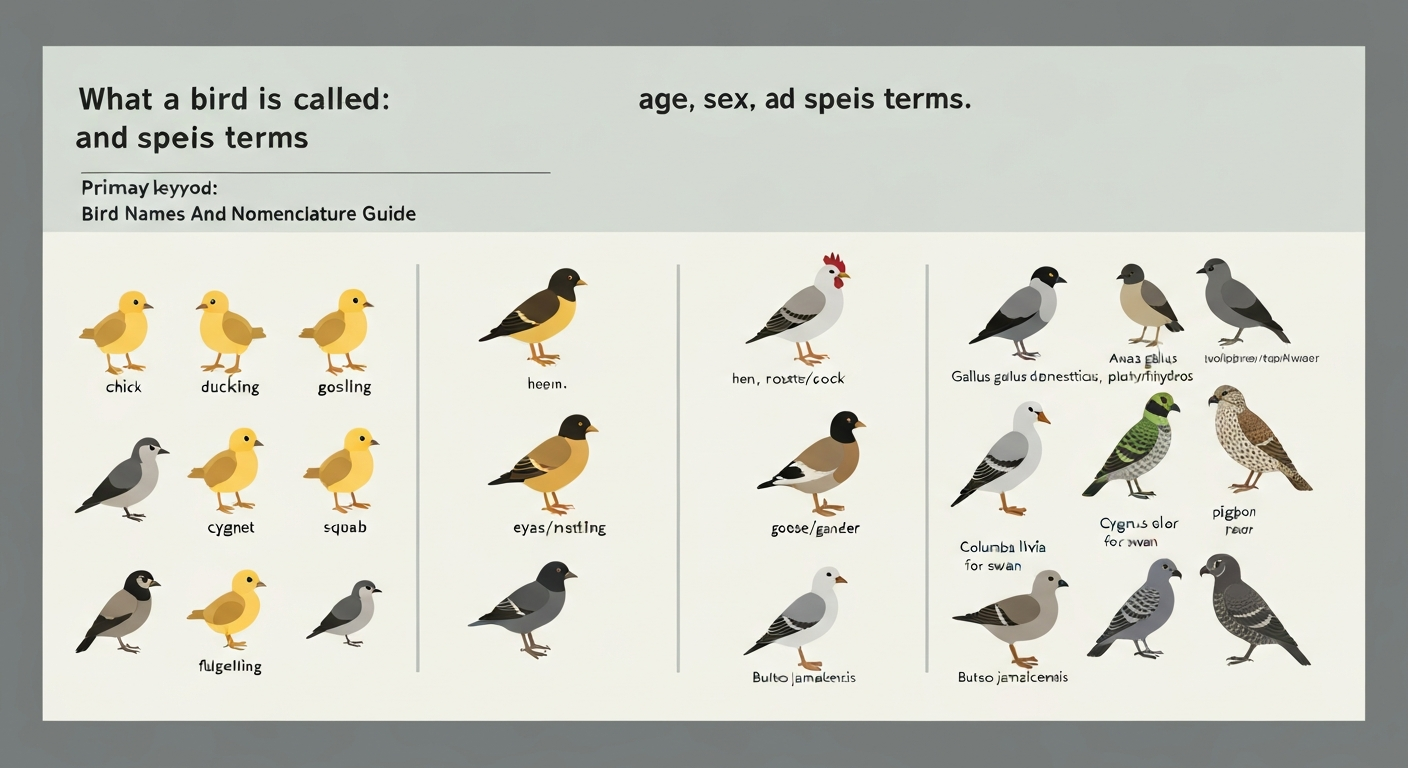
What a 'bird is called': age/sex names, homes, common vs scientific names, pet‑naming tips & examples
Common names for a small bird and quick identification tips by size, habitat, calls, plus meaning vs scientific names.
Learn the male bird terms like cock, drake, bull, and stag, plus how to choose the right one by species and use.