Bird is not an Irish surname in origin. It is primarily an English surname, derived from the Old and Middle English word for a bird, and it arrived in Ireland mainly through English and Anglo-Irish settlers. That said, some people with the name Bird in Ireland do have genuine native roots, because a handful of Gaelic Irish surnames were anglicised to Bird over the centuries. So the honest answer is: usually English, occasionally Irish by adoption or anglicisation, and the only way to know which applies to your specific family is to dig into Irish primary records.
Is Bird an Irish Surname? Origins, Meaning and Evidence

Maya Castellanos
6 Aug 2026
Where the surname Bird actually comes from
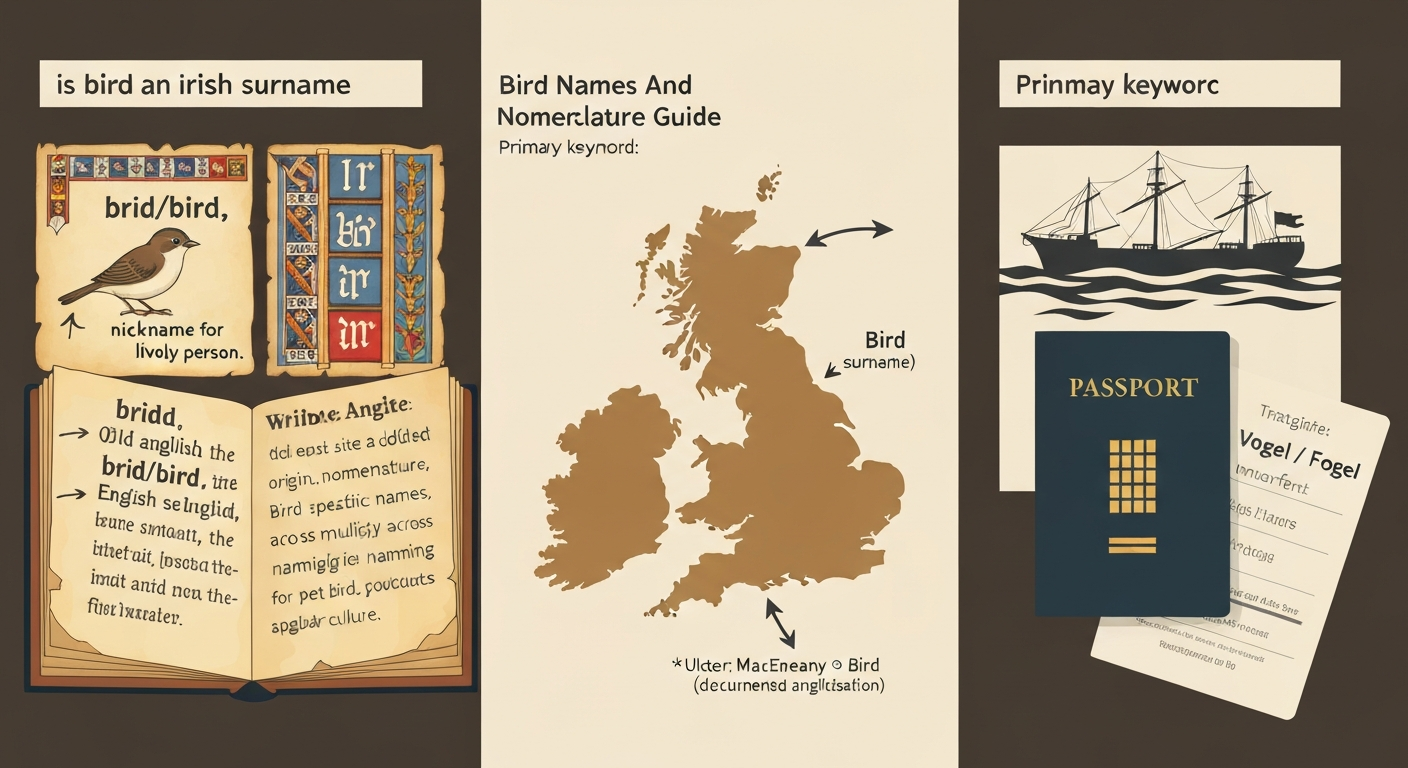
The surname Bird traces back to the Old English word bridd and the Middle English brid or bird, which originally referred specifically to a young bird or fledgling rather than any bird in general. Somewhere along the way it broadened in meaning, and by the medieval period it was being attached to people as a nickname. Those people were probably being compared to birds in some flattering or joking way: a light-footed person, an energetic or lively character, or perhaps someone with a notably musical voice. Occupational origins have also been suggested, covering people who caught birds or kept them for falconry and the table.
What is clear from surname dictionaries is that this is firmly rooted in English linguistic soil, not Gaelic. There is no native Irish or Gaelic word lurking behind the mainstream Bird surname. The Oxford Dictionary of Family Names in Britain and Ireland treats it as an English nickname surname, and that classification is consistent across the major references. If you are tracing a Bird family and want to understand the full picture of what surnames can mean across languages, the broader topic of last names meaning bird across different cultures is worth exploring alongside this one.
Early records and how the name developed
Medieval and early modern English records show Bird appearing in various documentary forms across different counties, alongside the variant Byrd, which became particularly well established in the south and midlands of England. The name was never spectacularly common, but it maintained a consistent presence through the late medieval and early modern periods, turning up in parish registers, taxation records, and legal documents. By the time English settlement in Ireland was well underway during the 16th and 17th centuries, Bird was an established English surname that settlers could carry with them across the Irish Sea.
Spelling variants and names that get confused with Bird
Old records are full of spelling inconsistencies, and Bird is no exception. Clerks, priests, and census enumerators wrote what they heard, so a single family could appear under several different spellings across different documents. The main variants you will encounter are Byrd, Birde, Byrde, and occasionally Byard or Birdt. In some indexes Bird has also been transcribed as Bride, which can obviously cause genealogical headaches.
The name most commonly confused with Bird is Baird, and it is worth being careful here because the two have quite different origins. Baird is predominantly Scottish, derived from the Gaelic word for a poet or bard (Mac a' Bhàird), and George F. Black's authoritative Surnames of Scotland treats it as a separate name entirely. The visual similarity on handwritten documents and in some computerised indexes can create false matches, so if you find a Baird in a Scottish record do not assume it is the same family as an English Bird.
| Name | Likely Origin | Meaning/Root | Notes |
|---|---|---|---|
| Bird | English | Middle English brid/bird (young bird, nickname) | Core form; present in England, Ireland, US, Australia |
| Byrd | English | Same as Bird; variant spelling | Particularly associated with Virginia and the American South |
| Birde / Byrde | English | Archaic/historical spellings of Bird | Found in medieval and early modern records |
| Byard / Birdt | English | Orthographic variants | Occasional clerical spellings in older documents |
| Baird | Scottish/Gaelic | Mac a' Bhàird, from 'bard' (poet) | Separate etymology; sometimes confused with Bird in indexes |
Surnames meaning bird in other languages
English is hardly unique in producing a surname that simply means bird. Across Europe, people with birdlike qualities or connections to birds ended up with equivalent names in their own languages. The German and Dutch Vogel is the closest parallel, meaning bird directly, and it is one of the more common surnames in the German-speaking world. Yiddish-speaking Ashkenazic Jewish communities used Fogel (a Yiddish form of Vogel) as a family name. In French, L'Oiseau exists but is rare. Italian has Uccello, famously borne by the Renaissance painter Paolo Uccello. Spanish has Pájaro, and various Slavic languages produced equivalents such as the Czech Pták or Ptacek.
These names are genuine cognates in the sense that they all mean the same thing in their respective languages, but they developed independently rather than descending from a shared root. When families bearing these names migrated to English-speaking countries, some translated or anglicised them, which is how Vogel or Fogel occasionally became Bird in immigration records and naturalisation papers. The site's broader coverage of surnames meaning bird across languages goes into more depth on these international parallels.
How Bird ended up in Ireland
People named Bird have been living in Ireland for several centuries, but most of them got there through English settlement rather than indigenous Irish naming traditions. The Plantations of the 16th and 17th centuries, followed by ongoing waves of English and Protestant settlers during the 17th and 18th centuries, brought a wide range of English surnames to Ireland. Bird was among them. Chief Secretary's Office papers and other 19th-century Irish administrative records show the surname in use, and the standard Irish genealogical sources confirm its presence: searching the Tithe Applotment Books, Griffith's Valuation, and the 1901 and 1911 censuses produces multiple Bird households distributed across the island, with concentrations in counties associated with settler populations. Consult the Tithe Applotment Books & related Irish record sets (National Archives of Ireland) for primary-source evidence of Bird households and continuity in specific parishes.
The more interesting question for Irish genealogy is whether any Bird families in Ireland had a Gaelic origin. The answer is yes, in a small number of documented cases. Patrick Woulfe in Irish Names and Surnames and Edward MacLysaght in The Surnames of Ireland both record instances where Gaelic surnames were anglicised to Bird in local contexts. See LibraryIreland's digital edition of Woulfe and MacLysaght's entry noting that MacEneany (MacAneny/MacNeney) has been rendered locally as Bird in some Irish instances Woulfe's Irish Names and Surnames and MacLysaght's The Surnames of Ireland document MacEneany being anglicised as Bird.. The Gaelic name most associated with this is MacEneany (also written MacAneny, MacNeney, and in various other forms), a name from Ulster whose bearers sometimes adopted Bird as an anglicisation. The logic is a loose phonetic and semantic approximation rather than a direct translation. MacLysaght treats these cases as documented but uncommon, and professional genealogists generally advise treating most Irish Birds as English or Anglo-Irish unless there is specific evidence of Gaelic continuity in older records. That caution is sensible: the burden of proof should lie with demonstrating a Gaelic connection, not assuming one.
Checking the Irish record sets
If you are trying to establish whether your Bird family is genuinely Irish in origin rather than settler-descended, these are the primary sources worth searching systematically.
- Tithe Applotment Books (1823 to 1837): cover rural landholders across most of Ireland and are fully digitised via the National Archives of Ireland
- Griffith's Valuation (1847 to 1864): the most comprehensive 19th-century property survey, searchable online, showing county and townland distribution of Bird households
- 1901 and 1911 census returns: both are fully digitised and free to search; they give household details, ages, birthplaces, and religion
- Church of Ireland and Catholic parish registers: baptism and marriage records that, in some areas, survive from the late 18th century onward
- Registry of Deeds: land transaction records from 1708 onward, useful for establishing earlier presence and social status
- Chief Secretary's Office Registered Papers: administrative records that often contain incidental mentions of individuals across 19th-century Ireland
- Estate papers and landed estate records: if your Bird family held or rented land under a particular landlord, estate papers sometimes survive where parish records do not
- DNA testing combined with surname matching: genetic genealogy can confirm or challenge a claimed Irish origin and can distinguish English settler lines from families with longer Gaelic or continental roots
Finding a Bird family in these records confirms presence in Ireland, but it does not automatically confirm Irish origin. The additional step is checking whether the records suggest continuity predating large-scale English settlement in that area, or whether you can find a Gaelic form of the name in older Gaelic-language documents or in the Woulfe and MacLysaght name lists. If you cannot find that link, the working hypothesis should remain English settler origin.
Bird as a Jewish surname
This is a thread that surprises people but is well documented. Among Ashkenazic Jewish communities in central and eastern Europe, Vogel (German) and Fogel (Yiddish) were established family names meaning bird. During the great waves of Jewish migration to the United States, Britain, and other English-speaking countries between the 1880s and the 1920s, some families anglicised or translated their surnames to help with integration, to avoid antisemitic discrimination, or simply because immigration officials recorded what they heard phonetically. A Vogel or Fogel family arriving in New York or London could become Bird through direct translation, or the name could shift through intermediate spellings before settling on an English form.
This means that if you encounter a Bird family in early 20th-century American or British records with no apparent English ancestry, it is worth checking whether earlier generations in European records appear as Vogel, Fogel, Vogl, or related forms. Jewish genealogical databases, immigration manifests, and naturalisation papers are the best places to find this kind of name change documented. The sibling article on Bird as a Jewish surname goes into more detail on these specific migration and name-change patterns.
Where Bird is most common and who has made it famous
The surname Bird is most concentrated in England, particularly in the south and midlands, which aligns with its English nickname origins. In the United States, the spelling Byrd is notably associated with Virginia, where the Byrd family was one of the prominent colonial dynasties, and the name spread through the American South from there. Australia and New Zealand also have measurable Bird populations as a result of British emigration patterns.
Ireland has a smaller but documented Bird population, with the 1901 and 1911 censuses showing households across several counties, though without the concentration that would suggest a native Irish surname with deep pre-settler roots.
Notable bearers of the name have appeared across a surprisingly wide range of fields. Larry Bird, the basketball player from Indiana, is probably the most globally recognised. William Byrd, the Tudor composer, represents the name's deep English roots in the 16th century. Admiral Richard E. Byrd brought the name to Antarctica through his polar expeditions. In cricket, the English umpire Dickie Bird became a beloved figure. The name also appears in politics, music, and literature on both sides of the Atlantic, reflecting its distribution across English-speaking populations rather than any single national or ethnic community.
Putting it all together: is your Bird line Irish?
The surname Bird is English at its core, and most Bird families found in Ireland descended from English or Anglo-Irish settlers rather than from native Gaelic stock. However, documented exceptions exist: a small number of Gaelic Irish families, particularly those bearing variants of MacEneany in Ulster, did adopt Bird as an anglicised form, so some Irish Birds are genuinely Irish in a deeper sense. A further minority may reflect continental or Jewish name changes via Vogel or Fogel. The only reliable way to know which category your family falls into is to trace the line back through Irish records, look for a Gaelic form in the older name literature, and if necessary use genetic genealogy to test the geographic origin of your direct paternal or maternal lines. For anyone exploring the broader question of where the Bird surname comes from and what it means across cultures, those related topics on bird-derived surnames and their etymologies are a natural next step. For a focused discussion of where the last name Bird comes from, see where does the last name bird come from. For a focused discussion of bird last name meaning, see the related article on Bird surname etymology. See the related guide on surnames meaning bird for cross‑linguistic parallels, anglicisations, and examples of how Bird corresponds to names like Vogel, Fogel, Uccello, and Pták.
FAQ
Direct answer: Is "Bird" an Irish surname?
Short answer: Sometimes — but usually not. Bird is principally an English surname (a medieval nickname from Middle/Old English brid/bird). In Ireland many Birds descend from English or Anglo‑Irish settlers or later migrants. However, some Irish instances are documented anglicisations of native Gaelic names, and a few cases reflect continental (including Jewish) anglicisations or translations. Each family must be verified from records before calling it "Irish."
What is the etymology and historical origin of the surname Bird?
The core origin is English: from Middle/Old English brid/bird meaning a young bird or simply “bird.” It began as a nickname (for a young person, a singer, or someone thought bird‑like) and appears in medieval and early modern English records (spellings such as Brid, Birde, Bird, Byrd). The form Byrd is an established orthographic variant in England.
What spelling variants and close names should I watch for?
Common variants: Bird, Byrd, Birde, Byard/Byarde, Birdt and occasional scribal forms (Bride). Be careful not to conflate Bird with the separate Scottish name Baird (from Gaelic/Scots meaning 'bard' or poet), which generally has a distinct origin despite occasional spelling overlaps.
How does the surname appear in Ireland — could it be native Gaelic?
Two main ways Bird shows up in Irish sources: (1) as an English/Anglo‑Irish surname brought by settlers, landlords, soldiers, or migrants (the common case), and (2) occasionally as an anglicisation or simplification of Gaelic surnames (some older sources link forms such as MacEneany / MacAneny / MacNeney and others to Bird in particular localities). Documentary evidence is required to demonstrate a native Gaelic origin for any given Bird line.
Is there evidence of Birds living in Ireland historically?
Yes. Bird appears in Irish primary records (Chief Secretary's Office papers, Tithe Applotment Books, Griffith's Valuation, the 1901/1911 censuses, parish and estate records). These show households named Bird across several counties, especially where settler populations were present. Presence alone doesn’t prove Gaelic origin.
Could Bird be a Jewish or continental surname in English form?
Yes. Continental surnames meaning “bird,” especially German/Dutch Vogel (and Yiddish Fogel/Fogel‑type), were sometimes respelled, translated, or simplified after migration to English‑speaking countries. In some families Vogel→Bird (literal translation) or Vogel→Fogel→Bird may occur; such adoption is best confirmed by migration records, naturalisation papers, religious records and family tradition.
Next Articles
Bird Last Name Meaning: How to Trace Your Surname’s Origin
Trace bird surnames by spelling, variants, and language origin to find the bird term behind your last name.
Is Bird a Jewish Surname? Origins and How to Verify
Is Bird a Jewish surname? Learn likely origins, common confusion, spelling variants, and concrete steps to verify your f
Where Does the Last Name Bird Come From? Origins & Research
Trace the surname Bird origins, variants, and records to confirm whether it’s nickname, trait, or place based.