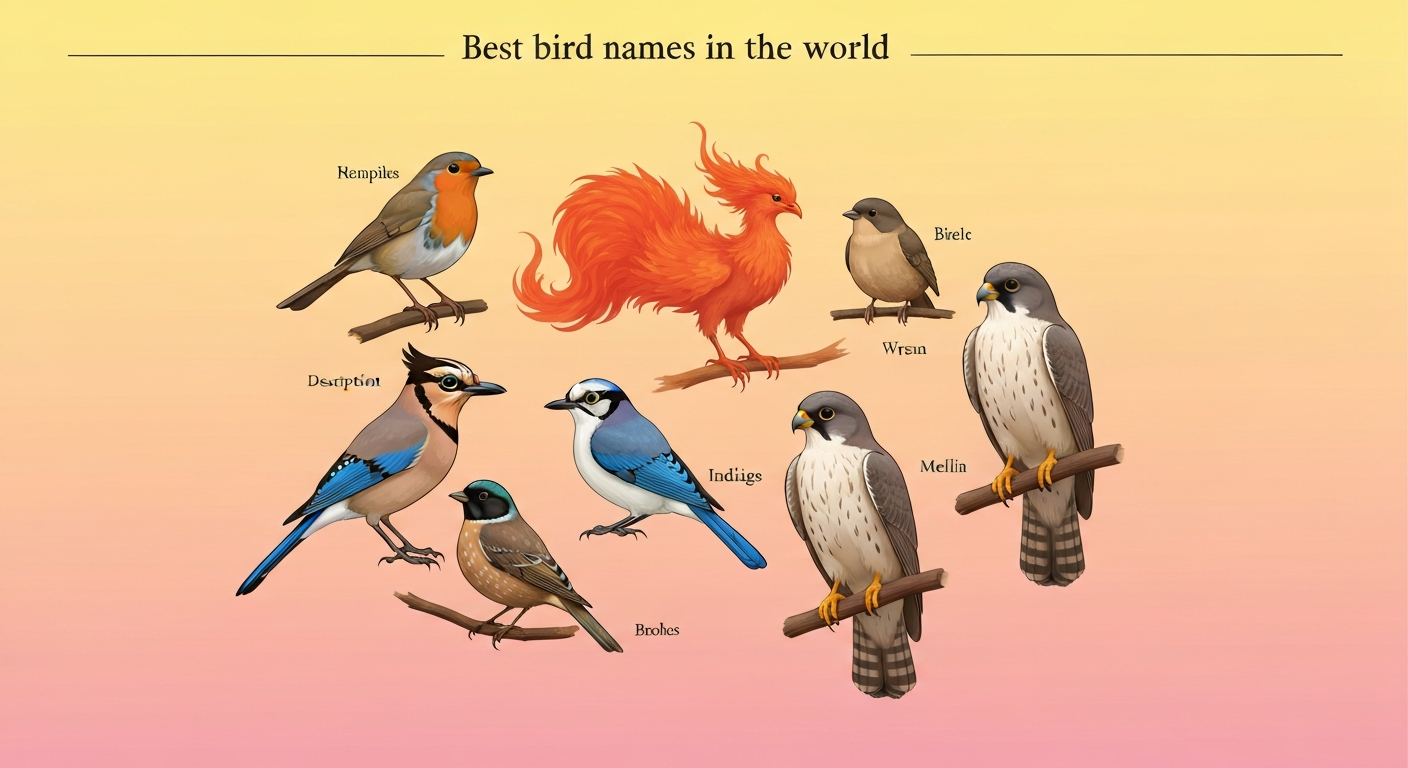
The best bird names in the world are ones that carry real meaning, roll off the tongue, and tell you something true about the creature they belong to. Names like Robin, Phoenix, Jay, Wren, Merlin, and Indigo stand out because they balance beauty, history, and clarity in equal measure. Whether you are hunting for a name for a new pet parrot, trying to understand why a flamingo is called a flamingo, or just fascinated by the linguistic ecosystems that birds have inspired across cultures, you will find what you need here.
Best Bird Names in the World: Top 50 Meaningful Ideas

Maya Castellanos
22 Jul 2026
Who this guide is for and what it covers
This guide is written for anyone who takes bird names seriously, which turns out to be a surprisingly wide crowd. Pet bird owners looking for the perfect name for a budgie or cockatiel will find curated lists with meaning, origin, and species suitability. Birders and language enthusiasts who want to understand why a bird is called what it is will get etymology going back to Latin, Greek, Old English, and beyond. Crossword solvers, sports fans, and pop-culture readers will find a dedicated section on how bird names spill into everyday life. And if you are brand new to birds, the definitions and nomenclature sections will give you a solid foundation before you dive into the fun stuff.
What "bird" and "bird name" actually mean in English
The word "bird" itself has a pleasingly mysterious origin. The Old English form was "bridd," which originally referred specifically to a young bird or chick. The modern sense of any feathered vertebrate developed gradually through the Middle English period. The Cambridge Dictionary defines bird as "a creature with feathers and wings, usually able to fly," while Merriam-Webster extends it to cover all members of class Aves, the approximately 10,000 species of warm-blooded, egg-laying, feathered animals living today. That biological definition matters here because a "bird name" can mean two quite different things depending on context.
A bird name in the vernacular sense is the everyday English label used to identify a species: Robin, Blue Jay, Peregrine Falcon. In the scientific sense, a bird name is the formal two-part Latin binomial assigned under the rules of the International Code of Zoological Nomenclature (ICZN), such as Erithacus rubecula for the European Robin. When people search for the "best bird names in the world," they are usually thinking about the vernacular layer, but understanding both helps enormously when you want to know where a name actually came from. For a short explanation of what a bird name is, see the related overview.
Common names versus scientific names: how bird nomenclature works
Every bird species carries at least two names: the common (vernacular) name used in everyday language, and the scientific binomial composed of a genus name followed by a species epithet, both written in Latin or Latinized Greek. The binomial system was formalized by Carl Linnaeus in the 18th century and is now governed by the ICZN, which sets strict rules about how scientific names are formed, published, and prioritized. The principle of priority means the first validly published name for a species takes precedence, which is why some names that seem outdated or even offensive by modern standards are still technically valid in taxonomy.
Common names are a different story. The IOC World Bird List, maintained by the International Ornithological Congress, is probably the most widely used global authority for standardizing English common names, while the eBird/Clements Checklist from Cornell Lab does the same for North American birding communities. BirdLife International maintains its own list as well. These organizations sometimes disagree on spellings, hyphenation, or capitalization. For practical purposes, if you see a bird name written with initial capitals (e.g., "African Grey Parrot" rather than "african grey parrot"), that is the ornithological convention for formal species names. Informal references and pet names drop the capitals.
Are bird names regulated? The plain-language answer
Scientific bird names are strictly regulated by the ICZN. You cannot simply invent a new Latin binomial and have it recognized; it must be formally published in a way that meets the Code's requirements for availability, and it must not already exist. Common names, however, are largely unregulated. There is no governing body that prevents someone from calling their pet cockatiel "Sir Reginald" or from a local community inventing a regional nickname for a species. Authoritative bodies like the IOC and AviList (the new collaborative global checklist effort) issue recommended English names, but these are standards by consensus, not legal requirements. The practical implication is that the "best" common bird names are determined by widespread adoption and clarity rather than by any official rulebook.
How bird names are created: folk, geography, description, and sound
Bird names come from a surprisingly rich variety of sources, and knowing them makes every name more interesting. The major categories are descriptive, geographic, honorific, onomatopoeic, and mythological, and most names blend more than one category.
- Descriptive names: These describe a bird's appearance, color, or behavior. Robin comes from the Old French "robin," a diminutive of Robert, but the bird earned the name largely because it was a familiar, friendly garden creature. Flamingo derives from the Portuguese "flamingo" (from "flama," flame), referencing its vivid pink color.
- Geographic names: Many birds are named after the place where they were first formally described. The Canary takes its name from the Canary Islands (which themselves were named after dogs, from Latin "canis," not birds). The African Grey Parrot, the Andean Condor, and the Eurasian Jackdaw all carry geographic labels.
- Honorific names: Scientists and explorers frequently named species after patrons, colleagues, or monarchs. Gould's Finch honors the ornithologist John Gould; the Victoria Crowned Pigeon (Goura victoria) was named for Queen Victoria.
- Onomatopoeic names: Some of the most evocative names simply copy the bird's call. Cuckoo is a direct phonetic imitation of the sound. Chickadee imitates the North American bird's two-note call. Whip-poor-will and Bobwhite do the same.
- Mythological and literary names: Phoenix is the most famous example, a mythological bird reborn from flame. Merlin (the small falcon) shares a name with the legendary wizard, though the bird's name came from the Old French "esmerillon" rather than from Arthurian legend directly.
- Linguistic borrowings: English bird names have been borrowed from dozens of languages. Macaw appears to come from a Portuguese or Tupi word. Budgerigar derives from the Gamilaraay word "gijirrigaa." Kakapo comes from Maori.
The top bird names in the world: ranked with meaning, origin, and more
The following ranking weighs four factors: how widely the name is recognized across cultures, how strong its etymology is, how satisfying it sounds phonetically, and how well it transfers to a pet bird context. Names with deep roots in multiple languages and clean pronunciation tend to rank highest.
| Rank | Name | Meaning / Etymology | Origin | Species / Pet Type | Pronunciation |
|---|---|---|---|---|---|
| 1 | Robin | From Old French 'Robin,' diminutive of Robert; applied to the red-breasted thrush for its familiar, friendly character | Old French / Germanic | European Robin (Erithacus rubecula); excellent pet name for any small, sociable bird | ROB-in |
| 2 | Phoenix | From Greek 'phoinix,' the mythological firebird reborn from ashes; also connected to the Phoenician purple-red dye | Ancient Greek | Mythological; ideal name for a brightly colored parrot or a bird rescued from difficult circumstances | FEE-niks |
| 3 | Jay | From Old French 'geai,' ultimately from Late Latin 'gaius'; possibly imitative of the bird's harsh call | Old French / Latin | Blue Jay (Cyanocitta cristata), Eurasian Jay (Garrulus glandarius); great short name for a talkative pet | JAY |
| 4 | Wren | From Old English 'wrenna'; possibly connected to Proto-Germanic roots meaning 'tail-up bird' | Old English | Eurasian Wren (Troglodytes troglodytes); charming name for small finches, canaries, or wrens | REN |
| 5 | Indigo | From Greek 'indikon' via Latin 'indicum,' meaning 'from India'; refers to the deep blue dye and the bird's vivid color | Greek / Latin via Sanskrit | Indigo Bunting (Passerina cyanea); beautiful name for blue or vividly colored pet birds | IN-dih-goh |
| 6 | Merlin | From Old French 'esmerillon,' a small falcon; the wizard association came later and reinforced the name's mystique | Old French | Merlin (Falco columbarius); striking name for any small, spirited bird of prey or an energetic pet | MUR-lin |
| 7 | Kestrel | From Old French 'cresserelle,' possibly imitative of the bird's call or from 'crécelle' (rattle) | Old French | Common Kestrel (Falco tinnunculus); strong, memorable name for confident, active pet birds | KES-truhl |
| 8 | Finch | From Old English 'finc,' connected to Proto-Germanic '*finkiz'; possibly onomatopoeic | Old English / Proto-Germanic | Any finch species (Fringillidae family); straightforward and warm as a pet name | FINCH |
| 9 | Calyx | From Greek 'kalyx,' the outer whorl of a flower; used as a poetic bird name evoking delicacy and natural beauty | Ancient Greek | Ornamental name; suits canaries, budgerigars, or any small, delicate songbird | KAY-liks |
| 10 | Condor | From Quechua 'kuntur,' the massive Andean vulture; one of the few bird names borrowed directly from a South American indigenous language | Quechua | Andean Condor (Vultur gryphus); powerful name for large parrots or macaws | KON-dor |
| 11 | Mavis | From Old French 'mauvis,' the song thrush; a genuine bird name that also functions perfectly as a human name | Old French | Song Thrush (Turdus philomelos); one of the loveliest crossover names for a pet bird or a person | MAY-vis |
| 12 | Oriole | From Medieval Latin 'oriolus,' derived from Latin 'aureolus' (golden); a perfect color-descriptive name | Medieval Latin / Latin | Baltimore Oriole (Icterus galbula), Golden Oriole (Oriolus oriolus); ideal for yellow or orange birds | OR-ee-ohl |
| 13 | Skye | From Old Norse 'ský' (cloud); geographical name referencing the Isle of Skye; evokes open sky and freedom | Old Norse | Any free-flying species used as a poetic pet name; suits doves, parakeets, or cockatiels | SKY |
| 14 | Tanager | From Tupi 'tangara,' a bird name from the indigenous language of Brazil; brought into English via Portuguese and Spanish | Tupi / Portuguese | Scarlet Tanager (Piranga olivacea); vivid, exotic-sounding name for brightly colored tropical birds | TAN-uh-jer |
| 15 | Phoebe | From Greek 'Phoibe,' meaning shining or radiant; also the name of an Eastern North American flycatcher | Ancient Greek | Eastern Phoebe (Sayornis phoebe); a graceful human-style bird name for any gentle or melodious pet | FEE-bee |
| 16 | Ibis | From Greek 'ibis,' itself borrowed from Egyptian; the sacred ibis was central to ancient Egyptian religion and associated with Thoth | Greek / Ancient Egyptian | Scarlet Ibis (Eudocimus ruber), Sacred Ibis (Threskiornis aethiopicus); elegant short name with deep history | EYE-bis |
| 17 | Garnet | From Old French 'grenate,' ultimately from Latin 'granatum' (pomegranate); refers to the deep red gemstone and color | Old French / Latin | Name for any red or deep-colored bird; especially suits lovebirds, rosellas, or red-factor canaries | GAR-net |
| 18 | Petrel | Possibly named after Saint Peter, from the bird's habit of appearing to walk on water (like Peter in the Bible) | Latin / Biblical allusion | Storm Petrel (Hydrobates pelagicus); evocative and unusual name for a spirited, sea-loving bird type | PET-ruhl |
| 19 | Raven | From Old English 'hraefn,' Proto-Germanic '*khrabanaz'; deeply embedded in Norse, Celtic, and Native American mythology | Old English / Proto-Germanic | Common Raven (Corvus corax); one of the most iconic and culturally loaded bird names in the world | RAY-ven |
| 20 | Lark | From Old English 'lawerce,' Proto-Germanic '*laiwaz'; associated with dawn song and freedom in literature and music | Old English | Skylark (Alauda arvensis), Meadowlark (Sturnella spp.); joyful, literary name for any cheerful songbird | LARK |
Alphabetical list of common bird names (A to Z)
This is a quick-browse reference covering well-known English common bird names spanning species from across the globe. Names follow IOC World Bird List conventions where applicable.
- A: Albatross, Avocet, Auk
- B: Blackbird, Bluebird, Budgerigar, Bunting, Bustard
- C: Canary, Cardinal, Cassowary, Chickadee, Condor, Cormorant, Crane, Crow, Cuckoo
- D: Dove, Duck, Dunlin
- E: Eagle, Egret, Emu
- F: Falcon, Finch, Flamingo, Flycatcher
- G: Gannet, Goldfinch, Goose, Grackle, Grebe, Grosbeak, Grouse
- H: Harrier, Hawk, Heron, Hoopoe, Hummingbird
- I: Ibis
- J: Jay, Junco
- K: Kestrel, Kingfisher, Kite, Kiwi
- L: Lapwing, Lark, Loon, Lorikeet
- M: Macaw, Martin, Merlin, Mockingbird, Myna
- N: Nightingale, Nightjar, Nuthatch
- O: Oriole, Osprey, Ostrich, Owl, Oystercatcher
- P: Parakeet, Parrot, Pelican, Penguin, Petrel, Pheasant, Phoebe, Pigeon, Plover, Puffin
- Q: Quail
- R: Rail, Raven, Redstart, Robin, Rosella
- S: Sandpiper, Shrike, Siskin, Skua, Skylark, Snipe, Sparrow, Starling, Stork, Swallow, Swan, Swift
- T: Tanager, Teal, Tern, Thrush, Tit, Toucan, Turnstone
- V: Vulture
- W: Warbler, Waxwing, Wheatear, Whimbrel, Woodpecker, Wren
- Y: Yellowhammer
- Z: Zebra Finch
The most commonly used bird names: a quick reference
Based on eBird observation frequency, global internet search volume, and general household familiarity, these are the bird names that come up most often in everyday speech, pet naming, and casual conversation.
- Robin: consistently among the most searched and best-loved bird names globally
- Eagle: universally recognized; appears on national flags and in countless cultural references
- Sparrow: one of the most widespread genera on earth, present on almost every continent
- Parrot: generic name for hundreds of species; the default word most people use for any hookbill pet
- Dove: globally understood symbol of peace; probably the most culturally loaded short bird name
- Raven: strong literary and mythological presence; used in names, sports teams, and brands
- Crow: closely related to Raven but more commonly observed; frequent in folklore worldwide
- Owl: among the most instantly recognizable bird silhouettes and names across cultures
- Swallow: common migratory bird with global presence and strong metaphorical use in literature
- Jay: short, punchy, and widely used both as a species name and as a human given name
Human-style bird names: when they work and which species suit them
Some bird names make a seamless transition into human names, and this crossover has a long history. Mavis (song thrush) has been used as a woman's name in English-speaking countries since at least the 19th century. Robin has been a popular given name for both boys and girls for decades. Phoebe, Jay, Martin, and Wren are all actively used as first names while simultaneously being authentic bird names with documented scientific backing.
These human-style names tend to work especially well for pet birds that bond closely with people, particularly parrots, cockatiels, and African Grey Parrots, because the name feels natural to say repeatedly during training and interaction. Shorter names of one or two syllables are easier for the bird to recognize and respond to. A Cockatiel named "Jay" or "Wren" will likely learn its name faster than one named "Bartholomew," though the latter has its own undeniable charm.
| Human-Style Bird Name | Bird Species Connection | Works Best For | Why It Works |
|---|---|---|---|
| Robin | European Robin (Erithacus rubecula) | Finches, small parrots, cockatiels | Warm, familiar, one clear vowel sound |
| Wren | Eurasian Wren (Troglodytes troglodytes) | Small birds, budgies, canaries | Single syllable, soft consonants, easy to call |
| Phoebe | Eastern Phoebe (Sayornis phoebe) | Cockatiels, lovebirds, doves | Musical two-syllable rhythm; birds respond to 'ee' endings |
| Jay | Blue Jay, Eurasian Jay | Parrots, macaws, mynas | Sharp, punchy; cuts through ambient noise |
| Mavis | Song Thrush (Turdus philomelos) | Canaries, finches, small songbirds | Old-fashioned charm; musical association |
| Martin | House Martin (Delichon urbicum) | Medium parrots, cockatiels, pigeons | Classic human name with direct avian equivalent |
| Merlin | Merlin falcon (Falco columbarius) | Raptors kept by falconers, energetic parrots | Wizard connotation adds personality |
Practical guidance for naming a pet bird
Naming a pet bird is more consequential than it might seem. Birds, especially parrots and corvids, can live for decades. An African Grey Parrot can live 40 to 60 years. A cockatiel typically lives 15 to 25 years. That means the name you choose will be repeated thousands of times across your bird's lifetime and will need to make sense to vets, bird-sitters, and family members who may not share your sense of humor. A few practical things to think about before you commit.
- Length matters: One or two syllable names work best for training. Birds respond most readily to names ending in a vowel sound ("Kiwi," "Lola," "Rio") because the open sound carries clearly.
- Avoid confusing similar sounds: If you are naming multiple birds, avoid names that rhyme or share opening consonants. "Jay" and "Kay" will confuse a bird during training sessions.
- Species personality: Match the name's energy to the species. A name like "Storm" suits a bold macaw better than a gentle cockatiel. "Pearl" suits a quiet, delicate dove more than a raucous cockatoo.
- Longevity check: Will this name still feel appropriate in 20 years? Trendy pop-culture names can date a bird (and its owner) badly.
- Vet communication: Choose a name that is unambiguous over the phone. A name like "Phoenix" is clear; a name like "Psych" may cause endless confusion.
- Conservation awareness: Avoid naming a pet bird after a species listed as Critically Endangered or Endangered on the IUCN Red List, such as the Spix's Macaw (Cyanopsitta spixii). It can give the misleading impression that the species is widely available as a pet when it is effectively extinct in the wild.
- Social birds vs. solitary: Parrots and corvids that interact closely with people benefit from names with strong identity weight. More independent species like canaries can carry a wider range of names since the naming is more for your pleasure than theirs.
Naming checklist: seven steps to choosing the right bird name
- Identify your bird's species and look up its typical lifespan, temperament, and vocal abilities from a source like Cornell Lab's All About Birds.
- Shortlist three to five names that feel right, ideally with one or two syllables and a clear vowel ending.
- Say each name out loud ten times in a row at conversational volume. The one that feels least tiring to repeat is usually the right choice.
- Check that no two names on your shortlist rhyme or start with the same sound if you plan to name multiple birds.
- Look up the etymology of your top candidate. Knowing what a name means adds depth to your relationship with it and gives you a story to share.
- Run the name past a practical test: spell it out loud to someone else and ask them to write it down. If it causes confusion, reconsider.
- Commit and use it consistently from day one. Birds learn their names through repetition; switching names mid-way is confusing for the bird.
Pronunciation tips and phonetic spellings
Bird names are notoriously tricky to pronounce correctly, especially when they come from Latin, Greek, or indigenous languages. Forvo, crowd‑sourced pronunciation recordings is a large archive of native‑speaker pronunciations useful for sourcing real‑voice examples, though recordings vary in quality and should be verified Forvo — crowd‑sourced pronunciation recordings. Here are phonetic guides for names that commonly trip people up, using a simplified pronunciation style that does not require prior knowledge of IPA notation. For scientific name pronunciation, the International Ornithologists' Union maintains specific guidance, and Merriam-Webster and Cambridge Dictionary both provide IPA transcriptions for English common names.
| Name | Phonetic Spelling | Common Mispronunciation | Notes |
|---|---|---|---|
| Kestrel | KES-truhl | kes-TREL | Stress falls on the first syllable |
| Ibis | EYE-bis | IB-is | Long 'I' at the start, rhymes with 'bias' |
| Oriole | OR-ee-ohl | oh-RYE-ol | Three syllables; stress on the first |
| Tanager | TAN-uh-jer | tuh-NAY-jer | Stress on first syllable; 'g' is soft like 'j' |
| Petrel | PET-ruhl | peh-TREL | Two syllables; rhymes with 'kettle' approximately |
| Condor | KON-dor | CON-door | Short 'o' in second syllable |
| Phoebe | FEE-bee | FOH-bee | The 'ph' is always an 'f' sound from Greek |
| Calyx | KAY-liks | KAL-ix | Long 'a' in first syllable |
| Avocet | AV-oh-set | av-oh-SAY | English final syllable is 'set,' not the French 'say' |
| Merlin | MUR-lin | MAIR-lin | The 'e' in British English is closer to 'u' in 'fur' |
When teaching a bird's name to a vet, bird-sitter, or friend, spell it out and then say it phonetically in the same breath. "It is spelled K-E-S-T-R-E-L, pronounced KES-truhl" avoids misunderstandings at the vet's reception desk.
Cultural references, mythology, and etymology highlights
Bird names carry more cultural weight than almost any other category of animal name. Here is a sweep through the most significant etymology and mythology attached to names in this guide.
- Raven: In Norse mythology, Odin kept two ravens named Huginn (Thought) and Muninn (Memory), who flew across the world each day and reported back. The raven appears in Celtic mythology as a battle omen and in the Haida and other Pacific Northwest First Nations traditions as a trickster creator figure. Edgar Allan Poe's 1845 poem cemented the Raven's literary status in English. The word itself goes back through Old English 'hraefn' to Proto-Germanic '*khrabanaz,' a root found in German 'Rabe' and Dutch 'raaf.'
- Phoenix: The earliest Greek sources describe the Phoenix as a bird that lived for 500 years before burning and rising renewed from its own ashes. The name connects to 'phoinix,' meaning purple-red or crimson, the color of the mythological bird. It later gave its name to the city of Phoenix, Arizona, which was founded on the site of a former Native American settlement, with the idea of rising from what came before.
- Flamingo: The Portuguese sailors who named this bird in the 15th century saw in its shocking pink color a direct resemblance to flame. 'Flamingo' comes from 'flama' (flame) combined with a Germanic '-ing' suffix meaning 'relating to.' The birds were common along the coasts of the Iberian Peninsula and West Africa on early exploration routes.
- Canary: The Canary Islands were named 'Insula Canaria' by the Romans, meaning Island of Dogs, after the large dog population reported there by Juba II of Mauritania around 25 BCE. The yellow songbird took the island's name, and the color 'canary yellow' followed from the bird. A bird that named a color that named an island chain demonstrates just how many layers a single word can carry.
- Budgerigar: This is one of the few English bird names borrowed directly from an Australian Aboriginal language. The Gamilaraay word 'gijirrigaa' described the small green parakeet native to Australia's interior. English speakers approximated this as 'budgerigar' in the early 19th century. The word likely combines elements meaning 'good' and 'cockatoo' or 'parrot,' though exact translation remains debated among linguists.
- Albatross: From Portuguese 'alcatraz,' originally meaning pelican or large seabird, itself from Arabic 'al-ghattas' (the diver). The albatross of Coleridge's 'Rime of the Ancient Mariner' (1798) turned the bird into the most famous literary symbol of burden and guilt in English poetry.
Bird names in sports, wordplay, and pop culture
Bird names punch well above their weight in sports team naming. The reason is straightforward: birds project strength (Eagles, Hawks, Falcons), swiftness (Swifts, Swallows), or community character (Robins for friendly local teams). Here is a quick tour of where bird names appear outside the field guide.
- Sports teams: The Philadelphia Eagles (NFL), the Atlanta Hawks (NBA), the Baltimore Ravens (NFL), the Seattle Seahawks (NFL), the Toronto Blue Jays (MLB), and the Louisville Cardinals are among the most high-profile bird-named franchises. In English football, Crystal Palace play as the Eagles, and Norwich City's canary is one of the most distinctive mascots in the game.
- Crossword and wordplay: Short bird names like JAY, TIT, EMU, OWL, and DAW (jackdaw) are crossword staples because of their compact letter counts and useful consonant-vowel patterns. Many crossword veterans know more obscure bird names than dedicated birders because constructors rely on them for awkward grid slots.
- Pop culture characters: Tweety (a canary), Iago (the parrot in Disney's Aladdin), Hedwig (the snowy owl in Harry Potter), and Big Bird (a large yellow bird in Sesame Street) are among the most culturally embedded fictional bird characters. Notably, Hedwig's name comes from a medieval German saint, not from any bird etymology, which is a reminder that pet bird names and fictional bird names often travel by a different route entirely.
- Brand and place names: Twitter famously chose a bird as its logo and icon. The Roadrunner is an iconic Looney Tunes character based on the actual Greater Roadrunner (Geococcyx californianus) of the American Southwest. The phoenix appears on the seals and flags of multiple cities and states.
- Music: "Free Bird" (Lynyrd Skynyrd), "Rockin' Robin" (Bobby Day), "When Doves Cry" (Prince), "Blackbird" (The Beatles), and "Three Little Birds" (Bob Marley) represent just a fraction of how bird names and imagery saturate popular music.
Sample name sets by bird type
If you want targeted inspiration by species group rather than browsing the full ranked list, these short sets give you a starting point. Each name here has a genuine etymological or cultural connection to the species type it is paired with.
| Bird Type | Suggested Names | Rationale |
|---|---|---|
| Parrot / Macaw | Indigo, Phoenix, Iago, Rio, Calyx | Bold, colorful names that match the personality and plumage; Iago has pop-culture parrot recognition |
| Canary | Mavis, Oriole, Garnet, Wren, Lark | Musical and color-referencing names suit these vocal, warm-colored songbirds |
| Finch / Budgerigar | Robin, Phoebe, Skye, Finch, Pearl | Gentle, approachable names for small, social birds that respond to soft sounds |
| Cockatiel | Jay, Merlin, Pippin, Wren, Echo | Short, energetic names for these curious and trainable birds |
| Raptor (falconry) | Merlin, Kestrel, Condor, Storm, Talon | Strong, monosyllabic or two-syllable names suited to commanding presence |
| Waterfowl / Dove | Skye, Lark, Pearl, Marina, Ibis | Flowing, peaceful names that complement gentle, graceful species |
Image ideas: what photos and visuals to include with this guide
A guide like this earns its images rather than using them as filler. Here are the visual types that would add the most genuine value alongside the text.
- Pet portrait gallery: close-up photographs of a budgerigar, African Grey Parrot, cockatiel, and canary, each with a name tag or name card showing the name used in the ranked list alongside the species name. Caption each with the etymology in a single line.
- Etymology map: a world map showing the origin points of borrowed bird names (Tupi for Tanager, Quechua for Condor, Gamilaraay for Budgerigar, Arabic via Portuguese for Albatross, Old Norse for Skye). This visual communicates the global nature of English bird naming at a glance.
- Pronunciation diagram: a simple graphic showing the syllable-stress patterns for the ten trickiest names in the pronunciation table above. Color-coded syllable blocks are more accessible than IPA for general readers.
- Mythology illustration: a stylized depiction of the Phoenix or a raven with Nordic motifs, placed alongside the cultural references section. Ensure any illustration is appropriately licensed or original.
- Name-tag mock-up: a fun graphic showing a bird's cage with a small name tag that reads 'Hello, my name is Phoebe (Eastern Phoebe / Sayornis phoebe)' to illustrate the common name versus scientific name point.
Where this guide connects to the wider site
This article touches on several topics that are explored in much greater depth elsewhere on this site. If the section on common versus scientific names sparked your curiosity, the pages covering bird common names and the full common bird names list go deeper into how vernacular names are assigned and standardized across different regional traditions. The most common bird names page breaks down frequency data and explains why certain names dominate global checklists. See the most common bird names for a breakdown of frequency data and why certain names dominate global checklists. For those interested in the unregulated nature of vernacular bird naming, the article on why bird names are unregulated is essential reading and explains what this means practically for birders, taxonomists, and conservation communicators. Read the article on why bird names are unregulated for a full explanation of how English common names evolve by usage rather than formal rules. The bird definition in English page expands on the linguistic history of the word itself, and the section on bird names that could be human names explores the crossover phenomenon in much greater depth, with historical examples going back several centuries.
How to use this guide and where to go next
If you came here to name a pet bird, the ranked table and the sample name sets by species type give you everything you need to make a confident decision. Work through the seven-step checklist, pick a name with etymology you find genuinely interesting, and commit to it from day one. If you came for the linguistics, the etymology highlights and the origins section should give you enough threads to pull on for a long while. The alphabetical list is there for quick browsing whenever you need it, and the pronunciation guide is worth bookmarking for those moments before a vet appointment when you want to confirm you have been saying "Kestrel" correctly for the past three years (you probably have, but it is good to check). Bird names are one of the richest intersections of natural history, linguistics, mythology, and culture in the English language. The more you dig into them, the more you find.
FAQ
What is an SEO-optimized title and ≤160-character description for an article about the best bird names in the world?
Title: "Best Bird Names in the World: Meanings, Origins & Top Picks for Pets". Meta description (≤160 chars): "Curated list of the best bird names worldwide — meanings, origins, pronunciations, species fit, and naming tips for pet owners and bird lovers." (Cite Google Search Central for metadata best practices.)
Which top bird names should appear in a ranked, publication-ready list and what information should each entry include?
Include a curated ranked list (example top 20) with columns: name | meaning | origin/etymology (sourced) | pronunciation (IPA or learner-friendly) | suggested species/pet-types | short note on suitability. Example entries with sourced etymologies: 1) Aurora | "dawn" (Latin aurōra; OED/Online Etymology Dictionary) | pronunciation: /əˈrɔːrə/ or /əˈrɔːrə/ (Merriam‑Webster) | suited to songbirds, canaries, cockatiels | bright, poetic choice. 2) Kiwi | from Māori kīwī (bird name) — pronunciation /ˈkiːwi/ or /ˈkiwi/ (Forvo/Cambridge) | best for round, small pet birds or as nickname; note: also national symbol of New Zealand (cite Māori and cultural context). 3) Pico | Spanish/Italian for "small beak"/"peak" (etymology: Latin pēcus? verify via Etymonline/OED) | pronunciation /ˈpiːko/ | good for finches and hummingbirds. (For each entry, use Jobling for Latin/Greek elements when the name derives from binomials; use OED or Etymonline for English-derived names; cite pronunciation sources such as Merriam‑Webster, Cambridge, Forvo.)
Can you give a sample table layout (name | meaning | origin | species | pronunciation) for publication?
Yes. The table should be included under a heading like "Top Bird Names" and use columns: Name | Meaning | Origin / Etymology (sourced) | Suggested Species / Pet-Type | Pronunciation. Include short in-cell notes (e.g., conservation flags). Provide citation links in caption or an adjacent reference list pointing to OED/Etymonline, Jobling, Merriam‑Webster/Cambridge, Cornell All About Birds, and BirdLife/IUCN where relevant.
What alphabetical/common-names list and 'most frequently used' short list should the article include?
Include two complementary lists: 1) Alphabetical list of popular bird names (A–Z) — e.g., Apollo, Beaky, Charlie, Daffodil, Echo, Fig, Gus, Hazel, Indigo, Juno, Kiwi, Lark, Mango, Niko, Olive, Pico, Quinn, Ruby, Sky, Tweety, Uno, Vesper, Wren, Xanthe, Yuki, Zephyr. 2) Short 'Most Frequently Used' list (top 10 based on pet naming surveys and breeder forums — sample: Charlie, Bella, Sunny, Kiwi, Tweety, Mango, Ruby, Coco, Sky, Buddy). Note: when citing "most frequent" use, reference data sources (pet-name surveys, breeder forums, social-media counts, e.g., Instagram hashtags, and ideally any published pet-name datasets). If no robust dataset exists, label the list as editorial/curated rather than empirical.
How should the article define the terms 'bird' and 'bird name' in plain English?
'Bird' (common English): a warm-blooded, feathered vertebrate of class Aves, typically with wings, beak, and egg-laying reproduction (short definition for readers; cite Cornell Lab of Ornithology / All About Birds for authoritative species-level context). 'Bird name' (in English): any word or phrase used to refer to a bird or to name a bird (this includes vernacular/common names used by birders, scientific/binomial names used by ornithologists under ICZN rules, and pet names chosen by owners). Clarify distinction between vernacular/common names and owner-assigned pet names.
What is the difference between common (vernacular) bird names and scientific (binomial) names, and what naming conventions govern each?
Common/vernacular names: informal English names used by the public and birders (e.g., 'mourning dove'); spelling and usage can vary by region and checklist. Authoritative checklists such as IOC World Bird List, eBird/Clements Checklist, and AviList standardize these names and should be cited for consistency. Scientific/binomial names: governed by the International Code of Zoological Nomenclature (ICZN). Rules cover availability, priority, formation of genus and species epithets (often Latin or Greek roots), and valid publication; cite the ICZN Code and outreach pages. Note: common names are largely unregulated — anyone can coin a pet name — while scientific names follow formal rules (cite ICZN, Jobling for etymology).