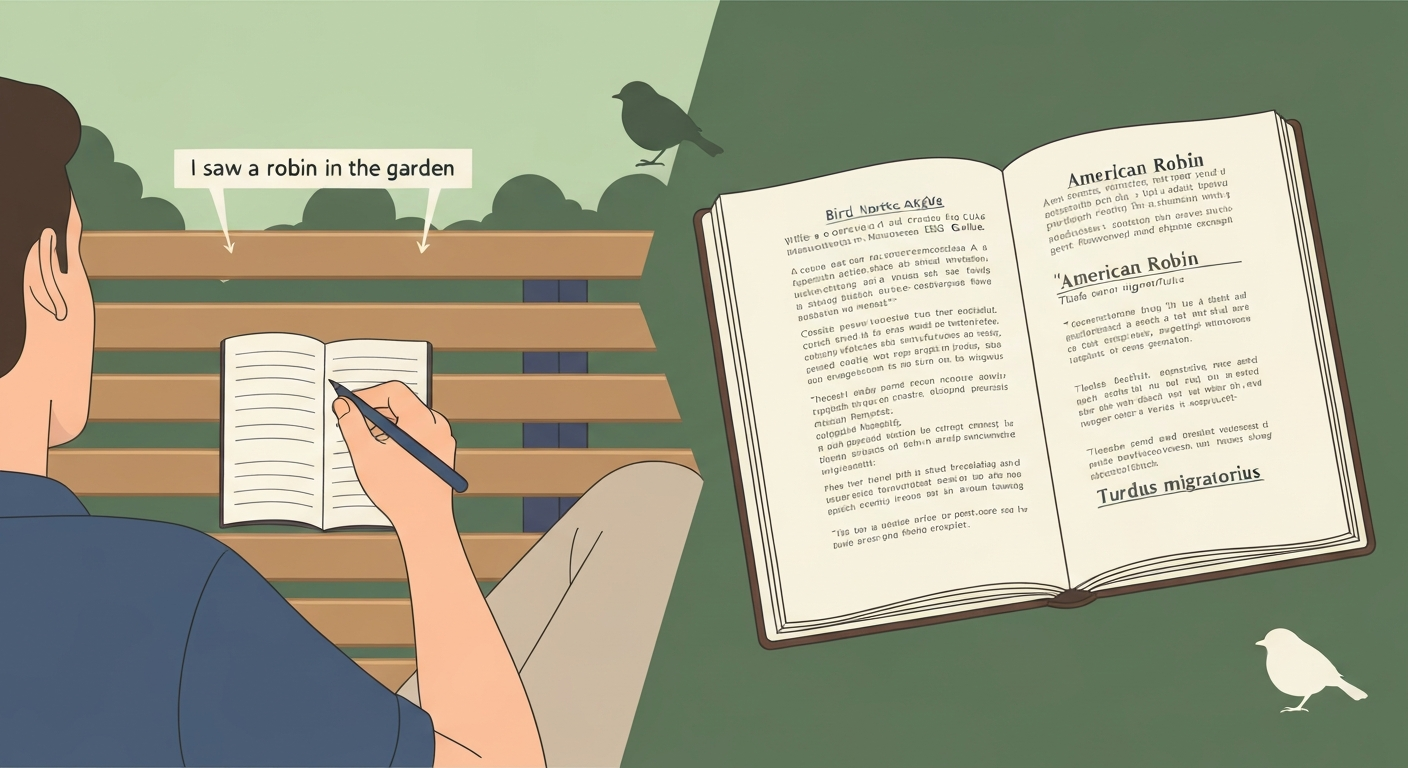
Most bird names are common nouns in everyday English, meaning they get no capital letter in general prose. When you write 'I saw a robin in the garden,' robin is functioning exactly like the word dog or tree: a generic label for a type of creature. However, when ornithologists publish official checklists, the same bird becomes 'American Robin,' capitalized like a proper name. Both uses are correct. The difference is not about the bird itself but about which set of rules you are following and why.
Are Bird Names Proper Nouns? Clear Rules and Examples

Maya Castellanos
15 Jul 2026
Common noun vs proper noun: the quick version
A common noun names a general class of things: city, river, dog, bird. A proper noun names a specific, individual entity and is capitalized in English: London, the Amazon, Lassie. The grammatical test is simple. Can you put 'a' or 'the' in front of it and mean any member of a group? Then it is a common noun. Does it point to one particular, named thing? Then it is a proper noun. Merriam-Webster, Cambridge Dictionary, and Oxford Advanced Learner's Dictionary all draw this distinction consistently: 'bird' in ordinary usage is a common noun; 'The Beatles' is a proper noun.
| Term | Type | Why | Example sentence |
|---|---|---|---|
| bird | Common noun | Names a class of animals, not a specific individual | A bird landed on the fence. |
| robin | Common noun (general use) | Names a type of bird, not one unique individual | I spotted a robin this morning. |
| American Robin | Proper noun (ornithological standard) | Standardized species name on official checklists (AOS, IOC) | The American Robin arrives early in spring. |
| Turdus migratorius | Scientific proper name | Formal Latin binomial under ICZN rules | Turdus migratorius breeds across North America. |
| Tweety | Proper noun | A specific named individual (a pet or fictional character) | Tweety escaped from his cage again. |
When 'bird' is a common noun and when it becomes part of a proper name
The word bird on its own is always a common noun. It names a biological class, not a specific creature. 'The birds sang all morning' is no different grammatically from 'the dogs barked.' You would never capitalize it in running text. Where things get interesting is when 'bird' appears inside a proper name: the Arizona Cardinals (a sports team), the Birds (a Hitchcock film title), or Larry Bird (a very famous basketball player whose surname happens to be a common noun used as a proper name). In those cases the word bird is part of a fixed proper noun and takes a capital letter for the same reason any proper name does.
The confusion usually starts not with the word bird itself but with species names like robin, cardinal, or sparrow. Those words feel halfway between a category label and a specific name, which is exactly why style guides disagree about how to handle them.
Three categories of bird names and how they work
It helps to separate bird names into three distinct types, because each category follows its own rules. Mixing them up is the main source of capitalization confusion.
Species common names
These are vernacular English names like robin, cardinal, blue jay, or black-capped chickadee. They developed over centuries of common use and vary across regions. In general prose they are treated as common nouns and written in lowercase. The Associated Press Stylebook treats common names of animals and plants in lowercase and prescribes retaining capitalization for elements derived from proper nouns, per its guidance on animals, capitalization, and genus/species Associated Press Stylebook excerpts (AP Style guidance on animals, capitalization, genus/species). Ornithological checklists, however, standardize and capitalize them (American Robin, Northern Cardinal, Blue Jay) to ensure that scientists and birders worldwide are referring to exactly the same species. Whether to capitalize depends entirely on which style guide or authority you are following.
Scientific (Latin) names
Every described bird species has a formal two-part scientific name governed by the International Code of Zoological Nomenclature (ICZN). The genus name is always capitalized and the species epithet is always lowercase: Turdus migratorius (American Robin), Cardinalis cardinalis (Northern Cardinal). Both parts are italicized. This rule has no exceptions and no style-guide variation. A robin is always Turdus migratorius in scientific writing, whether you are publishing in a journal, writing a field guide, or labeling a museum specimen.
Personal and pet names
When you name your pet parrot Mango or your rescued pigeon Winston, that name is a proper noun in the fullest sense. It refers to one specific individual and gets a capital letter exactly the way a person's name does. 'My parrot Mango loves grapes' follows the same grammar as 'My neighbor Winston loves grapes.' The species name (parrot, pigeon) stays lowercase; the individual name (Mango, Winston) gets a capital.
Scientific naming rules under the ICZN
The ICZN has been governing zoological nomenclature since 1895, and its rules on formatting are non-negotiable in scientific contexts. The binomial (two-part) name always consists of the genus (capitalized) plus the species epithet (lowercase), and the whole name is italicized. If you are referring to the genus alone you still capitalize and italicize it: Turdus spp. (meaning multiple species within the genus Turdus). Family and order names, like Turdidae (thrush family) or Passeriformes (perching birds), are capitalized but not italicized.
- Genus name: capitalized and italicized (Turdus)
- Species epithet: lowercase and italicized (migratorius)
- Full binomial: Turdus migratorius
- Family name: capitalized, not italicized (Turdidae)
- Order name: capitalized, not italicized (Passeriformes)
- Subspecies: a third italicized, lowercase epithet added after the species name
- Abbreviation after first mention: T. migratorius is acceptable in the same document
CDC and university editorial style guides (including Yale School of Medicine's published guidance) follow these same ICZN conventions. If you see a scientific name in a journal that violates these rules, it is an error, not a style choice.
What the style guides actually say
This is where writers and editors genuinely have a choice, because the three major authorities reach different conclusions about vernacular species names.
| Style authority | Vernacular bird names | Example | Best for |
|---|---|---|---|
| American Ornithological Society (AOS) checklist | Capitalize standardized English names | American Robin, Black-capped Chickadee | Scientific papers, field guides, checklists, eBird data |
| IOC World Bird List | Capitalize standardized English names | Northern Cardinal, Barn Swallow | International ornithology, conservation reports |
| Chicago Manual of Style | Lowercase common names in general prose | american robin, northern cardinal | Books, academic humanities writing |
| Associated Press (AP) | Lowercase common names; capitalize proper-noun elements | american robin, Canada goose | Newspapers, magazines, online news |
| ICZN (scientific names) | Genus capitalized, species lowercase, both italicized | Turdus migratorius | All scientific and academic contexts |
The practical upshot is that neither the ornithological convention nor the Chicago/AP convention is wrong. They serve different audiences. A field guide to North American birds follows AOS or IOC. A newspaper feature about backyard birdwatching follows AP. A novel mentioning cardinals follows Chicago. The mistake is applying one convention while expecting another.
Robin and cardinal: working through the examples
These two species come up constantly in questions about bird-name capitalization, partly because they also appear in cultural and sports contexts. Here is how the grammar actually works across those different situations.
Robin
In general prose, robin is a common noun: 'A robin pulled a worm from the lawn.' In AOS checklist style, the North American species is the American Robin, capitalized. In British English, the European Robin (Erithacus rubecula) gets the same treatment in ornithological writing. Robin is also a common given name for people, which makes it a proper noun in that context: 'Robin called to say she saw a robin in the garden' is grammatically unambiguous even if slightly comic. The plural robins stays lowercase in general text and Robins when referring to the standardized name on a checklist, a sports team (the Baltimore Orioles' rivals in popular conversation, though technically the Cincinnati Reds' old nickname was the Redlegs, not Robins). Do you capitalize robin the bird? Only if you are using an ornithological checklist style or if you are using it as a proper name.
Cardinal
The Northern Cardinal (Cardinalis cardinalis) gets capitalized in AOS style and stays lowercase in Chicago/AP general prose: 'I watched a cardinal at the feeder all afternoon.' As a sports team name, the Arizona Cardinals and St. Louis Cardinals are proper nouns because they are the official names of specific organizations, and Cardinals is capitalized regardless of any bird style guide. The word cardinal also names a rank in the Catholic Church: 'The cardinal addressed the congregation.' That is a different common noun. Whether the sports teams, the church title, or the bird came first in inspiring the name is a fun etymological question, and the answer involves a bit of all three. If you're curious about whether the sports teams or church officials were named after the bird, see the discussion on are cardinals named after the bird. The plural forms: cardinals (lowercase) in general prose, Cardinals when referring to the sports franchise.
Compound and geographic bird names: capitalization and hyphens
Many English bird names are compound names built from a geographic or descriptive element plus a bird type: American Robin, Canada Goose, Black-capped Chickadee, White-breasted Nuthatch. In AOS and IOC checklist style, the entire standardized name is capitalized, whether or not the first element is a proper noun on its own. In AP and Chicago down-style, the rule is more nuanced: a proper-noun element like 'American' or 'Canada' retains its capital even in lowercase-bird-name style, because it is inherently a proper noun. So AP might write 'Canada goose' but not 'american robin' (because American derives from a proper noun, America). This is genuinely where editors get confused.
On hyphens: ornithological authorities treat hyphens as meaningful, not optional. The IOC and AOS publish explicit hyphenation rules alongside their name lists. See Adoptions & Applications, IOC World Bird List (discussion of hyphenation/capitalization and adoption by organizations) for the IOC's published name lists and related discussion of hyphenation and capitalization practices Adoptions & Applications — IOC World Bird List (discussion of hyphenation/capitalization and adoption by organizations). A Black-capped Chickadee is hyphenated because 'black-capped' is a compound modifier. Removing the hyphen or adding one where none belongs is treated as a name change in formal contexts. For general editorial writing, follow your house style on compound modifiers but check the official checklist if you need the precise standardized form.
| Bird name | AOS / IOC style | AP / Chicago general prose | Note |
|---|---|---|---|
| American Robin | American Robin | American robin | American derives from a proper noun, so it stays capitalized in all styles |
| Canada Goose | Canada Goose | Canada goose | Canada is always a proper noun; goose lowercased in AP/Chicago |
| Northern Cardinal | Northern Cardinal | northern cardinal | Northern is a direction, not a proper noun; lowercase in AP/Chicago |
| Black-capped Chickadee | Black-capped Chickadee | black-capped chickadee | Hyphen required in all styles; compound modifier |
| Ruby-throated Hummingbird | Ruby-throated Hummingbird | ruby-throated hummingbird | Hyphen required; descriptive compound modifier |
A practical checklist for writers, pet owners, and editors
Before you type or correct a bird name, run through these questions in order.
- Am I writing a scientific name (binomial)? If yes: genus capitalized, species lowercase, both italicized. No exceptions.
- Am I writing for an ornithological publication, field guide, checklist, or citizen-science database (eBird)? If yes: use the standardized English name from AOS (North/Middle America) or IOC (global) in capitalized form, with official hyphens.
- Am I writing general prose for a book, magazine, newspaper, or website? If yes: check your house style. Chicago = lowercase common names. AP = lowercase common names but keep capitals on inherently proper-noun elements like 'American' or 'Canada.'
- Does the name include a proper-noun element (a country, a person's name, a place name)? If yes: that element stays capitalized in all styles (American Robin, Wilson's Warbler, Canada Goose).
- Am I naming a specific individual pet bird? If yes: the personal name is a proper noun and gets a capital. The species name follows your style guide's rule for the context.
- Am I referring to a sports team, organization, or brand named after a bird? If yes: use the official team name as a proper noun with whatever capitalization the organization uses.
- Am I writing a plural? Plurals follow the same capitalization rule as the singular: robins (general prose), American Robins (checklist style), Cardinals (sports team).
The single rule worth memorizing
Bird names are common nouns by default. For a brief guide on whether 'bird' functions as a proper noun or a common noun, see bird proper noun or common noun. See 'bird is common or proper noun' for a one-sentence decision rule. If you want a short answer to is bird a proper noun, see the brief explanation in this guide. Capitalize them only when you are (a) using a standardized ornithological checklist name in a scientific or birding context, (b) the name contains an element that is a proper noun on its own (a place, a person), or (c) you are naming a specific individual animal or organization. For a concise summary, see Are bird names capitalized? (internal resource 49019af5-6ce0-4bc2-8ded-7a48b1282e37). Follow that rule and you will be right in almost every situation you encounter. Scientific binomials are a separate track entirely: genus always up, species always down, both always in italics.
Where to verify official names and origins
If you need to confirm the correct standardized English name, spelling, or hyphenation for a specific bird, these are the authorities worth bookmarking.
- American Ornithological Society (AOS) Check-list of North and Middle American Birds: the binding authority for English names and scientific names in North and Middle America; updated annually online
- IOC World Bird List (International Ornithologists' Union): the principal global standard for English bird names, including detailed hyphenation and capitalization conventions; freely available online with version history
- eBird / Clements Checklist (Cornell Lab of Ornithology): follows IOC taxonomy and publishes updated species names; useful for verifying names used in citizen-science records
- Merriam-Webster Dictionary: reliable for verifying whether a common bird name appears as a standard English entry and how it is typically used in non-specialist prose
- International Code of Zoological Nomenclature (ICZN): the authoritative source for scientific naming rules; the full code is available online through the ICZN website
- Chicago Manual of Style (CMOS): the standard reference for book and academic humanities capitalization, including its guidance on common versus proper nouns for animal names
- Associated Press Stylebook: the standard for journalism; check the 'animals' and 'capitalization' entries for current AP guidance on vernacular species names
For bird name etymologies and the history behind why a species ended up with the common name it has, the Auk (published by the American Ornithological Society through Oxford Academic) has carried detailed historical analyses of English bird name conventions, including the shift toward capitalized standardized names in ornithological publishing. That is the kind of deeper-dive reading that rewards anyone who wants to understand not just the rules but where they came from.
FAQ
Are bird names proper nouns in English?
Most bird names are common nouns when used generically (e.g., “a robin,” “several sparrows”). They become treated like proper nouns only when they name a particular individual (a pet’s name: “Robin”), a team/organization built from a proper noun (e.g., “the St. Louis Cardinals”), or when following an ornithological checklist that presents standardized English species names in Title Case (e.g., AOS/IOC usage: “American Robin”).
What is the difference between a common noun and a proper noun for bird names?
Common noun: names a class or type (bird, robin, goose) and is lowercased in normal running text. Proper noun: names a specific, unique entity (a person, place, organization, or unique animal name) and is capitalized (e.g., a pet named “Blue,” the sports team “Cardinals”). Dictionaries (Merriam‑Webster, Cambridge, Oxford) define this grammatical distinction.
How do scientific (Latin) names differ from English common names?
Scientific names follow the International Code of Zoological Nomenclature: genus capitalized, species epithet lowercase, and the full binomial is italicized (e.g., Turdus migratorius). English common names are vernacular and have varying capitalization rules depending on context and style guide.
What do major ornithological authorities (AOS, IOC) recommend for English bird-name capitalization?
Ornithological authorities publish standardized English names in Title/Headline case for consistency in checklists and databases (e.g., AOS lists “American Robin,” IOC lists “Black‑capped Chickadee”). These conventions are used in field guides, checklists, and citizen‑science databases.
What do mainstream editorial style guides (Chicago, AP) recommend?
General publishing/news style (Chicago Manual of Style, many book publishers, AP) usually prefers down‑style: lowercase common names in running text (e.g., “american robin” or often “a robin”), capitalizing only proper‑noun elements (e.g., “Canada goose” because Canada is a proper noun). House rules vary; editors should follow their chosen style.
Which rule should I follow when writing for different audiences?
Rule of context: - Scientific/ornithological/citizen‑science contexts: use the relevant checklist (AOS, IOC, Clements), Title Case for standardized English names, and italicize scientific names. - Popular writing, journalism, and general prose: follow your house style (typically lowercase common names except proper‑noun elements). - When in doubt, state which convention you follow in a preface or style note.
Next Articles
Bird is Common Noun or Proper Noun? How to Decide
Learn if bird is common or proper noun, with capitalization rules and examples, plus bird-name context tips.
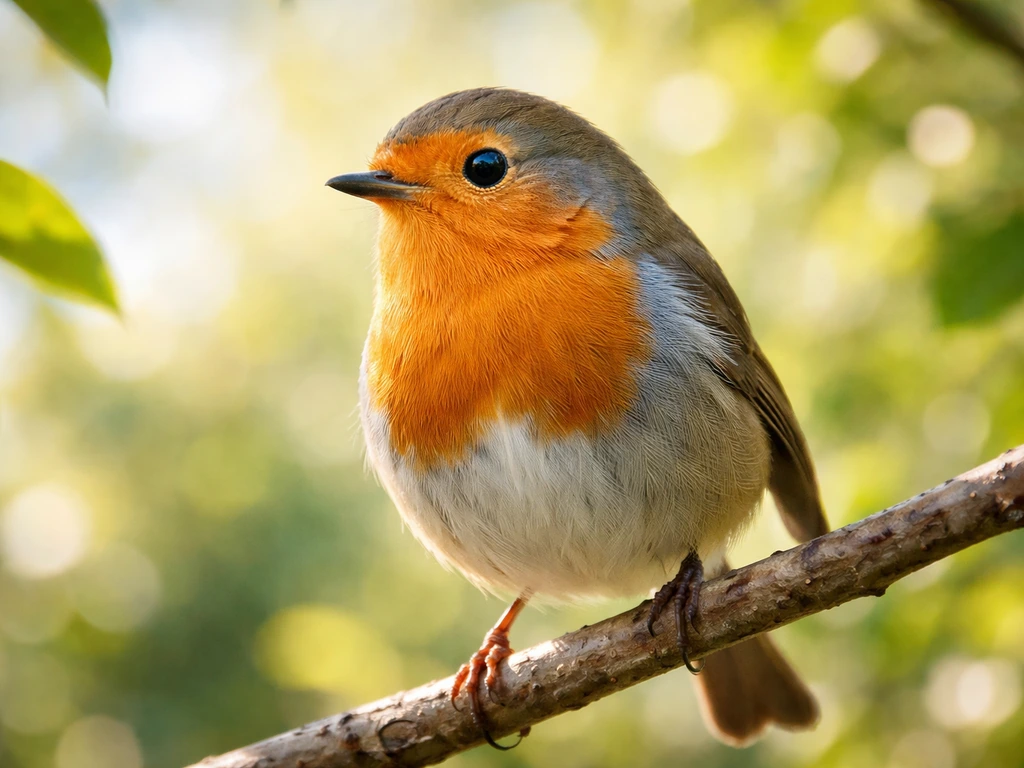
Do You Capitalize Robin the Bird? Simple Rules
Rules for capitalizing Robin vs robin the bird, including title cases and a quick checklist for real sentences.
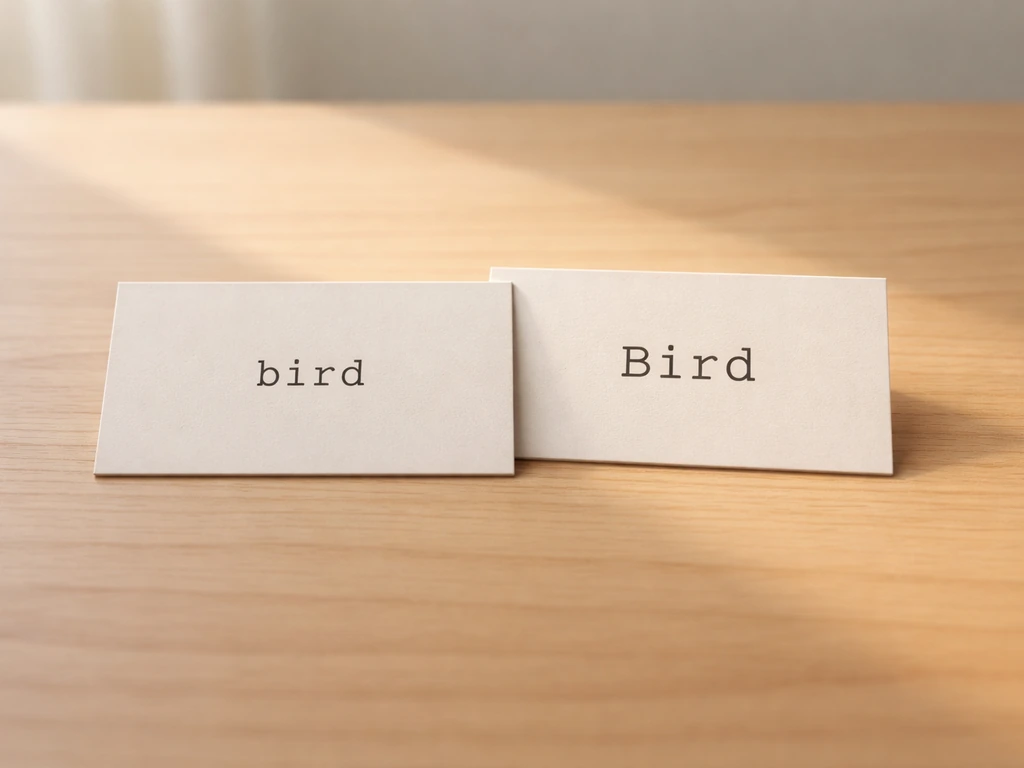
Is Bird a Proper Noun? Capitalization Rules for Bird Names
Learn if bird is a proper noun, when to capitalize Bird, and how to format common bird and species names correctly.