
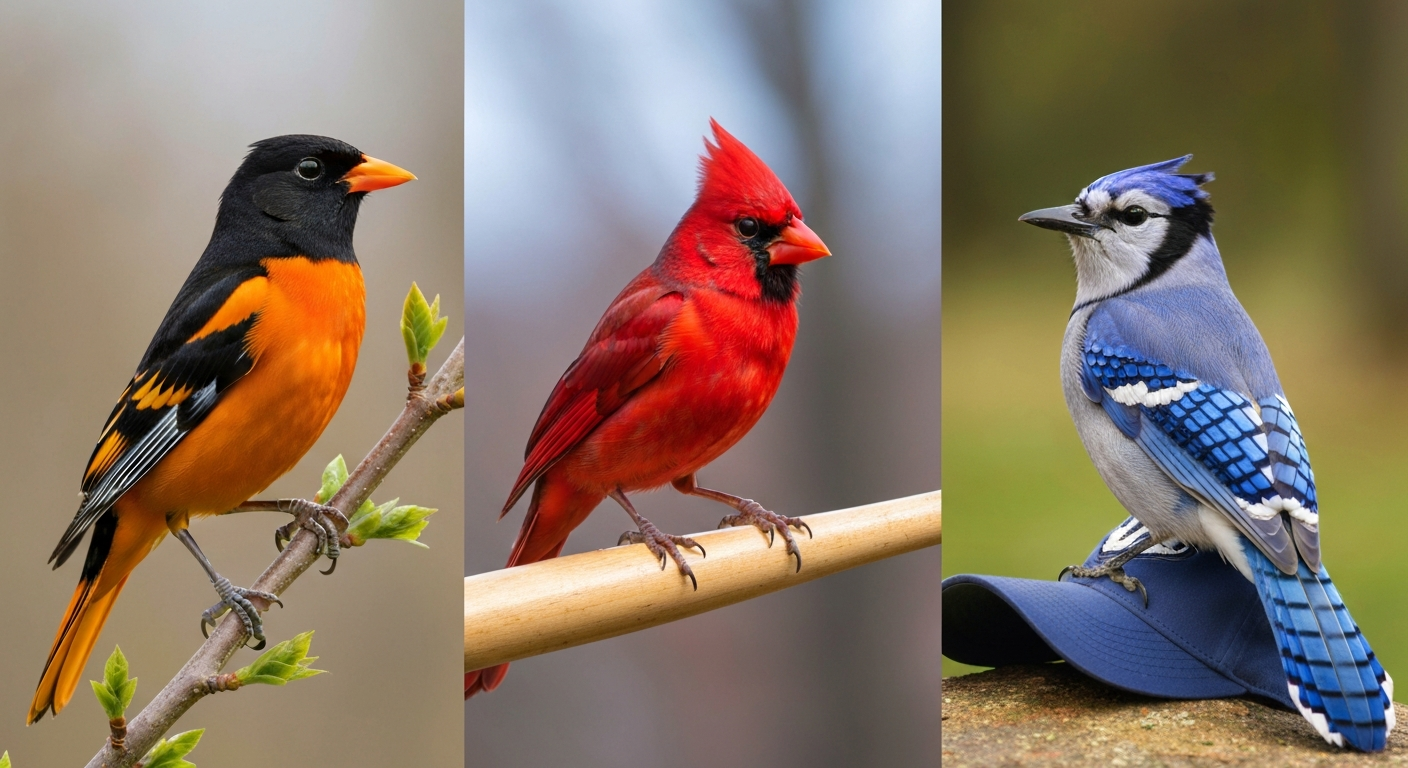
Three current MLB teams have official names that refer to bird species: the Baltimore Orioles, the St. Louis Cardinals, and the Toronto Blue Jays. That's it, three out of thirty franchises. If you've been mentally running through team names and second-guessing yourself on the Brewers or the Marlins, don't worry, I'll walk you through exactly how I counted and why some borderline cases don't make the cut.
How Many MLB Teams Have Bird Names? Quick Answer & List

Maya Castellanos
29 Jul 2026
What counts as a bird name (and what doesn't)
Before listing teams, it's worth being precise about the counting rule, because the answer changes depending on what you include. My approach here follows the same standard that SABR (the Society for American Baseball Research) uses when analyzing official franchise nicknames: only the formal, MLB-sanctioned club name counts. That means the name on the official MLB team index and the club's own website, not a mascot's name, not a logo motif, and not a fan nickname.
Here's what I'm excluding, and why each exclusion matters:
- Mascots with bird names: The Cardinals' mascot is Fredbird and the Blue Jays' is Ace, but a mascot name is not the team's official name. Plenty of non-bird teams have bird mascots.
- Logo birds: Several teams have used bird imagery in logos or uniforms over the years without the bird appearing in the official team name.
- Colloquial fan nicknames: Press-box shorthands and informal abbreviations (e.g., 'The Birds' for Baltimore) are not official franchise names.
- Minor league affiliates: The MLB parent club's name is the only name being counted here.
- Borderline profession/place names: The Milwaukee Brewers are named for the brewing industry, not a bird. The Florida/Miami Marlins are named for a fish. These don't qualify regardless of what the logo looks like.
The working rule is simple: if the official team name, as used on MLB.com and the club's own site, is itself the name of a recognized bird species, it counts. By that standard, the number is three.
The three MLB bird teams at a glance
| Team | Home City | Bird Species | Scientific Name | Mascot |
|---|---|---|---|---|
| Baltimore Orioles | Baltimore, MD | Baltimore Oriole | Icterus galbula | The Oriole Bird |
| St. Louis Cardinals | St. Louis, MO | Northern Cardinal | Cardinalis cardinalis | Fredbird |
| Toronto Blue Jays | Toronto, Ontario, Canada | Blue Jay | Cyanocitta cristata | Ace (prev. BJ Birdy) |
Baltimore Orioles
The bird behind the name
The Baltimore Oriole (Icterus galbula) is a striking medium-sized songbird in the blackbird family Icteridae. The male's flame-orange and black plumage is genuinely hard to miss, and those colors directly inspired both the team's identity and, eventually, Baltimore's civic color palette. Females are a more muted yellow-olive, but it's the male's vivid orange that most people picture when they hear the name. The species migrates through much of eastern North America and breeds as far north as southern Canada, making it a genuinely regional bird for the Baltimore area.
Name etymology and history
The bird itself was named in honor of George Calvert, the first Lord Baltimore, whose family heraldic colors were black and gold (orange). English colonists noticed that the bird's colors matched the Calvert coat of arms and named it accordingly. So 'Baltimore Oriole' is essentially a heraldic name folded into natural history, which is a lovely piece of linguistic layering. The baseball franchise officially adopted the Orioles name in 1954 when the Browns relocated from St. Louis to Baltimore, though the name had been used by earlier Baltimore baseball clubs going back to the 1890s.
Logo and mascot notes
The Orioles have used both a realistic bird logo and a cartoonish bird character across different uniform eras. The costumed mascot is officially called The Oriole Bird, which is admirably on-the-nose naming. The cartoon bird logo, introduced in the 1960s and revived in updated forms, is one of the more recognizable bird logos in American sports. Image suggestion: a male Baltimore Oriole (Icterus galbula) perched on a branch against a green leafy background, showcasing the orange-and-black plumage that maps directly to the team's color scheme.
St. Louis Cardinals
The bird behind the name
The Cardinal in question is the Northern Cardinal (Cardinalis cardinalis), one of the most recognizable backyard birds in North America. The male's all-red plumage with a distinctive crest is iconic, and the species is a year-round resident throughout much of the eastern and central United States, so it's a genuinely local bird for St. Louis. The scientific name, Cardinalis cardinalis, is a lovely example of a tautonym, where the genus and species name are the same word.
Name etymology and history
The word 'cardinal' in the bird's name traces back to the bright red robes worn by Roman Catholic cardinals. Early European naturalists in North America saw the male bird's red plumage and made the comparison directly. The St. Louis baseball team picked up the Cardinals nickname around 1900. According to team history, the name came from a comment by a fan who overheard a remark about the team's new red uniforms, describing the color as 'a lovely shade of cardinal.' The name stuck, layering the ecclesiastical color reference, the bird association, and civic identity all into one word.
Logo and mascot notes
The Cardinals have one of the most storied logo traditions in baseball: the 'Birds on the Bat' motif, introduced in the 1920s, shows two cardinal birds perched on a baseball bat. That design has been the franchise's primary bird logo in various updated forms ever since, and it's among the oldest continuously used bird-based logo marks in professional sports. The official costumed mascot is Fredbird, introduced in 1979. Image suggestion: a male Northern Cardinal (Cardinalis cardinalis) in full red plumage perched on a snow-dusted branch, which captures both the bird's vivid color and its cold-weather hardiness as a year-round resident.
Toronto Blue Jays
The bird behind the name
The Blue Jay (Cyanocitta cristata) is a bold, intelligent corvid native to North America. The species is year-round across much of the eastern half of the continent and is a common urban and suburban bird in Toronto. Blue Jays are known for their loud calls, assertive personalities, and striking blue, white, and black plumage. Cyanocitta cristata breaks down neatly: Cyanocitta comes from the Greek for 'blue chattering bird,' and cristata is Latin for 'crested.' As a bird-name etymologist, I find it satisfying that the scientific name essentially just means 'crested blue chattering bird,' which is exactly what a Blue Jay is.
Name etymology and history
The Toronto franchise was established in 1977 as an expansion team. The name 'Blue Jays' was selected through a public naming contest, with the club choosing it partly for the bird's connection to Canada and partly for the blue color, which complemented the team's intended uniform palette. Unlike the Orioles and Cardinals, whose bird names evolved through decades of informal use before becoming official, the Blue Jays' name was deliberately chosen from day one.
Logo and mascot notes
The Blue Jays' logo has gone through several redesigns over the decades, from a realistic blue jay profile in the early years to more stylized and abstract marks in the 1990s, then back toward a cleaner, bird-forward design in their 2012 rebrand. The franchise has had two costumed mascots: BJ Birdy, who served from the team's early years until 1999, and Ace, who is the current mascot. Image suggestion: a Blue Jay (Cyanocitta cristata) in sharp focus showing the full blue, white, and black plumage with the distinctive crest raised, ideally in a naturalistic setting that reflects the bird's urban-park habitat around Toronto.
Former MLB teams and historical bird nicknames
If you stretch the count to include historical franchises, a few interesting bird names pop up. The most notable is the Brooklyn Robins, who played in the National League from 1914 to 1931. The Robins nickname was used informally to refer to the Brooklyn team (officially the Brooklyn Superbas or Brooklyn Dodgers depending on the era), largely because manager Wilbert Robinson was so popular that sportswriters started calling the team after him. So 'Robins' was a manager's nickname that happened to share a name with a bird, not a deliberate avian choice. That's an important distinction, and under my counting rules, it wouldn't qualify as an official bird team name even if the franchise were still active.
The Philadelphia Blue Jays were a brief attempt at rebranding the Phillies during the 1940s, with the club officially adopting the 'Blue Jays' name for a few seasons before reverting. That's a genuine historical bird team name, though the franchise is now the Phillies. There were also various early 20th-century uses of 'Cardinals' as a secondary name for teams that eventually became something else entirely. None of these historical cases change the current count of three, but they're worth knowing about if you're researching the full arc of bird naming in professional baseball.
How MLB's bird names compare to other sports
Three out of thirty is a 10% bird-name rate for MLB. The NFL has a comparable handful of bird-named franchises, including the Philadelphia Eagles, Atlanta Falcons, Baltimore Ravens, Seattle Seahawks, and Arizona Cardinals (the same Cardinal bird, with the franchise having moved from Chicago to St. Louis to Arizona). That's five out of thirty-two NFL teams, a slightly higher rate. The NBA and NHL have fewer bird-named teams by comparison. If you're curious about how the NFL's bird names break down in detail, that's worth its own deep dive. See the breakdown of how many NFL teams have bird names for a detailed count and list. For a related update on which bird names are changing, see which bird names are changing. For a quick list and rankings of notable species-themed team and pet names, see top bird names.
What's interesting from a nomenclature perspective is that all three MLB bird teams use North American species that are genuinely local to the region the team represents. The Baltimore Oriole breeds in Maryland, the Northern Cardinal is a year-round St. Louis resident, and the Blue Jay is an everyday bird in Toronto. That's not a coincidence: regional wildlife is a common source for team identity, and birds that are visually striking and locally familiar make for strong mascots. This same principle shows up in pet bird naming culture, where common regional species often inspire names people give to their own birds. For playful suggestions when naming a pet bird, see a roundup of the best bird names funny.
The names themselves, as names
From a pure naming perspective, all three team names are compound common names: Baltimore Oriole pairs a place name with a bird name, Blue Jay pairs a color with a family name, and Cardinal stands alone as a color-derived ecclesiastical word that crossed over into ornithology. These naming patterns mirror how many pet birds get named, and they reflect broader conventions in how English speakers name species: place of association, color, behavior, or cultural reference. For a related sports-language example, see why does golf use bird names which explains how bird terms like 'birdie' and 'eagle' entered golf vocabulary. If you enjoy that kind of linguistic pattern-spotting in bird names generally, the same logic applies whether you're naming a species, a team, or a parakeet. For more examples and inspiration, see a roundup of the best bird species names for how these naming patterns play out across species and common pet-bird choices. For inspiration on naming hunting dogs with avian themes, see a list of the best bird dog names.
FAQ
SEO title and meta description
Title: How Many MLB Teams Have Bird Names? — Orioles, Cardinals, Blue Jays (Explained) Meta description: Quick answer: 3 MLB teams have official bird‑species names. This guide lists each team (species, home city, mascot/logo notes), explains counting rules, gives short etymologies and historical bird‑named clubs, offers image suggestions and sourcing guidance, and links to related nomenclature pages.
Immediate numeric answer
There are 3 current Major League Baseball franchises whose official team names refer to bird species: the Baltimore Orioles, St. Louis Cardinals, and Toronto Blue Jays.
Counting rules: what counts and what doesn’t
Counting method (use these explicit rules when answering the core question): - Count only current MLB franchises’ official team names as listed by MLB and the club (MLB.com franchise pages). - Include a team only if its official name explicitly names a bird species (singular or plural). - Exclude teams whose official names are professions, places, colors, or other objects even if their logo/mascot depicts a bird (e.g., Seattle Mariners has a bird‑ish mascot at times? — not official). - Exclude colloquial or historical press nicknames that were never the franchise’s formal name, and exclude minor‑league or promotional names. Sources: MLB team index (mlb.com/team) and SABR guidance on official vs. informal nicknames.
Complete list of current MLB teams with bird names (species, mascot/logo notes, home city)
1) Baltimore Orioles — Species: Baltimore oriole (Icterus galbula). Home city: Baltimore, Maryland. Mascot/logo notes: Official name 'Baltimore Orioles'; team mascot is the Oriole Bird; logo uses the oriole bird imagery. Source: mlb.com/orioles; Cornell All About Birds species account for Baltimore oriole. 2) St. Louis Cardinals — Species: Cardinal (commonly the Northern Cardinal, Cardinalis cardinalis). Home city: St. Louis, Missouri. Mascot/logo notes: Official name 'St. Louis Cardinals'; signature logo motif is the 'Birds on the Bat'; mascot is Fredbird. Source: mlb.com/cardinals; Cardinals logo history resources; Cornell All About Birds on Northern Cardinal. 3) Toronto Blue Jays — Species: Blue jay (Cyanocitta cristata). Home city: Toronto, Ontario (Canada). Mascot/logo notes: Official name 'Toronto Blue Jays'; current mascot 'Ace' (historical BJ Birdy); logo and team identity feature a blue jay head/crest. Source: mlb.com/bluejays; Blue Jay species page at Cornell All About Birds.
Compact quick‑reference table (one line per team)
Baltimore Orioles — Species: Baltimore oriole (Icterus galbula) — City: Baltimore, MD — Mascot/Logo: Oriole Bird; bird logo imagery. | St. Louis Cardinals — Species: Northern cardinal (Cardinalis cardinalis) — City: St. Louis, MO — Mascot/Logo: Fredbird; 'Birds on the Bat' logo. | Toronto Blue Jays — Species: Blue jay (Cyanocitta cristata) — City: Toronto, ON — Mascot/Logo: Ace (current); BJ Birdy (historic); blue jay head/crest logo.
Short etymologies and historical notes for each team
Baltimore Orioles: Name origin: The oriole is Maryland’s state bird and the name links to the 19th‑century Baltimore oriole image used by earlier Baltimore clubs. The current MLB franchise (established 1901 as the Milwaukee Brewers/other early lineages; moved/renamed over time) adopted the Orioles name when the St. Louis Browns moved to Baltimore in 1954 and took the historic local nickname. Sources: mlb.com/orioles; All About Birds (Baltimore Oriole). St. Louis Cardinals: Name origin: The 'Cardinals' nickname dates to the late 19th/early 20th century—attributed to the team’s cardinal red trim and to a sportswriter’s reference; the bird motif (cardinal bird) became formalized in logos and uniforms, producing the iconic 'Birds on the Bat' mark (in use since the 1920s). Sources: mlb.com/cardinals; Cardinals logo histories; All About Birds (Northern Cardinal). Toronto Blue Jays: Name origin: Chosen in 1976 when the expansion franchise was awarded to Toronto; 'Blue Jays' references the common North American blue jay and the team adopted bird imagery immediately (blue jay head logos, team crest). Sources: mlb.com/bluejays; Blue Jay species account (Cornell).
Next Article
Which Bird Names Are Changing Now How to Verify New vs Old
Step by step guide to identify current bird name changes, compare old vs new, verify sources, and update checklists