As of June 2026, the two most reliable places to check which bird names are changing right now are the IOC World Bird List's English Name Updates page and Cornell's Clements/eBird checklist updates page. Both show you the old name, the new name, the scientific name, and the reason for the change, all in one place. If a name change is real and current, it will be on at least one of those pages. That's the short workflow. Everything below helps you go deeper.
Which Bird Names Are Changing Now How to Verify New vs Old

Maya Castellanos
15 Jun 2026
How to identify which bird names are changing

The first thing to know is that bird names change through two separate but overlapping systems: the IOC World Bird List (used widely outside North America and globally for English names) and the Clements/eBird Checklist (the backbone taxonomy for eBird and most North American birding). ABA’s 2024 Checklist Committee report similarly treats Clements and eBird as a backbone taxonomy for incorporating and tracking nomenclatural changes in ABA global naming blank" rel="noopener noreferrer">Clements/eBird Checklist (the backbone taxonomy for eBird and most North American birding). Both publish formal updates on predictable schedules, and both explicitly list old names alongside new names so you are never left guessing what changed.
Here is a simple workflow that works whether you are a casual lister or a serious taxonomist:
- Go to the IOC World Bird List Updates page and look for the 'English Name Updates' section. It shows a table with the previous IOC list name, the current accepted name, the scientific name, and notes explaining why the change happened.
- Cross-check with the Clements/eBird Updates and Corrections page. Cornell posts an annual update overview (the most recent was October 2025, releasing the v2025 spreadsheet on 31 October 2025) with an explicit 'English Name Changes' section.
- If you want to verify when a change became official, check the IOC's update diary, which works as a chronological index of all changes, giving you effective dates.
- For South American species or especially contested splits, check the SACC (South American Classification Committee) Recent Changes index at LSU, which was last updated 27 February 2026 and shows proposal trails for every scientific change.
- If the bird appears in eBird, search it there. eBird warns users that 'Common Names can change, especially when splits occur,' and name changes from each taxonomy update roll through eBird outputs quickly after the annual release.
One practical tip: if you cannot find a species under its old name in eBird, that itself is a signal that the name has changed. eBird's last taxonomy update went live on 28 October 2025, so anything you remember from before that date may already carry a new label.
Current examples of bird-name changes
Let's make this concrete. The IOC English Name Updates page lists a range of real changes, each with a note explaining the rationale. Here are several current examples pulled directly from that resource:
| Old Common Name | New Common Name | Scientific Name | Type of Change |
|---|---|---|---|
| Audubon's Shearwater | Sargasso Shearwater | Puffinus lherminieri | English name revision |
| Racket-tailed Coquette | Racket-tipped Thorntail | Discosura longicaudus | English name + group name revision |
| Houbara Bustard | African Houbara | Chlamydotis undulata | English name clarification after split |
| Solomons Cockatoo | Solomons Corella | Cacatua ducorpsii | English group name corrected to genus alignment |
| Yellow-billed Honeyeater | Yellow-billed Giant Honeyeater | Gymnomyza viridis | English name expanded to reflect taxonomy |
On the scientific name side, taxonomy updates frequently shift species between genera. When that happens, the authority (the person who first named the species) gets placed in parentheses in the citation, per ICZN Code Article 51. So if you see parentheses around an author name that were not there before, the genus has changed. That is a reliable tell that a scientific name revision has occurred, even if the species epithet stayed the same.
Why bird names change
Taxonomy and phylogenetics

Most name changes trace back to new genetic research. When DNA analysis reveals that a species was actually two distinct lineages (a split), or that two recognized species are actually one (a lump), the common name usually has to change to reflect that. Splits are the biggest driver of new common names because you suddenly need two distinct labels where one used to do the job. The 'African Houbara' example above is a classic split outcome: what was once one Houbara Bustard is now two species, so each got a geographically specific name.
Formal naming rules for scientific names
Scientific names are governed by the International Code of Zoological Nomenclature (ICZN). The key rule is the Principle of Priority (Article 23): the oldest validly published name takes precedence. This sounds simple, but it means that when researchers dig up an older, forgotten description of a species, the newer familiar name can get displaced. A name also has to meet formal availability criteria under Article 11, which covers things like publication requirements, Latin or Latinized form, and explicit description. If an older name turns out to meet all those criteria, it bumps the current name, even if the current one has been in use for decades.
English naming conventions and committee decisions
English common names are not governed by the ICZN. Instead, they follow guidelines published by ornithological bodies like the American Ornithological Society (AOS). The AOS guidelines for English bird names try to make group names (like 'plover' or 'warbler') taxonomically coherent, which is why a bird can lose a group name if its family placement changes. When the 'Solomons Cockatoo' became 'Solomons Corella,' that was the English name being brought into alignment with the genus Cacatua, which houses the corella group. Committees meet annually, consider proposals, and vote on changes, so the process is deliberate rather than arbitrary.
How to research the origin and meaning of an updated name
Once you know a name has changed, the fun part (from a language perspective) is figuring out what the new name actually means and why it was chosen. Here is how to dig into that:
- Start with the IOC or Clements update notes. The change notes often explain the reasoning in plain English, for example referencing the geographic range, the type specimen location, or a recognizable physical feature the new name captures.
- For scientific names, break the name into its Latin or Greek roots. The species epithet and genus name almost always encode something: a habitat, a physical trait, a person's name (an eponym), or a place. 'Puffinus lherminieri,' for example, combines a Medieval Latin word for a seabird with the name of French naturalist Félix Louis L'Herminier.
- For eponyms (names honoring a person), check the original species description or a resource like the Handbook of the Birds of the World (HBW) species account, which usually includes a note on who the species was named after.
- The IOC's own species accounts sometimes include etymology notes. The Clements spreadsheet includes authority fields and date of publication, which point you toward the original description where naming rationale lives.
- For the meaning behind common names, think about the components: 'Sargasso Shearwater' ties the bird to the Sargasso Sea, which is a key part of its range, giving the name actual informational value over the old eponymous name.
One thing worth noting: when a name changes from an eponym (a person's name) to a descriptive name, it is sometimes a deliberate move by nomenclature committees to reduce names honoring historical figures with problematic legacies. That conversation is ongoing in ornithology right now and is worth following if you are interested in the cultural politics of naming.
How to update your bird lists, field guides, and apps
Knowing which names changed is one thing. Getting your personal resources synchronized is another. Here is a practical approach depending on what you use:
eBird and digital checklists
eBird automatically updates its taxonomy each October. The v2025 update rolled out on 28 October 2025. If you submitted checklists before that date under an old name, eBird handles the remapping automatically for most split and lump scenarios. You can verify your personal lists by checking the 'My eBird' section and comparing species names against the Clements v2025 spreadsheet, which is freely downloadable from Cornell. eBird also supports alternate common-name sets, including IOC English names, so you can toggle between naming conventions if you prefer one over the other.
Printed field guides
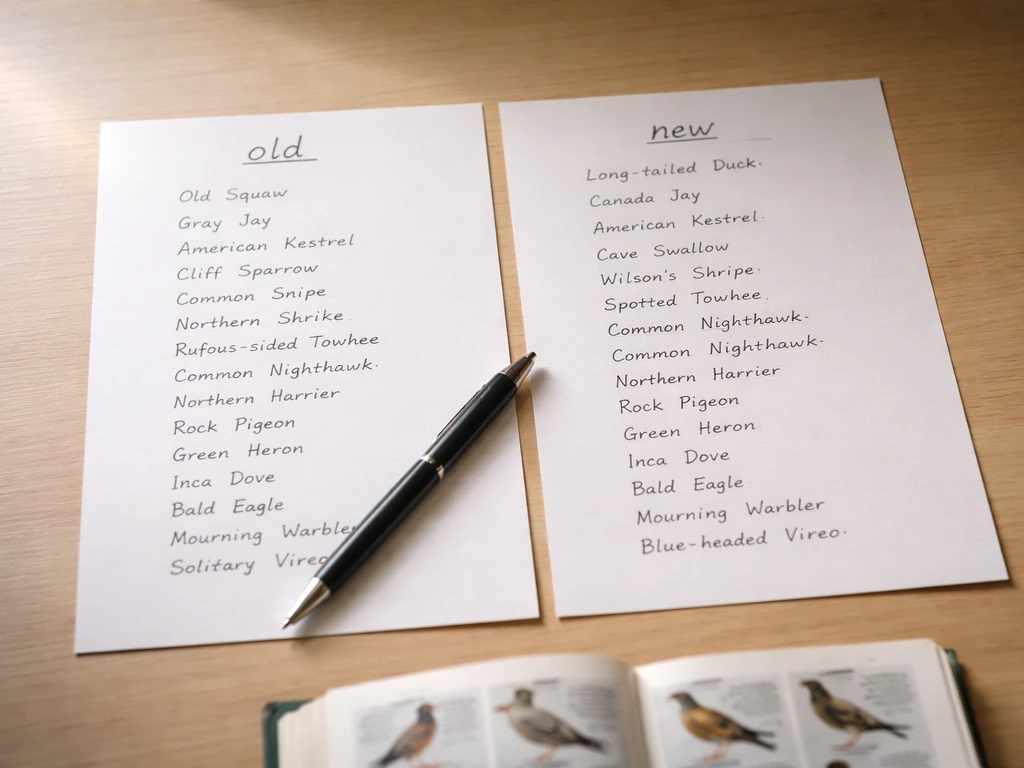
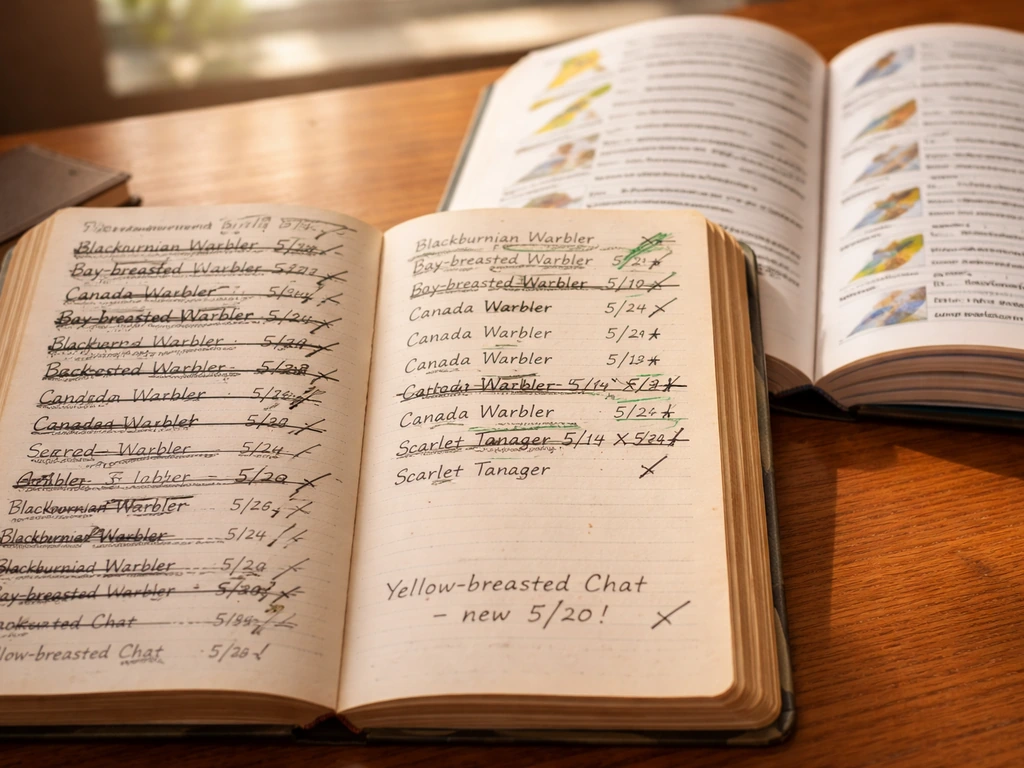
Printed guides go stale quickly during active taxonomic periods. The practical move is to keep a running annotation in your guide: when a name changes, pencil the new name next to the old one and note the update year. Some birders keep a separate name-change log tucked inside the front cover. For any guide more than two or three years old, cross-check every split-prone family (shearwaters, sparrows, and flycatchers are perennial targets) against the current Clements or IOC list before you rely on the guide in the field.
Third-party apps and databases
Apps like Merlin Bird ID (Cornell), BirdNet, and regional apps typically follow the Clements taxonomy and update annually, but the timing varies. Check the app's 'About' or 'Taxonomy' section for the version year. If your app still says v2024 and you are reading this in June 2026, it is worth checking whether a v2025 or v2026 update is available. For citizen-science databases beyond eBird, check whether they use IOC or Clements as their backbone, since the two systems sometimes use different names for the same bird.
What name changes mean for pet birds, wordplay, and pop culture
If you are naming a pet bird, official name changes matter less than you might think. Your pet cockatiel does not care what the IOC calls its wild cousins. That said, if you want a name that signals you know your ornithology, using the current accepted common name (rather than an outdated one) is a nice touch. If you are choosing a pet bird name, you might also like the best bird dog names for inspiration.
If you want the best bird names that are funny or playful, you can use the same update workflow to make sure you are laughing at the current accepted names, not old ones best bird names funny. A pet named 'Sargasso' after the newly renamed Sargasso Shearwater, for instance, has a story behind it that a name like 'Audubon' no longer accurately tells.
For anyone interested in the broader world of bird naming for pets, the landscape of top bird names and species-specific naming traditions is worth exploring separately. If you want a different kind of naming project, explore the best bird dog names for inspiration before you settle on a final choice.
Pop culture and sports references are slower to update. NFL and MLB teams with bird names (think the Philadelphia Eagles or the Baltimore Orioles) are obviously not going to rebrand because a taxonomic committee revised a genus. If you are wondering how many MLB teams have bird names, you can count them using the current team nicknames MLB teams with bird names.
To get the exact count, you would start by listing every NFL franchise whose official name includes a bird species or bird-type term, then cross-check that list against a bird-name definition you are using consistently how many NFL teams have bird names. But crossword puzzles, trivia, and nature writing do sometimes lag behind official nomenclature in ways that create confusion.
If you are writing a nature piece or crafting a bird-themed wordplay puzzle and you use an outdated name, you may inadvertently date your work. The safest habit is to check the current IOC or Clements list before publishing any bird name in a context where accuracy matters.
Golf's bird-named scoring terms (birdie, eagle, albatross) are entirely metaphorical and immune to ornithological revision, which is a small mercy. If you are curious why golf uses bird names in the first place, the story is mostly about metaphor and tradition rather than current bird taxonomy.
But for anyone tracking bird names in sports, culture, and wordplay contexts, the underlying species names that inspired those references do keep shifting, and the linguistic history of a name sometimes changes meaning entirely when the taxonomy catches up. Staying current with IOC and Clements updates is the most reliable way to keep your bird knowledge as accurate as your enthusiasm.
If you want a quick starting point for the best bird species names to use today, compare the accepted IOC and Clements versions side by side.
FAQ
If I use scientific names, do I still need to worry about changing English bird names?
Yes, but only if the change affects the name you use. If you track by scientific name, the match is usually stable, even when English common names change. When you compare lists across IOC and Clements, first align on the scientific name, then check the common-name column to see whether both systems renamed it or only one did.
Why does my app or website show an old bird name even after the update pages say it changed?
It can help you avoid false alarms. A single checklist, eBird report, or app result might lag a taxonomy update, or it might be using an alternate common-name set. Confirm the change by checking an official update page for the same timeframe, and then verify whether your app’s “taxonomy version year” is current.
Which source should I trust if IOC and Clements show different English names for the same species?
Not necessarily. In practice, IOC and Clements sometimes diverge on English names and, less often, on the underlying taxonomy they apply to a region. If you want consistency, pick one backbone (IOC English names or Clements taxonomy), then stick to that naming set in eBird toggles and in any downstream tools you export to.
How can I tell whether a “former name” is a true synonym or a split where the old bird became two new ones?
Sometimes. A “formerly X” label on an update list can reflect a split, a lump, or a move in classification where the old English name may be reassigned. For split cases, look for two new names tied to two different scientific taxa, and be careful not to assume the old name maps one-to-one.
If I keep my own bird sightings spreadsheet, what’s the safest way to store names so I do not break my history?
Yes, and it affects data. If you export or archive sightings, store both the scientific name and the common-name string you saw at the time. Later, you can remap common names to the accepted ones without losing the identity of the species in your dataset.
My field guide is only a little old. When is it actually risky to trust its bird names?
Check the date and the taxonomy version, not just the publication year of the guide. If you are using materials from 2024 or earlier, the safest approach is to cross-check split-prone groups with the current IOC or Clements list before relying on the names in the field.
What is a fast way to diagnose whether a scientific-name update was caused by a genus move versus something else?
Look for the punctuation cue in the scientific authority, parentheses around the author name, which indicates a genus-level move. Then confirm the exact “English name old to new” mapping on an update page, since common names can change for reasons that are not limited to genus changes.
If eBird remaps automatically, how do I still spot errors or edge cases in my own records?
If the change is recent, the best signal is whether the database is on the newest taxonomy cycle, then how it remaps your previous entries. In eBird, the remapping is generally automatic for many split and lump outcomes, but you should still check “My eBird” for species where you notice unexpected shifts or missing familiar names.
Could my confusion be from switching naming conventions rather than the bird name actually changing?
Yes, alternate common-name sets can cause confusion even when the taxonomy is current. In eBird and similar tools, confirm which naming convention is active (for example IOC English names versus the local/default set). If the name differs but the scientific name matches, you likely have a naming-set toggle rather than a taxonomy change.
If I am naming a pet bird, do I need the newest accepted name, or can I keep the old one I already like?
It depends on your goal. For pet-naming, you can usually use the current accepted common name as a “nice-to-have,” since it is the wild taxonomy that matters for official lists and data accuracy. For any public-facing use (posts, books, signage), verify the current common name first to avoid quietly propagating outdated names.
Next Article
Best Funny Bird Names: Ideas and How to Pick the Right One
Funny bird name ideas plus tips to choose, test, and refine the best name by species, color, and personality.