
The secretary bird got its name because its dramatic black crest feathers look uncannily like quill pens tucked behind a clerk's ear, which is exactly what 18th and 19th century office workers called 'secretaries' used to do. That visual resemblance struck early European naturalists hard enough that the word 'secretary' stuck as the permanent common name for this tall, snake-stomping African raptor. The full story is a little more complicated than that one sentence, though, because there's a rival Arabic-origin hypothesis floating around online that some experts now seriously question. If you are wondering how do you call a bird with a specific name, the “secretary bird” example shows how common names often reflect appearance or behavior rather than a single fixed rule.
Secretary Bird Why Named: Real Origin of the Name

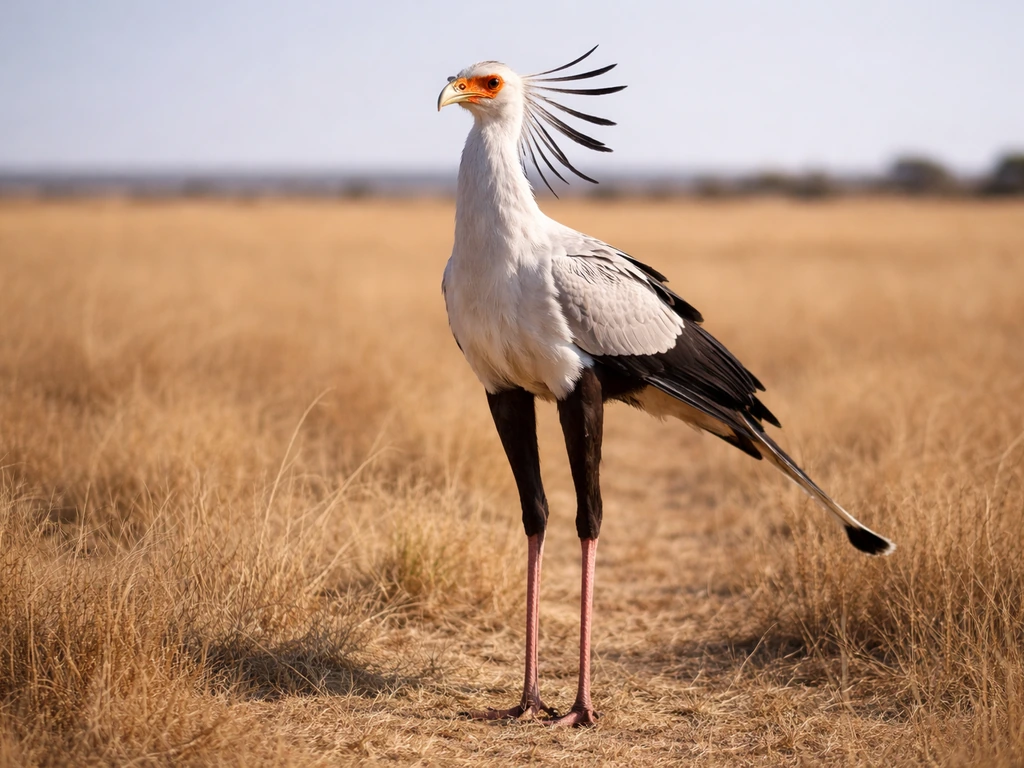
What the secretary bird actually is
Before we get into the name, a quick orientation. The secretary bird (Sagittarius serpentarius) is a large African raptor, but it's genuinely unlike almost every other bird of prey you can think of. It stands roughly 1. 5 meters tall on long crane-like legs, has an eagle-shaped body, and spends most of its life walking through open grasslands, savanna, and shrubland rather than soaring and diving from the sky.
The PMC peer-reviewed article on secretarybird ecology describes grassland, dwarf shrubland, savanna, and open woodland as preferred habitats while noting they avoid dense forest, thicket, and rocky mountainous or hilly areas [open grasslands, savanna, and shrubland](https://pmc. ncbi. nlm. nih.
gov/articles/PMC4016007/). It is the only living bird of prey considered primarily terrestrial in habit. When it finds a snake, rodent, or other small prey, it doesn't use its beak to kill it: it stomps the animal to death with powerful kicks to the head. That combination of height, long legs, upright posture, and dramatic head plumage is what makes identifying it so easy and, as you'll see, is exactly what gave the bird its peculiar English name.
The 'secretary' in the name: what it actually refers to
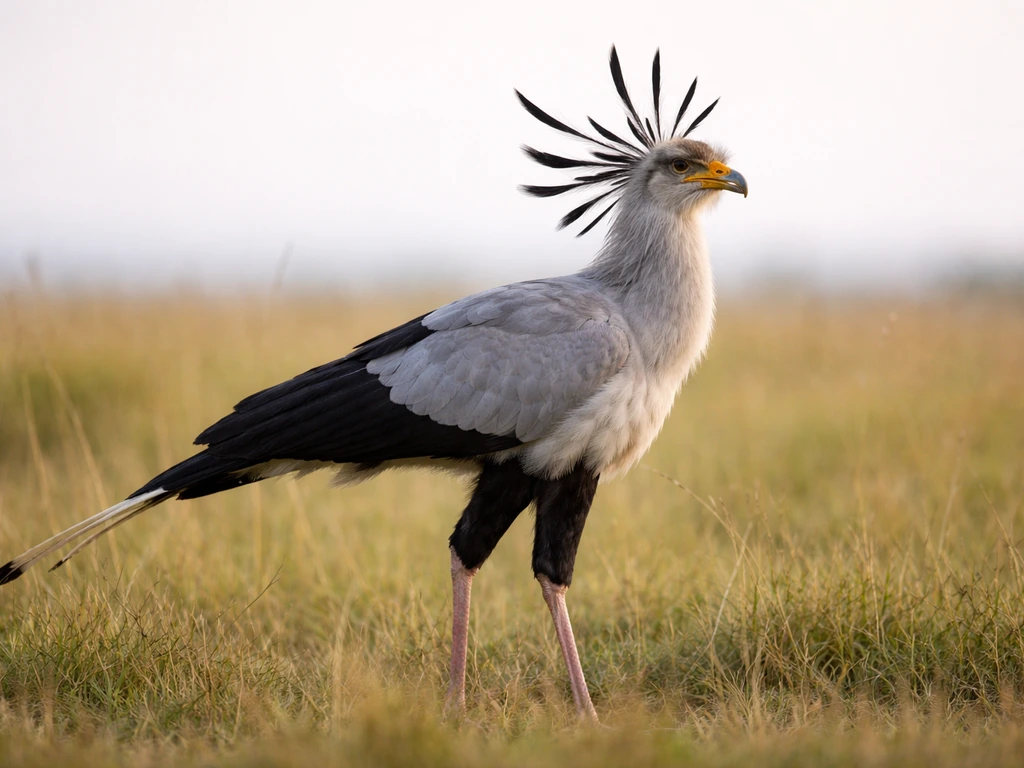
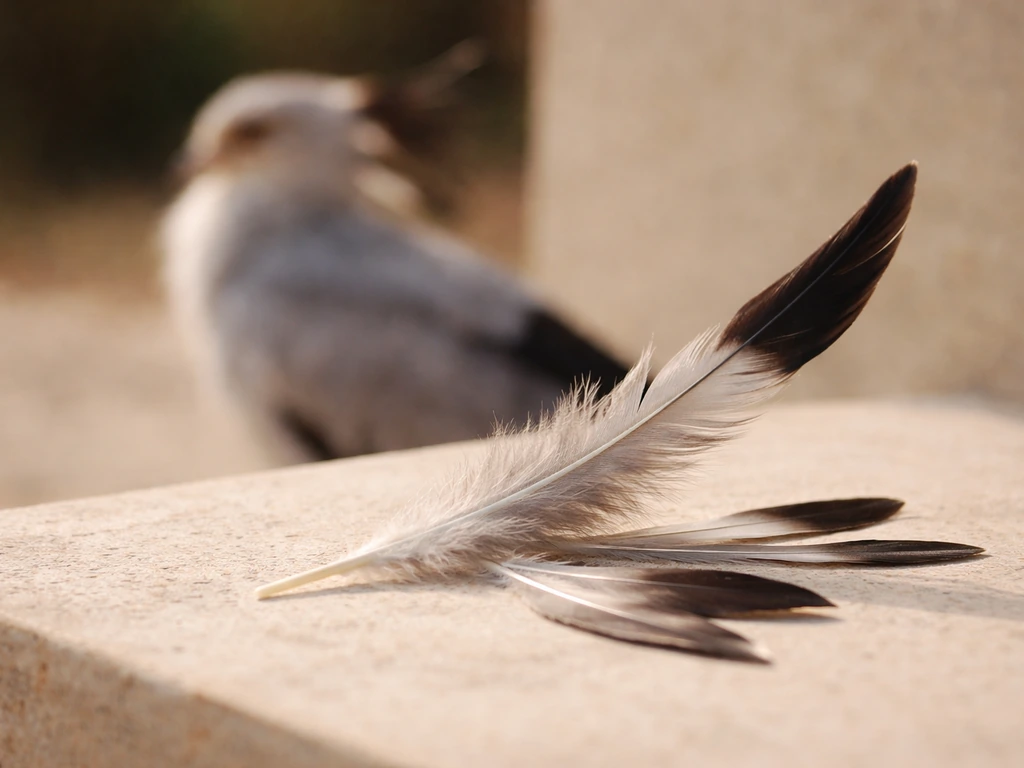
The bird has twenty black crest feathers that fan out from the back of its head. When you see one standing in a field, those feathers genuinely look like a bundle of quill pens poking up behind the bird's 'ear. ' In the 18th and 19th centuries, office clerks and legal secretaries routinely tucked spare quill pens behind their ears while they worked, keeping them handy for the next line of writing.
When European naturalists encountered this bird, the visual metaphor was immediate and obvious: here was a creature that looked, improbably, like a Victorian office worker mid-task. Multiple authoritative dictionary sources anchor this explanation directly. Collins English Dictionary states the bird is 'so called because its crest resembles a group of quill pens stuck behind the ear. ' Merriam-Webster's word history section puts it the same way.
Britannica ties the English common name to the quill-pen-behind-the-ear image explicitly, noting the crested appearance suggests 'quill pens, as secretaries once did' carry.
How the name took hold historically
The naming happened during the period of European natural history documentation of African wildlife. Dutch naturalist Arnout Vosmaer described the species in 1769, and by 1780 the French naturalist Georges-Louis Leclerc (better known as the Comte de Buffon) was using the term 'Le Secrétaire' in French, explaining that the name referred to the bird's long quill-like crest feathers resembling a quill pen held behind an ancient scribe's ear.
The English form 'Secretary Bird' appears in Dutch etymological bird-name records dated to 1781, right on the heels of the French usage, which suggests the term crossed from French into English almost immediately. John Frederick Miller produced the first formal pictorial description in 1779, and taxonomist Johann Hermann formally assigned the genus name Sagittarius in 1783.
By the time the 1911 Encyclopaedia Britannica was describing the Secretary-bird's distribution across Africa from the Gambia to Khartoum to the southern tip of the continent, the English name was thoroughly established.
How the name travels across languages
What's interesting from an etymology and bird-naming perspective is how different language communities handled this common name differently. Germanic languages largely preserved the 'secretary' metaphor: in Afrikaans it's 'sekretarisvoël,' in Dutch 'secretarisvogel,' and both clearly translate the same office-worker-with-quill image into their respective tongues. French keeps 'secrétaire' as one option but also uses 'serpentaire' and the longer 'messager sagittaire,' which illustrates a language community holding two different naming metaphors simultaneously: one about appearance and one about the bird's prey.
Spanish and Italian drop the secretary metaphor entirely and go with 'serpentario,' which pivots the common name toward the bird's famous snake-hunting behavior rather than its looks. The Quebec linguistic authority (OQLF) preserves the etymology by explaining that the French 'secrétaire' owes its name to the bird's crest resembling a secretary's feather-quill tucked behind the ear.
| Language | Common Name | Metaphor Used |
|---|---|---|
| English | Secretary bird | Quill pens behind the ear (appearance) |
| French | Secrétaire / Serpentaire / Messager sagittaire | Appearance + snake prey + archer |
| Afrikaans | Sekretarisvoël | Quill pens behind the ear (appearance) |
| Dutch | Secretarisvogel | Quill pens behind the ear (appearance) |
| Spanish | Serpentario | Snake prey (behavior) |
| Italian | Serpentario | Snake prey (behavior) |
Myth vs. fact: the Arabic origin theory
If you search online for 'secretary bird name origin,' you'll find a second explanation that gets repeated confidently: that the name doesn't come from quill pens at all, but from an Arabic phrase 'saqr et-tair' (or 'saqr at-tair'), loosely meaning 'falcon of the hunt' or 'hunter bird.' The story goes that this Arabic phrase was corrupted by French speakers into 'secrétaire,' which then got translated into English as 'secretary.' Some sources, including a note in ornithologist Alan C. Kemp's 1995 work, present this as a legitimate alternative hypothesis.
The problem is that this hypothesis has serious problems under scrutiny. National Geographic presents both theories but explicitly states the origin is 'not known for certain' and flags that some experts find the Arabic-corruption route doubtful. A scholarly etymology critique (published in Studia Etymologica Cracoviensia) examines the transliteration issues involved in the Arabic-to-French pathway and finds that the relevant Arabic forms are not straightforwardly attested in the way the hypothesis requires. BirdLife South Africa's own discussion of the name acknowledges the uncertainty and treats the quill-pen explanation as the more grounded of the two.
The practical takeaway: the quill-pen secretary resemblance is the explanation that has the broadest support from dictionaries, natural historians, and ornithologists. A peer-history style account in the Journal of African Ornithology PDF (via Rhino Resource Center) discusses the Buffon-era “Le Secrétaire” naming) as part of the evidence base for the “secretary” name rather than as folk tradition. The Arabic corruption theory is genuinely interesting and worth knowing about, but treat it as an unresolved hypothesis rather than an established fact.
When you see it stated definitively on a bird fact page, that confidence is doing more work than the evidence supports. If you've ever wondered, is there a bird called boobies, it's the same kind of question about how names get applied and repeated online bird fact page.
What the scientific name tells you (and what it doesn't)
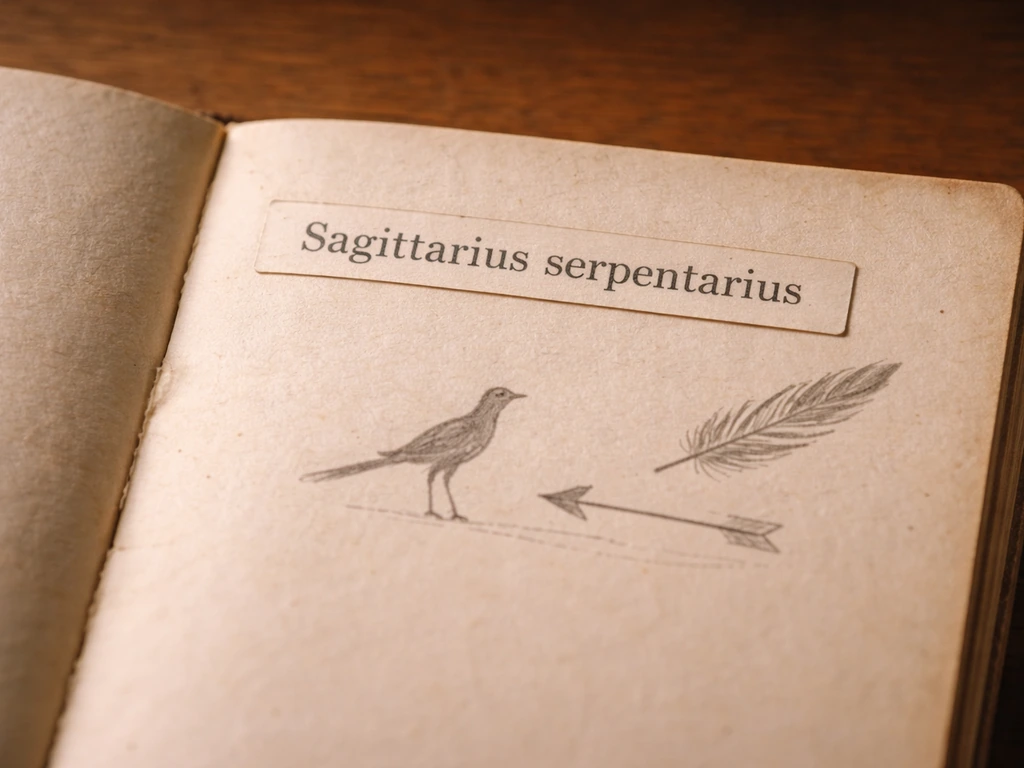
The scientific name, Sagittarius serpentarius, takes a completely different approach from the common English name and doesn't reference the secretary/quill-pen metaphor at all. Sagittarius is Latin for 'archer,' assigned by Johann Hermann in 1783. The connection to archery is thought to reflect the bird's long straight legs, which may have suggested the stance of an archer, though as with many historical zoological names, the exact reasoning isn't fully documented. Serpentarius comes from the Latin serpens/serpentis, meaning 'serpent' or 'snake,' and directly references the bird's famous habit of hunting and killing snakes. Treccani and multiple European natural history sources confirm this derivation, with serpentarius essentially meaning 'of or relating to serpents' in classical Latin.
So the common English name (secretary bird) points at how the bird looks, while the scientific name (Sagittarius serpentarius) points at what the bird does. The two naming traditions were developed by different people, in different contexts, drawing on different aspects of the animal's identity. That split is actually a great illustration of why common names and scientific names diverge so consistently: common names tend to capture the first vivid impression, while formal taxonomic names often try to capture something more biologically definitive. If you're interested in how this pattern plays out across other species, the way bird scientific names are constructed is a whole fascinating thread.
Why this matters if you care about bird names
For anyone who loves bird nomenclature, the secretary bird is one of the more entertaining naming case studies out there because it gives you three different naming frameworks in one species: a visually-based English common name rooted in a specific historical moment (Victorian office culture), a set of translated common names that either preserve or abandon that metaphor depending on the language, and a Latin scientific name that ignores appearance entirely and goes straight to prey.
It's also a useful reminder that 'why is this bird called X' questions often have a 'probably' or 'most likely' in the honest answer rather than a clean certainty. Asking why a bird is called a bird follows the same idea, since common names often come from early observers and noticeable traits rather than one official source why is this bird called X.
The secretary bird's name is well-supported, but even here the dictionaries hedge: 'probably from resemblance to quill pens. The reason is usually traced to a cultural association rather than anything anatomical. ' That kind of linguistic humility is worth modeling.
If you're using this knowledge to name a pet bird, especially a large, upright, or visually distinctive one, the secretary bird pattern gives you a useful framework. Names that capture a vivid visual impression or a prominent behavioral quirk tend to stick and feel satisfying in a way that purely descriptive or arbitrary names don't. A bird with dramatic head feathers, an upright posture, or an unexpected habit practically names itself if you pay attention the same way those 18th-century naturalists did. You don't need to invent something: you need to notice something. If you’re wondering why bird names can sound so strange, the secretary bird’s case shows how names often start as vivid metaphors rather than literal descriptions.
Where to go next
- For dictionary-level etymology anchoring, Merriam-Webster and Collins both include explicit word-history notes on 'secretary bird' that are worth bookmarking as reliable quick references.
- If you want the deepest scholarly treatment of competing hypotheses, the ScienceDirect 'Quick guide: Secretary birds' article summarizes the historical naming debate with dates and named proponents, which is the most research-oriented summary publicly available.
- BirdLife South Africa's Bird of the Year 2019 page on the secretarybird discusses name uncertainty in accessible language and is a good practical starting point for understanding how the ornithological community treats contested common names.
- For understanding how other unusual bird names came about, exploring why certain species have names that seem bizarre or counterintuitive is a genuinely rewarding rabbit hole, and many of the patterns you'll find mirror what happened with the secretary bird: a specific moment, a specific observer, and one vivid resemblance that got locked in forever.
FAQ
Is the “secretary bird” name definitely from the quill-pen crest, or could it be from Arabic “falcon of the hunt” instead?
Most mainstream references treat the quill-pen crest resemblance as the best-supported explanation, but the Arabic “falcon of the hunt” idea is not fully settled. A safe way to say it is that the quill-pen origin is the most widely supported account, while the Arabic-corruption story remains an unresolved hypothesis rather than a confirmed etymology.
Why do some websites state the Arabic origin as fact instead of “possibly” or “unproven”?
That often happens when a secondary source repeats an alternative hypothesis without carrying forward the original uncertainty. If you see definitive wording, check whether the source provides evidence for specific historical language forms and a credible step-by-step pathway from Arabic to French to English. Absent that, it is better to treat it as a speculative alternative.
Who came up with the English name first, and was it used immediately after the French term?
The article suggests French usage appears in the late 1700s and English shows up in etymological records shortly after. “Immediate” cross-language transfer is plausible, but pinning down a single person is hard because common names typically spread through correspondence, traveling naturalists, and translated works rather than being coined by one identifiable author.
Do other languages keep the “secretary” metaphor, or do they name the bird differently?
Many languages diverge in metaphor choice. Some preserve the office-worker or secretary imagery by translating the same idea directly, while others abandon it entirely and base the common name on hunting behavior (especially snake killing). That difference is common because common names usually reflect what local observers find most noticeable or useful.
What does the scientific name “Sagittarius serpentarius” tell me that the common name does not?
It points more toward function than appearance. Sagittarius relates to an “archer” idea (linked to posture and legs), while serpentarius explicitly references snakes. If you are learning the bird’s identity quickly, the scientific name is often more predictive of behavior than the English common name.
If the name is tied to quill pens, does the bird actually look like quill pens behind an ear in all situations?
It is a best-effort visual metaphor, not a one-to-one match. The crest feathers can be fanned and prominent when the bird is alert, which is when the “quill pen” impression is strongest. In flight or at different angles, the metaphor may be less obvious, but the static upright crest is what early observers likely had in view.
Does the secretary bird’s behavior (stomping snakes) ever influence the common name in English?
Not in the standard English term. English relies on the crest resemblance metaphor, while other languages sometimes use snake-hunting references. If you are translating or creating names, be aware that English and scientific naming traditions may highlight different traits.
Why do dictionary and encyclopedia entries sometimes say “probably” or “likely” for the name origin?
Because common names are historical conventions that often spread through observation and analogy, not through a single written naming decree. Even when the explanation is strongly supported, there can be gaps in documentation, so cautious wording reflects uncertainty about the exact historical steps.
If I want to use this for naming a pet bird, what traits from the secretary-bird pattern are most likely to “work” for a nickname?
Aim for traits that are reliably visible and consistent, like a distinctive crest, an upright posture, or a recurring behavior rather than a one-time moment. The secretary-bird case shows that names stick when people repeatedly see the same striking cue, then match it to a cultural reference they recognize.