Bird names are weird because they come from at least two completely different systems built for different purposes, by different people, in different centuries, often in languages nobody speaks anymore. Common names grew organically through folklore, regional observation, and colonial exploration, then got borrowed and mangled across dozens of languages.
Why Are Bird Names So Weird? Common and Scientific Meanings

Maya Castellanos
7 Jun 2026

Scientific names were deliberately built from Latin and Greek to be stable and universal, but that stability comes at the cost of spellings and pronunciations that feel alien to modern eyes. If you are wondering what the scientific name for a bird is, it is usually a two-part Latin binomial that stays consistent across countries and languages Scientific names.
Once you understand that these two tracks exist and why they evolved separately, most of the 'weirdness' starts making complete sense.
How bird naming actually evolved: two systems, two goals
Before the 18th century, naturalists named birds however they liked, and chaos followed. A single species might have five different names across five countries, and nobody could agree on which was correct. Carl Linnaeus changed everything in 1758 when he published the 10th edition of Systema Naturae, introducing binomial nomenclature consistently for animals. The idea was elegant: every species gets exactly two Latin words, a genus name and a species epithet, forming what the International Code of Zoological Nomenclature (ICZN) formally calls a binomen. That system has governed scientific naming ever since, with a formal code first published in 1905 and replaced by the current ICZN Code in 1961.
Common names, on the other hand, have no equivalent governing body with real enforcement power. They evolved through centuries of birdwatching, hunting, farming, and storytelling in dozens of languages. The mismatch between the two systems is the root cause of most naming confusion. Scientific names are frozen in Latin and governed by strict rules. Common names are alive, messy, and constantly shifting. Both are useful, but they serve completely different audiences.
The push to standardize English common names only really got serious at the 1990 International Ornithological Congress, which eventually produced 'Birds of the World: Recommended English Names,' supervised by ornithologists Frank Gill and Minturn Wright. The goal was to harmonize the names that English speakers across different countries were using for the same birds, because the regional variation had become genuinely confusing.
What actually makes bird names sound so strange

A big part of the perceived weirdness is spelling versus pronunciation. Scientific names are built from Latin and ancient Greek, and neither is a spoken language anymore. The International Ornithologists' Union pronunciation guide makes this explicit: because Latin isn't a living language, even many ornithologists aren't sure how to say their birds' names. One concrete example from that guide: the letter 'c' sounds like 's' before i or e, but like 'k' before a, o, or u. So 'Ciconia' (the stork genus) starts with an 's' sound, not a 'k' sound. When you inherit a Latinized spelling and then try to pronounce it with English phonics, things go sideways fast.
Translation is another major culprit. Many common names were coined in one language, then transliterated or half-translated into English, keeping odd letter combinations or sounds that made perfect sense in the original but look bizarre in English. Colonial-era naturalists were naming birds in the field using Portuguese, Dutch, French, Spanish, or local indigenous words, then writing them up in Latin for publication. That journey from field observation to formal name often introduced spellings that no English speaker would ever naturally produce.
Onomatopoeia adds another layer. Many birds are named for their calls, which means the name is an attempt to spell a sound. What sounds like a reasonable phonetic approximation to a Dutch or French ear can look completely inexplicable in English. The cuckoo is one of the tidier examples because English happened to land on a spelling that works. Many others were not so lucky.
Eponyms and place names: the people and locations behind the oddities
A huge number of bird names commemorate specific people (eponyms) or places (toponyms), and this is one of the richest sources of strange-sounding names. The Sandwich tern is a perfect example: it's named after Sandwich Bay in Kent, England, which served as the type locality where the species was formally described. The scientific name, 'sandvicensis,' even encodes the old Latinized spelling of Sandwich. Without knowing that town exists, the name looks completely arbitrary.
Eponymous names are currently the subject of significant debate. The American Ornithological Society (AOS) has an active English Common Names Project specifically addressing problematic eponymous names, with a formal committee process for recommending changes. Names honoring historical figures with problematic legacies are being reviewed and sometimes replaced, which means bird names you learned five years ago may already have official alternatives.
The secretary bird is a great case study in how a name can get genuinely weird through time. Boobies are a real group of seabirds, and the word has a colorful history that explains why the name feels so odd is there a bird called boobies. In fact, the debate around how did the secretary bird get its name comes down to competing stories from European naturalists and colonial-era settlers.
You can see a similar pattern in how some body-related slang terms, like why the middle finger is called the bird, also develop competing stories over time. The scientific name Sagittarius serpentarius translates cleanly to 'archer of snakes,' a reference to the bird's snake-hunting behavior.
But the common name 'secretary bird' has at least two competing origin stories: one traces it to the French naturalist Buffon, who thought the crest feathers resembled the quill pens secretaries once tucked behind their ears; another traces it to the Dutch word 'secretaris' used by settlers in South Africa. If you are wondering how did the secretary bird get its name, these competing stories explain where the word secretarybird-like idea came from. There's even a third theory linking 'Sagittarius' to 'Secretarius' through corruption over time. The name stuck not because it's accurate but because it's old and nobody agreed on anything better.
The secretary bird's naming history is a small masterclass in how common names accumulate layers of competing lore.
Etymology patterns that repeat once you know what to look for
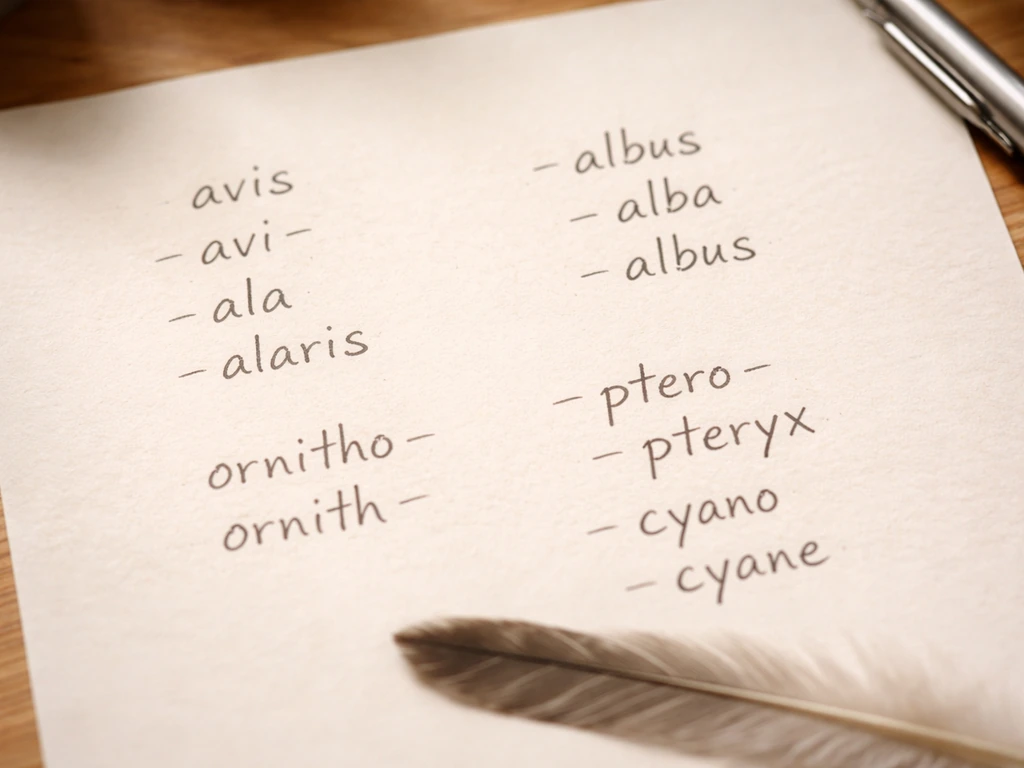
Once you start reading bird scientific names with a little Latin and Greek literacy, patterns emerge everywhere. The same roots appear across hundreds of species, and recognizing them turns a wall of confusing text into something readable.
| Root / Pattern | Meaning | Example |
|---|---|---|
| avis (Latin) | bird | Avian, Avifauna |
| ornis / ornith- (Greek) | bird | Ornithology, Otis (bustard genus) |
| serpentarius (Latin) | of snakes | Sagittarius serpentarius (secretary bird) |
| -vorus (Latin) | eating / devouring | Insectivorous, piscivorous species epithets |
| -cola (Latin) | dweller / inhabitant | Rupicola (rock-dweller, as in cock-of-the-rock) |
| Sagittarius (Latin) | archer | Secretary bird genus |
| sandvicensis (Latinized place) | of Sandwich (Kent) | Thalasseus sandvicensis (Sandwich tern) |
| Onomatopoeia | spelling a sound | Cuckoo, Chiffchaff, Kookaburra |
The Birds of the World 'Key to Scientific Names' guide was built precisely to make these patterns accessible. It covers current accepted etymologies, flags known misspellings and variant forms, and even handles cases where later editors 'corrected' a name to a purer classical form, creating a divergence between the original spelling and later usage. That divergence is itself a source of confusion and another reason names can look inconsistent across references.
Descriptive terms based on behavior, color, or habitat are also extremely common. A bird named 'rufus' is reddish. One named 'niger' or 'nigra' is black. 'Aquaticus' means water-dwelling. These descriptors were Linnaeus's way of packing field-guide information directly into the name, which is genuinely elegant once you know the vocabulary.
Why common names vary by region and keep changing
The same bird can have legitimately different official common names in North America, the UK, and Australia, because common names were never governed by a single binding authority the way scientific names are. The 'Birds of the World: Recommended English Names' project was an explicit attempt to fix this by unifying English names globally, but it's a recommendation, not a mandate. Different checklists, field guides, and apps still diverge.
eBird's common-name list is a practical example of how fluid this is. Their help center notes that common names change especially when taxonomy splits occur, and their list was last updated in October 2025 following the 2025 taxonomic update. The 2024 eBird taxonomy update also aligned some common names with IOC and BirdLife International usage, such as standardizing 'Amazon' for Amazona parrots across regional lists. This kind of alignment is ongoing work, which means if you've been birding for a decade, some names in your field notes may already be deprecated.
Taxonomy splits are a particularly disruptive cause of name changes. When genetic research reveals that what everyone called one species is actually two, both resulting species need names. Sometimes one keeps the old name and the other gets a new one; sometimes both get renamed to avoid implying that either is 'the original.' The AOS and IOC both have formal processes for approving these changes, but the lag between scientific decision and updated app or field guide can be years.
Naming pet birds: practical tips so you don't create confusion

Choosing a name for a pet bird is genuinely fun, but there are a few practical things worth knowing before you commit to something that turns out to be confusing, already taken, or accidentally a species name. Here's how to think through it.
Avoid using common species names as personal names
Naming your cockatiel 'Cockatoo' or your macaw 'Amazon' sounds fun in isolation, but it creates genuine confusion when you're talking to a vet, a boarding facility, or anyone else who works with birds. They will not know if you mean the bird's species or its name. Stick to names that don't double as species identifiers.
Mining etymology for great pet names
The same Latin and Greek roots that make scientific names feel weird are actually a goldmine for distinctive, meaningful pet names. 'Rufus' for a red bird, 'Alba' for a white one, 'Mira' (from mirabilis, wonderful), or 'Sage' as a nod to Sagittarius all work beautifully without being confusing. The Birds of the World Key to Scientific Names is freely searchable and gives you the meaning behind hundreds of roots you can adapt.
Spelling and pronunciation: keeping it livable
If you name your bird something you have to spell out every time you mention it at the vet, you'll regret it quickly. If you love the Latin or Greek source but the spelling is unwieldy, anglicize it. 'Corvus' becomes 'Korvo.' 'Picus' (woodpecker genus) becomes 'Pike.' You keep the etymological flavor without creating a spelling problem. Aim for something you can say clearly over the phone without repeating yourself three times.
Check for regional duplicates

Because common names vary so much by region, a name that feels creative in one country may already be the default common name for a different species somewhere else. If you plan to travel with your bird or join online communities with international members, a quick search of the IOC World Bird List or eBird can tell you whether your chosen name already belongs to a species in another country's standard checklist.
A quick checklist before finalizing a pet bird name
- Make sure it's not an existing species common name in your region or the regions you interact with most
- Check that it's easy to spell and say clearly out loud, especially in a vet context
- If you're borrowing from Latin or Greek, verify the actual meaning using the Birds of the World Key to Scientific Names or a reputable etymology dictionary
- Avoid names that sound like commands you'll use in training, since birds can conflate similar-sounding words
- If the name is an eponym (someone's surname), check that it doesn't also happen to be an official bird eponym that could cause confusion in ornithological communities
Bird names feel weird until you see the machinery behind them: centuries of Latin scholarship, colonial field notes, competing regional traditions, genetic taxonomy revisions, and ongoing standardization projects all pulling in slightly different directions. Once you understand the two-track system of scientific versus common names, the etymology patterns, and why both change over time, the weirdness resolves into something more like a fascinating history lesson. If you're wondering how do you call a bird in the first place, start by separating the bird's common name from its scientific name. And when it comes to naming your own bird, that same history gives you an enormous, largely untapped vocabulary to draw from.
FAQ
Why do some bird scientific names look like they have spelling mistakes or extra letters across different field guides?
Because later editors sometimes “correct” Latinized spellings, but not everyone adopts the correction. You can also encounter misspellings that have stuck as variants in older references. When comparing guides, check the accepted spelling and look for “variant” or “orthography” notes rather than assuming the first version you see is the only correct one.
Are bird common names always tied to one species, or can the same common name refer to different birds?
They can refer to different birds, especially across regions and when taxonomy splits or lumps species. A common-name label might be reused informally even after scientists change classifications. If you are communicating with a vet or using a checklist, the safest approach is to pair the common name with the scientific binomial.
How can I tell whether a bird name I’m seeing is outdated?
Common names drift over time, and scientific names can change when taxonomy is revised. Practical check: confirm the current accepted scientific name in a recent taxonomy list, then see whether the common name is listed as current, alternate, or deprecated. If the scientific name has changed, the common name may also be shifting even if people keep using the old label.
Why do people argue about bird names like they are politically or culturally “loaded”?
Many controversies focus on eponyms (names honoring specific people) and on whether the name should reflect modern values. That means an official name can change even if the bird itself did not. If you learn a name from an older book, you might be using a term that a newer authority has replaced or is actively reconsidering.
When I try to pronounce a scientific bird name, is there a “right” way?
There is a best-effort convention, but since Latin is not spoken as a living language, pronunciation guides can’t produce one universally agreed sound. Even specialists may differ. The useful mindset is to prioritize consistency for your own conversations, or just avoid pronouncing fully by using the common name plus first-letter genus abbreviation (for example, “C. something”) when you are unsure.
Why do some bird names sound like they describe behavior, but they do not match what I observe?
Many names are based on early observations, a limited geographic region, or an older classification. A behavior or habitat label can become misleading after the species’ range is reinterpreted or the taxonomy changes. If it seems wrong, it helps to check the etymology for the name and confirm you are looking at the correct species.
What’s the difference between a genus name and a species epithet in scientific bird names?
The genus is the broader group shared by related species, it is the part that starts with a capital letter. The species epithet is the second word, it differentiates within the genus and is usually an adjective or noun in Latin form. Confusion often happens because the “weirdness” is mostly in the first word, but the epithet can also carry descriptive information.
Can I use a Latin or Greek root to invent a pet bird name, or will it cause confusion?
You can, and it often works well for pet names because they are distinct and not tied to official species usage. The key caveat is avoiding names that double as common or scientific names of real species in the same context where you will be speaking, like a local bird club or a vet clinic. Do a quick search in your region’s common-name listings before you commit.
Why do eBird and other apps sometimes show different common names than my field guide?
Because apps update at different times and they may adopt taxonomy or English-name recommendations on slightly different schedules. They can also align their lists after taxonomy splits or lumps are approved by different committees. If you are tracking species over years, keep notes of the scientific name in addition to the common name so your records remain interpretable even when labels change.
If I need to communicate a bird’s identity reliably, what should I use, common name or scientific name?
Use the scientific name when accuracy matters (vet visits, shipping, breeding paperwork, or cross-border discussions). Common names are useful for everyday talk, but they vary by region and can be ambiguous during name transitions. A good compromise is to say the common name and then add the scientific binomial the first time you mention it in a conversation.
Why do some bird names come from places, and why do they sometimes keep an “old” spelling?
Place-based names often preserve the type locality spelling from when the species was first described, and those spellings reflect older forms of the language or colonial-era transcription. That can create “mysterious” letter patterns to modern readers. If you wonder where the name came from, the etymology is usually tied to the original description locality and its historical spelling conventions.
Next Article
Is There a Bird Called Boobies? Booby Meaning and Species
Yes, boobies are seabirds: booby is the singular. Learn meaning, species types, naming, and how to identify.